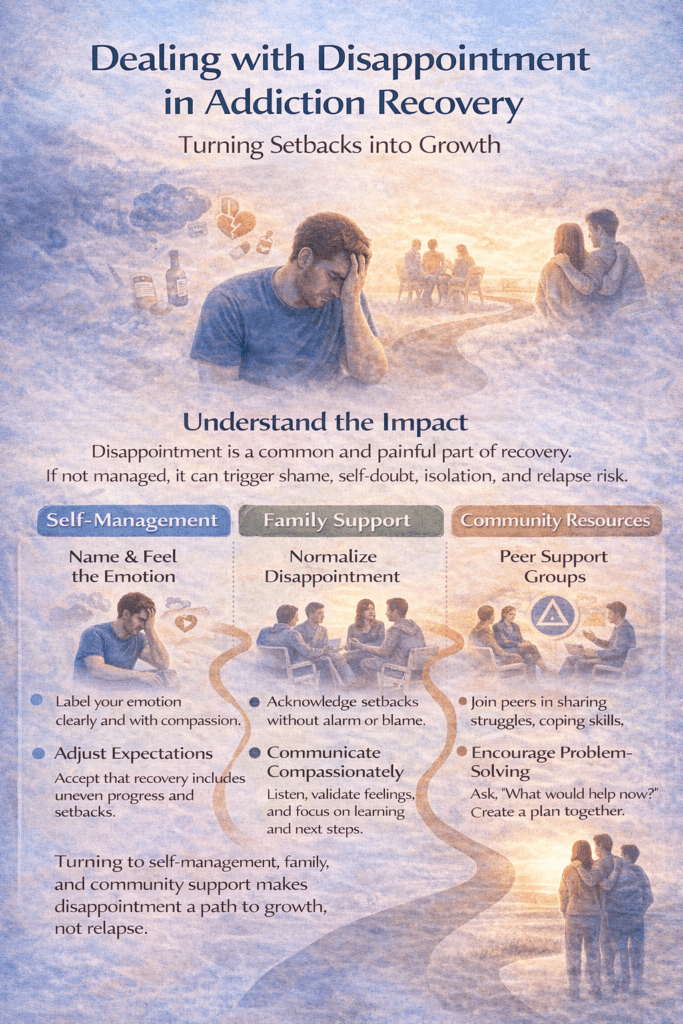
Disappointment is a natural and often painful part of addiction recovery, emerging when progress feels slow, expectations are unmet, or setbacks occur. If not addressed, disappointment can trigger shame, isolation, and relapse risk. Managing disappointment effectively requires more than individual effort—it involves self-management strategies that support emotional regulation, family support that provides understanding and stability, and community resources that reinforce connection and resilience throughout the recovery process.
Dealing With Disappointment in Addiction Recovery: Turning Setbacks Into Growth
Disappointment is an inevitable part of addiction recovery. It can arise when progress feels slower than expected, when cravings return, when relationships don’t heal as quickly as hoped, or when a lapse occurs after a period of stability. For many people in recovery, disappointment can feel heavy—sometimes triggering shame, self-doubt, or the urge to give up. Learning to handle disappointment in healthy ways is essential for long-term recovery.
Recovery often begins with hope and motivation, but it is not a straight path. Expectations—about how life should look, how fast change should happen, or how others should respond—can set the stage for disappointment. When reality doesn’t match these expectations, emotional pain follows. Recognizing that disappointment is a normal emotional response, not a sign of failure, helps reduce its power.
One of the most important steps in dealing with disappointment is separating emotions from identity. Feeling disappointed does not mean you are broken or incapable of recovery. It means something mattered to you. Emotions signal values, effort, and growth—not weakness. Allowing disappointment to be felt rather than avoided prevents it from turning into resentment or relapse.
Disappointment becomes especially dangerous when it is paired with harsh self-judgment. Thoughts like “I should be better by now” or “I’ve ruined everything” increase stress and undermine motivation. Replacing these thoughts with compassionate realism—“Recovery is hard, and setbacks are part of learning”—supports resilience and persistence.
Another key skill is adjusting expectations without losing hope. Recovery does bring meaningful change, but often in uneven steps. Progress may show up as improved coping, better awareness, or healthier choices—even when outcomes aren’t perfect. Redefining success as effort and growth rather than flawless outcomes reduces the risk of repeated disappointment.
Connection also plays a critical role. Disappointment tends to isolate people, making struggles feel personal and unique. Sharing feelings openly with peers, counselors, sponsors, or trusted family members reminds individuals that disappointment is a shared experience in recovery—not a personal flaw.
Disappointment can also be used as information rather than evidence of failure. Asking reflective questions—What didn’t work? What support was missing? What did I learn about myself?—turns emotional pain into guidance for future decisions. This approach transforms setbacks into tools for growth.
Importantly, disappointment does not cancel progress. Recovery is built on repetition, learning, and recommitment. Each time someone responds to disappointment with honesty, support, and self-compassion, the foundation of recovery becomes stronger.
Dealing with disappointment in addiction recovery means learning to stay engaged even when outcomes fall short. When disappointment is met with understanding instead of avoidance, it loses its power to derail recovery. Over time, individuals learn that disappointment does not mean the end of the journey—it often marks a deeper step forward.
Self-Management Strategies for Dealing With Disappointment in Addiction Recovery
Disappointment is a common and often painful experience in addiction recovery. It can arise from setbacks, unmet expectations, strained relationships, or progress that feels slower than hoped. When disappointment is not managed effectively, it can trigger shame, discouragement, or cravings. Self-management strategies help individuals respond to disappointment in ways that protect recovery and support emotional resilience.
A key self-management skill is clearly naming the emotion. Many people try to push away disappointment or label it as failure. Pausing to acknowledge, “I’m feeling disappointed right now,” helps reduce emotional intensity and prevents reactive behavior. Naming emotions creates space for choice rather than impulse.
Practicing self-compassion is essential when disappointment appears. Recovery challenges long-standing patterns, and setbacks do not erase effort or progress. Replacing harsh self-talk with compassionate statements—such as “This is difficult, and I’m still learning”—helps regulate stress and maintain motivation.
Another important strategy is reframing expectations. Unrealistic or rigid expectations often fuel disappointment. Adjusting expectations to reflect the nonlinear nature of recovery allows individuals to measure success by effort, insight, and healthier responses rather than perfect outcomes.
Using disappointment as feedback strengthens self-management. Reflecting on what contributed to the outcome—such as stress levels, triggers, or gaps in support—turns emotional pain into practical information. This reflection supports problem-solving and future planning rather than self-blame.
Grounding and emotion-regulation techniques help manage the physical discomfort that often accompanies disappointment. Deep breathing, mindfulness exercises, movement, or brief sensory grounding calm the nervous system and reduce urges to escape or numb emotions.
Maintaining daily structure and routine provides stability during emotionally difficult periods. Consistent sleep, meals, recovery activities, and self-care routines protect against impulsive decisions driven by discouragement.
Journaling or expressive writing can help process disappointment safely. Writing about thoughts, emotions, and lessons learned clarifies perspective and prevents rumination. This practice supports emotional release without acting on urges.
Another vital strategy is seeking connection rather than isolation. Disappointment often pushes people inward. Reaching out to peers, sponsors, counselors, or trusted supports can counter shame and reinforce accountability.
Finally, recommitment is a powerful self-management choice. Recovery does not require perfection—it requires return. Choosing to stay engaged, even after disappointment, strengthens confidence and long-term resilience.
Dealing with disappointment in addiction recovery is a learned skill. Through awareness, compassion, reflection, and structure, individuals can manage disappointment without it becoming a trigger. Each time disappointment is met with healthy self-management, recovery becomes more stable, flexible, and sustainable.
Family Support Strategies for Dealing With Disappointment in Addiction Recovery
Disappointment is a common experience in addiction recovery—not only for individuals in recovery, but also for their families. Loved ones may feel discouraged when progress seems slow, when a lapse occurs, or when hopes for quick change are unmet. How families respond to disappointment can either strengthen recovery or unintentionally increase shame and relapse risk. Supportive, informed family strategies help transform disappointment into resilience and growth.
One of the most important family strategies is normalizing disappointment. Recovery is not linear, and setbacks or delays do not mean failure. When families understand this, they are less likely to react with panic, blame, or hopelessness. Calm reassurance—“This is hard, and it doesn’t erase your progress”—helps reduce emotional pressure and supports continued engagement in recovery.
Compassionate communication is essential during moments of disappointment. Families should focus on listening rather than lecturing or correcting. Allowing a loved one to express frustration, sadness, or regret without interruption or judgment fosters trust and emotional safety. Validation does not mean approval of harmful behavior; it means acknowledging the emotional experience.
Avoiding catastrophic thinking is another key strategy. Families may fear that disappointment signals inevitable relapse or permanent failure. Expressing these fears through ultimatums or criticism can intensify stress and cravings. Staying grounded in the present and focusing on next steps rather than worst-case scenarios supports stability.
Families can also help by reframing expectations. Recovery often involves gradual improvements—better coping, increased honesty, healthier choices—rather than dramatic, immediate change. Recognizing and naming these small gains reduces repeated disappointment and reinforces motivation.
Encouraging problem-solving rather than punishment strengthens recovery. When disappointment arises, families can ask supportive questions such as, “What support might help right now?” or “What did you learn from this?” This approach turns disappointment into a learning opportunity rather than a source of shame.
Maintaining consistent boundaries is equally important. Compassion does not mean removing accountability or tolerating harmful behavior. Clear, calm boundaries protect both the individual and the family system while reinforcing responsibility and safety.
Families must also practice self-care. Disappointment can be emotionally exhausting, and families may neglect their own needs as they focus on recovery outcomes. Seeking family counseling, peer support groups, or education helps loved ones manage their own emotions and avoid burnout.
Finally, families support recovery by expressing continued belief and hope. Hearing “We still believe in you” or “We’re here, even when things are hard” can counteract shame and discouragement during vulnerable moments.
When families respond to disappointment with empathy, realistic expectations, and steady support, they help prevent setbacks from becoming turning points for relapse. Instead, disappointment becomes part of a shared recovery process—one grounded in patience, connection, and long-term healing.
Community Resource Strategies for Dealing With Disappointment in Addiction Recovery
Disappointment is a frequent and often overlooked challenge in addiction recovery. Individuals may feel discouraged by setbacks, slow progress, strained relationships, or unmet expectations about what recovery should look like. Community resources play a vital role in helping people process disappointment in healthy ways, preventing it from turning into shame, isolation, or relapse.
One of the most powerful community strategies is peer recovery support. Recovery groups, peer coaches, and recovery community organizations provide spaces where disappointment can be openly discussed without judgment. Hearing others share similar struggles normalizes the experience and reduces the sense of personal failure. Peer support reinforces the message that disappointment is part of growth, not a reason to quit.
Accessible counseling and mental health services are essential for managing disappointment. Community-based therapy, outpatient programs, and integrated behavioral health services help individuals develop emotional regulation skills, challenge negative thinking, and process setbacks constructively. These services are especially important for individuals with co-occurring anxiety, depression, or trauma.
Community organizations can also offer skills-based recovery programming focused on resilience, coping, and relapse prevention. Workshops on emotional regulation, mindfulness, stress management, and cognitive restructuring give individuals practical tools to manage disappointment and maintain motivation.
Creating recovery-friendly environments strengthens emotional safety. Recovery community centers, sober living programs, and supportive housing provide structured, nonjudgmental spaces where individuals can regroup after setbacks without fear of rejection. Stability and belonging reduce the emotional intensity of disappointment.
Education and stigma reduction efforts are another key community strategy. Public education campaigns and provider training help shift the narrative from “failure” to “learning.” When communities understand addiction as a chronic, treatable condition, individuals are less likely to internalize disappointment as shame.
Community-based crisis and support services also play an important role. Hotlines, peer warm lines, and mobile crisis teams provide immediate support during moments of acute disappointment or emotional distress. Timely, compassionate responses can prevent discouragement from escalating into relapse.
Collaboration between healthcare, social services, and recovery organizations improves continuity of care. When individuals experience disappointment, seamless access to care adjustments—such as increased support, counseling, or case management—helps them stay engaged rather than dropping out.
Finally, supporting the well-being of recovery workers and volunteers is critical. Training in trauma-informed and compassion-centered care ensures that individuals experiencing disappointment are met with understanding rather than judgment, reinforcing trust in recovery systems.
When communities respond to disappointment with connection, education, and accessible support, recovery becomes more resilient. Community resource strategies transform disappointment from a breaking point into a moment of reinforcement—helping individuals stay engaged, learn from challenges, and continue moving forward in recovery.
Frequently Asked Questions
Here are some common questions:
Why is disappointment so common in addiction recovery?
Recovery is a nonlinear process. Progress often includes setbacks, emotional ups and downs, and slower-than-expected change. Disappointment arises when expectations about recovery, relationships, or personal growth do not match reality.
Is feeling disappointed a sign of failure in recovery?
No. Disappointment is not a failure—it is a normal emotional response to unmet expectations. Feeling disappointed often means you care deeply about your recovery and the life you are building.
How can disappointment increase relapse risk?
When disappointment turns into shame, hopelessness, or self-criticism, stress levels rise, and coping skills weaken. Without healthy support or regulation, disappointment can trigger cravings or impulsive behavior.
What is the healthiest way to respond to disappointment?
The healthiest response is acknowledgment without judgment. Naming the emotion, practicing self-compassion, reflecting on what can be learned, and seeking support help prevent disappointment from becoming a trigger.
Should disappointment be avoided or pushed away?
No. Avoiding disappointment often intensifies it. Allowing the feeling, understanding its source, and responding with care reduces its emotional impact and supports resilience.
How can self-management strategies help with disappointment?
Self-management skills such as emotional regulation, realistic expectation-setting, grounding techniques, journaling, and routine help individuals process disappointment without acting on urges or giving up.
What role does family support play during disappointment?
Families can reduce shame by normalizing setbacks, listening without judgment, avoiding blame, and maintaining supportive but consistent boundaries. Family reactions greatly influence how disappointment is processed.
How should families avoid responding to disappointment?
Families should avoid panic, threats, ultimatums, or catastrophic thinking. These reactions increase stress and discourage openness, making recovery more difficult.
How do community resources help with disappointment in recovery?
Peer support groups, counseling services, recovery programs, and crisis supports provide validation, skill-building, and connection. Community resources remind individuals they are not alone and help them stay engaged after setbacks.
Does disappointment mean recovery isn’t working?
No. Disappointment often signals growth, effort, and change. Recovery “working” does not mean feeling good all the time—it means learning to handle difficult emotions without returning to substance use.
How can expectations be adjusted to reduce disappointment?
Shifting expectations from perfection to progress helps. Measuring success by effort, insight, and healthier responses rather than outcomes reduces repeated disappointment.
What if disappointment follows a lapse or relapse?
A lapse does not erase recovery. Responding with learning, increased support, and recommitment—rather than shame—helps individuals return to recovery more quickly and safely.
Can disappointment become a strength in recovery?
Yes. When processed constructively, disappointment builds resilience, self-awareness, and emotional tolerance. Many people identify disappointment as a turning point rather than an ending.
Conclusion
Dealing with disappointment in addiction recovery is not about avoiding difficult emotions, but learning to respond to them with compassion, structure, and support. Self-management strategies help individuals regulate emotions and reframe setbacks as learning opportunities. Family support reduces shame and fosters accountability through empathy and healthy boundaries. Community resources provide education, peer connection, and accessible care that sustain motivation and engagement. Together, these approaches transform disappointment from a setback into a source of strength—supporting long-term recovery, resilience, and continued growth.
Video: Facing Disappointment in Recovery: Turning Setbacks Into Strength