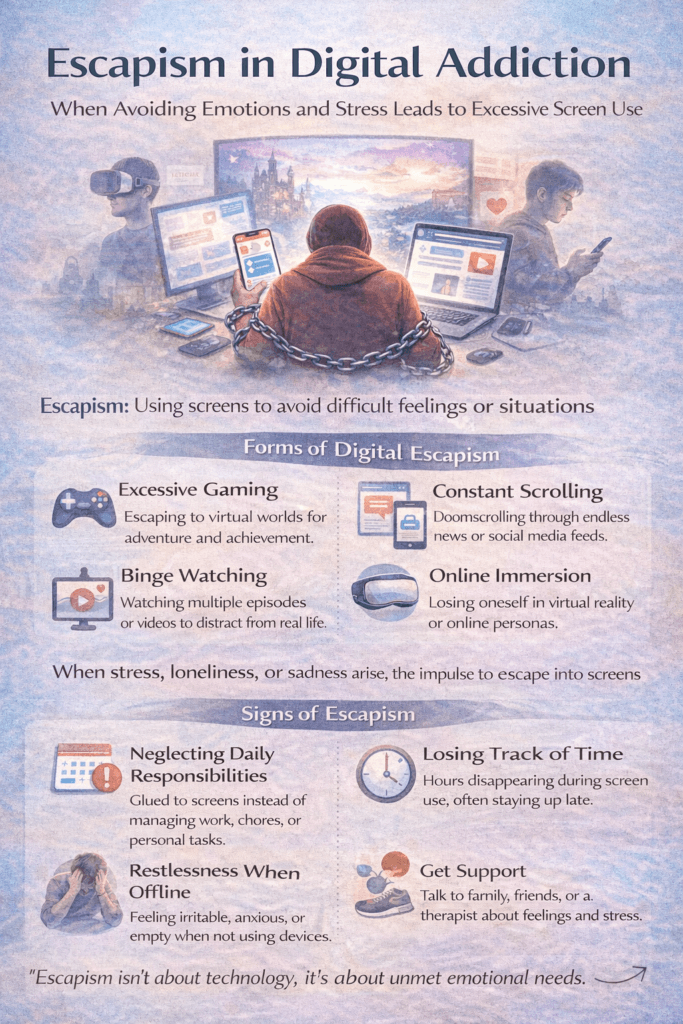
Escapism is a key driver of digital addiction, where excessive gaming, social media use, or streaming becomes a way to avoid stress or emotional discomfort. While digital platforms offer temporary relief, reliance on them to escape reality often increases anxiety and avoidance over time. Addressing escapism in digital addiction requires more than reducing screen time—it involves self-management strategies, supportive family involvement, and community resources that help build healthier coping skills and real-life engagement.
Escapism in Digital Addiction: When Online Worlds Become a Way to Avoid Reality
Escapism is a powerful psychological drive behind many forms of digital addiction. Social media, gaming, streaming platforms, and endless online content can offer temporary relief from stress, loneliness, boredom, or emotional pain. When digital use shifts from recreation to avoidance, escapism becomes a central factor in addiction.
At its core, escapism is the desire to disconnect from uncomfortable thoughts, emotions, or life circumstances. Digital environments are uniquely effective at providing this escape. They offer immediate distraction, immersive experiences, and predictable rewards—likes, wins, levels, notifications—that pull attention away from real-world challenges. For a moment, anxiety subsides, responsibilities recede, and emotional discomfort is deferred.
Over time, the brain begins to associate digital engagement with relief. This creates a cycle: stress or dissatisfaction triggers the urge to escape, digital use provides short-term comfort, and real-life issues remain unresolved. As responsibilities pile up or relationships strain, distress increases—making escape even more appealing. The behavior shifts from choice to compulsion.
Escapism-driven digital addiction often shows up as excessive gaming, doomscrolling, binge-watching, or constant social media use. Individuals may lose track of time, neglect sleep or responsibilities, and feel irritable or restless when disconnected. While the digital activity itself may differ, the underlying function is the same: avoiding emotional discomfort rather than addressing it.
Emotionally, escapism can blunt awareness and delay growth. Avoided feelings—grief, anxiety, insecurity, or frustration—do not disappear; they resurface with greater intensity. This can lead to increased anxiety, low mood, reduced self-esteem, and a sense of being “stuck.” Ironically, the escape meant to provide relief often deepens distress over time.
Importantly, escapism is not a character flaw. It is a coping strategy that develops when healthier tools feel unavailable or overwhelming. Many people turn to digital escape during periods of trauma, burnout, social isolation, or major life transitions. Understanding escapism as a signal—not a failure—opens the door to meaningful change.
Reducing escapism in digital addiction involves addressing both behavior and underlying needs. Setting boundaries around screen time is helpful, but insufficient on its own. Sustainable change requires developing alternative strategies for managing stress, regulating emotions, and fostering connection. Mindfulness, movement, creative outlets, therapy, and real-world relationships help replace avoidance with engagement.
Recovery from digital addiction is not about eliminating technology—it is about restoring balance. When individuals learn to face discomfort with support and skill, digital tools return to their appropriate role as tools rather than escapes. Escapism loses its grip when life feels manageable, meaningful, and emotionally supported.
Ultimately, addressing escapism in digital addiction is about reconnecting with emotions, with others, and with oneself. When reality is engaged with rather than avoided, the need to escape diminishes, and healthier digital habits naturally follow.
Self-Management Strategies for Escapism in Digital Addiction: Replacing Avoidance With Healthy Coping
Escapism plays a central role in digital addiction. Many people turn to excessive gaming, social media, streaming, or endless scrolling not for enjoyment alone, but to avoid stress, emotional discomfort, or unmet needs. Self-management strategies help individuals recognize this pattern and develop healthier coping strategies without relying on digital escapism.
The first step in self-management is awareness of emotional triggers. Escapist digital use often increases during moments of boredom, loneliness, anxiety, or overwhelm. Pausing to ask, “What am I trying to avoid right now?” builds insight and interrupts automatic behavior. Awareness transforms digital use from reflex to choice.
Setting intentional boundaries around technology use supports behavior change. This may include scheduled screen-free times, app limits, device-free bedrooms, or turning off nonessential notifications. Boundaries reduce constant stimulation and create space to experience emotions rather than escape them.
Addressing the underlying emotional needs is essential. Escapism thrives when individuals lack effective coping tools. Learning stress-management techniques such as deep breathing, grounding exercises, journaling, or mindfulness helps regulate emotions without avoidance. These skills teach the nervous system that discomfort can be tolerated and managed safely.
Replacing digital escape with meaningful activities strengthens recovery. Movement, creative expression, outdoor time, hobbies, and face-to-face connection provide relief and fulfillment without the long-term cost of compulsive screen use. The goal is not constant productivity, but intentional engagement.
Developing self-compassionate self-talk is another key strategy. Harsh self-criticism increases shame and drives further avoidance. Compassionate language—“I’m struggling right now, and that’s okay”—reduces emotional intensity and supports healthier choices.
A gradual reduction rather than a sudden restriction improves sustainability. Abruptly discontinuing digital activities can increase distress and lead to rebound use. Step-by-step changes allow the brain to adapt and reduce reliance on escapism over time.
Monitoring progress through reflection or journaling helps reinforce learning. Tracking when digital escape occurs, what emotions are present, and which coping strategies help build confidence and self-efficacy.
When escapism feels overwhelming or rooted in deeper anxiety, depression, or trauma, professional support can strengthen self-management. Therapy and digital wellness coaching help individuals develop emotion regulation, distress tolerance, and healthier coping patterns.
Self-management is not about rejecting technology—it is about reclaiming agency. By understanding emotional drivers, setting compassionate boundaries, and building effective coping skills, individuals can reduce escapism, restore balance, and use digital tools in ways that support rather than replace real-life engagement.
Family Support Strategies for Escapism in Digital Addiction: Helping Loved Ones Reconnect With Real Life
Escapism is a common driver of digital addiction, where excessive gaming, social media use, or streaming becomes a way to avoid stress, emotions, or real-life challenges. Families often notice withdrawal, irritability, or disconnection before the individual recognizes the pattern. Family support can play a powerful role in addressing escapism by fostering understanding, providing structure, and creating emotional safety.
A key family strategy is approaching the issue with empathy rather than confrontation. Escapism is rarely about laziness or defiance; it is often a coping response to overwhelm, anxiety, loneliness, or pressure. Opening conversations with concern—“I’ve noticed you seem stressed and online a lot lately”—reduces defensiveness and builds trust.
Listening without judgment is essential. Families may be tempted to criticize screen time or debate content, but such criticism and debate often intensify avoidance. Instead, allowing loved ones to share what digital spaces provide—relief, control, connection—helps families understand the emotional role escapism plays.
Families can support healthier patterns by co-creating boundaries rather than imposing rules. Collaborative agreements on screen-free times, shared meals, or device-free bedrooms are perceived as supportive rather than punitive. When boundaries are mutual and consistent, they promote stability and respect.
Modeling balanced digital behavior is another powerful strategy. When family members demonstrate healthy technology use—putting phones away during conversations, engaging in offline activities, managing stress without screens—it reinforces change through example rather than instruction.
Encouraging alternative coping and connection addresses the root of escapism. Families can invite participation in shared activities such as walks, hobbies, games, creative projects, or meaningful conversations. These experiences provide relief and connection without avoidance.
Families should also help identify emotional or situational triggers that increase escapism, such as academic pressure, work stress, social conflict, or loneliness. Gently recognizing patterns helps loved ones develop awareness without shame.
When escapism significantly interferes with relationships, responsibilities, or mental health, families can encourage professional support. Therapy, family counseling, or digital wellness programs provide structured tools to address emotional regulation and coping skills.
Equally important is family self-care. Supporting someone with digital addiction can be frustrating and emotionally draining. Maintaining personal boundaries, seeking education, and accessing support prevent burnout and resentment.
Escapism in digital addiction is a signal that something deeper needs care. When families respond with empathy, consistency, and connection, they help loved ones feel safe enough to face challenges rather than avoid them—thereby strengthening relationships and supporting healthier digital habits over time.
Community Resource Strategies for Escapism in Digital Addiction: Building Support Beyond the Screen
Escapism is a core driver of digital addiction, where individuals use gaming, social media, streaming, or online platforms to avoid stress, emotional pain, or unmet needs. While personal insight and family support are essential, community resources play a critical role in addressing escapism by offering education, connection, and healthier alternatives for coping and engagement.
One of the most impactful community strategies is digital wellness education. Workshops hosted by libraries, schools, community centers, and nonprofits can teach how digital platforms are designed to capture attention and reinforce avoidance. Understanding these mechanisms empowers individuals to make informed choices rather than feeling controlled by technology.
Accessible mental health services are vital in reducing escapism. Community counseling programs, low-cost therapy, and group-based mental health services help individuals develop emotional regulation, distress tolerance, and coping skills. When people have support for managing anxiety, depression, or trauma, reliance on digital escape decreases.
Peer-based support groups and skill-building programs offer safe spaces to discuss digital addiction without stigma. Group discussions normalize struggles, reduce isolation, and allow participants to learn practical strategies from others facing similar challenges. Peer connection helps replace digital avoidance with real-world support.
Communities can also promote engagement in offline activities. Recreation programs, art classes, fitness groups, volunteering opportunities, and social clubs provide meaningful alternatives to screen-based escape. These activities foster purpose, belonging, and competence—key protective factors against addiction.
Creating low-stimulation and screen-free community spaces supports nervous system regulation. Libraries, wellness centers, and community hubs that emphasize quiet, creativity, movement, and mindfulness help individuals reconnect with the present moment and reduce dependence on digital immersion.
Educational institutions and workplaces contribute by integrating digital balance into policies and programming. Encouraging regular breaks, limiting nonessential screen use, and promoting mental health awareness reduces burnout and avoidance behaviors across the community.
Community leaders and organizations can further reduce escapism by promoting realistic narratives around productivity and success. Reducing pressure, comparison, and constant connectivity helps people feel less overwhelmed and less driven to escape digitally.
Finally, supporting the helpers matters. Training for educators, counselors, youth workers, and volunteers in trauma-informed and compassion-centered approaches ensures that individuals struggling with digital escapism are met with understanding rather than blame.
Escapism in digital addiction thrives in environments of isolation, pressure, and emotional overload. Communities counter this by providing education, connection, mental health support, and meaningful engagement. When community resources prioritize well-being over constant connectivity, individuals gain the support needed to address challenges directly, reducing the need to escape and strengthening collective resilience.
Frequently Asked Questions
Here are some common questions:
What is escapism in digital addiction?
Escapism in digital addiction refers to using technology—such as gaming, social media, streaming, or endless scrolling—to avoid uncomfortable emotions, stress, responsibilities, or real-life challenges. The digital activity becomes a coping mechanism rather than a form of balanced engagement.
Why do people use digital platforms for escapism?
Digital environments provide immediate distraction, predictable rewards, and emotional relief. They offer a sense of control, achievement, or connection that may feel lacking in real life, especially during stress, loneliness, anxiety, or burnout.
Is escapism always unhealthy?
No. Short-term escapism, such as relaxing with a game or show, can be healthy. It becomes problematic when digital escape is the primary or exclusive coping mechanism and begins to interfere with responsibilities, relationships, or emotional well-being.
How does escapism lead to digital addiction?
When digital use consistently reduces discomfort, the brain learns to rely on it for relief. Over time, avoidance strengthens while real-life stressors remain unresolved, creating a cycle of increased use and decreased tolerance for discomfort.
What are common signs of escapism-driven digital addiction?
Signs include losing track of time online, neglecting daily responsibilities, irritability when offline, using screens to avoid emotions or tasks, social withdrawal, and feeling emotionally numb or stuck.
What emotions commonly drive escapism?
Stress, anxiety, sadness, loneliness, boredom, low self-esteem, and feeling overwhelmed are common emotional triggers. Escapism often increases during life transitions, trauma, academic or work pressure, or social difficulties.
Why does digital escapism make problems feel worse over time?
Avoided emotions and responsibilities do not disappear. They often intensify, leading to increased anxiety, guilt, and stress, which then fuels further avoidance and digital use.
How can individuals manage escapism independently?
Effective self-management includes recognizing emotional triggers, setting compassionate screen-time boundaries, developing coping skills, practicing mindfulness, replacing escapist activities with meaningful ones, and addressing stress directly.
How can families help someone struggling with digital escapism?
Families can help by responding with empathy, avoiding blame, co-creating screen boundaries, modeling healthy technology use, encouraging offline connection, and supporting emotional expression.
What role do community resources play?
Community resources provide education, mental health services, peer support, and offline engagement opportunities. These resources reduce isolation and help individuals develop coping skills beyond digital escape.
When should professional help be considered?
Professional support may be helpful when escapism significantly interferes with daily functioning, relationships, mental health, or when it is linked to anxiety, depression, trauma, or severe avoidance.
Can escapism in digital addiction be overcome?
Yes. With awareness, support, and skill development, individuals can reduce reliance on digital escape. As emotional regulation improves and real-life needs are addressed, the urge to escape decreases naturally.
Is recovery about eliminating technology completely?
No. Recovery focuses on balance and intentional use. Technology becomes a tool rather than a refuge when individuals feel capable of managing emotions and life challenges directly.
Conclusion
Reducing escapism in digital addiction is not about eliminating technology, but about restoring balance and emotional resilience. Self-management strategies help individuals recognize triggers, regulate emotions, and replace avoidance with healthy coping. Family support provides empathy, structure, and connection that make facing challenges feel safer. Community resources reinforce these efforts through education, mental health services, and opportunities for meaningful engagement. Together, these strategies transform digital use from an escape into a tool, supporting sustained well-being, stronger relationships, and healthier connections both online and offline.
Video: Are You Using Screens to Avoid Reality? #DigitalWellness #MindfulLiving