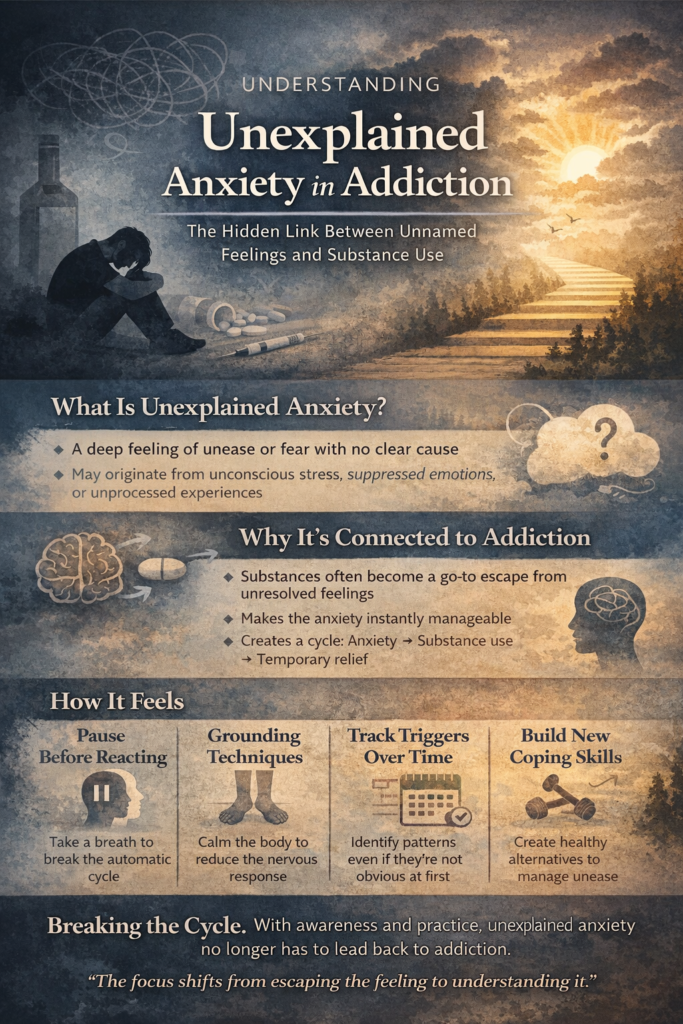
Unexplained anxiety in addiction is a common yet often misunderstood experience. Unlike situational anxiety, it arises without a clear or immediate cause, leaving individuals feeling uneasy, overwhelmed, and unsure of how to respond. In the context of addiction, this type of anxiety can be especially challenging, as it often emerges when substances are no longer used to numb or escape internal discomfort. What feels like “anxiety for no reason” is usually connected to deeper processes—such as suppressed emotions, accumulated stress, or neurological changes during recovery. Understanding this form of anxiety is essential, as it often plays a significant role in both the development and continuation of addictive behaviors.
Unexplained Anxiety: When Your Mind Feels Uneasy Without a Reason
Anxiety is often expected to have a cause—a stressful event, a looming deadline, a clear threat. But what happens when anxiety shows up without any obvious reason?
For many people, this experience can feel confusing, frustrating, and even alarming. You may find yourself asking, “Why do I feel this way when nothing is wrong?” The lack of a clear explanation can make the anxiety feel even more unsettling.
But unexplained anxiety is rarely truly “without cause.” More often, the cause just isn’t immediately visible.
Why Anxiety Can Feel Unexplained
The brain is constantly processing information—far beyond what we are consciously aware of. It scans for patterns, detects potential threats, and stores past experiences. Sometimes, anxiety arises not from the present moment, but from underlying processes such as:
- Unprocessed emotions that haven’t been fully acknowledged
- Past experiences or trauma that still influence current reactions
- Chronic stress that has built up over time
- Subtle triggers that aren’t consciously recognized
In these cases, anxiety isn’t random—it’s just operating beneath conscious awareness.
The Brain’s Role in “Random” Anxiety
From a psychological and neurological perspective, anxiety involves a network of brain systems working together:
- The amygdala detects potential threats—even subtle or symbolic ones
- The prefrontal cortex tries to interpret and regulate those signals
- The body responds with physical sensations like increased heart rate or tension
Sometimes, the amygdala reacts faster than conscious thought. The result is a feeling of anxiety that appears before a clear reason can be identified.
This is why anxiety can feel like it “comes out of nowhere,” even though the brain is responding to something—just not something obvious.
When Anxiety Has No Clear Story
Unexplained anxiety often lacks a narrative. There’s no clear “I’m anxious because…”—just a feeling.
This can lead to:
- Overthinking or searching for a cause
- Worry about the anxiety itself
- Feeling out of control or disconnected
Ironically, trying too hard to find an immediate explanation can sometimes intensify the experience.
The Connection to Emotional Suppression
In many cases, unexplained anxiety is linked to emotions that haven’t been fully processed.
When feelings are suppressed or avoided, they don’t disappear. Instead, they can show up indirectly—as tension, restlessness, or anxiety without a clear source.
For example:
- Unacknowledged sadness may feel like unease
- Suppressed anger may show up as irritability or anxiety
- Lingering stress may appear as constant nervousness
The anxiety becomes a signal—not of danger, but of something needing attention.
What Helps When You Can’t Explain It
When anxiety feels unexplained, the goal isn’t always to find the cause immediately. Instead, it can be more helpful to focus on how you respond to it.
Some helpful approaches include:
- Acknowledging the feeling without needing to define it right away
- Grounding techniques to bring attention back to the present moment
- Allowing the sensation to rise and fall without immediate resistance
- Reflecting later, when the intensity has decreased
Over time, patterns may become clearer—but they don’t have to be understood instantly to be managed.
A Different Way to View Anxiety
What if unexplained anxiety isn’t a malfunction—but a message?
Not necessarily a clear or direct message, but a signal that something in your internal system has been activated.
Instead of asking:
- “Why is this happening?”
It can sometimes help to ask:
- “What might my mind or body be responding to?”
This shift reduces frustration and opens the door to curiosity.
Closing Thought
Unexplained anxiety can feel unsettling because it lacks clarity—but it is not without meaning.
Your brain is not working against you. It is responding, protecting, and processing—sometimes in ways that aren’t immediately visible.
You don’t have to understand everything all at once.
Sometimes, the first step is simply recognizing that the feeling is there—and that it’s allowed to be.
Understanding Unexplained Anxiety: Practical Self-Management Strategies
Unexplained anxiety can feel especially unsettling—not just because of the discomfort itself, but because there’s no clear reason for it. Without a cause, it’s harder to make sense of what’s happening, and that uncertainty can make the anxiety feel even more intense.
But even when anxiety doesn’t come with an obvious explanation, it can still be understood—and managed.
Self-management strategies aren’t about forcing answers. They’re about building awareness, stability, and a sense of control, even when things feel unclear.
Why Self-Management Matters
When anxiety feels “random,” the natural response is often to search for a reason or try to eliminate the feeling quickly.
However, constantly trying to figure it out can increase frustration and keep the mind in a loop. Self-management shifts the focus from:
- “Why is this happening?”
to - “How can I respond to this in a helpful way?”
This shift reduces pressure and helps regulate both the mind and body.
1. Acknowledge the Feeling Without Forcing an Explanation
One of the most effective starting points is simple acknowledgment.
Instead of:
- “This doesn’t make sense—I need to fix it.”
Try:
- “I’m feeling anxious right now, even if I don’t know why.”
This reduces internal resistance. Anxiety often intensifies when it’s questioned or pushed away.
2. Ground Yourself in the Present Moment
Unexplained anxiety often pulls attention inward or into imagined scenarios.
Grounding techniques help reconnect you with the present:
- Notice 5 things you can see
- 4 things you can touch
- 3 things you can hear
- 2 things you can smell
- 1 thing you can taste
This shifts the brain away from internal alarm signals and toward sensory awareness.
3. Regulate the Body First
Even when the cause is unclear, the physical response is real.
Start with the body:
- Slow, steady breathing (in for 4, out for 6)
- Relaxing muscle tension
- Gentle movement, like walking
When the body calms, the intensity of anxiety often decreases.
4. Track Patterns Over Time
Unexplained anxiety may not be random—it may just be subtle.
Keep a simple log:
- When did the anxiety show up?
- What was happening before it started?
- How intense was it?
Over time, patterns may emerge—such as certain environments, times of day, or internal states.
5. Allow the Anxiety to Rise and Fall
Anxiety often behaves like a wave:
- It builds
- Peaks
- Then gradually decreases
Trying to suppress or escape it can prolong the experience. Instead, remind yourself:
- “This will pass.”
- “I don’t have to act on this feeling.”
This builds tolerance and reduces fear of the anxiety itself.
6. Limit Overthinking and “Cause Hunting.”
While reflection is helpful, excessive analysis can become counterproductive.
If you notice yourself looping:
- Gently redirect attention to the present
- Set aside time later for reflection instead of doing it in the moment
Not every feeling needs an immediate explanation.
7. Create Predictable Routines
Unexplained anxiety can feel chaotic. Structure helps counter that.
Simple routines like:
- Regular sleep schedules
- Consistent meals
- Planned daily activities
create a sense of stability that reduces overall anxiety levels.
8. Build Emotional Awareness Gradually
Sometimes unexplained anxiety is connected to emotions that haven’t been fully recognized.
You can start small:
- “Could this be stress?”
- “Am I overwhelmed, even a little?”
You don’t need perfect answers—just curiosity.
A Different Perspective
Unexplained anxiety doesn’t mean something is wrong with you.
It often means your mind and body are responding to something subtle, accumulated, or not yet fully understood.
Self-management isn’t about eliminating anxiety completely.
It’s about learning that you can experience it—without being controlled by it.
Closing Thought
You don’t need to have all the answers to begin feeling better.
When anxiety shows up without explanation, your response matters more than the cause.
Because even when the reason isn’t clear,
your ability to stay present, grounded, and aware is something you can build—and rely on.
Supporting the Unseen: Helping Loved Ones with Unexplained Anxiety
It can be difficult to support someone who is struggling with anxiety—especially when they can’t explain why.
Family members often look for a cause, a solution, or something concrete to fix. But with unexplained anxiety, there may be no clear answer. Your loved one might say, “I don’t know what’s wrong,” or “Nothing happened, I just feel this way.”
This can leave families feeling confused, helpless, or even frustrated.
But support in these moments isn’t about finding the cause—it’s about understanding the experience.
Why Unexplained Anxiety Is Hard for Families
When anxiety has no visible trigger, it can be misunderstood as:
- Overreacting
- Avoidance
- Attention-seeking
- Lack of effort to “get better.”
In reality, unexplained anxiety is often rooted in internal processes that aren’t immediately visible—even to the person experiencing them.
For families, the challenge is learning to support something without a clear explanation.
1. Validate the Feeling—Even Without Understanding It
You don’t need to understand why someone feels anxious to validate that they do.
Instead of:
- “But nothing’s wrong.”
Try:
- “I can see this is really uncomfortable for you.”
- “I may not fully understand, but I’m here with you.”
Validation reduces isolation, which often makes anxiety worse.
2. Avoid Pushing for Immediate Answers
It’s natural to ask questions like:
- “What’s causing this?”
- “What happened?”
But when someone doesn’t know, repeated questioning can increase pressure and frustration.
Sometimes, the most helpful approach is:
- Allowing uncertainty
- Letting the person feel without needing to explain
Understanding often comes later—not in the moment.
3. Focus on Support, Not Solutions
Families often want to fix the anxiety quickly.
But unexplained anxiety doesn’t always respond to quick solutions.
Instead of:
- Offering constant advice
Try:
- Sitting with them
- Offering calm presence
- Asking, “What would help right now?”
Support creates stability—even when answers are unclear.
4. Help Regulate the Environment
When someone is anxious, their surroundings can either intensify or reduce that anxiety.
Families can help by:
- Keeping a calm tone of voice
- Reducing unnecessary stress or stimulation
- Encouraging breaks or quiet space when needed
A steady environment helps counter internal chaos.
5. Don’t Take It Personally
Unexplained anxiety can sometimes lead to:
- Irritability
- Withdrawal
- Short responses
It’s easy to interpret this as rejection, but often it reflects internal overwhelm—not the relationship.
Understanding this can prevent unnecessary conflict and maintain connection.
6. Encourage Healthy Coping—Gently
You can support without forcing.
Examples:
- “Do you want to go for a walk together?”
- “Would it help to sit somewhere quieter?”
Small, low-pressure suggestions can be more effective than strong directives.
7. Learn About Anxiety Together
Sometimes, understanding grows through shared learning.
Exploring topics like:
- How the brain processes anxiety
- The role of stress and emotional buildup
- Common patterns in unexplained anxiety
can help both you and your loved one feel less confused and more prepared.
8. Support Without Over-Controlling
Trying to control the situation—monitoring, directing, or constantly checking—can increase pressure.
Balance is key:
- Be available, but not intrusive
- Offer help, but respect independence
Support works best when it feels like a partnership, not control.
A Shift in Perspective
Unexplained anxiety isn’t a lack of explanation—it’s a delay in understanding.
Your loved one isn’t hiding the answer from you.
They may still be trying to understand it themselves.
When families shift from:
- “Why is this happening?”
to - “How can I support you through this?”
They create space for both connection and clarity.
Closing Thought
You don’t need all the answers to be supportive.
Sometimes, the most meaningful thing you can offer is presence—steady, patient, and nonjudgmental.
Because when anxiety feels confusing and isolating,
being understood—even without explanation—can make all the difference.
Unexplained Anxiety in Addiction: The Feelings Beneath the Surface
Anxiety is often expected to have a reason. A stressful situation, a clear fear, something identifiable. But for many people struggling with addiction, anxiety shows up without a clear cause—sudden, persistent, and difficult to explain.
This kind of anxiety can feel especially unsettling. Without a reason, it becomes harder to manage and easier to escape.
And that’s where addiction often enters the picture.
When Anxiety Feels “Out of Nowhere”
Unexplained anxiety is rarely truly random. It often comes from internal processes that aren’t fully conscious, such as:
- Accumulated stress
- Suppressed emotions
- Past experiences that haven’t been processed
- Ongoing mental or physical strain
The brain is constantly scanning for signals of discomfort or threat—even subtle ones. Sometimes, it reacts before the mind can make sense of why.
The result is a feeling of anxiety without a clear story attached.
Why This Matters in Addiction
When anxiety can’t be explained, it becomes harder to tolerate.
People may think:
- “I don’t know why I feel this way, but I need it to stop.”
Substances or addictive behaviors offer a quick and predictable way to change that feeling:
- Alcohol may calm the nervous system
- Drugs may numb or override the discomfort
- Compulsive behaviors may distract from the sensation
Over time, the brain learns:
unexplained anxiety → substance use → temporary relief
This reinforces the cycle, making substances the go-to response for feelings that aren’t understood.
The Role of Emotional Suppression
In many cases, unexplained anxiety is closely tied to emotional suppression.
When emotions like sadness, anger, or fear are pushed down, they don’t disappear. Instead, they can reappear in less recognizable forms—like anxiety.
For example:
- Unprocessed grief may feel like restlessness
- Suppressed anger may show up as tension or unease
- Chronic overwhelm may turn into constant anxiety
The anxiety becomes a signal—but one that’s hard to interpret.
Why the Anxiety Feels So Intense
Unexplained anxiety often feels more distressing than anxiety with a known cause because:
- There’s no clear way to resolve it
- It creates uncertainty and loss of control
- It can lead to overthinking or fear of the feeling itself
This can increase the urge to escape quickly, reinforcing reliance on substances.
Breaking the Cycle
Understanding unexplained anxiety is a key step in recovery.
Instead of immediately trying to eliminate the feeling, the focus shifts to:
- Recognizing the anxiety without needing an instant explanation
- Allowing the feeling to exist without reacting impulsively
- Exploring patterns over time, rather than in the moment
- Developing alternative coping strategies
This reduces the automatic link between anxiety and substance use.
Learning to Stay Instead of Escaping
One of the most important shifts in recovery is learning that anxiety—even when unexplained—is tolerable.
This doesn’t mean it’s comfortable.
It means it can be experienced without needing to escape it immediately.
Over time, this builds:
- Emotional tolerance
- Self-awareness
- Reduced dependence on substances for relief
A Different Perspective
What if unexplained anxiety isn’t meaningless—but simply not yet understood?
Instead of viewing it as something to get rid of, it can be seen as:
- A signal of internal imbalance
- A reflection of something unprocessed
- A starting point for awareness
This shift reduces fear and increases curiosity.
Closing Thought
Unexplained anxiety in addiction isn’t just a symptom—it’s often part of the underlying process.
The goal isn’t to immediately solve or eliminate the feeling.
It’s to change your relationship with it.
Because when anxiety no longer has to be escaped,
It loses much of its power to drive behavior.
Frequently Asked Questions
Here are some common questions:
1. What is unexplained anxiety in addiction?
Unexplained anxiety in addiction refers to feelings of unease, fear, or tension that arise without a clear or immediate cause, particularly in individuals who use or are recovering from substances. It often feels random but is usually connected to underlying psychological or physiological processes.
2. Why does anxiety feel “unexplained”?
Anxiety can feel unexplained because its triggers are not always conscious. It may come from:
- Suppressed or unprocessed emotions
- Past experiences or trauma
- Chronic stress buildup
- Brain and body changes during recovery
The brain can react before the person fully understands why.
3. How is unexplained anxiety connected to addiction?
In addiction, substances are often used to manage uncomfortable feelings. When anxiety appears without a clear cause, substances may become a quick way to escape it.
This creates a cycle:
anxiety → substance use → temporary relief → return of anxiety
4. Is unexplained anxiety common in recovery?
Yes. It is especially common in early recovery when substances are no longer masking emotions or stress. The brain and body are also adjusting, which can increase sensitivity to anxiety.
5. Can anxiety be present even when nothing is wrong?
Yes. Anxiety does not always reflect a real or immediate danger. It can be a response to internal signals, such as stress, emotional buildup, or changes in brain chemistry, rather than to external events.
6. What does unexplained anxiety feel like?
People often describe it as:
- A sense of unease or dread
- Restlessness or tension
- Racing thoughts without a clear focus
- Physical symptoms like a rapid heartbeat or a tight chest
It may feel intense despite having no obvious reason.
7. Why is unexplained anxiety harder to manage?
It can be harder to manage because:
- There’s no clear problem to solve
- It creates uncertainty and loss of control
- It may lead to overthinking or frustration
This can increase the urge to escape the feeling quickly.
8. Is unexplained anxiety a trigger for relapse?
Yes, it can be. When anxiety feels overwhelming and confusing, individuals may return to substances for relief, especially if they haven’t yet developed alternative coping strategies.
9. How can someone manage unexplained anxiety without substances?
Helpful strategies include:
- Acknowledging the feeling without needing an immediate explanation
- Using grounding or breathing techniques
- Pausing before reacting
- Tracking patterns over time
- Reaching out for support
These approaches focus on response rather than immediate resolution.
10. Does unexplained anxiety mean something is wrong with me?
No. It often means your mind and body are processing something that isn’t fully conscious yet. It’s a common human experience, especially in the context of stress or recovery.
11. Can suppressed emotions cause unexplained anxiety?
Yes. Emotions that are not recognized or expressed can surface indirectly as anxiety. For example, sadness, anger, or overwhelm may not feel clear, but can still affect the body and mind.
12. Should I try to figure out the cause right away?
Not always. Trying to force an explanation can increase frustration. It’s often more helpful to manage the feeling first and reflect on possible causes later when the intensity has decreased.
13. When should someone seek professional help?
Professional support may be helpful if:
- Anxiety is frequent or intense
- It interferes with daily functioning
- It increases cravings or relapse risk
- There is a history of trauma or mental health conditions
Therapy can help uncover patterns and build coping skills.
14. What is the long-term goal in managing unexplained anxiety in addiction?
The goal is not to eliminate anxiety completely, but to:
- Recognize it
- Tolerate it
- Respond to it without using substances
- Gradually understand underlying patterns
This shifts the experience from overwhelming to manageable.
Conclusion
Addressing unexplained anxiety in addiction requires a shift from seeking immediate answers to building tolerance, awareness, and healthier coping strategies. Rather than viewing the anxiety as meaningless or irrational, it can be understood as a signal of underlying processes that are not yet fully recognized. With time, support, and self-management, individuals can learn to experience this anxiety without relying on substances for relief. As understanding grows, the intensity and influence of the anxiety often decrease. Ultimately, recovery is not about eliminating anxiety completely, but about developing the ability to face it with greater clarity, resilience, and control.
Video: