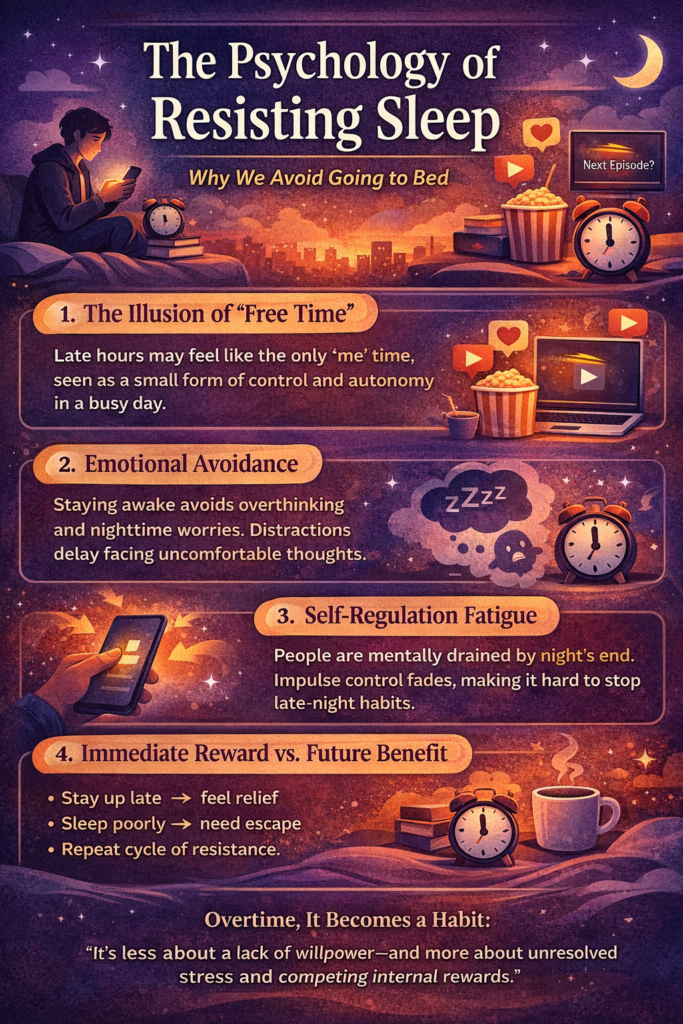
Resisting sleep is a common but often misunderstood behavior that goes beyond simple procrastination. Many people stay up despite feeling tired, caught between knowing they need rest and struggling to act on it. This pattern is often driven by emotional avoidance, the need for personal time, and the brain’s preference for immediate rewards. Understanding these factors helps shift the focus from self-criticism to the underlying needs and habits behind the behavior.
The Psychology of Resisting Sleep: Why We Avoid Going to Bed
The Paradox of Being Tired—but Not Sleeping
Most people have experienced it: you’re exhausted, you know you should go to bed, yet you stay up—scrolling, watching, or doing anything except sleeping. This behavior, often called bedtime procrastination, isn’t simply about poor time management. It reflects a deeper psychological conflict between what we need and what we feel driven to do.
At its core, resisting sleep is not about a lack of discipline—it’s about competing emotional and cognitive processes.
The Illusion of “Free Time”
One of the most common drivers of sleep resistance is the feeling that nighttime is the only time that truly belongs to you.
After a day filled with:
- Work or school demands
- Social obligations
- Stress and responsibilities
Late-night hours can feel like reclaimed personal time. This is sometimes referred to as “revenge bedtime procrastination”—staying up to compensate for a lack of control during the day.
Emotional Avoidance and Delayed Shutdown
Sleep requires disengagement—not just physically, but mentally.
For many people, bedtime creates space for:
- Overthinking
- Anxiety
- Unprocessed emotions
Staying awake becomes a way to avoid that internal experience. Distractions (phones, TV, gaming) act as buffers, keeping uncomfortable thoughts at a distance.
In this sense, resisting sleep is less about wanting to stay awake—and more about not wanting to face what comes with quiet.
Self-Regulation Fatigue
Throughout the day, we rely on self-control to make decisions, manage behavior, and regulate emotions. By nighttime, this system is depleted.
This leads to:
- Lower impulse control
- Increased susceptibility to distractions
- Difficulty following through on intentions (like going to bed early)
So even if you plan to sleep earlier, your brain is less equipped to enforce that decision later in the day.
Immediate Reward vs. Future Benefit
Sleep is a long-term investment, but late-night activities provide immediate gratification.
Your brain tends to favor:
- Short-term rewards (dopamine from scrolling, shows, etc.)
over - Long-term benefits (feeling rested tomorrow)
This creates a classic psychological conflict:
“I know I should sleep” vs. “I want this right now.”
Identity and Autonomy
For some, staying up late is tied to a sense of identity or control:
- “This is my time.”
- “No one is telling me what to do.”
Going to bed can feel like giving up control, especially for individuals who feel constrained during the day. Resisting sleep becomes a subtle form of autonomy.
Why It Becomes a Habit
Over time, this pattern reinforces itself:
- Stay up late → feel temporary relief or enjoyment
- Sleep poorly → feel tired and stressed the next day
- Increased need for “escape” at night
- Repeat
This cycle turns occasional sleep resistance into a consistent behavioral pattern.
Breaking the Pattern: A Psychological Shift
Addressing sleep resistance isn’t just about forcing better habits—it’s about understanding what the behavior is doing for you.
Key shifts include:
- Creating small pockets of control during the day (so night doesn’t carry all the weight)
- Reducing emotional overload before bedtime (journaling, winding down)
- Lowering the barrier to sleep (simple routines instead of strict rules)
- Balancing reward (finding healthier ways to relax earlier in the evening)
Final Thought
Resisting sleep is not a failure of willpower—it’s a reflection of unmet needs, emotional avoidance, and competing motivations.
When you understand why you’re staying up, it becomes easier to change the pattern—not by forcing yourself to sleep, but by addressing what’s keeping you awake.
Taking Back Your Nights: Self-Management Strategies for Understanding the Psychology of Resisting Sleep
Why Sleep Resistance Needs a Different Approach
If you’ve ever told yourself “I’ll go to bed earlier tonight”—and didn’t—you’re not alone. Resisting sleep isn’t just a bad habit; it’s a psychological pattern driven by stress, emotional avoidance, and the need for control or reward.
That means fixing it isn’t about forcing discipline—it’s about understanding what your late-night behavior is doing for you and replacing it with healthier strategies.
Strategy 1: Identify Your “Why” Before Fixing the Behavior
Before changing anything, ask:
- Am I staying up to decompress?
- Am I avoiding stress or thoughts?
- Do I feel like this is my only free time?
Why it matters:
Different causes require different solutions. You can’t solve emotional avoidance with a stricter bedtime.
Strategy 2: Reclaim Time Earlier in the Day
One of the biggest drivers of sleep resistance is the feeling that nighttime is your only personal time.
Try:
- Scheduling intentional downtime earlier (even 20–30 minutes)
- Doing something enjoyable before you’re exhausted
- Creating small moments of autonomy during the day
Goal: Reduce the pressure to “make up” for everything at night.
Strategy 3: Lower the Emotional Volume Before Bed
If your mind becomes loud at night, it makes sense you’d avoid sleep.
Helpful tools:
- Journaling to offload thoughts
- Light reflection (not deep problem-solving)
- Relaxation routines (music, stretching, quiet activities)
Key idea: You’re not trying to eliminate thoughts—just make them more manageable.
Strategy 4: Use “Micro-Commitments” Instead of Big Rules
Strict rules like “I have to be asleep by 10” often backfire.
Instead:
- Commit to starting your bedtime routine (not finishing it)
- Tell yourself: “I’ll just get in bed.”
- Reduce the mental resistance to beginning
Action becomes easier when the expectation feels smaller.
Strategy 5: Make Sleep the Easier Option
Right now, staying up is often more rewarding than going to bed.
Shift the balance:
- Dim lights and reduce stimulation
- Keep your bed environment comfortable and inviting
- Limit high-reward distractions right before bed
Psychology: Behavior follows the path of least resistance.
Strategy 6: Replace, Don’t Remove, Nighttime Rewards
If late nights feel good, removing them entirely creates resistance.
Instead:
- Move some of those activities earlier
- Replace high-stimulation habits (endless scrolling) with lower-stimulation ones (reading, calm shows)
- Keep a sense of “me time,” just in a healthier form
Strategy 7: Work With Your Energy, Not Against It
You don’t need perfect discipline—you need timing.
- Notice when you naturally feel sleepy
- Start your routine before your second wind hits
- Avoid pushing past early fatigue (this often leads to late nights)
Strategy 8: Address the Avoidance Loop
If sleep means facing thoughts or stress, avoidance will continue.
Gradually:
- Build tolerance for quiet moments
- Sit with discomfort for short periods
- Practice not immediately escaping into distraction
This reduces the need to delay sleep in the first place.
Strategy 9: Focus on Consistency, Not Perfection
You don’t need to fix your sleep overnight.
Instead:
- Aim for small improvements
- Keep a consistent wake-up time when possible
- Expect setbacks without abandoning the effort
Progress > perfection is key for behavioral change.
A More Helpful Perspective
Resisting sleep isn’t laziness or lack of discipline—it’s often:
- A response to stress
- A need for control or reward
- A form of emotional avoidance
Self-management works when it targets these underlying needs, not just the surface behavior.
Final Thought
The goal isn’t to force yourself into bed—it’s to make sleep feel like something you want, not something you’re giving up.
When your days feel more balanced, and your mind feels less overwhelming,
going to bed stops being a battle—and starts to feel like relief.
Supporting Better Nights: Family Strategies for Understanding the Psychology of Resisting Sleep
When Sleep Becomes a Struggle at Home
Sleep resistance doesn’t just affect the individual—it often impacts the entire household. Families may notice patterns like staying up too late, difficulty winding down, or constant exhaustion the next day. This can lead to frustration, especially when it looks like the person is “choosing” not to sleep.
However, resisting sleep is rarely about defiance or laziness. It is often linked to stress, emotional avoidance, overstimulation, or the need for personal time. When families understand the psychology behind it, they can respond in ways that are more supportive and effective.
Shifting From Frustration to Understanding
Instead of asking:
“Why won’t they just go to bed?”
Shift to:
“What is making sleep feel difficult or undesirable for them?”
This shift reduces conflict and opens the door to more helpful support.
Strategy 1: Understand the Underlying Causes
Sleep resistance can be driven by:
- The need to decompress after a long day
- Anxiety or overthinking at night
- Feeling a lack of control during the day
- Habitual use of stimulating activities (phones, TV)
Recognizing these factors helps families address the root causes, not just the behavior.
Strategy 2: Avoid Power Struggles Around Bedtime
Constant reminders or pressure can lead to resistance.
Avoid:
- Arguing about bedtime
- Using shame or criticism
- Turning sleep into a conflict
Instead:
- Keep communication calm and neutral
- Focus on support rather than control
Strategy 3: Create a Supportive Evening Environment
Families can help shape an environment that encourages sleep:
- Lower lighting in the evening
- Reduce noise and stimulation
- Encourage calming activities
Goal: Make winding down feel natural, not forced.
Strategy 4: Encourage Healthy Daytime Balance
Sleep resistance often starts earlier in the day.
Support:
- Breaks and downtime during the day
- Balanced schedules (not overly packed)
- Opportunities for autonomy and relaxation
When people feel less overwhelmed, they are less likely to “reclaim time” late at night.
Strategy 5: Model Healthy Sleep Behaviors
Family behavior influences individual habits.
Model:
- Consistent sleep routines
- Reduced screen time before bed
- Healthy attitudes toward rest
People are more likely to adopt behaviors they see regularly.
Strategy 6: Support Emotional Wind-Down
If nighttime brings overthinking or stress, families can help by:
- Encouraging low-pressure conversations
- Supporting journaling or reflection
- Offering reassurance without forcing discussion
This reduces the need to avoid sleep to avoid thoughts.
Strategy 7: Respect Autonomy While Offering Guidance
Sleep is personal, and too much control can backfire.
Instead of:
- “You need to go to bed now.”
Try:
- “What would help you wind down tonight?”
This encourages cooperation rather than resistance.
Strategy 8: Reduce Late-Night Overstimulation
Families can gently support limits around:
- Screen use before bed
- High-energy activities late at night
This isn’t about strict rules—it’s about reducing barriers to sleep.
Strategy 9: Focus on Patterns, Not One Night
Avoid reacting strongly to occasional late nights.
Instead:
- Look at consistent patterns
- Address habits over time
- Support gradual changes
This keeps the focus on long-term improvement, not short-term control.
Strategy 10: Be Patient With the Process
Changing sleep behavior takes time.
Expect:
- Resistance at first
- Gradual adjustment
- Occasional setbacks
Patience and consistency are more effective than pressure.
A Healthier Family Approach
When families respond with understanding rather than frustration:
- Conflict decreases
- Communication improves
- Sleep becomes easier to approach
Support works best when it addresses why the behavior exists, not just the behavior itself.
Final Thought
Resisting sleep is often a signal—not a choice.
When families recognize the emotional and psychological factors behind it, they can shift from trying to control bedtime to supporting healthier patterns.
In that kind of environment, sleep becomes less of a struggle—
and more of a natural, supported part of daily life.
It Takes a System: Community Resource Strategies for Understanding the Psychology of Resisting Sleep
Why Sleep Resistance Isn’t Just an Individual Issue
While resisting sleep often feels like a personal habit, it is deeply influenced by environment, culture, and access to support. Long work hours, constant digital stimulation, stress-heavy lifestyles, and a lack of mental health resources all contribute to why so many people struggle to go to bed on time.
Understanding sleep resistance through a community lens shifts the question from:
“Why can’t I just go to bed?”
to
“What in my environment is making rest harder?”
Strategy 1: Promote Workplace and School Awareness
Many communities unintentionally reinforce sleep deprivation through:
- Overloaded schedules
- Late-night deadlines
- “Hustle culture” expectations
Community-level change includes:
- Encouraging realistic workloads
- Promoting flexible schedules when possible
- Educating about the importance of sleep for performance and mental health
Impact: When rest is normalized, individuals feel less pressure to sacrifice sleep.
Strategy 2: Increase Access to Mental Health Resources
Sleep resistance is often tied to:
- Anxiety
- Overthinking
- Emotional avoidance
Community support can include:
- Affordable counseling services
- Stress management workshops
- Public education on coping strategies
When people have tools to manage their thoughts and emotions, they are less likely to avoid sleep as an escape.
Strategy 3: Create Spaces That Encourage Wind-Down, Not Stimulation
Modern environments are designed for constant engagement—bright lights, screens, noise.
Communities can help by promoting:
- Quiet spaces (libraries, relaxation areas)
- Evening wellness programs (yoga, meditation, low-stimulation activities)
- Reduced exposure to late-night high-stimulation environments
Goal: Make rest feel like a supported behavior rather than an isolated effort.
Strategy 4: Leverage Public Health Education
Many people don’t understand why they resist sleep.
Community education can address:
- The psychology of bedtime procrastination
- The impact of screen use and dopamine cycles
- The role of stress and emotional regulation
Workshops, campaigns, and online resources can help reframe sleep from a chore to a critical mental health practice.
Strategy 5: Encourage Digital Well-Being Initiatives
Technology plays a major role in sleep resistance.
Community-level strategies include:
- Promoting screen-time awareness
- Encouraging device-free routines
- Supporting digital wellness campaigns
Some communities and organizations even implement:
- “No email after hours” policies
- App-based reminders for wind-down routines
Strategy 6: Support Family and Household Education
Sleep habits are often shaped at home.
Community programs can teach families:
- How to model healthy sleep behaviors
- The importance of consistent routines
- How to reduce nighttime overstimulation
This is especially important for children and adolescents, where patterns begin early.
Strategy 7: Provide Accessible Wellness Programs
Communities that invest in well-being make healthier behaviors easier.
Examples:
- Evening fitness or relaxation classes
- Stress-reduction groups
- Community-based mindfulness programs
These give people alternative ways to decompress, reducing the need to reclaim time late at night.
Strategy 8: Normalize Rest as a Value
One of the biggest barriers to healthy sleep is cultural:
- “Sleep is lazy.”
- “I’ll rest when I’m done.”
- “Being busy equals productivity.”
Communities can shift this by:
- Highlighting rest as essential for success
- Sharing research on sleep and cognitive performance
- Promoting balanced lifestyles
A Systems Perspective
Resisting sleep is often not just about individual choices—it’s shaped by:
- Environmental stimulation
- Social expectations
- Lack of emotional support
- Cultural attitudes toward rest
When communities address these factors, individuals don’t have to rely solely on willpower.
Final Thought
Better sleep doesn’t happen in isolation—it happens in environments that support rest, reduce pressure, and provide tools for managing stress.
When communities begin to value rest as much as productivity,
going to bed stops feeling like giving something up—
and starts feeling like gaining something essential.
Frequently Asked Questions
Here are some common questions:
1. Why do I stay up late even when I’m tired?
This happens because your brain is balancing two competing drives:
- The need for rest
- The desire for immediate reward (scrolling, watching, relaxing)
At night, the reward system often wins—especially when your mental energy is low.
2. Is resisting sleep just a lack of discipline?
No. Sleep resistance is rarely about laziness or poor discipline. It’s more often linked to:
- Emotional avoidance
- Stress or mental overload
- The need for personal time
- Decision fatigue
It’s a psychological pattern, not a character flaw.
3. What is “revenge bedtime procrastination”?
It refers to staying up late to reclaim time for yourself after a day that felt controlled or overwhelming.
It’s essentially your mind saying:
“This is my time, even if it costs me sleep.”
4. Why does my mind race more at night?
At night, distractions decrease, which allows:
- Unprocessed thoughts
- Anxiety
- Emotional concerns
to surface more clearly. Staying awake can become a way to delay facing those thoughts.
5. Why is it harder to go to bed at night than in the morning?
By nighttime, your self-control is depleted—a concept known as self-regulation fatigue.
This leads to:
- More impulsive decisions
- Less follow-through on intentions
- Greater attraction to easy, rewarding activities
6. Why do I get a “second wind” at night?
When you push past your natural sleep window, your body can release alertness signals, making you feel temporarily energized.
This often leads to:
- Staying up even later
- Disrupting your natural sleep cycle
7. Why do screens make it worse?
Screens contribute in two major ways:
- Psychological stimulation (endless content, dopamine rewards)
- Biological disruption (blue light affecting melatonin production)
Together, they make it harder to feel sleepy and easier to stay engaged.
8. Is sleep resistance related to anxiety or stress?
Yes. Many people resist sleep because it creates space for:
- Overthinking
- Worry
- Emotional discomfort
Avoiding sleep can be a subtle way of avoiding these experiences.
9. Why does staying up late feel good in the moment?
Late-night activities provide:
- Immediate gratification
- A sense of control
- Relief from daily demands
Even though the long-term effect is negative, the short-term reward reinforces the behavior.
10. Can resisting sleep become a habit?
Yes. Over time, a cycle forms:
- Stay up late → feel temporary relief
- Sleep poorly → feel tired and stressed
- Need more “escape” at night
- Repeat
This reinforces the pattern, making it automatic.
11. How can I tell what’s driving my sleep resistance?
Ask yourself:
- Am I avoiding something (stress, thoughts, emotions)?
- Do I feel like I have no time for myself during the day?
- Am I overstimulated or mentally drained?
Your answer points to the root cause, which guides the solution.
12. What’s the most effective way to change this pattern?
Instead of forcing earlier sleep, focus on:
- Reducing stress earlier in the day
- Creating intentional downtime before night
- Lowering stimulation before bed
- Building tolerance for quiet and stillness
Change happens when you address why you stay up, not just that you do.
Conclusion
Ultimately, resisting sleep is not a failure of willpower but a signal of competing internal demands—between rest and reward, quiet and distraction, structure and autonomy. By recognizing the emotional and cognitive factors at play, individuals can begin to address the root causes rather than just the symptoms. When we shift from forcing sleep to understanding what keeps us awake, we create space for more sustainable change. In doing so, sleep becomes less of a nightly struggle and more of a natural outcome of a balanced, well-supported routine.
Video: