Addiction is commonly associated with substances such as drugs and alcohol, but this narrow definition overlooks a wide range of behaviors that can be equally compulsive and harmful. Many forms of addiction—such as excessive use of technology, workaholism, gambling, or codependency—often go unrecognized because they are socially accepted or even encouraged. This lack of recognition can prevent individuals from identifying their struggles and seeking appropriate support. Understanding the overlooked forms of addiction requires a broader perspective, one that focuses not just on what the addiction is, but on the underlying patterns of dependency, control, and emotional coping that define it.
The Overlooked Forms of Addiction
When most people hear the word addiction, they often think of substances like drugs or alcohol. While these are widely recognized and studied, they represent only part of a much broader picture. Addiction is not limited to substances—it can also involve behaviors, emotions, and patterns that are often normalized or even encouraged by society. As a result, many forms of addiction remain overlooked, misunderstood, and untreated.
Understanding these hidden forms of addiction is essential, not only for expanding awareness but also for improving how we approach mental health and recovery.
What Defines Addiction?
At its core, addiction is not about the substance or behavior itself—it is about the relationship a person has with it. Addiction typically involves:
- Compulsive engagement despite negative consequences
- Loss of control
- Emotional reliance or escape
This means that anything capable of altering mood or providing relief can potentially become addictive.
Behavioral Addictions: The Invisible Struggle
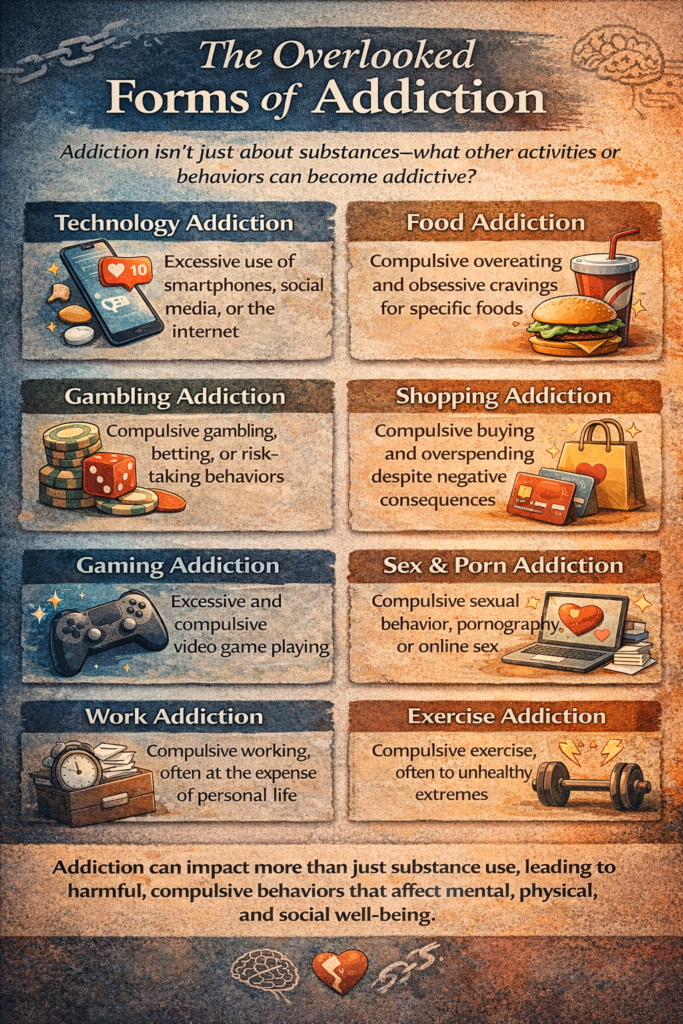
Unlike substance use, behavioral addictions often go unnoticed because they involve everyday activities. Some common but overlooked forms include:
- Gambling addiction
- Internet or social media addiction
- Gaming addiction
- Shopping or spending addiction
Because these behaviors are socially accepted—and sometimes even rewarded—it can be difficult to recognize when they become harmful.
Work and Achievement Addiction
In many cultures, overworking is praised as a sign of ambition or dedication. However, work addiction (workaholism) can have serious consequences, including burnout, strained relationships, and declining mental health.
Individuals may feel:
- An inability to disconnect from work
- Guilt when not being productive
- A constant need to achieve more
What appears to be success on the outside can mask compulsive and unhealthy patterns.
Relationship and Emotional Addictions
Addiction can also develop in interpersonal and emotional contexts. Examples include:
- Codependency
- Love or relationship addiction
- Validation-seeking behaviors
In these cases, individuals may rely on others for self-worth or emotional stability, creating cycles that are difficult to break.
Food and Exercise Addictions
Eating and physical activity are essential for health, but they can also become compulsive.
- Food addiction may involve emotional eating or loss of control around certain foods
- Exercise addiction can lead to overtraining, physical harm, and neglect of other areas of life
These forms are often overlooked because they occur within activities generally considered healthy.
Why These Addictions Are Overlooked
Several factors contribute to the lack of recognition:
- Social acceptance of certain behaviors
- Stigma focused mainly on substance use
- Difficulty identifying clear boundaries between healthy and unhealthy behavior
- Lack of awareness and education
As a result, individuals may struggle without realizing they are dealing with addiction.
The Psychological Function Behind Addiction
Whether substance-based or behavioral, addiction often serves a similar purpose:
coping with emotional pain, stress, trauma, or unmet needs.
Overlooked addictions are particularly challenging because they are:
- Easily justified
- Less likely to be questioned by others
- More difficult to label as problematic
This can delay recognition and intervention.
The Importance of Expanding Awareness
Recognizing overlooked forms of addiction allows for:
- Earlier intervention
- More inclusive treatment approaches
- Reduced stigma around non-substance addictions
It also helps individuals understand that addiction is not defined by what is used—but by how and why it is used.
Moving Toward a Broader Understanding
Recovery begins with awareness. By expanding the definition of addiction, we create space for more people to recognize their struggles and seek support without feeling invalidated or misunderstood.
Final Thought
Addiction does not always look like what we expect. It can hide in routines, achievements, relationships, and everyday behaviors.
The real question is not what someone is addicted to—
but why.
And when we begin to ask that question,
We open the door to understanding, compassion, and meaningful change.
Awareness to Action: Self-Management Strategies for Understanding Overlooked Addictions
Addiction is often associated with substances like drugs or alcohol, but many forms of addiction exist beyond what is commonly recognized. Behavioral and emotional addictions—such as excessive social media use, workaholism, or codependency—can quietly develop and persist because they are socially accepted or even encouraged. This makes them harder to identify and, in many cases, harder to address.
Understanding overlooked forms of addiction is the first step. The next step is learning how to manage these patterns intentionally, using self-awareness and practical strategies to regain control and promote healthier behaviors.
Recognizing the Pattern, Not Just the Behavior
A key self-management strategy is shifting focus from the behavior itself to the pattern behind it.
Ask yourself:
- Am I using this behavior to escape or cope?
- Do I feel out of control or unable to stop?
- Is this affecting my well-being or relationships?
This level of reflection helps identify whether something has moved from a habit into a compulsive pattern.
Building Self-Awareness Through Reflection
Overlooked addictions often operate automatically. Increasing awareness interrupts this cycle.
Try:
- Journaling about triggers and emotional states
- Tracking how often and why you engage in the behavior
- Noticing patterns of use during stress or discomfort
This practice, known as self-monitoring, is a foundational tool in behavior change.
Understanding Emotional Triggers
Many overlooked addictions serve as coping mechanisms for underlying emotions, such as:
- Stress
- Loneliness
- Anxiety
- Low self-worth
Identifying these triggers allows you to address the root cause rather than just the surface behavior.
For example:
“I scroll endlessly when I feel overwhelmed.”
This insight creates an opportunity to respond differently.
Replacing, Not Just Removing, the Behavior
Simply stopping a behavior is often ineffective if it serves an emotional purpose. Self-management involves replacing the behavior with healthier alternatives.
Examples include:
- Replacing excessive screen time with physical activity or hobbies
- Replacing emotional eating with mindfulness or journaling
- Replacing work overuse with structured rest and boundaries
The goal is to meet the same need in a more sustainable way.
Setting Clear Boundaries
Because many overlooked addictions involve everyday activities, boundaries are essential.
This might look like:
- Limiting time spent on certain apps or activities
- Setting work hours and respecting rest time
- Creating “no-use” zones (e.g., no phone during meals or before bed)
Boundaries turn vague intentions into concrete, manageable actions.
Challenging Rationalizations
Overlooked addictions are often justified with thoughts like:
- “Everyone does this.”
- “It’s not that bad.”
- “I can stop anytime.”
Self-management requires recognizing and challenging these cognitive distortions. Replace them with more balanced thinking:
- “Even if it’s common, it’s affecting me negatively.”
Developing Healthy Coping Skills
Since many addictions are tied to emotional regulation, building healthy coping strategies is essential.
These can include:
- Mindfulness or meditation
- Physical activity
- Talking to someone you trust
- Creative outlets
The stronger your coping skills, the less you rely on addictive behaviors.
Creating Accountability
Self-management doesn’t mean doing everything alone. Accountability increases consistency and motivation.
This can involve:
- Sharing goals with a trusted person
- Joining support groups
- Using apps or tools to track progress
External support helps reinforce internal commitment.
Practicing Gradual Change
Overlooked addictions are often deeply ingrained, so change should be gradual and realistic.
Start with:
- Small reductions in behavior
- One boundary at a time
- One new coping strategy
Sustainable change is built through consistency, not perfection.
The Shift Toward Intentional Living
At its core, managing overlooked addictions is about moving from automatic behavior to intentional choice.
Final Thought
Not all addictions are obvious—but their impact is real. The challenge with overlooked addictions is not just recognizing them, but taking steps to address them without minimizing their significance.
Self-management is the bridge between awareness and change.
It allows you to understand your patterns, take control of your behavior, and create a life guided not by compulsion but by choice.
Because the most important question is not just what you’re doing—
But whether it’s truly serving you.
Seeing What’s Hidden: Family Support Strategies for Overlooked Addictions
Addiction does not always look like what we expect. While substances such as drugs and alcohol are widely recognized, many forms of addiction—like excessive gaming, social media use, workaholism, or codependency—often go unnoticed. These behaviors can be normalized or even praised, making it difficult for both individuals and families to recognize when something has become harmful.
For families, this creates a unique challenge: how do you support someone when the problem isn’t obvious? Understanding overlooked forms of addiction is the first step. The next step is learning how to respond in ways that are supportive, informed, and effective.
Recognizing Subtle Signs of Addiction
Unlike substance use, overlooked addictions may not have clear or immediate consequences. Instead, they often show up through patterns of behavior over time.
Families can look for:
- Increasing time spent on a specific activity
- Irritability or distress when unable to engage in it
- Neglect of responsibilities or relationships
- Emotional reliance on the behavior to cope
Recognizing these patterns helps families move beyond “This seems normal” to “This might be a concern.”
Avoiding Minimization and Denial
Because many overlooked addictions involve socially accepted behaviors, it’s easy to minimize their impact.
Common thoughts include:
- “At least it’s not drugs.”
- “Everyone does this.”
However, minimizing can delay support and allow the pattern to deepen. Families play an important role in taking concerns seriously, even when the behavior appears harmless on the surface.
Opening Conversations Without Judgment
Addressing overlooked addictions requires sensitivity. Direct confrontation or criticism can lead to defensiveness, especially when the behavior is not widely recognized as a problem.
Effective communication includes:
- Expressing concern rather than accusation
- Using “I” statements (e.g., “I’ve noticed you seem stressed when you’re not working”)
- Creating a safe space for honest conversation
This approach encourages openness rather than resistance.
Understanding the Emotional Function of the Behavior
Overlooked addictions often serve as coping mechanisms for underlying issues such as stress, anxiety, loneliness, or low self-esteem.
Families can support by asking:
- What need is this behavior fulfilling?
- What might they be trying to avoid or manage?
Understanding the emotional role of the behavior shifts the focus from judging the action to supporting the person.
Encouraging Healthy Alternatives
Instead of simply trying to stop the behavior, families can help introduce healthier ways to cope and engage.
Examples include:
- Encouraging hobbies or activities that promote balance
- Supporting social connections outside the addictive behavior
- Promoting routines that include rest, movement, and variety
The goal is not just to remove the behavior, but to replace it with something more sustainable.
Setting Boundaries When Necessary
Support does not mean allowing harmful patterns to continue unchecked. In some cases, families may need to set boundaries around behaviors that impact the household or relationships.
This might include:
- Limiting enabling behaviors (e.g., covering for missed responsibilities)
- Setting expectations around shared time or responsibilities
- Communicating clear and respectful limits
Boundaries provide structure while maintaining care and respect.
Encouraging Professional Support
Because overlooked addictions are less visible, individuals may not recognize the need for help. Families can gently encourage professional support, such as:
- Therapy or counseling
- Behavioral addiction specialists
- Support groups
Framing help-seeking as a tool for growth rather than a sign of failure can reduce resistance.
Supporting Without Taking Over
Families often feel the urge to “fix” the situation, but lasting change requires the individual’s own involvement. The role of the family is to support, not control.
This includes:
- Offering encouragement rather than pressure
- Allowing the individual to take responsibility for change
- Being present without becoming over-involved
Creating a Balanced Family Environment
Families can also reflect on their own dynamics. Sometimes, overlooked addictions are reinforced by shared habits or expectations (e.g., constant productivity, heavy screen use).
Promoting balance within the family can include:
- Modeling healthy boundaries
- Encouraging open discussions about mental health
- Valuing rest and well-being alongside achievement
The Power of Awareness and Support
Overlooked forms of addiction may be less visible, but their impact is real. Families who take the time to understand these patterns can provide meaningful support that promotes awareness, balance, and long-term well-being.
Final Thought
Addiction doesn’t always look extreme or obvious—it often hides in everyday behaviors. But when families learn to see beyond the surface, they can become a powerful source of insight and support.
Because sometimes, the most important step isn’t confronting what’s obvious—
It’s recognizing what’s been quietly overlooked all along.
Expanding Awareness: Community Strategies for Addressing Overlooked Addictions
Addiction is often associated with substances like drugs and alcohol, but many forms of addiction exist beyond these visible categories. Behavioral and emotional addictions—such as excessive technology use, gambling, workaholism, or codependency—are frequently overlooked because they are normalized within society. As a result, individuals struggling with these patterns may go unrecognized and unsupported.
Communities play a critical role in shaping how addiction is understood and addressed. By expanding awareness and developing targeted strategies, communities can help bring these hidden forms of addiction into focus and create pathways for support, prevention, and recovery.
Recognizing the Limits of Traditional Definitions
Many community systems—healthcare, education, and social services—are structured around substance-based addiction models. While important, these frameworks can overlook behavioral addictions that do not fit traditional criteria.
Community awareness begins with asking:
- What types of addiction are we recognizing—and which are we missing?
- Are certain harmful behaviors being normalized or overlooked?
Expanding definitions allows communities to respond more inclusively and effectively.
Promoting Mental Health and Addiction Literacy
A key strategy is increasing public understanding of addiction in all its forms. When people are informed, they are better equipped to recognize patterns and respond appropriately.
Community initiatives can include:
- Educational workshops and seminars
- School-based programs on behavioral health
- Public awareness campaigns highlighting non-substance addictions
Education reduces stigma and helps individuals identify struggles earlier.
Creating Accessible and Inclusive Support Services
Many existing support systems are designed primarily for substance use disorders. Communities can improve support by expanding services to include behavioral addictions.
This might involve:
- Counseling services that address compulsive behaviors
- Support groups for issues like gaming, internet use, or work addiction
- Integrating behavioral addiction support into existing mental health services
Inclusivity ensures that no form of addiction is dismissed or minimized.
Leveraging Peer Support and Shared Experience
Peer support is especially valuable for overlooked addictions, where individuals may feel misunderstood or invalidated. Community-based peer programs provide:
- Validation of experiences
- A sense of belonging
- Practical strategies for change
When people connect with others who share similar struggles, it reduces isolation and increases engagement.
Challenging Social Norms That Reinforce Harm
Many overlooked addictions are tied to behaviors that are socially accepted or encouraged. For example:
- Constant productivity in the work culture
- Heavy reliance on digital technology
- Consumer-driven lifestyles
Communities can challenge these norms by:
- Promoting balance and well-being
- Encouraging healthy boundaries
- Redefining success beyond productivity or consumption
This cultural shift helps prevent harmful patterns from being normalized.
Integrating Services Across Systems
Overlooked addictions often intersect with mental health, education, and social environments. Community strategies are most effective when they are integrated across systems.
This includes collaboration between:
- Schools and mental health providers
- Workplaces and wellness programs
- Community organizations and healthcare services
Integrated approaches provide more comprehensive and coordinated support.
Early Identification and Intervention
Because overlooked addictions are less visible, early identification is crucial. Communities can implement screening and outreach programs to detect patterns before they become severe.
Examples include:
- School counselors identifying behavioral concerns
- Workplace wellness programs addressing burnout
- Community outreach initiatives targeting at-risk populations
Early intervention improves outcomes and reduces long-term impact.
Encouraging Open Dialogue and Reducing Stigma
Stigma is not limited to substance use—it also affects behavioral addictions, which are often dismissed as “lack of discipline” or “bad habits.”
Communities can foster open dialogue by:
- Creating safe spaces for discussion
- Sharing diverse experiences of addiction
- Promoting empathy and understanding
When people feel safe to speak openly, they are more likely to seek help.
The Role of Community in Broadening Recovery
Recovery is not just about stopping a behavior—it is about creating environments that support healthier ways of living. Communities that recognize overlooked addictions contribute to a more inclusive and effective recovery landscape.
Final Thought
The overlooked forms of addiction are no less serious—they are simply less visible. And what remains unseen often remains untreated.
Communities have the power to change that.
By expanding awareness, challenging norms, and building inclusive support systems, communities can ensure that no struggle is dismissed simply because it doesn’t fit the traditional image of addiction.
Because true understanding begins not with what is obvious—
But with what we are willing to see.
Frequently Asked Questions
Here are some common questions:
1. What are “overlooked forms of addiction”?
These are addictions that do not involve substances like drugs or alcohol but instead involve behaviors or emotional patterns, such as social media use, work, relationships, or shopping.
2. Can someone be addicted to behaviors, not just substances?
Yes. Addiction is defined by compulsive engagement, loss of control, and continued behavior despite negative consequences, not just by substance use.
3. Why are these forms of addiction often overlooked?
They are often:
- Socially accepted or normalized
- Less visible than substance use
- Misunderstood as habits rather than addictions
This makes them harder to recognize and address.
4. What are common examples of overlooked addictions?
Examples include:
- Technology or social media addiction
- Gambling addiction
- Workaholism
- Shopping addiction
- Food-related addiction
- Relationship or codependency patterns
5. How can you tell if a behavior has become an addiction?
Signs include:
- Loss of control over the behavior
- Using it to cope with emotions
- Negative impact on daily life or relationships
- Difficulty stopping despite consequences
6. Is work addiction really a problem if someone is successful?
Yes. Even if it appears productive, work addiction can lead to:
- Burnout
- Strained relationships
- Poor mental and physical health
Success does not eliminate harm.
7. How do overlooked addictions affect mental health?
They can contribute to:
- Anxiety and depression
- Emotional dependence
- Low self-esteem
- Chronic stress
These effects can be just as serious as substance-related addictions.
8. Why do people develop behavioral addictions?
They often develop as coping mechanisms for:
- Stress
- Trauma
- Loneliness
- Emotional pain
The behavior provides temporary relief, reinforcing the cycle.
9. Are overlooked addictions less serious than substance addictions?
No. While they may differ in physical impact, they can still cause significant psychological, emotional, and social harm.
10. How does society contribute to overlooked addictions?
Society may:
- Normalize excessive behaviors (e.g., overworking, constant online presence)
- Reward productivity or consumption
- Minimize emotional or behavioral struggles
This makes it harder to identify unhealthy patterns.
11. Can someone have multiple forms of addiction?
Yes. It is common for individuals to experience co-occurring addictions, where multiple behaviors or substances are used to cope.
12. How can someone begin addressing an overlooked addiction?
Steps include:
- Increasing self-awareness
- Identifying triggers and patterns
- Setting boundaries
- Seeking support (therapy or groups)
13. How can families recognize these addictions?
Families can look for:
- Changes in behavior or priorities
- Emotional reliance on certain activities
- Withdrawal from relationships
- Increased defensiveness when questioned
14. What role does stigma play in overlooked addictions?
Stigma can cause these addictions to be dismissed as:
- “Not serious”
- “Just habits”
- “Lack of discipline”
This prevents individuals from seeking help.
15. What is the most important takeaway about overlooked addictions?
The key takeaway is that addiction is defined by the relationship to the behavior—not the behavior itself. Even everyday activities can become harmful when they are used compulsively to cope or escape.
Conclusion
The overlooked forms of addiction highlight the need to move beyond traditional definitions and assumptions about what addiction looks like. When certain behaviors are normalized, their harmful effects can remain hidden, delaying awareness and intervention. By expanding our understanding of addiction to include behavioral and emotional patterns, we create opportunities for earlier recognition, more inclusive support, and reduced stigma. Ultimately, acknowledging these less visible forms of addiction allows individuals and communities to respond with greater empathy and effectiveness, ensuring that no struggle is dismissed simply because it does not fit the expected image of addiction.
Video: