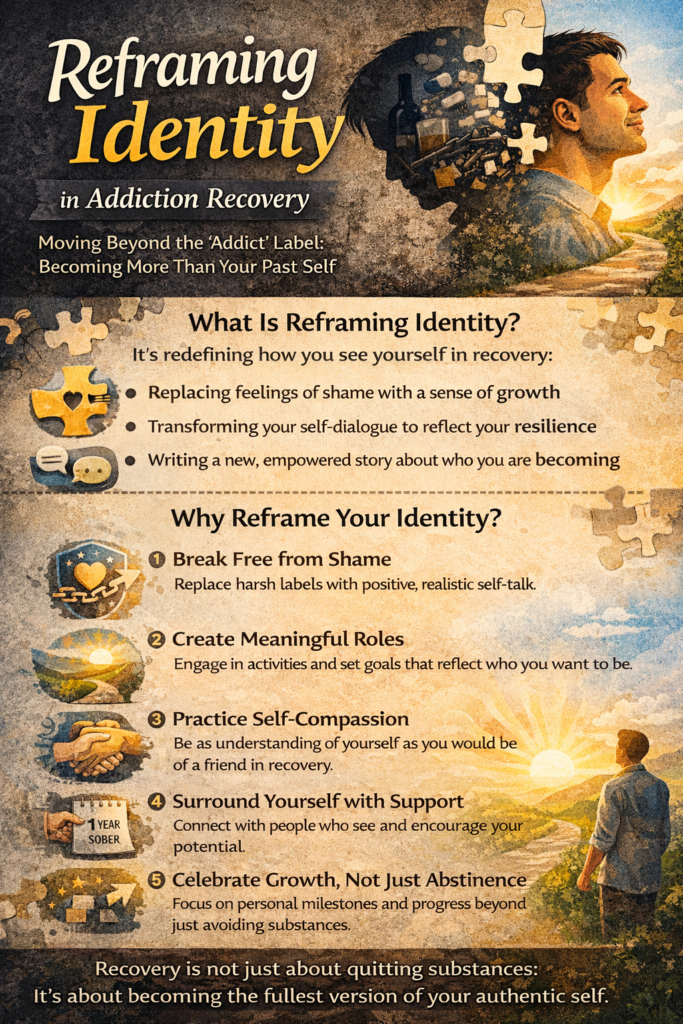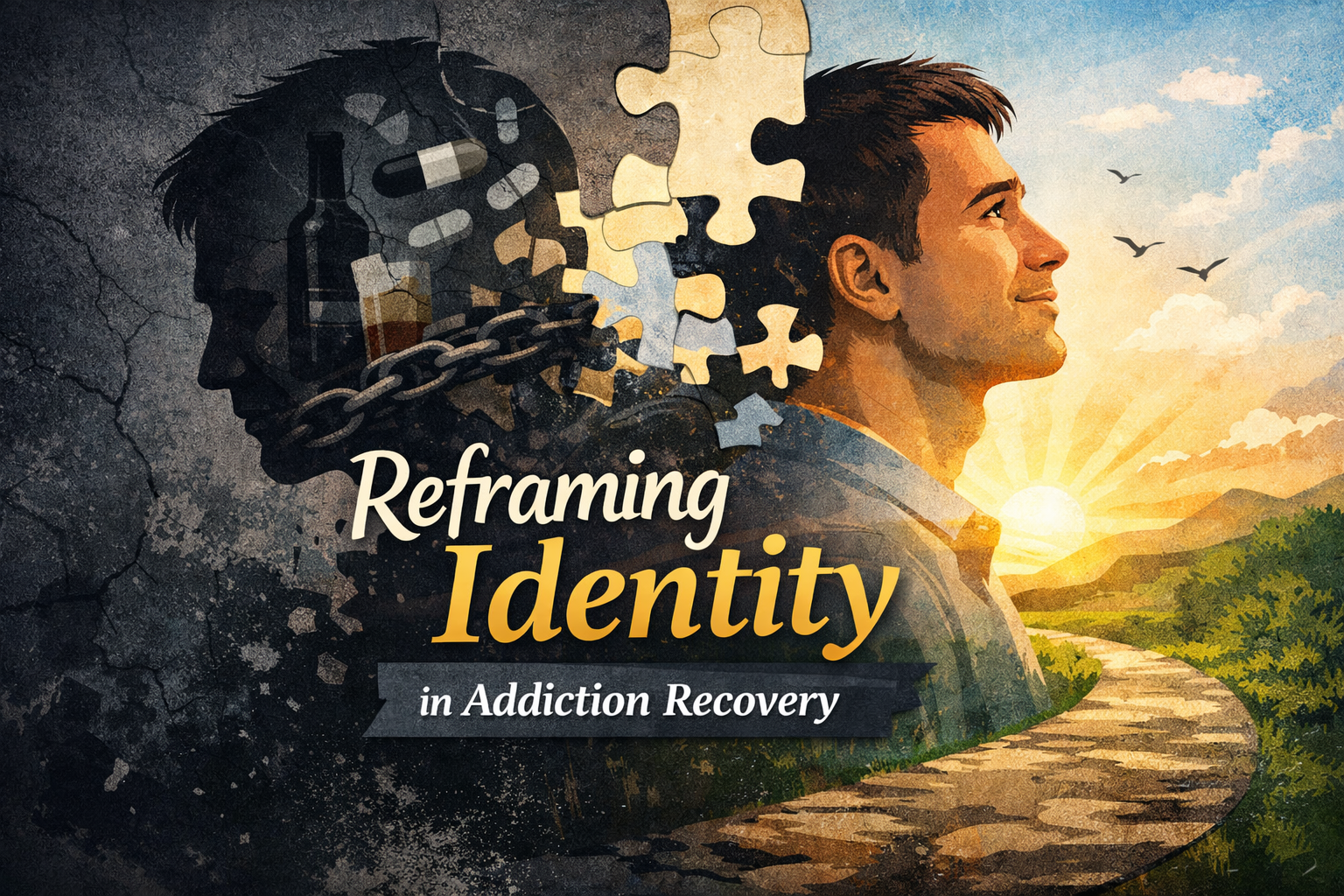
Reframing identity in addiction recovery is a critical yet often overlooked aspect of the healing process. While much attention is given to stopping substance use, recovery also requires a fundamental shift in how individuals see themselves. Addiction can narrow identity into a single, stigmatized label, overshadowing a person’s strengths, values, and potential. To move forward, individuals must begin to separate who they are from what they have experienced. This process involves challenging internalized beliefs, redefining personal narratives, and recognizing that identity is not fixed but continuously evolving. Reframing identity allows individuals to move beyond shame and limitation, creating space for growth, resilience, and a renewed sense of self.
Reframing Identity in Addiction Recovery: Becoming More Than Your Past
Addiction has a way of shrinking identity. Over time, a person may begin to see themselves not as a whole human being, but as a label—an addict, a failure, someone who can’t change. These labels can feel permanent, especially after repeated setbacks. But recovery is not just about stopping substance use. It is about reclaiming and rebuilding identity.
The Problem with Labels
Labels can be useful in clinical settings—they help define patterns and guide treatment. But outside of that context, they often become limiting. When someone internalizes the identity of “addict,” it can overshadow every other part of who they are: their strengths, values, talents, and potential.
This is where reframing becomes essential. Reframing identity means shifting from a fixed, stigmatized label to a dynamic, evolving sense of self.
You Are Not Your Behavior
One of the most important distinctions in recovery is understanding that behavior is not identity. Addiction involves patterns of behavior, often driven by neurobiology, environment, and coping mechanisms—not a person’s core worth.
Reframing might look like:
- From “I am an addict” → “I am a person in recovery.”
- From “I always mess up” → “I am learning new ways to cope.”
- From “I’m broken” → “I’ve been through experiences that shaped me.”
This shift may seem small, but language influences belief—and belief influences behavior.
The Role of Narrative
Humans make sense of their lives through stories. In addiction, the internal narrative often becomes dominated by guilt, shame, and perceived failure. Recovery invites a rewrite of that story.
Instead of a narrative centered on loss, the story can evolve into one of:
- resilience
- growth
- survival
- transformation
You are not erasing your past—you are integrating it into a broader, more empowering narrative.
Identity as a Process, Not a Destination
A common misconception is that recovery ends when substances are no longer used. In reality, recovery is an ongoing process of becoming. Identity is not something you “find” once—it is something you continuously shape.
Exploring identity in recovery might involve:
- reconnecting with interests that were lost
- developing new roles (student, parent, professional, artist)
- building values-based goals
- forming relationships that reflect your growth
Each of these contributes to a more complete sense of self.
Replacing Escape with Meaning
For many, substance use served as a form of escape—relief from pain, stress, or emptiness. When that escape is removed, a void can form. Reframing identity includes learning to fill that space with meaning rather than avoidance.
This doesn’t happen overnight. It involves discomfort, uncertainty, and trial and error. But over time, meaning becomes more sustainable than escape.
Letting Go of Shame
Shame is one of the biggest barriers to identity change. It tells you that your past defines you, that you are unworthy of growth. But shame thrives on silence and rigid thinking.
Reframing identity requires challenging shame with:
- self-compassion
- realistic thinking
- acknowledgment of progress, not just perfection
You can hold yourself accountable without defining yourself by your worst moments.
The Power of Small Identity Shifts
Identity change doesn’t require a dramatic transformation. It often starts with small, consistent shifts:
- keeping a promise to yourself
- choosing a healthier coping strategy
- showing up even when it’s difficult
Each action reinforces a new identity: someone who is capable, resilient, and evolving.
Conclusion: Becoming More Than the Label
Recovery is not about erasing who you were—it’s about expanding who you are. The label of addiction may be part of your story, but it is not the whole story.
Reframing identity allows you to move from a place of limitation to possibility. It opens the door to a more nuanced, compassionate, and empowered sense of self.
You are not just someone who struggled.
You are someone who is rebuilding, redefining, and becoming.
Self-Management Strategies for Reframing Identity in Addiction Recovery
Reframing identity in addiction recovery is not just a mindset shift—it’s a daily practice. Moving from “this is who I was” to “this is who I am becoming” requires intentional self-management. Without structure and awareness, it’s easy to fall back into old narratives and patterns. With the right strategies, however, identity transformation becomes something you actively build, not something you passively hope for.
Why Self-Management Matters in Identity Change
Recovery involves more than abstinence—it involves rewiring how you see yourself and how you respond to life. Self-management bridges that gap. It provides tools to regulate emotions, challenge negative beliefs, and reinforce a healthier sense of self.
Identity is shaped by repeated thoughts and behaviors. What you consistently do—and how you interpret those actions—becomes who you believe you are.
1. Cognitive Reframing: Changing the Inner Dialogue
Your internal language plays a powerful role in identity. Many people in recovery carry automatic thoughts rooted in shame or failure.
Self-management begins with noticing and challenging those thoughts:
- “I always mess up.” → “I’ve struggled before, but I’m learning new patterns.”
- “I’m weak.” → “I’m developing strength through effort.”
This process isn’t about false positivity—it’s about accuracy. You are not defined by isolated moments, but by patterns you are actively working to change.
2. Behavioral Alignment: Acting Into a New Identity
Identity is reinforced through action. Even when you don’t fully believe in a new version of yourself yet, behaving in alignment with it helps solidify it.
Ask yourself daily:
- What would someone in recovery who values growth do today?
Then act accordingly—whether that means attending a meeting, setting boundaries, or choosing a healthier coping strategy. Over time, these actions accumulate into evidence that supports your new identity.
3. Emotional Regulation: Managing Without Escaping
Substance use often served as a way to avoid or numb difficult emotions. In recovery, learning to tolerate and regulate emotions is essential.
Effective self-management strategies include:
- grounding techniques (focusing on the present moment)
- paced breathing
- labeling emotions instead of reacting to them
When you handle emotions without escaping, you begin to see yourself as capable rather than overwhelmed.
4. Values Clarification: Defining Who You Want to Be
Reframing identity requires clarity about what matters to you. Without this, it’s easy to drift back into old roles.
Take time to define:
- What do I value? (e.g., honesty, stability, connection, growth)
- What kind of person do I want to be in difficult moments?
Values act as a compass. They guide decisions and help you build an identity rooted in intention rather than impulse.
5. Routine and Structure: Creating Stability
A consistent routine reduces chaos and reinforces a sense of control. Structure helps anchor your day and minimizes opportunities for relapse triggers.
Examples of supportive routines:
- regular sleep and wake times
- scheduled meals
- planned activities that support recovery
- time for reflection or journaling
Stability in daily life supports stability in identity.
6. Self-Monitoring: Tracking Patterns and Progress
Awareness is a core part of self-management. Tracking your thoughts, emotions, and behaviors helps you identify patterns that either support or undermine your recovery.
This might include:
- journaling triggers and responses
- noting moments of success (even small ones)
- reflecting on what worked and what didn’t
Self-monitoring shifts you from reacting automatically to responding intentionally.
7. Building Self-Compassion: Replacing Shame with Growth
Identity change cannot happen in a constant state of self-criticism. Shame reinforces the old identity; self-compassion allows space for growth.
Self-compassion doesn’t mean avoiding accountability—it means responding to setbacks with:
- understanding instead of harsh judgment
- curiosity instead of defeat
- commitment to try again
Growth is not linear, and your identity should not depend on perfection.
8. Social Reinforcement: Surrounding Yourself with Support
Identity is influenced by the environment. The people you interact with can either reinforce old labels or support your evolving self.
Seek out:
- recovery-supportive communities
- relationships that reflect your values
- environments that encourage growth
When others begin to see you differently, it becomes easier to see yourself differently as well.
Conclusion: Practicing the Identity You’re Building
Reframing identity in addiction recovery is not a one-time realization—it is a series of daily choices. Through self-management strategies, you actively shape how you think, act, and respond to challenges.
You don’t have to fully believe in your new identity to begin.
You only need to practice it.
Over time, those practices become habits.
Those habits become patterns.
And those patterns become who you are.
You are not just recovering—you are redefining yourself, one decision at a time.
Family Support Strategies in Reframing Identity in Addiction Recovery
Recovery does not happen in isolation. While the individual does the internal work of change, the family plays a powerful role in shaping how identity is rebuilt. The way loved ones speak, respond, and relate can either reinforce old labels or support a new, healthier sense of self.
Reframing identity in addiction recovery is not just an individual process—it is relational. Families can become part of the healing environment when they shift from judgment to understanding, and from control to support.
Why Family Support Matters in Identity Reframing
Addiction often reshapes family dynamics—trust may be broken, communication strained, and roles distorted. Even after substance use stops, these patterns can linger. If families continue to see the individual only through the lens of past behavior, it becomes harder for that person to see themselves differently.
Supportive family involvement helps:
- reinforce a new identity beyond addiction
- reduce shame and stigma
- create emotional safety
- strengthen motivation for continued recovery
In many ways, families act as mirrors. What they reflect back can influence how a person defines themselves.
1. Shift the Language: From Labels to Person-First Communication
Language matters. Referring to someone primarily as “an addict” can unintentionally reinforce a fixed identity.
Families can support identity change by using person-first language:
- “You’re working hard in recovery” instead of “You’re still an addict.”
- “I see your progress” instead of “I hope you don’t mess up again.”
This doesn’t ignore the past—it acknowledges growth and effort in the present.
2. Support Without Controlling
It’s natural for families to want to prevent relapse, but overcontrol can feel suffocating and undermine autonomy. Identity growth requires a sense of ownership.
Healthy support looks like:
- encouraging responsibility rather than enforcing it
- offering help without micromanaging
- allowing space for independent decision-making
Recovery is stronger when it is self-directed rather than imposed.
3. Rebuild Trust Gradually
Trust is often damaged during active addiction, and rebuilding it takes time on both sides. Families can support this process by being realistic and consistent.
Helpful approaches include:
- setting clear, fair boundaries
- acknowledging small steps of reliability
- avoiding “all-or-nothing” thinking
Trust is not restored overnight—it is rebuilt through repeated, consistent actions.
4. Validate Effort, Not Just Outcomes
Focusing only on results (e.g., staying sober) can overlook the daily effort required to maintain recovery. Identity shifts are reinforced when effort is recognized.
For example:
- “I know that was a tough situation, and you handled it well.”
- “I can see you’re trying, even when it’s hard.”
This reinforces the identity of someone who is resilient and committed, not just someone avoiding relapse.
5. Encourage New Roles and Identities
Recovery involves more than leaving something behind—it involves building something new. Families can support this by encouraging the individual to explore roles beyond addiction.
This might include:
- supporting education or career goals
- encouraging hobbies or creative outlets
- recognizing strengths and talents
The more roles a person develops, the less power the addiction label holds.
6. Improve Communication Patterns
Open, respectful communication creates a foundation for identity change. This includes both expressing concerns and actively listening.
Effective communication strategies:
- use “I” statements instead of blame (“I feel worried when…”)
- listen without immediately correcting or judging
- allow space for honest conversations about struggles
When communication improves, relationships become a source of support rather than stress.
7. Educate Yourself About Addiction and Recovery
Understanding addiction as a complex condition—not a moral failing—can shift how families respond. Education reduces stigma and increases empathy.
Learning about:
- triggers and relapse risk
- emotional regulation challenges
- the process of identity change
…can help families respond in ways that support growth rather than reinforce shame.
8. Take Care of Yourself as a Family Member
Supporting someone in recovery can be emotionally demanding. Family members also need boundaries, support, and self-care.
This might involve:
- seeking counseling or support groups
- setting limits to protect your well-being
- recognizing your own emotional needs
Healthy support is sustainable support. When families are overwhelmed, it can lead to burnout or resentment, which impacts everyone involved.
Conclusion: Becoming Part of the Healing Process
Reframing identity in addiction recovery is not just about how individuals see themselves—it’s also about how they are seen by others. Families have the opportunity to become part of that transformation.
By shifting language, supporting autonomy, rebuilding trust, and encouraging growth, families help create an environment where a new identity can take root.
Recovery is not just about leaving addiction behind.
It’s about building a life—and an identity—that can move forward.
And when families walk alongside that process with understanding and intention, the impact can be lasting and profound.
Community Strategies in Reframing Identity in Addiction Recovery
Recovery is often described as a personal journey, but identity is never formed in isolation. It is shaped, reinforced, and reflected through the communities we belong to. For individuals in addiction recovery, the community can either anchor them to old labels or help them step into a new sense of self.
Reframing identity in recovery becomes more sustainable when the environment supports it. Community strategies focus on creating spaces where individuals are seen not for who they were at their worst, but for who they are becoming.
Why Community Matters in Identity Reframing
Humans are social beings. The beliefs we hold about ourselves are often influenced by how others treat us. When someone is surrounded by stigma or skepticism, it can reinforce a fixed identity tied to addiction. On the other hand, supportive communities offer validation, a sense of belonging, and accountability.
Community support helps:
- normalize the challenges of recovery
- reduce isolation and shame
- reinforce positive identity shifts
- provide role models of long-term recovery
In many ways, community acts as a social mirror—reflecting back possibilities rather than limitations.
1. Creating Recovery-Supportive Environments
A strong recovery community provides psychological safety. This means individuals can be honest about struggles without fear of judgment or rejection.
Key elements of supportive environments:
- acceptance without enabling harmful behavior
- encouragement of growth and accountability
- shared understanding of recovery challenges
Whether through formal groups or informal networks, feeling safe to be authentic is foundational to identity change.
2. Peer Support and Shared Experience
One of the most powerful aspects of community is connection with others who have lived similar experiences. Peer support reduces the sense of being “different” or alone.
Benefits of peer support:
- shared language and understanding
- mutual encouragement during difficult moments
- modeling of healthy coping and long-term recovery
Seeing others who have successfully reframed their identity makes change feel possible and attainable.
3. Reducing Stigma Through Community Awareness
Stigma can keep individuals stuck in an identity defined by addiction. Communities play a critical role in challenging misconceptions and promoting more accurate, compassionate perspectives.
Community strategies include:
- education about addiction as a complex condition
- promoting person-first language
- highlighting recovery success stories
As stigma decreases, individuals are given more space to redefine themselves.
4. Encouraging Meaningful Roles and Contribution
Identity grows through participation. When individuals in recovery are given opportunities to contribute, they begin to see themselves as valuable members of a community.
This might involve:
- volunteering
- mentorship roles
- employment or skill-building opportunities
- creative or advocacy work
Contribution shifts identity from “someone who struggled” to “someone who gives, builds, and leads.”
5. Building Consistent Social Structure
Regular interaction with a supportive community creates stability. Structured environments help reinforce routines and provide ongoing accountability.
Examples include:
- scheduled recovery meetings
- group activities or workshops
- community events focused on wellness
Consistency strengthens both habits and identity, making recovery feel like a way of life rather than a temporary phase.
6. Promoting Inclusive and Nonjudgmental Spaces
Not everyone’s recovery journey looks the same. Communities that allow for diverse experiences and pathways help individuals feel accepted without pressure to fit a single mold.
Inclusive communities:
- respect different recovery approaches
- avoid comparison or competition
- support individuals at various stages of recovery
This flexibility allows identity to evolve authentically rather than being shaped by rigid expectations.
7. Access to Resources and Opportunities
Communities that provide access to resources—such as education, employment, housing, and mental health services—help individuals rebuild practical aspects of their lives.
These resources:
- support independence
- reduce stressors that can trigger relapse
- reinforce a functional, stable identity
When basic needs are met, individuals have more capacity to focus on personal growth and identity development.
8. Celebrating Progress and Milestones
Recognition matters. Celebrating progress—whether it’s days of sobriety, personal achievements, or growth milestones—reinforces a positive identity.
This can include:
- acknowledging anniversaries of recovery
- recognizing personal accomplishments
- offering encouragement and affirmation
Celebration shifts focus from past mistakes to present and future growth.
Conclusion: Identity Grows Where It Is Supported
Reframing identity in addiction recovery is not just about changing how someone thinks—it’s about changing the environment that shapes those thoughts. Community plays a vital role in this transformation.
When individuals are surrounded by support, opportunity, and understanding, they are more likely to internalize a new identity—one rooted in growth, connection, and purpose.
Recovery is not just an individual achievement.
It is a collective effort, strengthened by the communities that choose to see people not as their past, but as their potential.
Frequently Asked Questions
Here are some common questions:
1. What does “reframing identity” mean in addiction recovery?
Reframing identity refers to the process of changing how a person sees themselves after experiencing addiction. Instead of identifying solely as “an addict,” individuals begin to view themselves as complex, evolving people with strengths, values, and potential. It involves shifting from a fixed, stigmatized identity to one that reflects growth and change.
2. Why is identity important in recovery?
Identity influences behavior. If someone believes they are incapable of change, they are more likely to act in ways that reinforce that belief. In contrast, developing a healthier identity—such as “someone who is resilient and working toward recovery”—can support long-term behavioral change and reduce the risk of relapse.
3. How does addiction affect a person’s identity?
Addiction often narrows identity, causing individuals to define themselves primarily through their substance use and related experiences. Over time, shame, stigma, and repeated setbacks can reinforce a negative self-concept, making it difficult to see oneself outside of the addiction.
4. Is reframing identity the same as denying the past?
No. Reframing identity does not mean ignoring or minimizing past experiences. Instead, it involves integrating those experiences into a broader narrative of growth. The past becomes one part of the story—not the defining feature.
5. How long does it take to change identity in recovery?
Identity change is an ongoing process rather than a fixed endpoint. It develops gradually through consistent behaviors, new experiences, and shifts in thinking. There is no set timeline—progress varies for each individual.
6. What role does language play in identity?
Language shapes perception. The way individuals talk about themselves (e.g., “I am a failure” vs. “I am learning”) influences how they think and behave. Similarly, how others speak to and about them can reinforce either a limiting or empowering identity.
7. Can someone still identify as “in recovery” without being limited by it?
Yes. Identifying as “in recovery” can be empowering when it reflects growth and commitment rather than limitation. The key is that it becomes one aspect of identity, not the entirety of it.
8. What are some practical ways to start reframing identity?
- Challenge negative self-talk
- Engage in behaviors aligned with personal values
- Set and achieve small, realistic goals
- Explore new roles (e.g., student, parent, employee)
- Reflect on progress rather than perfection
These actions help build evidence for a new, healthier self-concept.
9. How do relationships influence identity in recovery?
Relationships act as mirrors. Supportive relationships can reinforce a positive identity by recognizing growth and effort, while negative or stigmatizing environments can reinforce old labels. Social support is a key factor in sustaining identity change.
10. What is the connection between identity and relapse?
A fixed, negative identity (e.g., “I’ll always be this way”) can increase the likelihood of relapse by reducing motivation and hope. In contrast, a flexible, growth-oriented identity supports resilience and encourages individuals to view setbacks as part of the process rather than proof of failure.
11. Can identity change without professional help?
While some individuals may begin reframing their identity independently, professional support (such as therapy or counseling) can provide structured guidance, tools, and accountability. Support groups and community resources can also play a significant role.
12. Why is self-compassion important in identity reframing?
Self-compassion helps reduce shame and creates a mental environment where change is possible. Without it, individuals may remain stuck in self-criticism, which reinforces negative identity patterns and discourages progress.
13. What challenges might arise during identity change?
- Resistance to letting go of familiar labels
- Fear of the unknown or uncertainty
- Persistent negative self-beliefs
- External stigma or lack of support
These challenges are normal and can be addressed through consistent effort and support.
14. How can families and communities support identity reframing?
They can:
- use person-first, non-stigmatizing language
- recognize effort and progress
- encourage independence and growth
- provide supportive, nonjudgmental environments
Their role is to reinforce the evolving identity rather than the past one.
15. What does a “healthy identity” in recovery look like?
A healthy identity is flexible, realistic, and growth-oriented. It includes:
- awareness of past experiences without being defined by them
- a sense of purpose and direction
- alignment with personal values
- confidence in the ability to cope and adapt
Conclusion
Reframing identity in addiction recovery is not a one-time realization but an ongoing process of transformation. It requires consistent effort, self-awareness, and support from both internal and external sources. By shifting away from limiting labels and embracing a more dynamic and compassionate view of self, individuals can build an identity rooted in growth rather than past behavior. This transformation strengthens long-term recovery by fostering purpose, confidence, and resilience. Ultimately, recovery is not just about leaving addiction behind—it is about becoming someone new, someone defined not by their struggles, but by their capacity to change, adapt, and move forward.
Video: