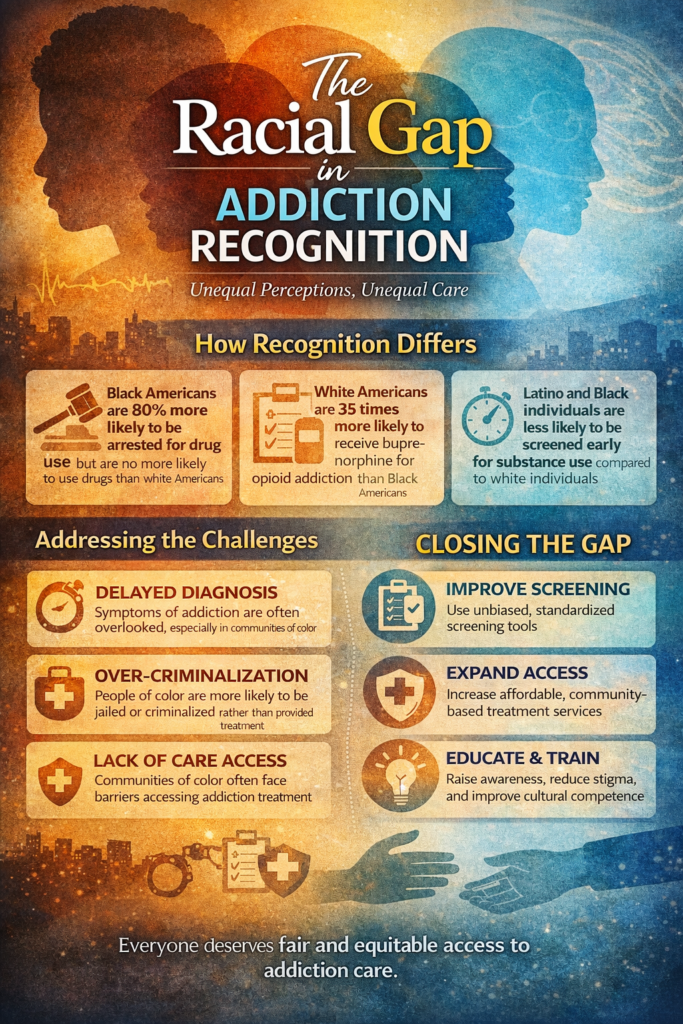
Addiction affects individuals across all racial and cultural backgrounds, yet the way it is recognized, understood, and addressed is not equally distributed. The racial gap in addiction recognition reflects disparities in how symptoms are identified, interpreted, and responded to within healthcare systems, communities, and society at large. These differences are shaped by historical context, implicit bias, unequal access to care, and varying cultural perceptions of substance use. As a result, some individuals are more likely to receive timely support and treatment, while others may be overlooked, misunderstood, or disproportionately criminalized. Understanding this gap is essential for promoting equitable care and ensuring that all individuals have the opportunity for early intervention and recovery.
The Racial Gap in Addiction Recognition: Who Gets Seen and Who Gets Missed
Addiction does not discriminate—but recognition of addiction often does. Across healthcare systems, communities, and public perception, there is a persistent racial gap in how substance use is identified, understood, and treated. This gap affects who receives help, how quickly intervention occurs, and ultimately, who has access to recovery resources.
Understanding this disparity is essential—not only for equity, but for effective public health.
Understanding the Recognition Gap
The “racial gap in addiction recognition” refers to differences in how substance use is perceived and responded to across racial groups. Research and clinical observations suggest that:
- Some groups are more likely to be over-criminalized rather than treated
- Others are more likely to receive medicalized care and early intervention
- Symptoms of addiction may be misinterpreted or overlooked, depending on the racial context
This gap is not about differences in need—it is about differences in response.
Historical and Social Context
To understand the present, it’s important to acknowledge the past. Policies, media narratives, and systemic inequalities have shaped how addiction is viewed across racial groups.
For example:
- Certain substance epidemics have been framed as criminal issues, while others have been framed as public health crises
- Communities of color have historically faced reduced access to healthcare and treatment services
- Stigma and bias can influence both self-reporting and provider response
These patterns contribute to unequal recognition and intervention.
Implicit Bias in Healthcare and Society
Implicit (unconscious) bias can affect how addiction is identified and treated.
This may include:
- Underestimating or overlooking substance use in some populations
- Over-associating substance use with criminal behavior in others
- Differences in screening, diagnosis, and referral to treatment
Even well-intentioned systems can perpetuate disparities without awareness and corrective action.
Barriers to Recognition and Care
Several structural and cultural barriers contribute to the gap:
- Limited access to culturally competent care
- Distrust of healthcare systems in marginalized communities
- Stigma within communities, which may discourage seeking help
- Lack of targeted outreach and education
These barriers can delay recognition until problems become more severe.
Consequences of the Gap
When addiction is not recognized early or accurately, the consequences are significant:
- Delayed or absent treatment
- Increased health complications
- Greater involvement with the criminal justice system
- Widening health disparities across populations
Early recognition is one of the most important factors in successful recovery, making this gap especially critical.
Strategies to Close the Gap
1. Improve Screening and Assessment
Standardized, unbiased screening tools can help ensure consistent identification across populations.
2. Increase Cultural Competence
Training providers to understand cultural context and reduce bias improves diagnosis and care.
3. Expand Access to Care
Improving the availability of affordable, community-based treatment services is essential.
4. Promote Community Education
Raising awareness about addiction as a health condition—not a moral failing—can reduce stigma.
5. Build Trust in Healthcare Systems
Engaging communities through outreach and representation helps bridge gaps in trust and access.
Moving Forward
Addressing the racial gap in addiction recognition requires both awareness and action. It involves examining systems, challenging assumptions, and creating equitable pathways to care.
Final Thoughts
Addiction may affect individuals across all backgrounds, but recognition—and the opportunity for recovery—is not equally distributed. Closing this gap is not only a matter of fairness; it is a necessary step toward improving outcomes for everyone.
When we improve recognition, we improve access. And when access improves, recovery becomes possible for more people—regardless of race or background.
Self-Management Strategies for Addressing the Racial Gap in Addiction Recognition
The racial gap in addiction recognition is not only a systemic issue—it is also shaped by individual awareness, perception, and behavior. While large-scale change requires policy and institutional reform, meaningful progress can also begin at the personal level. Self-management strategies empower individuals—whether healthcare providers, educators, or community members—to recognize bias, improve awareness, and contribute to more equitable identification and response to addiction.
Addressing this gap starts with intentional self-reflection and action.
1. Increase Self-Awareness of Bias
Implicit biases can influence how addiction is perceived across different racial groups.
Self-management begins with:
- Reflecting on personal assumptions about substance use
- Recognizing how media and social narratives shape perception
- Being open to identifying and correcting bias
Awareness is the first step toward change.
2. Commit to Continuous Education
Understanding the historical and social context of addiction disparities is essential.
Strategies include:
- Learning about racial inequities in healthcare and addiction treatment
- Engaging with research, training, and cultural competence resources
- Staying informed about evolving best practices
Education helps replace assumptions with informed understanding.
3. Use Objective and Consistent Criteria
Inconsistent recognition often stems from subjective judgment.
To reduce this:
- Apply the same screening and assessment standards across all individuals
- Focus on observable behaviors and symptoms rather than stereotypes
- Avoid making assumptions based on background or appearance
Consistency improves fairness and accuracy.
4. Practice Reflective Decision-Making
Before making judgments or decisions, pause and evaluate your thinking.
Ask:
- “Would I interpret this behavior the same way in a different person?”
- “Am I relying on evidence or assumption?”
This intentional pause reduces automatic, biased responses.
5. Engage in Perspective-Taking
Understanding different lived experiences can improve recognition and response.
This can involve:
- Listening to voices and stories from diverse communities
- Considering how cultural, social, and economic factors influence behavior
- Avoiding one-size-fits-all interpretations of addiction
Empathy enhances accuracy and connection.
6. Strengthen Communication Skills
Clear, respectful communication encourages openness and disclosure.
Key practices:
- Use nonjudgmental language
- Ask open-ended questions
- Create a safe environment for discussion
When individuals feel understood, they are more likely to share concerns related to substance use.
7. Seek Feedback and Accountability
Self-management improves with external input.
Consider:
- Asking colleagues or peers for feedback on decision-making
- Participating in supervision or reflective practice groups
- Being open to correction without defensiveness
Accountability supports growth and consistency.
8. Advocate Within Your Sphere of Influence
Individual actions can influence broader systems.
Examples:
- Encouraging equitable practices in your workplace or community
- Sharing knowledge and resources with others
- Supporting inclusive policies and practices
Small actions can contribute to larger change.
9. Monitor Your Own Practices Over Time
Ongoing reflection helps ensure that improvements are sustained.
You can:
- Review past decisions or interactions
- Identify patterns in your responses
- Adjust strategies as needed
Self-monitoring reinforces long-term change.
10. Commit to Cultural Humility
Cultural humility goes beyond competence—it involves lifelong learning and openness.
It includes:
- Acknowledging what you don’t know
- Valuing others’ experiences and perspectives
- Remaining adaptable and respectful
This mindset supports more equitable and effective recognition of addiction.
Final Thoughts
Closing the racial gap in addiction recognition requires more than awareness—it requires intentional, ongoing self-management. By examining biases, applying consistent standards, and engaging in continuous learning, individuals can play a meaningful role in creating more equitable systems of care.
Change begins with systems, but it is sustained through people. And through deliberate self-management, each person can contribute to a more just and responsive approach to recognizing addiction.
Family Support Strategies for Addressing the Racial Gap in Addiction Recognition
The racial gap in addiction recognition is often discussed in terms of healthcare systems and policy—but families play a critical and often overlooked role. Within the home, beliefs about substance use, cultural norms, stigma, and communication patterns can influence whether addiction is recognized early or ignored until it becomes severe.
Families are often the first line of awareness. When equipped with the right understanding and strategies, they can help close the gap in recognition and support timely intervention.
1. Increase Awareness Within the Family
Many families may not recognize early signs of addiction, especially when influenced by cultural beliefs or stigma.
Families can:
- Learn common signs of substance use and addiction
- Understand that addiction can affect anyone, regardless of background
- Challenge myths or stereotypes about who “looks like” they have an addiction
Awareness is the first step toward early recognition.
2. Address Stigma and Silence
In some communities, discussing substance use may be seen as taboo, leading to denial or avoidance.
Strategies include:
- Encouraging open, judgment-free conversations
- Avoiding language that shames or blames
- Recognizing addiction as a health condition, not a moral failure
Reducing stigma creates space for honesty and early intervention.
3. Foster Open Communication
Communication patterns within families can either support or hinder recognition.
Effective approaches:
- Ask open-ended questions (“How have you been coping lately?”)
- Listen without interrupting or judging
- Create a safe space where concerns can be shared
When individuals feel safe, they are more likely to disclose struggles.
4. Recognize Cultural Influences
Cultural values and experiences can shape how addiction is viewed and addressed.
Families can:
- Reflect on how culture influences beliefs about substance use
- Balance cultural values with evidence-based understanding
- Remain open to seeking help outside traditional norms when needed
Cultural awareness supports more accurate recognition.
5. Advocate for Proper Assessment and Care
Families can play a key role in ensuring that professionals take concerns seriously.
This may involve:
- Seeking second opinions if concerns are dismissed
- Asking for comprehensive assessments
- Advocating for equitable treatment and access to care
Advocacy helps counteract potential bias in systems.
6. Encourage Early Help-Seeking
Delays in seeking help can worsen outcomes.
Families can:
- Normalize reaching out for support
- Provide information about available resources
- Support the individual in taking first steps toward care
Early action improves recovery outcomes.
7. Support Without Enabling
Balancing support and accountability is essential.
Families should:
- Offer emotional support and encouragement
- Avoid covering up or minimizing substance use
- Promote responsibility while maintaining compassion
Healthy support reinforces growth rather than avoidance.
8. Build Trust Within the Family System
Trust is essential for honest conversations about substance use.
Ways to build trust:
- Follow through on commitments
- Maintain confidentiality when appropriate
- Respond with empathy rather than punishment
Trust encourages openness and early disclosure.
9. Seek Education and External Support
Families do not have to navigate this alone.
They can:
- Attend family education programs
- Join support groups
- Learn from community and professional resources
External support strengthens the family’s ability to respond effectively.
10. Model Healthy Attitudes and Behaviors
Family norms influence individual behavior and perception.
Families can:
- Model healthy coping strategies
- Demonstrate balanced attitudes toward substances
- Encourage wellness-focused lifestyles
Modeling reinforces positive patterns and awareness.
Final Thoughts
Addressing the racial gap in addiction recognition begins not only in systems but in everyday interactions within families. By increasing awareness, reducing stigma, and fostering open communication, families can play a powerful role in ensuring that addiction is recognized early and addressed equitably.
When families move from silence to support, they help create pathways to care that might otherwise be missed. And in doing so, they help close a gap that affects not just individuals but entire communities.
Community Resource Strategies to Address the Racial Gap in Addiction Recognition
The racial gap in addiction recognition is not only a matter of individual awareness or family support—it is deeply rooted in community structures, access to resources, and systemic inequities. Communities play a critical role in shaping how addiction is perceived, identified, and addressed. When community resources are accessible, culturally responsive, and equitable, they can significantly reduce disparities in recognition and improve pathways to care.
Closing the gap requires intentional, community-driven strategies.
1. Expand Culturally Competent Outreach Programs
Effective outreach must reflect the communities it serves.
Strategies include:
- Providing education in culturally relevant ways
- Partnering with trusted community leaders and organizations
- Offering services in multiple languages
Culturally competent outreach increases awareness and trust, making individuals more likely to seek help.
2. Increase Access to Community-Based Screening
Early recognition begins with accessible screening.
Communities can:
- Offer screenings in schools, community centers, and clinics
- Use standardized tools to reduce bias
- Integrate screening into general health services
Accessible screening helps identify concerns before they escalate.
3. Strengthen Partnerships with Local Organizations
Collaboration enhances reach and effectiveness.
Key partners may include:
- Faith-based organizations
- Nonprofits and advocacy groups
- Schools and educational institutions
These organizations often have established trust within communities and can help bridge gaps in awareness and access.
4. Train Community Providers on Bias and Equity
Those on the front lines—health workers, educators, and social service providers—play a key role in recognition.
Training should focus on:
- Implicit bias awareness
- Equitable assessment practices
- Cultural humility and responsiveness
This helps ensure consistent and fair identification of addiction across populations.
5. Improve Access to Affordable Treatment Services
Recognition without access to care is ineffective.
Communities should:
- Expand low-cost or free treatment options
- Increase the availability of outpatient and community-based programs
- Reduce barriers such as transportation and insurance limitations
Equitable access ensures that recognition leads to action.
6. Develop Targeted Public Health Campaigns
Public messaging influences perception.
Effective campaigns:
- Address stigma directly
- Highlight that addiction affects all communities
- Use inclusive and representative imagery and language
Targeted campaigns can reshape narratives and improve recognition.
7. Build Trust Through Community Engagement
Distrust in healthcare systems can delay recognition and care.
Communities can:
- Host forums and listening sessions
- Involve community members in program design
- Ensure representation in leadership and service delivery
Trust is essential for engagement and early intervention.
8. Provide Navigation and Case Management Services
Navigating systems can be challenging, especially for underserved populations.
Support services can:
- Help individuals access appropriate care
- Coordinate between services
- Reduce confusion and delays
Navigation support increases the likelihood of successful follow-through.
9. Address Social Determinants of Health
Factors such as housing, employment, and education influence both addiction and access to care.
Community strategies should include:
- Housing assistance programs
- Job training and employment support
- Access to education and social services
Addressing these factors creates a more stable foundation for recognition and recovery.
10. Monitor and Evaluate Equity in Services
Communities must assess whether resources are reaching all populations equitably.
This includes:
- Collecting and analyzing data on service use
- Identifying disparities in access or outcomes
- Adjusting programs to address gaps
Ongoing evaluation ensures accountability and improvement.
Final Thoughts
Addressing the racial gap in addiction recognition requires more than awareness—it requires coordinated, community-level action. By expanding access, improving cultural competence, and building trust, communities can create systems that recognize addiction early and respond equitably.
When community resources are inclusive and accessible, they not only close gaps in recognition—they open doors to recovery for individuals who might otherwise remain unseen. And in doing so, communities move closer to a more just and effective approach to addiction care.
Frequently Asked Questions
Here are some common questions:
1. What is the racial gap in addiction recognition?
The racial gap in addiction recognition refers to differences in how substance use and addiction are identified, interpreted, and addressed across racial groups. Some populations are more likely to receive early diagnosis and treatment, while others are overlooked, misdiagnosed, or treated through the criminal justice system instead of healthcare.
2. Why does this gap exist?
This gap is influenced by multiple factors, including:
- Implicit bias in healthcare and society
- Historical inequalities in access to care
- Differences in how addiction is portrayed in the media
- Structural barriers such as cost, location, and availability of services
These factors shape how addiction is recognized and responded to.
3. Does addiction affect certain racial groups more than others?
Addiction affects people across all racial and ethnic groups. However, recognition, treatment, and outcomes can differ significantly due to disparities in access and response, rather than differences in prevalence.
4. How does bias affect addiction recognition?
Bias—especially unconscious (implicit) bias—can influence:
- Whether symptoms are taken seriously
- How behaviors are interpreted
- Whether someone is referred for treatment
This can lead to underdiagnosis in some groups and over-criminalization in others.
5. What is meant by over-criminalization?
Over-criminalization refers to situations where substance use is more likely to result in legal consequences (such as arrest or incarceration) rather than being treated as a health issue. This has disproportionately affected some racial groups.
6. Are there differences in access to addiction treatment?
Yes. Some communities face greater barriers, including:
- Fewer treatment facilities
- Lack of insurance or financial resources
- Transportation challenges
- Limited culturally competent care
These barriers can delay or prevent access to treatment.
7. How does stigma contribute to the gap?
Stigma can discourage individuals from seeking help and can also influence how others respond to them. In some communities, addiction may be more heavily stigmatized, leading to silence, denial, or delayed recognition.
8. What role do healthcare providers play in this issue?
Healthcare providers play a critical role in recognizing addiction early. Their training, awareness of bias, and use of standardized screening tools can either reduce or unintentionally reinforce disparities.
9. How can communities help close the gap?
Communities can:
- Promote education and awareness about addiction
- Support culturally responsive programs
- Build trust between residents and healthcare systems
- Advocate for equitable access to care
Community engagement is key to improving recognition and outcomes.
10. What are culturally competent services?
Culturally competent services are those that:
- Respect and understand cultural differences
- Use inclusive communication
- Adapt care to meet the needs of diverse populations
These services improve trust and effectiveness in treatment.
11. Why is early recognition so important?
Early recognition allows for:
- Faster intervention
- Better treatment outcomes
- Reduced risk of complications
Delays in recognition often lead to more severe health and social consequences.
12. Can this gap be reduced or eliminated?
Yes, but it requires coordinated effort:
- Reducing bias in systems and individuals
- Expanding access to care
- Improving education and awareness
- Implementing equitable policies and practices
Progress is possible with sustained commitment.
Conclusion
Addressing the racial gap in addiction recognition requires a commitment to awareness, equity, and systemic change. While the disparities are complex and deeply rooted, they are not unchangeable. Through improved education, culturally responsive practices, unbiased screening, and expanded access to care, progress can be made toward more equitable recognition and treatment. Ultimately, closing this gap is not only a matter of fairness—it is a critical step in improving health outcomes and strengthening communities. When addiction is recognized consistently and compassionately across all populations, the path to recovery becomes more accessible for everyone.
Video: Race Shouldn’t Decide Your Recovery #AddictionAwareness #HealthEquity