In recovery, qualities like kindness, empathy, and a desire to help others are often encouraged—and rightly so. However, these traits can sometimes serve a different purpose beneath the surface. What appears to be genuine kindness may actually be driven by fear, a need for approval, or difficulty expressing personal needs. This is where Nice Guy Syndrome can subtly take shape. Instead of fostering authentic connection, “niceness” becomes a way to manage discomfort, avoid conflict, or seek validation. Recognizing this pattern is an important part of recovery because real growth involves not just changing behaviors but understanding the motivations behind them.
Nice Guy Syndrome in Recovery: When Kindness Becomes Control
In recovery spaces, kindness is often treated as a gold standard. Be supportive. Be understanding. Be “nice.” On the surface, these values seem essential—especially for people healing from addiction, trauma, or dysfunctional relationships.
But not all “nice” behavior is healthy.
Sometimes, what looks like kindness is actually something more complicated—and more harmful.
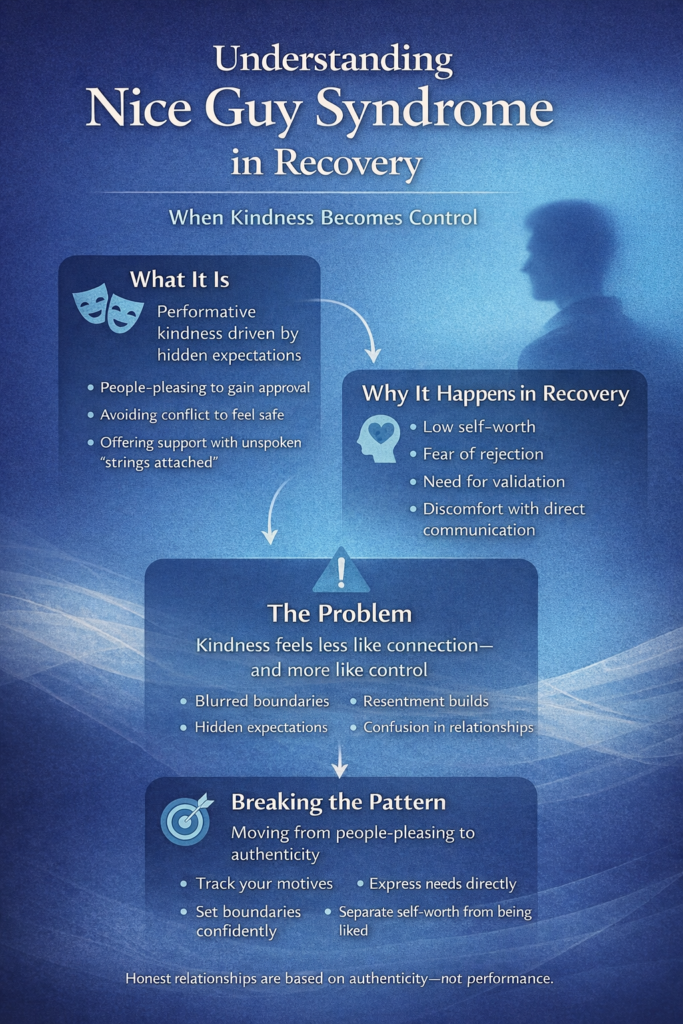
What Is “Nice Guy Syndrome” in Recovery?
“Nice Guy Syndrome” isn’t about genuine kindness. It’s about performative niceness—behavior that appears caring on the outside but is driven by hidden expectations underneath.
In recovery settings, this can show up as:
- Being overly helpful to gain approval
- Avoiding conflict at all costs
- Offering support while secretly expecting validation, loyalty, or control
- Struggling to express needs directly
At its core, it’s less about giving and more about earning something in return.
Why It Shows Up in Recovery
Recovery often attracts people who are already working through:
- Low self-worth
- Fear of rejection
- People-pleasing tendencies
- A need for external validation
For some, being “the nice one” becomes a survival strategy. It feels safer to be agreeable than to risk conflict or abandonment.
But recovery doesn’t just expose harmful behaviors—it also exposes the underlying patterns.
When “Nice” Turns Into Manipulation
The shift from kindness to manipulation isn’t always obvious. It usually lives in the expectation behind the behavior.
For example:
- Helping others, but feeling resentful when it isn’t reciprocated
- Offering support, but expecting emotional access or influence in return
- Avoiding honesty to maintain a “good” image
- Using kindness to avoid accountability
This isn’t always intentional. In many cases, it’s learned behavior. But unaddressed, it can create the same kind of unhealthy dynamics people are trying to heal from.
The Impact on Recovery Spaces
Recovery environments depend on trust, boundaries, and authenticity. When “nice” behavior is actually conditional, it can:
- Blur boundaries
- Create unspoken pressure or obligation
- Lead to resentment and burnout
- Undermine genuine connection
People may feel supported at first—but over time, something feels off.
What Healthy Kindness Actually Looks Like
Real kindness in recovery is different. It’s not about being liked—it’s about being honest and grounded.
Healthy kindness includes:
- Giving without hidden expectations
- Respecting others’ autonomy and boundaries
- Communicating needs directly
- Accepting that not everyone will approve of you
- Being supportive without overextending yourself
It’s quieter. Less performative. But far more sustainable.
Moving From “Nice” to Authentic
Letting go of “Nice Guy Syndrome” doesn’t mean becoming cold or uncaring. It means shifting from approval-seeking to authenticity.
That might look like:
- Saying no without guilt
- Expressing disagreement respectfully
- Checking your motives before offering help
- Letting go of the need to be seen as “good.”
In recovery, growth isn’t just about stopping harmful behaviors—it’s about building healthier ways of relating to others.
Final Thought
Not all kindness is healing.
Sometimes, the most important shift in recovery is learning that being real is more valuable than being liked.
Understanding Nice Guy Syndrome in Recovery: Self-Management Strategies for Authentic Change
In recovery, many people are encouraged to become more compassionate, supportive, and emotionally available. These are valuable traits—but for some, they can blur into something less healthy: Nice Guy Syndrome.
This pattern isn’t about genuine kindness. It’s about using “niceness” as a way to manage anxiety, gain approval, or avoid rejection. And in recovery, where identity and relationships are being rebuilt, these patterns can quietly shape how someone shows up.
The good news? With awareness and self-management, these behaviors can be understood—and changed.
What You’re Really Managing
At its core, Nice Guy Syndrome is less about behavior and more about internal regulation.
Common drivers include:
- Fear of conflict or abandonment
- Need for validation or reassurance
- Discomfort with direct communication
- Belief that worth is earned through being “good.”
So the goal isn’t just to “stop being nice.” It’s about learning how to manage the thoughts, emotions, and impulses underlying the behavior.
1. Track the “Why” Behind Your Kindness
Start by observing your actions in real time.
Before or after offering help, ask yourself:
- Why am I doing this?
- Am I expecting something back?
- Would I still do this if no one noticed?
This builds self-awareness, which is the foundation of change. You’re not judging the behavior—you’re understanding the motive behind it.
2. Notice Resentment as a Signal
Resentment is one of the clearest indicators of Nice Guy patterns.
If you find yourself thinking:
- “After everything I’ve done…”
- “They should appreciate me more…”
That’s a sign your “kindness” may have come with unspoken expectations.
Instead of suppressing resentment, use it as data:
- What did I expect?
- Did I communicate that expectation?
- Was I trying to earn something indirectly?
3. Practice Direct Communication
Many “nice” behaviors exist to avoid discomfort.
Self-management means building tolerance for honesty:
- Express needs clearly instead of hinting
- Say no without over-explaining
- Share opinions even if they might not be liked
This doesn’t mean being harsh—it means being clear and congruent.
4. Set Boundaries Before You Feel Drained
Over-giving is common in recovery, especially when trying to prove change or worth.
Try this:
- Pause before saying yes
- Check your energy level
- Ask: Do I actually have the capacity for this?
Healthy support is sustainable. If it consistently leads to burnout, it’s not actually supportive—for you or others.
5. Separate Self-Worth From Approval
A core part of Nice Guy Syndrome is tying identity to how others respond.
Self-management here involves:
- Noticing when your mood depends on others’ reactions
- Challenging the belief: “I need to be liked to be okay.”
- Building internal validation instead of chasing external approval
This is one of the hardest shifts—but also the most important.
6. Allow Discomfort Without Fixing It
Being “nice” is often a way to quickly reduce internal discomfort.
Instead, practice:
- Sitting with anxiety when you don’t please someone
- Letting silence or tension exist without immediately smoothing it over
- Accepting that not all interactions need to feel good
This builds emotional tolerance, which reduces the need for performative behaviors.
7. Redefine What Kindness Means
Real kindness in recovery isn’t about being agreeable—it’s about being honest, respectful, and boundaried.
It includes:
- Saying no when needed
- Being truthful even when it’s uncomfortable
- Helping without attachment to the outcome
This version of kindness creates trust—not confusion.
Final Thought
Nice Guy Syndrome isn’t a character flaw—it’s a learned strategy.
At some point, being “nice” likely helped you feel safer, more accepted, or more in control. But in recovery, what once protected you can start to limit you.
Self-management isn’t about becoming less kind.
It’s about becoming more real.
Because the goal of recovery isn’t to perform a better version of yourself—it’s to build a more honest one.
Supporting Without Enabling: Family Strategies for Understanding Nice Guy Syndrome in Recovery
Family support can be one of the most powerful influences in recovery. It can also be one of the most complicated—especially when behaviors like “niceness” are misunderstood.
When someone in recovery shows signs of Nice Guy Syndrome, their actions may look positive on the surface: helping others, avoiding conflict, and being agreeable. But underneath, these behaviors can be driven by anxiety, people-pleasing, or a need for validation.
For families, the challenge is learning how to support growth without reinforcing unhealthy patterns.
What Families Often See (and Miss)
From the outside, a person with Nice Guy tendencies may appear:
- Cooperative and easygoing
- Generous and helpful
- Conflict-avoidant
- Highly concerned with others’ feelings
These traits can be mistaken for emotional progress. But families may not see:
- The internal pressure to be liked
- The fear behind saying “no.”
- The resentment that builds when needs aren’t expressed
- The indirect ways expectations are communicated
Understanding this gap is the first step toward meaningful support.
1. Don’t Reinforce “Approval-Based” Behavior
It’s natural to praise kindness—but be mindful of what you’re reinforcing.
Instead of only affirming:
- “You’re so nice.”
- “You always take care of everyone.”
Try affirming:
- “I appreciate how honest you were.”
- “That boundary you set was really healthy.”
This shifts the focus from being liked to being authentic.
2. Encourage Direct Communication
People with Nice Guy patterns often communicate indirectly—hoping others will “just understand.”
Families can support growth by:
- Gently asking for clarity: “What do you actually need right now?”
- Not rewarding passive or vague communication
- Modeling directness in your own interactions
The goal is to make honesty feel safer than performance.
3. Normalize Healthy Conflict
Avoiding conflict can look like peace—but it often prevents real connection.
Help reframe conflict as:
- A normal part of relationships
- An opportunity for honesty
- Something that doesn’t automatically lead to rejection
You can do this by staying calm during disagreements and showing that relationships can handle tension without breaking.
4. Watch for Over-Giving and Step In
Excessive helping can be a red flag, not just a strength.
If you notice patterns like:
- Constantly saying yes
- Taking on others’ responsibilities
- Neglecting personal needs
You might say:
- “You don’t have to do everything for everyone.”
- “It’s okay to take care of yourself, too.”
This helps interrupt the belief that worth comes from overextending.
5. Don’t Accept Hidden Contracts
Sometimes “nice” behavior comes with unspoken expectations.
For example:
- Doing favors but expecting loyalty or emotional closeness
- Being supportive but becoming resentful when it’s not returned
Families can address this by:
- Bringing expectations into the open
- Not agreeing to things that weren’t clearly discussed
- Encouraging explicit communication instead of assumptions
This reduces confusion and prevents resentment from building.
6. Model Boundaries and Self-Respect
Family members play a powerful role in demonstrating what healthy behavior looks like.
That includes:
- Saying no without guilt
- Expressing needs clearly
- Respecting your own limits
When families model this consistently, it shows that respect and connection don’t require self-sacrifice.
7. Support Identity Beyond “Being Nice.”
Many people in recovery have built their identity around being “the good one” or “the helpful one.”
Encourage growth by recognizing:
- Personal interests
- Independent opinions
- Emotional honesty
This helps shift identity from performance to personhood.
Final Thought
Nice Guy Syndrome isn’t about being a bad person—it’s about relying on a strategy that once felt necessary.
Families don’t need to confront it harshly or “fix” it. The most effective support is often quieter:
- Reinforcing honesty over approval
- Valuing boundaries over compliance
- Making space for real, sometimes uncomfortable, communication
Because in recovery, the goal isn’t to raise someone who is always “nice.”
It’s to support someone who is genuine, self-aware, and emotionally honest.
Beyond Niceness: Community Resource Strategies for Addressing Nice Guy Syndrome in Recovery
Recovery doesn’t happen in isolation. It unfolds in communities—support groups, treatment programs, peer networks, and educational spaces. These environments shape not just sobriety, but how people relate to others.
That’s why patterns like Nice Guy Syndrome don’t just exist at the individual level—they’re influenced, reinforced, or challenged by the communities people engage in.
If recovery spaces unintentionally reward people-pleasing, conflict avoidance, or performative kindness, those patterns can persist. But when communities are intentional, they can become powerful environments for authentic change.
Why Community Matters in This Pattern
Nice Guy Syndrome often develops as a social strategy—learning to gain acceptance, reduce conflict, or feel safe in relationships.
So it makes sense that healing also requires a relational context.
Community resources can either:
- Reinforce “be nice, don’t rock the boat” dynamics
or - Encourage honesty, boundaries, and self-awareness
The difference lies in how those spaces are structured and supported.
1. Prioritize Psychoeducation in Recovery Programs
Many people don’t recognize Nice Guy patterns because they’re socially rewarded.
Community resources—like group therapy, workshops, and recovery programs—can help by:
- Teaching the difference between kindness and people-pleasing
- Explaining how indirect communication and hidden expectations work
- Highlighting the emotional cost of approval-seeking behaviors
When people can name the pattern, they’re more likely to change it.
2. Train Facilitators to Recognize the Pattern
Group leaders, sponsors, and counselors play a critical role.
Without awareness, they may unintentionally reinforce behaviors like:
- Over-participation to gain approval
- Agreeing with everyone to avoid tension
- Offering excessive support without boundaries
With training, facilitators can:
- Gently challenge performative niceness
- Encourage direct expression
- Create space for disagreement without shame
This shifts the culture from approval-based to authenticity-based.
3. Normalize Boundaries in Peer Support Spaces
Some recovery communities overemphasize selflessness, which can blur into over-giving.
Healthy community resources should:
- Encourage members to say no
- Respect time, energy, and emotional limits
- Avoid pressuring individuals to “always be there.”
Boundaries aren’t barriers—they’re what make sustainable support possible.
4. Create Space for Honest, Not Just Positive, Sharing
If recovery spaces reward only positivity, people may hide their real feelings.
Communities can counter this by:
- Validating discomfort, frustration, and disagreement
- Encouraging members to speak openly—even when it’s messy
- Avoiding the expectation that everyone must be agreeable
This reduces the need to perform “niceness” and increases emotional honesty.
5. Address Group Dynamics, Not Just Individual Behavior
Nice Guy patterns often show up in subtle group interactions:
- One person always stepping in to “fix” others
- Members avoid conflict to maintain harmony
- Unspoken expectations around helping and loyalty
Community resources can:
- Reflect these patterns back to the group
- Facilitate discussions about boundaries and roles
- Encourage shared responsibility rather than over-functioning by individuals
This keeps the focus on relational health, not just individual progress.
6. Offer Skill-Building Resources
Understanding the pattern isn’t enough—people need tools to change it.
Effective community resources include:
- Assertiveness training
- Communication workshops
- Boundary-setting exercises
- Role-playing difficult conversations
These skills help replace indirect, approval-based behaviors with clear, intentional actions.
7. Promote Diverse Models of Recovery
Not everyone heals the same way—and not everyone needs to be “the helper.”
Communities can support this by:
- Valuing different roles, not just the “supportive” one
- Encouraging individuality instead of conformity
- Highlighting that recovery includes self-focus, not just service
This reduces the pressure to earn a sense of belonging by being “nice.”
Final Thought
Nice Guy Syndrome doesn’t exist in a vacuum—it’s shaped by the environments people move through.
That means recovery communities have a choice.
They can unintentionally reward performance and approval-seeking,
or they can become spaces that challenge those patterns and support something deeper.
Because the goal of recovery isn’t to create people who are endlessly agreeable.
It’s to support individuals who can show up as honest, boundaried, and fully themselves—even in a room full of others.
Frequently Asked Questions
Here are some common questions:
1. What is Nice Guy Syndrome in recovery?
Nice Guy Syndrome in recovery refers to a pattern in which someone uses “niceness” to gain approval, avoid conflict, or feel secure. While it may look like kindness, it’s often driven by underlying fears or unmet emotional needs rather than genuine, unconditional care.
2. Is being nice a bad thing in recovery?
No—genuine kindness is healthy and important. The issue isn’t kindness itself, but when it’s performative or conditional. Healthy kindness is honest and boundaried, while Nice Guy patterns often involve hidden expectations or self-sacrifice.
3. How can I tell if my behavior is genuine or people-pleasing?
A key difference is intention:
- Genuine kindness: given freely, without expectation
- People-pleasing: done to gain approval, avoid discomfort, or control outcomes
A helpful question is: “Would I still do this if I got nothing in return?”
4. Why is this pattern common in recovery?
Many people in recovery struggle with:
- Low self-worth
- Fear of rejection
- Difficulty expressing needs
Being “nice” can feel like a safe way to connect with others while avoiding vulnerability or conflict.
5. Is Nice Guy Syndrome the same as manipulation?
Not always intentionally. While it can become manipulative (especially when expectations are hidden), it’s often a learned coping strategy rather than a conscious attempt to control others.
6. What are common signs of Nice Guy Syndrome?
- Difficulty saying no
- Avoiding conflict at all costs
- Feeling resentful after helping others
- Expecting appreciation or validation
- Struggling to express needs directly
7. Why do I feel resentful if I’m “just being nice”?
Resentment usually signals unspoken expectations. If you’re giving with the hope of receiving something back (validation, closeness, approval), and that doesn’t happen, frustration builds.
8. How does this pattern affect relationships in recovery?
It can:
- Blur boundaries
- Create confusion or mixed signals
- Lead to burnout or emotional exhaustion
- Prevent an authentic connection
Relationships may look supportive but lack honesty and balance.
9. How can I start changing this behavior?
Focus on small, practical shifts:
- Pause before saying yes
- Practice expressing needs directly
- Set boundaries even if it feels uncomfortable
- Check your motives before helping
Change comes from awareness + consistent practice.
10. Will people like me less if I stop being “nice”?
Some might—but the people who value authenticity will respect you more. Recovery often involves letting go of approval-based relationships and building healthier ones.
11. Can this pattern come from past trauma or addiction?
Yes. It often develops as a survival strategy in environments where:
- Love felt conditional
- Conflict felt unsafe
- Needs were ignored or punished
In recovery, those patterns can persist until they’re consciously addressed.
12. What does healthy behavior look like instead?
- Being kind and honest
- Giving without hidden expectations
- Saying no without guilt
- Communicating needs clearly
- Respecting both your boundaries and others’
Conclusion
Nice Guy Syndrome in recovery isn’t about being a bad person—it’s about relying on a learned way of relating that no longer serves you. As awareness grows, the focus shifts from being liked to being real. True progress comes from learning to communicate directly, set boundaries, and tolerate the discomfort that comes with honesty. In the long run, authentic connection is far more sustainable than performative kindness. Recovery isn’t about becoming “nicer”—it’s about becoming more self-aware, more grounded, and more genuine in how you show up in your relationships.
Video: