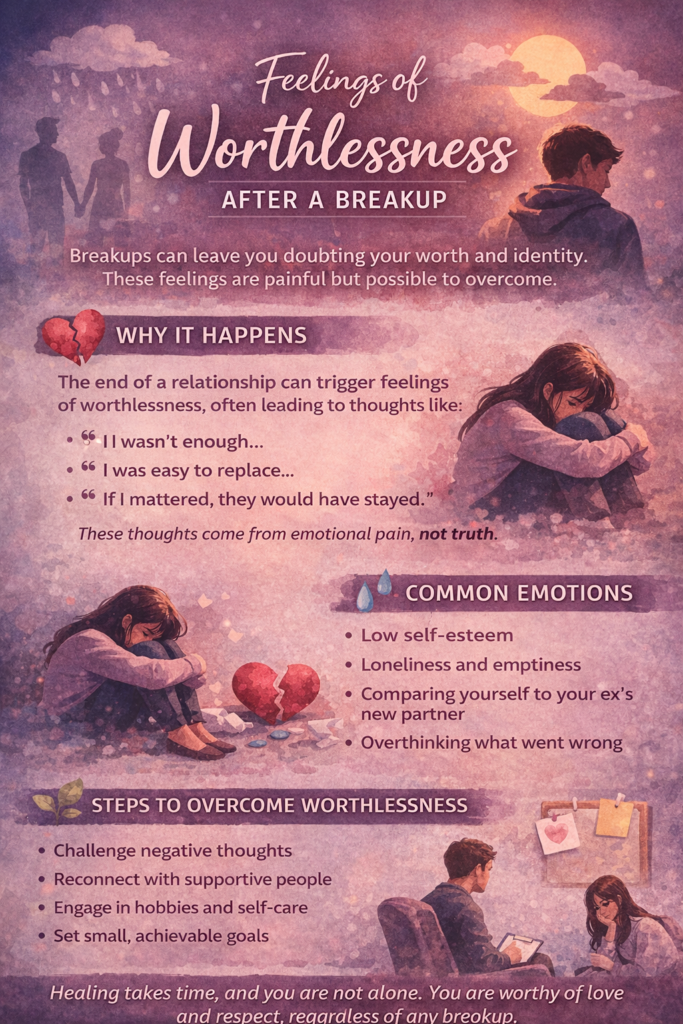
Feelings of worthlessness after a breakup are deeply emotional and often overwhelming. When a relationship ends, it can feel like more than just a loss of connection—it can feel like a loss of identity, validation, and self-worth. Many people begin to question their value, wondering if they were “enough” or why they were not chosen to stay. These thoughts, while common, are often shaped by emotional pain rather than reality. Understanding where these feelings come from is the first step toward healing and rebuilding a healthier sense of self.
💔 Feeling Worthless After a Breakup: Rebuilding Your Sense of Self
Breakups can leave more than just an empty space in your life—they can shake your sense of identity and self-worth. It’s common to feel discarded, replaceable, or as if you didn’t matter as much as you thought. These feelings of worthlessness can be deeply painful, especially when the relationship once felt meaningful and secure. Understanding why these emotions arise—and how to work through them—is an important step toward healing and rediscovering your value.
🧠 Why Breakups Can Trigger Feelings of Worthlessness
When a relationship ends, it can feel like a personal rejection, even when the reasons are complex.
Common underlying thoughts include:
- “I wasn’t enough.”
- “I was easy to replace.”
- “If I mattered, they would have stayed.”
These thoughts often stem from emotional attachment rather than objective truth. The brain tries to make sense of loss by turning inward, sometimes unfairly blaming oneself.
💭 The Emotional Impact
Feeling worthless after a breakup can affect multiple areas of your mental health.
You may experience:
- Low self-esteem
- Overthinking and self-criticism
- Sadness, emptiness, or loneliness
- Comparing yourself to others (especially a new partner)
These reactions are normal—but they can become overwhelming if left unaddressed.
🔄 Challenging the “I’m Not Enough” Narrative
One of the most important steps in healing is recognizing that a breakup does not define your worth.
Try reframing:
- Instead of “I wasn’t enough,” → “The relationship wasn’t the right fit.”
- Instead of “I was replaced,” → “They made a choice that reflects them, not my value.”
Your worth is not determined by someone else’s ability—or inability—to stay.
🌱 Rebuilding Self-Worth
Healing involves reconnecting with who you are outside of the relationship.
Start with:
- Engaging in activities that make you feel capable or fulfilled
- Reconnecting with supportive friends or family
- Practicing self-compassion rather than self-criticism
- Setting small, achievable goals
These steps help rebuild confidence gradually.
🧩 Avoiding Harmful Coping Patterns
When feeling worthless, it’s easy to fall into patterns that reinforce that belief.
Be mindful of:
- Constantly checking your ex’s social media
- Seeking validation through rebounds
- Isolating yourself from others
- Negative self-talk
These behaviors may offer temporary relief but often deepen emotional pain.
🤝 When to Seek Support
If feelings of worthlessness persist or begin to affect your daily functioning, it may be helpful to seek support.
Consider:
- Talking to a therapist or counselor
- Joining a support group
- Opening up to someone you trust
You don’t have to process this alone.
💬 Final Thoughts
Feeling worthless after a breakup is a painful but common experience—but it is not a reflection of your true value. Relationships end for many reasons, and not all of them are within your control. With time, reflection, and support, it’s possible to rebuild your sense of self and come out stronger, more self-aware, and more grounded in your worth.
🌱 Taking Back Your Power: Self-Management Strategies to Prevent Feeling Worthless After a Breakup
Breakups can deeply impact how you see yourself, sometimes leaving you feeling rejected, replaceable, or not “enough.” While these feelings are common, they don’t have to define your healing process. By using intentional self-management strategies, you can protect your self-worth, challenge negative thinking, and rebuild a stronger, more grounded sense of who you are.
🧠 Recognize and Interrupt Negative Thought Patterns
After a breakup, your mind may default to self-critical thoughts.
Common patterns:
- “I wasn’t good enough.”
- “I meant nothing to them.”
- “I’ll always be replaced.”
Self-management starts with awareness. When these thoughts arise:
- Pause and label them as thoughts—not facts
- Ask yourself, “Is this objectively true?”
- Replace them with more balanced perspectives
💭 Practice Self-Compassion
It’s easy to be hard on yourself after rejection, but healing requires kindness toward yourself.
Try:
- Speaking to yourself the way you would a close friend
- Acknowledging your pain without judgment
- Reminding yourself that breakups are a shared human experience
Self-compassion reduces emotional intensity and builds resilience.
🔄 Separate Your Identity from the Relationship
One of the biggest risks after a breakup is tying your worth to the relationship’s outcome.
Reframe your thinking:
- You are not defined by someone else’s choice
- A relationship ending does not equal personal failure
- Compatibility and timing play a major role
This shift helps you see the breakup more realistically.
🌿 Rebuild Your Routine and Sense of Self
Structure and routine can help ground you during emotional upheaval.
Focus on:
- Re-engaging in hobbies or interests you enjoy
- Creating a daily routine that supports your well-being
- Setting small, achievable goals
These actions reinforce a sense of control and identity.
🧩 Limit Triggers That Reinforce Worthlessness
Certain behaviors can intensify negative feelings.
Be mindful of:
- Constantly checking your ex’s social media
- Comparing yourself to others
- Replaying the relationship repeatedly in your mind
Setting boundaries around these triggers protects your mental space.
🤝 Strengthen Your Support System
You don’t have to rely solely on yourself.
Self-management includes:
- Reaching out to friends or family
- Talking openly about how you feel
- Accepting support rather than isolating
Connection helps counter feelings of worthlessness.
📅 Use Reflection for Growth, Not Self-Blame
Reflection can be helpful—but only when done constructively.
Ask yourself:
- What did I learn from this relationship?
- What do I want in future relationships?
- How can I grow without blaming myself?
Growth-focused reflection builds confidence rather than tearing it down.
🌱 When to Seek Extra Support
If feelings of worthlessness persist or worsen, additional support may be helpful.
Consider:
- Therapy or counseling
- Support groups
- Mental health resources
Seeking help is a proactive and empowering step.
💬 Final Thoughts
Preventing feelings of worthlessness after a breakup isn’t about ignoring pain—it’s about managing how you respond to it. By challenging negative thoughts, practicing self-compassion, and rebuilding your sense of self, you can move through heartbreak without losing your value. Healing takes time, but with the right strategies, you can come out stronger, more self-aware, and more confident in your worth.
👨👩👧👦 You Matter: Family Support Strategies to Prevent Feelings of Worthlessness After a Breakup
Breakups can leave individuals feeling emotionally shaken, questioning their value and place in others’ lives. During this vulnerable time, family support can play a powerful role in preventing feelings of worthlessness from taking root. Through understanding, encouragement, and consistent presence, families can help their loved one rebuild confidence and regain a sense of self-worth.
🧠 Create a Safe and Supportive Environment
One of the most important things a family can offer is emotional safety.
Supportive actions include:
- Listening without interrupting or judging
- Validating feelings (“That sounds really painful”)
- Avoiding dismissive statements like “Just move on.”
Feeling heard and understood can significantly reduce emotional distress.
❤️ Reinforce Their Worth
After a breakup, individuals often internalize rejection as a reflection of their value.
Families can help by:
- Reminding them of their strengths and positive qualities
- Highlighting their accomplishments and resilience
- Offering consistent reassurance without minimizing their pain
Hearing affirmations from trusted loved ones can counter negative self-beliefs.
🗣️ Encourage Open Communication
Creating space for honest conversations helps prevent emotional isolation.
Families should:
- Check in regularly without being intrusive
- Encourage expression of thoughts and emotions
- Be patient if the person needs time to open up
Open communication fosters connection and emotional processing.
🧩 Help Challenge Negative Thinking
Loved ones can gently support healthier perspectives.
For example:
- If they say, “I wasn’t enough,” respond with, “Relationships end for many reasons, not just one person’s worth.”
- Encourage balanced thinking rather than all-or-nothing conclusions
This helps reframe harmful narratives without invalidating feelings.
🌿 Promote Healthy Coping and Routine
Families can support recovery by encouraging positive daily habits.
This may include:
- Inviting them to participate in activities (walks, meals, hobbies)
- Encouraging regular sleep, nutrition, and self-care
- Helping them stay engaged in life rather than withdrawing
Routine brings stability during emotional upheaval.
🚫 Avoid Unhelpful Responses
Even well-meaning comments can unintentionally worsen feelings of worthlessness.
Avoid:
- Comparing their experience to others
- Criticizing the ex excessively (which may complicate emotions)
- Pressuring them to “get over it” quickly
Support should be patient and non-judgmental.
🤝 Encourage External Support When Needed
Sometimes additional help is beneficial.
Families can:
- Suggest speaking with a therapist or counselor
- Offer to help find resources
- Normalize seeking help as a healthy step
This reinforces that they don’t have to handle everything alone.
🌱 Be Consistent and Patient
Healing from a breakup takes time, and progress is not always linear.
Families can help by:
- Continuing to show up consistently
- Being patient with emotional ups and downs
- Celebrating small steps forward
Consistency builds a sense of stability and trust.
💬 Final Thoughts
Family support can be a powerful buffer against feelings of worthlessness after a breakup. Through empathy, encouragement, and steady presence, loved ones can help rebuild confidence and remind the individual of their inherent value. While they cannot take away the pain, families can make sure no one has to go through it alone—and that can make all the difference in the healing process.
🌍 You’re Not Alone: Community Resource Strategies to Prevent Feelings of Worthlessness After a Breakup
Breakups can leave individuals feeling isolated, rejected, and questioning their self-worth. While personal coping and family support are important, community resources provide an additional layer of connection and healing. Access to supportive environments, mental health services, and social networks can help individuals regain perspective, rebuild confidence, and realize they are not alone in their experience.
🧠 Access to Mental Health Services
Professional support can be a key factor in preventing feelings of worthlessness from deepening.
Community resources include:
- Counseling centers and therapy services
- Low-cost or sliding-scale mental health clinics
- Online therapy platforms and crisis support lines
These services provide guidance, coping strategies, and a safe space to process emotions.
🤝 Support Groups and Peer Networks
Connecting with others who have experienced similar situations can be incredibly validating.
Benefits of support groups:
- Shared understanding and reduced isolation
- Opportunity to express feelings openly
- Learning from others’ coping strategies
Peer support reminds individuals that their experience is common and survivable.
🏫 Workshops and Educational Programs
Many communities offer programs focused on emotional well-being and relationship skills.
Examples include:
- Breakup recovery or self-esteem workshops
- Stress management and resilience training
- Relationship education programs
These resources help individuals reframe their experience and build emotional strength.
🎨 Encouraging Social Engagement
Isolation can intensify feelings of worthlessness, while community involvement can counteract it.
Communities can provide:
- Recreational programs (fitness classes, art groups, clubs)
- Volunteer opportunities
- Social events that encourage connection
Engaging in meaningful activities helps rebuild identity and confidence.
📢 Online Communities and Digital Support
In today’s world, support isn’t limited to physical spaces.
Helpful options:
- Online forums and mental health communities
- Social media groups focused on healing and growth
- Educational content from mental health professionals
These platforms offer accessible, immediate support, especially for those who may be hesitant to seek in-person help.
❤️ Reducing Stigma Around Emotional Struggles
Communities play a vital role in normalizing conversations about heartbreak and mental health.
This can be done by:
- Promoting open discussions about emotional well-being
- Sharing stories of healing and resilience
- Encouraging help-seeking without shame
Reducing stigma makes it easier for individuals to reach out when they need support.
🧩 Resources for Crisis or Severe Distress
If feelings of worthlessness become overwhelming, immediate support is essential.
Communities should provide:
- Crisis hotlines
- Emergency mental health services
- Accessible intervention programs
Knowing help is available can be life-saving.
🌱 Building a Culture of Connection and Worth
Ultimately, community resources help create an environment where individuals feel seen, valued, and supported.
This includes:
- Encouraging kindness and inclusion
- Providing spaces for authentic connection
- Promoting mental health as a shared priority
💬 Final Thoughts
Preventing feelings of worthlessness after a breakup is not something anyone has to face alone. Community resources offer connection, understanding, and professional support that can make a meaningful difference in the healing process. By reaching out and engaging with these resources, individuals can begin to rebuild their sense of self and rediscover their value within a larger, supportive world.
Frequently Asked Questions
Here are some common questions:
Is it normal to feel worthless after a breakup?
Answer:
Yes, it’s very common. Breakups can trigger feelings of rejection and self-doubt, making you question your value. These feelings are a natural emotional response to loss—not a reflection of your actual worth.
Why do breakups affect self-worth so much?
Answer:
Relationships often become part of our identity. When they end, it can feel like losing validation, connection, and stability. This can lead to internal thoughts like “I wasn’t enough,” even if the breakup had many contributing factors.
Does feeling “replaceable” mean I didn’t matter?
Answer:
No. Feeling replaceable is a common emotional reaction, especially if an ex moves on quickly. However, someone else’s actions do not determine your value or the meaning of the relationship you had.
How long do these feelings usually last?
Answer:
There’s no set timeline. For some, these feelings fade within weeks; for others, it may take months. Healing depends on factors like emotional attachment, support systems, and coping strategies.
What are the signs that my thoughts are becoming unhealthy?
Answer:
Watch for:
- Persistent negative self-talk (“I’m not good enough”)
- Obsessive comparison to others
- Isolation or withdrawal
- Loss of motivation or hope
If these continue or worsen, it may be helpful to seek support.
How can I stop thinking “I wasn’t enough”?
Answer:
- Challenge the thought: Is this fact or feeling?
- Remind yourself that relationships end for many reasons
- Replace it with balanced thinking: “We weren’t the right fit.”
This takes practice, but it helps shift your mindset over time.
Can a breakup trigger anxiety or depression?
Answer:
Yes. Breakups can lead to increased anxiety, sadness, or even depressive symptoms—especially if self-worth is affected. These reactions are valid, but support may be needed if they become overwhelming.
Should I avoid my ex on social media?
Answer:
In many cases, yes. Constant exposure can reinforce feelings of worthlessness, especially if you’re comparing yourself or analyzing your behavior. Taking space can support emotional healing.
What are healthy ways to rebuild self-worth?
Answer:
- Practice self-compassion
- Reconnect with hobbies and interests
- Spend time with supportive people
- Set small, achievable goals
Rebuilding self-worth is a gradual process.
When should I seek professional help?
Answer:
Consider reaching out if:
- Feelings of worthlessness persist or intensify
- You’re struggling to function daily
- You feel stuck in negative thought patterns
A therapist or counselor can help you process emotions and rebuild confidence.
Conclusion
Although feeling worthless after a breakup can be incredibly painful, it is not a reflection of your true value. Breakups are complex and rarely defined by one person’s worth alone. With time, support, and intentional self-reflection, it is possible to challenge these negative beliefs and rebuild confidence. Healing involves recognizing your inherent worth, independent of any relationship, and learning to view the experience as part of growth rather than a measure of failure. Over time, this perspective can lead to stronger self-awareness, resilience, and a renewed sense of self-worth.
Video: Don’t Fall Into the Worthlessness Trap After a Breakup #healing #motivation