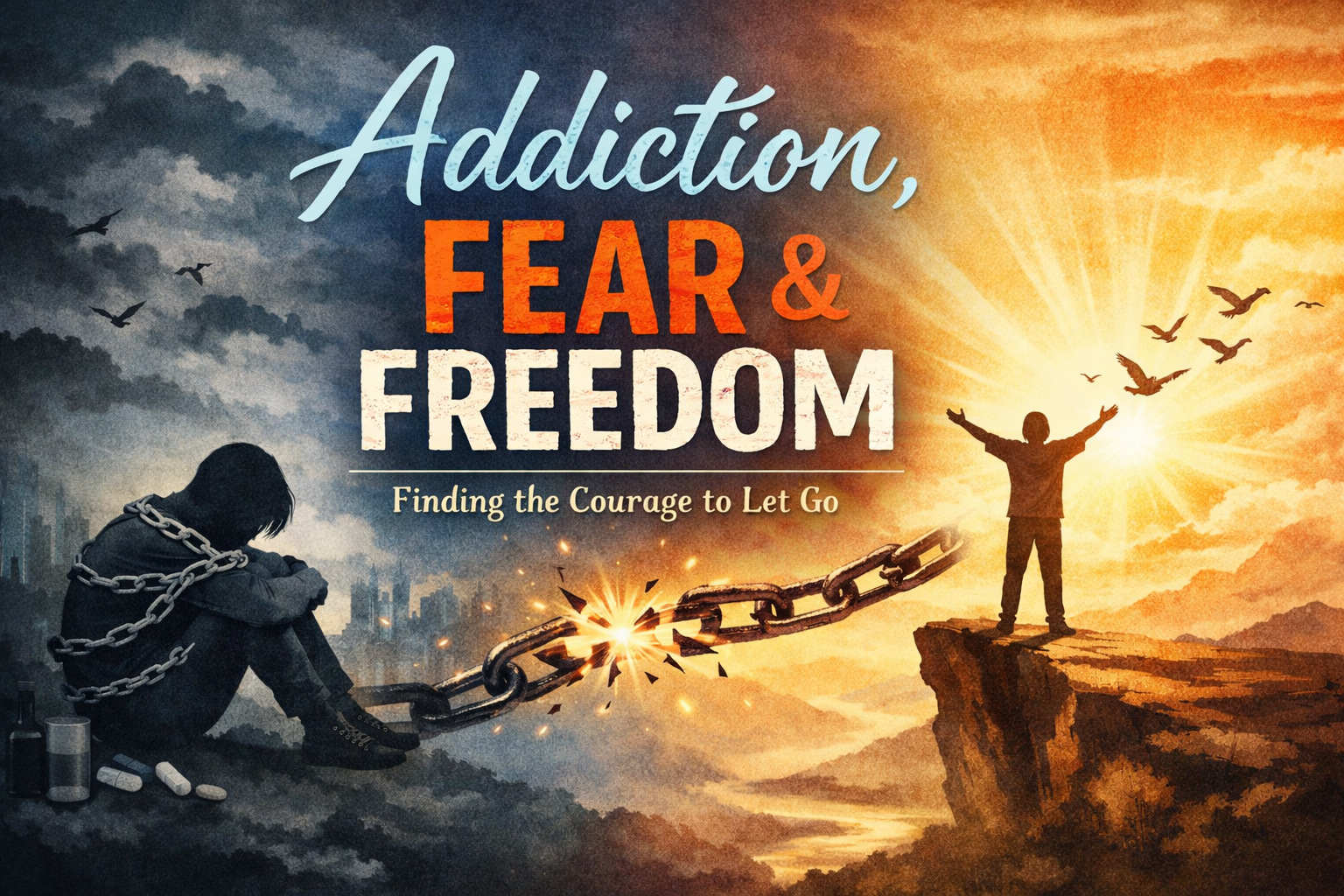
Addiction is often seen as a pursuit of pleasure or escape, but at its core, it is deeply intertwined with fear. Fear of pain, fear of discomfort, fear of facing emotions that feel overwhelming or unfamiliar. What begins as a way to cope can evolve into a cycle where the very thing used for relief becomes something a person feels they cannot live without. This creates a powerful tension between fear and freedom—where holding on feels safer than letting go, even when it causes harm. To understand addiction more fully, we have to look beyond behavior and recognize the role fear plays in shaping both dependence and the path toward recovery.
Addiction, Fear, and Freedom: The Space Between Holding On and Letting Go
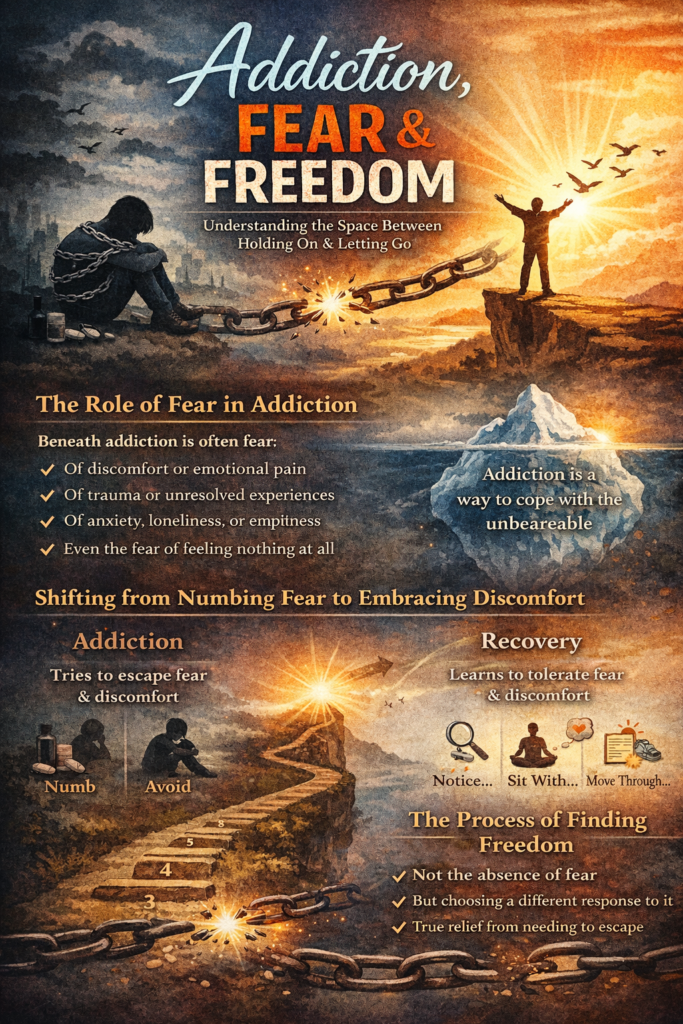
Addiction is often misunderstood as a pursuit of pleasure—but more often, it is a response to fear. Fear of discomfort. Fear of emptiness. Fear of facing emotions that feel too overwhelming to hold without something to soften them.
What begins as relief can slowly become reliance. And what once felt like a choice can start to feel like the only way to cope. Not because someone wants to stay stuck—but because fear convinces them they can’t survive without it.
To understand addiction, you have to understand fear.
And to understand recovery, you have to understand freedom.
😨 The Role of Fear in Addiction
At its core, addiction often protects against something:
- Emotional pain
- Trauma or unresolved experiences
- Anxiety, loneliness, or uncertainty
- Even the fear of feeling nothing at all
Substances and behaviors become a buffer—a way to regulate what feels unmanageable.
Over time, a deeper fear develops:
- “What will I feel if I stop?”
- “Who am I without this?”
- “Can I handle life as it is?”
This is where addiction tightens its grip—not just through habit, but through fear of what lies beyond it.
🔒 When Fear Feels Like Safety
One of the most confusing parts of addiction is that what harms you can also feel like what helps you.
It creates a paradox:
- The thing causing damage is also the thing providing relief
- The behavior that limits you is the one that feels safest
- Letting go feels more dangerous than staying the same
This isn’t irrational—it’s learned. The brain and body associate the substance or behavior with survival, even when it’s no longer serving you.
⚖️ The Turning Point: Awareness
Recovery often begins not with action, but with awareness:
- Recognizing the role fear plays
- Seeing the pattern clearly
- Questioning whether the “safety” is real or temporary
This moment is subtle but powerful.
It shifts the question from:
“Why can’t I stop?”
to
“What am I afraid will happen if I do?”
🔓 Freedom Isn’t the Absence of Fear
Freedom in recovery doesn’t mean fear disappears. It means your relationship to it changes.
Instead of:
- Escaping fear
- Numbing it
- Avoiding it
You begin to:
- Notice it
- Sit with it
- Move through it
Freedom is not about feeling nothing—it’s about being able to feel without needing to escape.
🌱 Learning to Tolerate Discomfort
A key part of recovery is developing the ability to tolerate discomfort without reacting immediately.
This includes:
- Sitting with anxiety for a few extra moments
- Allowing sadness without numbing it
- Experiencing boredom without filling every second
These small moments rebuild something powerful: trust in yourself.
🧭 Redefining Safety
Addiction teaches that safety comes from avoidance.
Recovery teaches that safety comes from capacity.
Not:
- “I need this to be okay.”
But:
- “I can handle this, even if it’s uncomfortable.”
This shift doesn’t happen overnight. It’s built slowly, through repeated experiences of facing fear—and surviving it.
💬 Final Thoughts
Addiction is not just about substances or behaviors.
It’s about fear—and the ways we try to protect ourselves from it.
Freedom is not found in eliminating fear, but in no longer being controlled by it.
It’s in the quiet moments where you:
- Pause instead of react
- Feel instead of avoid
- Choose instead of the default
Because the opposite of addiction isn’t just sobriety—
It’s the ability to live fully and honestly, without needing to escape yourself.
From Fear to Freedom: Self-Management Strategies for Understanding Addiction
Addiction is not just about what you do—it’s about what you’re trying not to feel. Beneath the surface, fear often drives the cycle: fear of discomfort, fear of emotional pain, even fear of facing life without a familiar coping mechanism.
Self-management in recovery isn’t about forcing yourself to “be better.” It’s about learning how fear operates in your body and mind—and developing the ability to respond differently. Freedom doesn’t come from eliminating fear, but from no longer being controlled by it.
🔍 Identify the Fear Beneath the Urge

Every urge is often tied to something deeper.
Ask yourself:
- What am I actually afraid of right now?
- Is this about stress, loneliness, failure, or discomfort?
- What feeling am I trying to avoid?
Strategy: Name the fear before reacting. When you can identify it, you create space between the feeling and the behavior.
⏸️ Practice the Pause Between Fear and Action

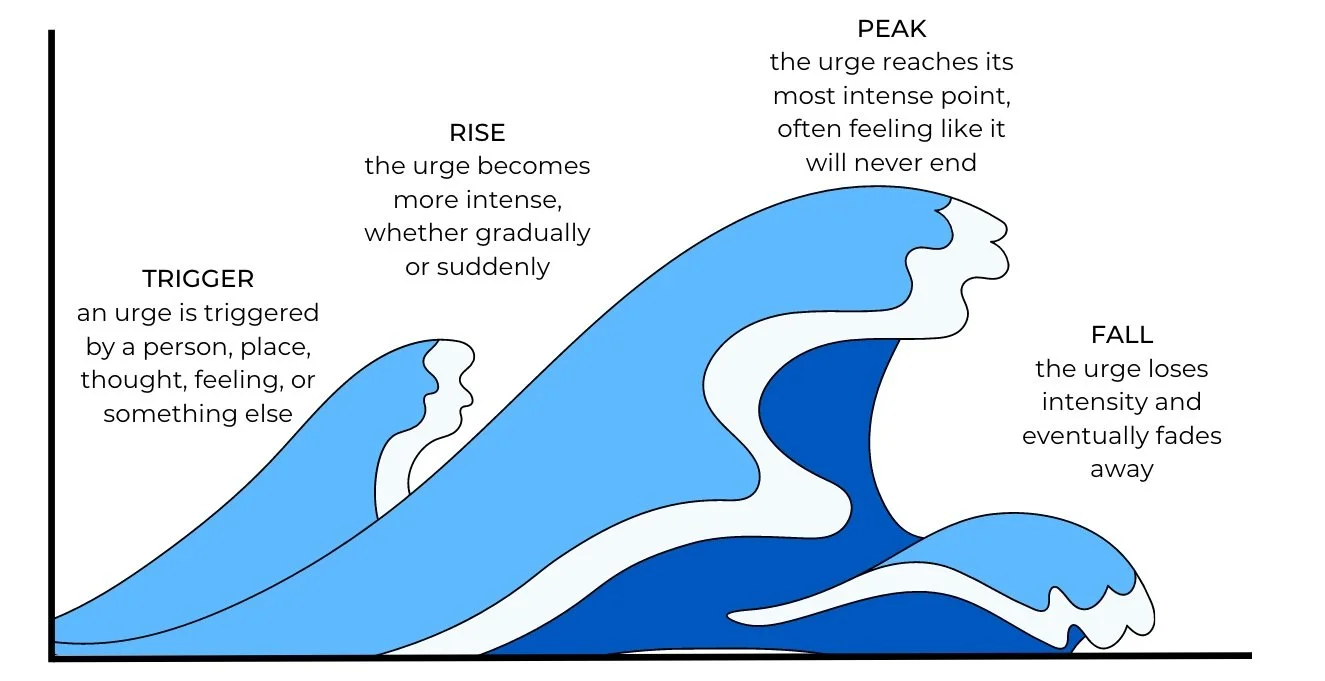
Addiction thrives on automatic reactions. Freedom begins in the pause.
Simple technique:
- Notice the urge
- Take a slow breath
- Wait 30–60 seconds before acting
This small gap weakens the fear-response loop and strengthens your ability to choose.
🫁 Regulate Your Body, Not Just Your Thoughts
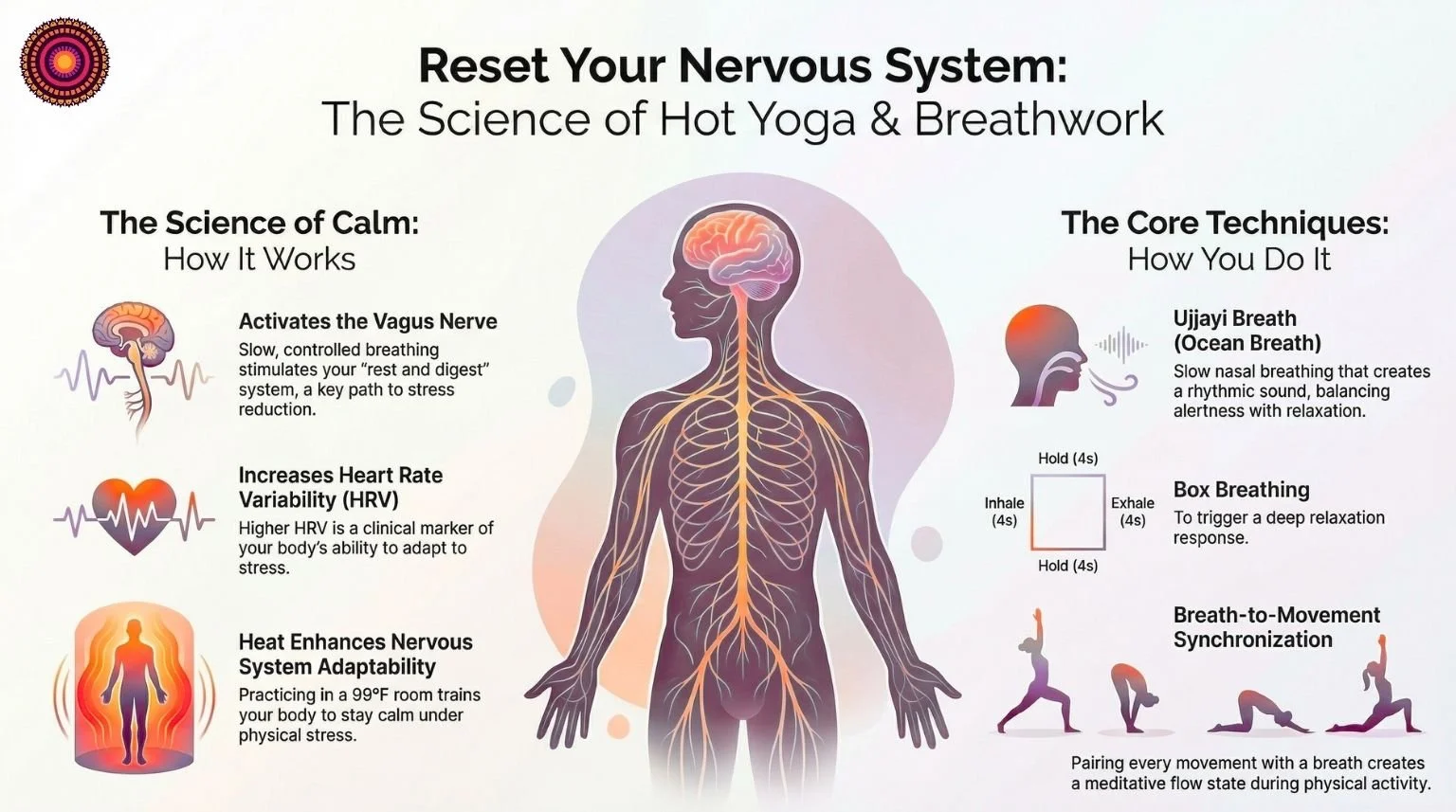
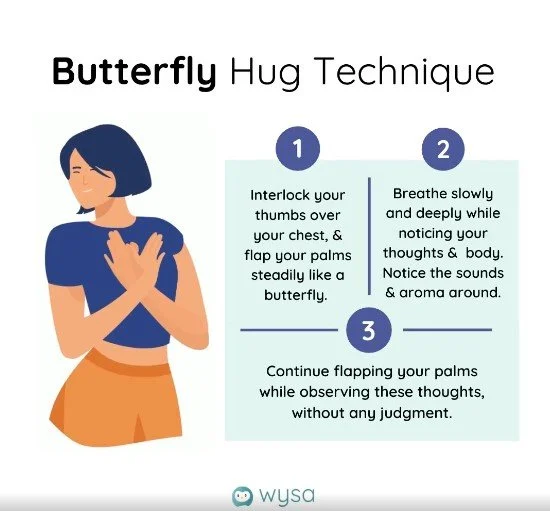
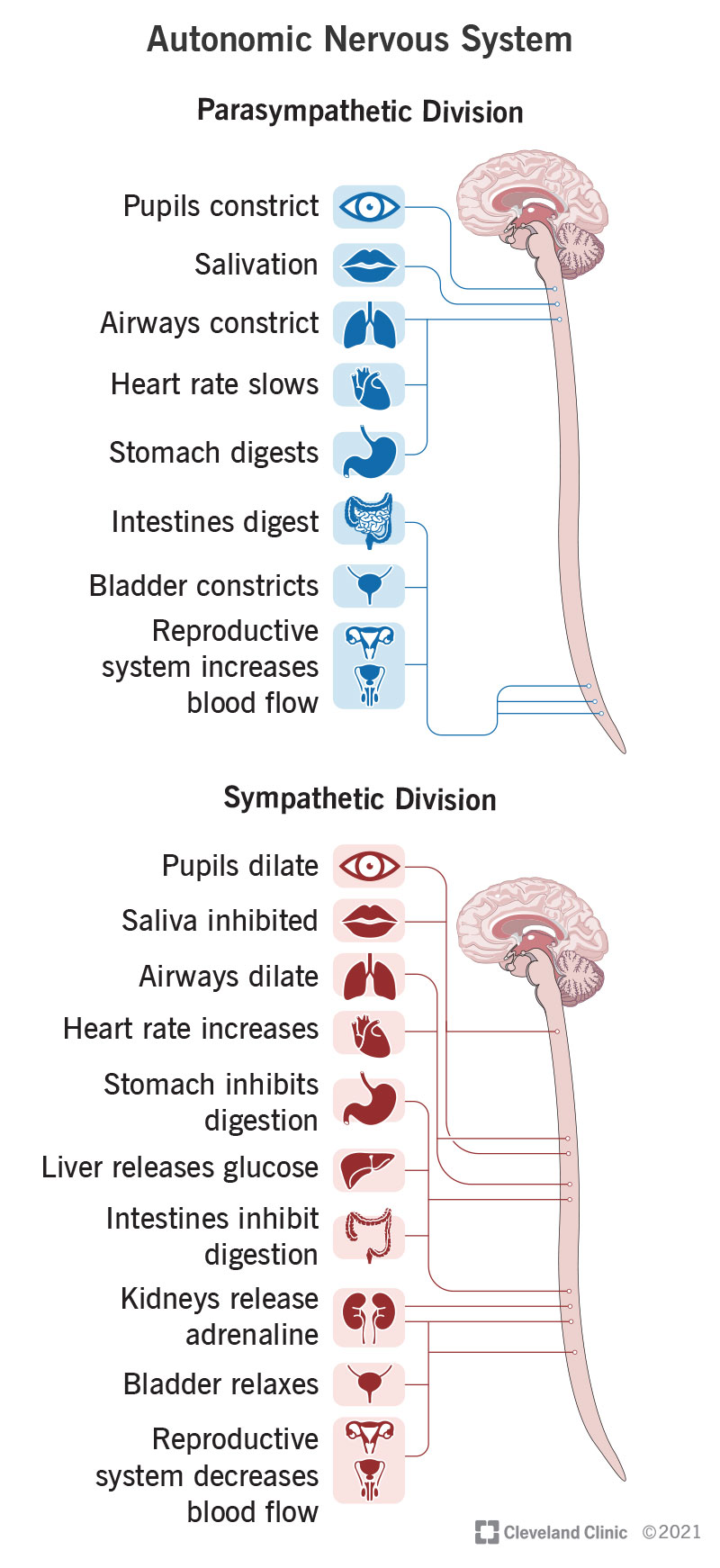
Fear is physical. It lives in your nervous system.
Instead of trying to “think your way out,” try:
- Slow breathing (longer exhales than inhales)
- Grounding (focus on physical sensations around you)
- Movement (walking, stretching)
Strategy: Calm the body first—your mind will follow.
🔁 Reframe Discomfort as Growth, Not Danger

One of the biggest shifts in recovery is how you interpret discomfort.
Instead of:
- “This feeling is too much.”
Try:
- “This feeling is temporary, and I can handle it.”
Strategy: Build tolerance gradually. Stay with discomfort a little longer each time.
⚖️ Create Safe Alternatives for Relief

If addiction is meeting a need, you need alternatives that meet that same need.
Examples:
- Stress → breathing, movement
- Loneliness → connection, conversation
- Overwhelm → rest, simplifying tasks
Strategy: Don’t just remove the behavior—replace the relief.
🧭 Track Patterns of Fear and Response
Awareness builds over time.
Notice:
- When fear shows up most
- What triggers it
- How you typically respond
- What helps, even slightly
Strategy: Keep simple notes. Patterns reveal themselves when you pay attention.
🌱 Redefine What Freedom Means
Freedom is not:
- Never feeling fear
- Always being in control
- Eliminating discomfort
Freedom is:
- Having a choice in how you respond
- Being able to feel without escaping
- Trusting yourself to handle what arises
💬 Final Thoughts
Addiction often begins as an attempt to manage fear.
Recovery is learning that you can face that fear—without needing to escape it.
Self-management is not about perfection. It’s about:
- Awareness
- Small pauses
- New responses
- Gradual trust in yourself
Because the path from addiction to freedom isn’t about becoming fearless—
It’s about realizing you were capable all along.
Holding Space, Not Control: Family Strategies for Navigating Addiction, Fear, and Freedom
When someone you love is struggling with addiction, what you often see are the behaviors—the use, the avoidance, the emotional distance. But underneath those behaviors is something deeper: fear.
Fear of withdrawal. Fear of facing emotions. Fear of change. Even fear of living without the one thing that has provided relief.
For families, understanding this changes everything. It shifts the focus from “Why are they doing this?” to
“What are they afraid of—and how can I support them through it?”
Because recovery isn’t just about stopping a behavior. It’s about learning to face fear—and families play a powerful role in that process.
🔍 See the Fear Beneath the Behavior

Addiction behaviors are often protective.
Instead of focusing only on what your loved one is doing, consider:
- What might they be trying to avoid feeling?
- What fear could be driving this behavior?
- When does it seem strongest?
Family strategy: Shift from judgment to curiosity. Understanding reduces conflict and opens communication.
💬 Communicate in a Way That Reduces Fear
Fear grows in environments of pressure, shame, and confrontation.
Try:
- “I can see this is hard—what does it feel like for you right now?”
- “You don’t have to go through this alone.”
- “I’m here to understand, not to judge.”
Avoid:
- Ultimatums driven by emotion
- Shaming or blaming language
- Forcing conversations when emotions are high
Family strategy: Create a space where fear can be expressed rather than hidden.
🫁 Help Regulate, Not React
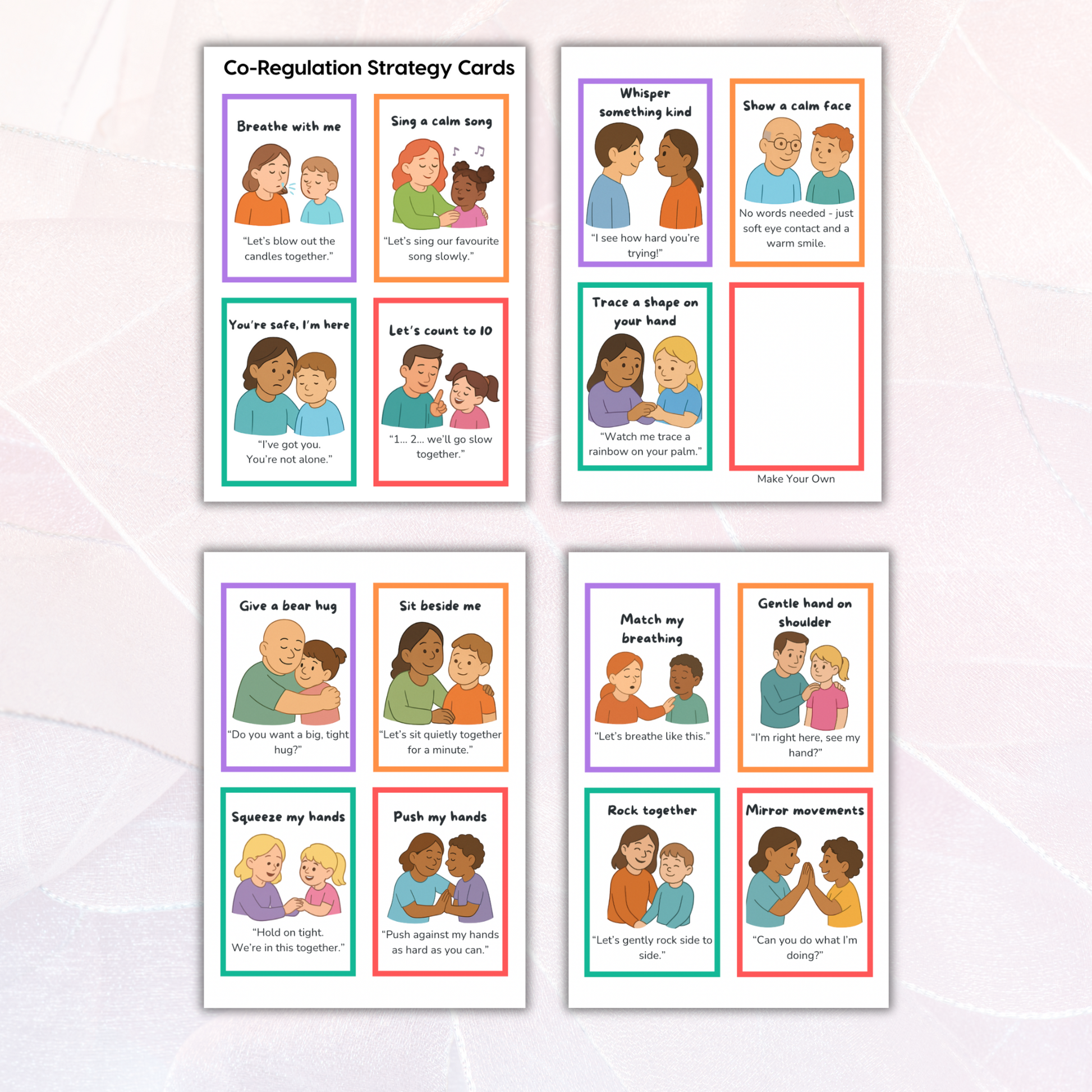
When someone is overwhelmed by fear, their nervous system is activated. Logic won’t reach them—but calm presence can.
You can help by:
- Staying steady in your tone and body language
- Avoiding escalation during emotional moments
- Being present without trying to “fix” everything
This is called co-regulation—your calm helps their system settle.
⚖️ Set Boundaries That Support Freedom

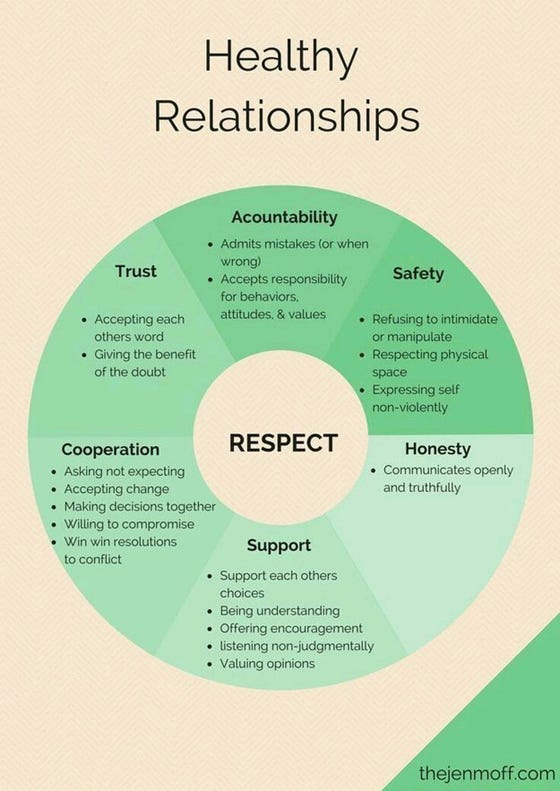
Supporting someone doesn’t mean removing all limits.
Healthy boundaries:
- Protect your well-being
- Prevent enabling harmful behavior
- Create structure and stability
Key shift:
Boundaries are not about control—they’re about creating an environment where change is possible.
🌱 Encourage Small Steps Toward Freedom
Freedom from addiction doesn’t happen all at once. It’s built through small moments:
- Sitting with discomfort a little longer
- Reaching out instead of withdrawing
- Trying something different, even briefly
Family strategy: Notice and acknowledge progress, no matter how small. This builds confidence and reduces fear.
🧭 Understand That Fear Doesn’t Disappear
Your loved one may still feel fear even as they make progress.
Recovery isn’t:
- Becoming fearless
- Always feeling stable
- Never struggling
It is:
- Learning to face fear without escaping
- Building tolerance for discomfort
- Developing trust in their ability to cope
Family strategy: Support the process, not just the outcome.
💬 Take Care of Your Own Emotional Space
Supporting someone through addiction and fear can be overwhelming.
You also need:
- Your own support system
- Space to rest and reset
- Boundaries around your emotional energy
You can’t hold space for someone else if you’re completely depleted.
💬 Final Thoughts
Addiction is often rooted in fear—but recovery is rooted in freedom. And that freedom isn’t about removing fear; it’s about no longer being controlled by it.
Families don’t create recovery—but they can create the conditions that support it:
- Understanding instead of judgment
- Calm instead of reactivity
- Boundaries instead of control
- Presence instead of pressure
Because sometimes the most powerful support isn’t telling someone how to change—
It’s showing them they are safe enough to try.
From Fear to Freedom: How Community Resources Support Recovery Beyond Addiction
Addiction is rarely just about substances or behaviors—it’s deeply connected to fear. Fear of withdrawal, fear of emotional pain, fear of change, and even fear of living without the familiar coping mechanisms that once provided relief.
For many, addiction becomes a way to manage that fear. And recovery? It requires facing it.
This is where community resources become essential. They don’t just help people stop using—they help people understand, regulate, and move through fear, creating a path toward real freedom.
🧠 Community Education: Understanding Fear as Part of Addiction
Many people don’t realize how central fear is to addiction.
Community education programs help individuals:
- Understand the connection between fear, stress, and substance use
- Learn how the brain and body respond to discomfort
- Reframe addiction as a coping response—not a failure
Strategy: When people understand why they feel the way they do, fear becomes less overwhelming and more manageable.
🤝 Peer Support: Reducing Fear Through Shared Experience
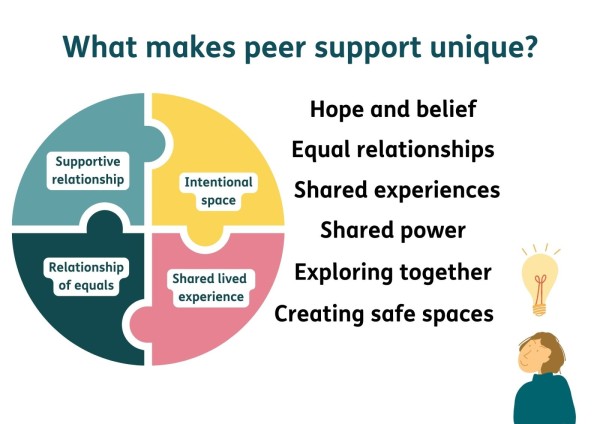
Fear thrives in isolation—but weakens in connection.
Peer support groups provide:
- A space to express fear without judgment
- Validation from others with similar experiences
- Real-life examples of moving through fear
Hearing someone say, “I was afraid too, and I made it through,” can be transformative.
Community strategy: Normalize vulnerability and shared experience as part of recovery.
🫁 Access to Regulation-Based Services
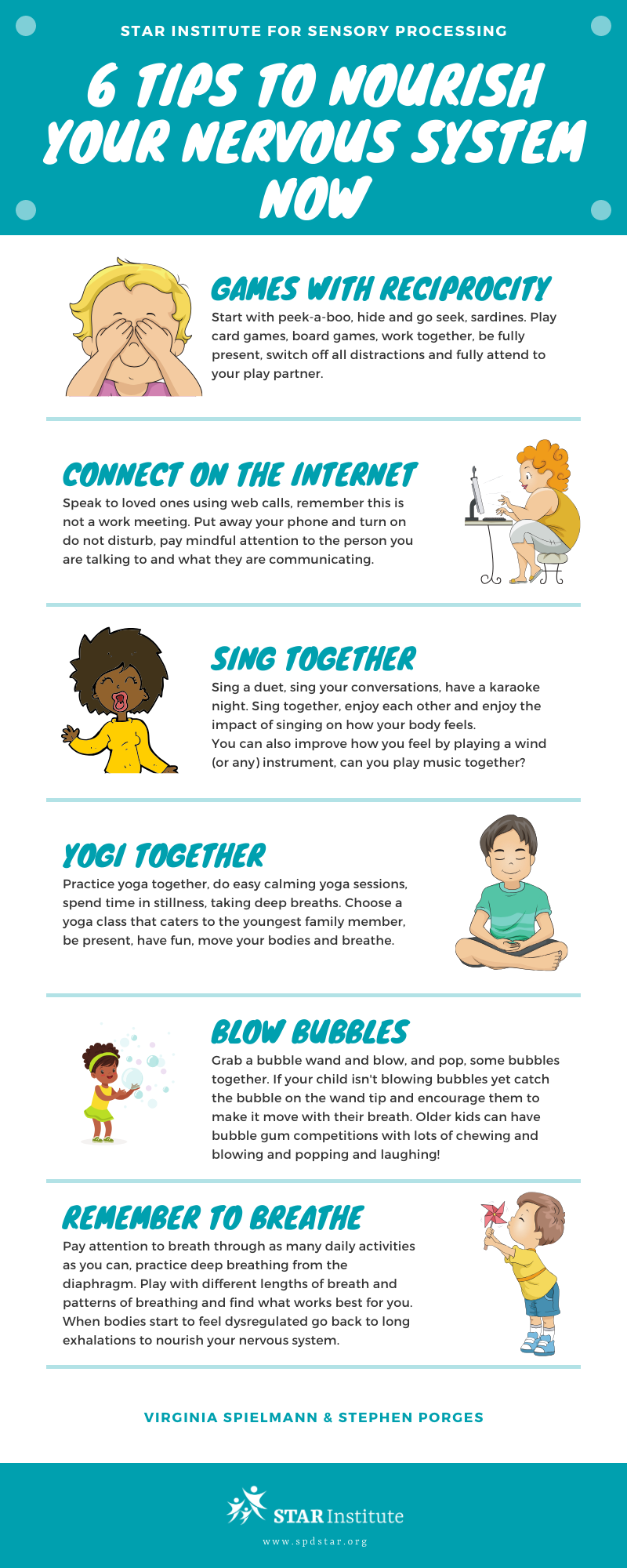

Because fear is physical, recovery must include body-based support.
Community resources may offer:
- Trauma-informed therapy
- Mindfulness and stress regulation programs
- Yoga, breathing, or somatic practices
These help individuals:
- Calm the nervous system
- Tolerate discomfort
- Reduce the intensity of fear-driven urges
Key idea: You can’t think your way out of fear—you have to regulate your way through it.
🏠 Safe and Stable Environments
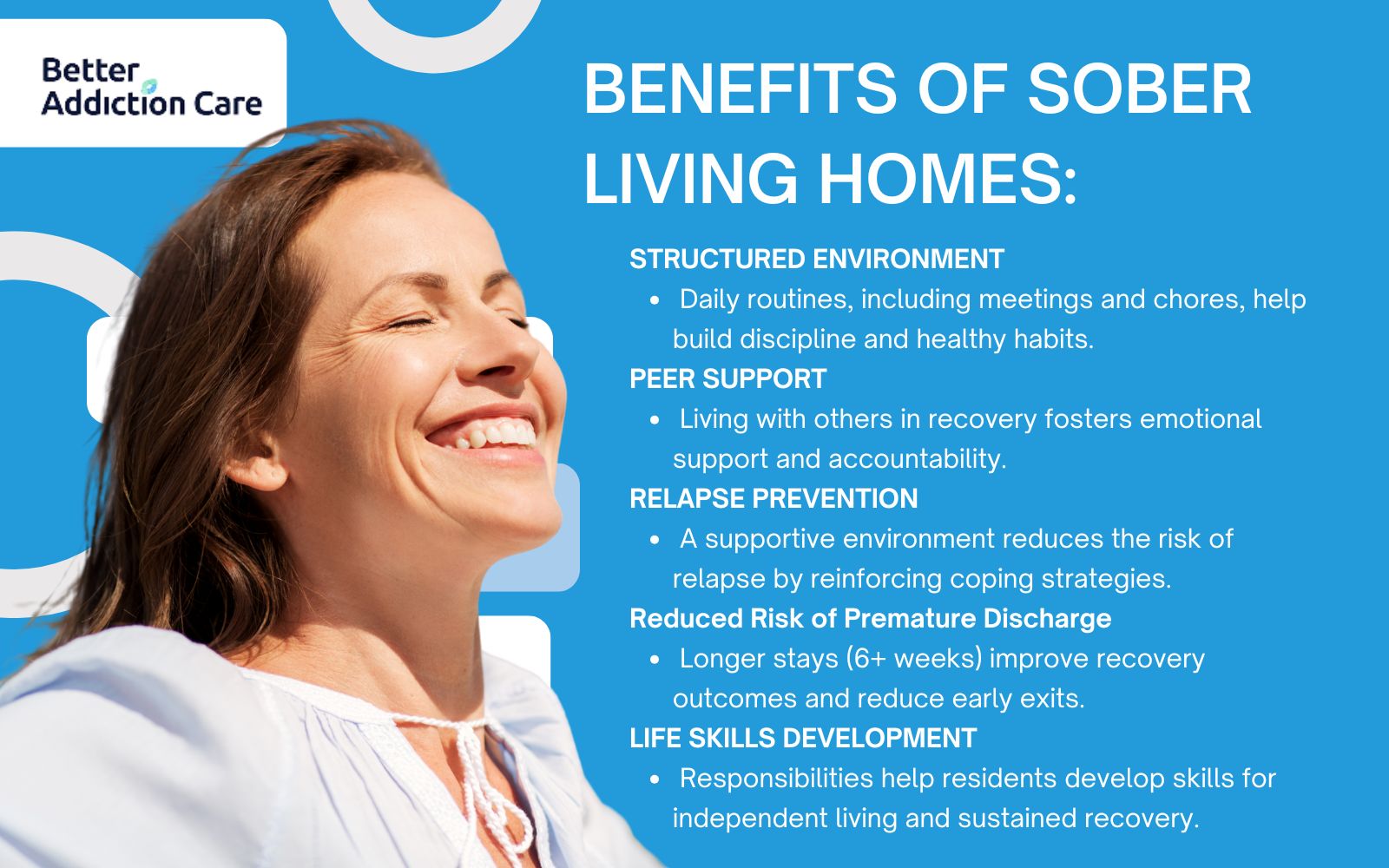
Fear increases in chaos and instability.
Community resources like:
- Sober living homes
- Recovery community centers
- Structured programs
…provide predictability and safety.
Strategy: A stable environment allows individuals to face fear gradually, rather than being overwhelmed by it.
🔁 Gradual Exposure to Life Without Avoidance
Avoidance strengthens fear. Community programs often help individuals:
- Re-engage with daily life (work, relationships, responsibilities)
- Face situations they previously avoided
- Build confidence through small, supported steps
This process helps shift the belief from:
“I can’t handle this.”
to
“I can, with support.”
🌱 Building a Network That Supports Freedom
True recovery happens when multiple supports come together:
- Education to understand fear
- Peer support to reduce isolation
- Therapy to regulate the body and mind
- Stable environments to create safety
This network doesn’t remove fear—but it makes it manageable and survivable.
💬 Final Thoughts
Addiction is often driven by fear—but freedom is built through support.
Community resources play a critical role in helping individuals:
- Understand their fear
- Face it safely
- Develop new ways of coping
Because freedom isn’t about never being afraid.
It’s about knowing you don’t have to face that fear alone.
And in that shared space—between fear and support—
real recovery begins.
Frequently Asked Questions
Here are some common questions:
1. What does fear have to do with addiction?
Fear is often at the core of addiction. Many people use substances or behaviors to avoid:
- Emotional pain
- Anxiety or stress
- Trauma or unresolved experiences
Over time, the brain associates the substance with relief, making it feel necessary for safety—even when it causes harm.
2. Is addiction really about avoiding feelings?
In many cases, yes. Addiction can function as a way to:
- Numb overwhelming emotions
- Escape discomfort
- Avoid facing difficult realities
It’s less about seeking pleasure and more about managing internal distress.
3. Why does letting go feel so scary?
Because the substance or behavior has become a coping mechanism. Letting go can feel like:
- Losing your only way to regulate emotions
- Facing feelings you’ve avoided
- Entering the unknown
The fear isn’t irrational—it’s tied to survival patterns in the brain and body.
4. What does “freedom” mean in recovery?
Freedom doesn’t mean:
- Never feeling fear
- Being completely in control all the time
It means:
- Having a choice in how you respond
- Being able to feel without needing to escape
- Not being controlled by cravings or avoidance
5. Can someone recover if they’re still afraid?
Yes. In fact, fear is part of recovery. Progress happens when someone:
- Feels fear
- Faces it gradually
- Learns they can tolerate it
Recovery isn’t about removing fear—it’s about changing your relationship with it.
6. Why does addiction feel “safe” even when it’s harmful?
Because the brain learns that the behavior provides relief.
This creates a paradox:
- The behavior causes harm
- But it also reduces distress in the short term
The brain prioritizes immediate relief over long-term consequences, making the behavior feel necessary.
7. What role does the body play in fear and addiction?
Fear is not just mental—it’s physical.
The nervous system can become:
- Overactive (anxiety, restlessness)
- Underactive (numbness, shutdown)
Addiction often becomes a way to regulate these physical states. That’s why recovery also involves body-based regulation (breathing, grounding, movement).
8. How do cravings relate to fear?
Cravings are often triggered by discomfort or fear.
They can feel like:
- Urgency in the body
- Restlessness or tension
- A strong pull toward relief
Cravings are not just “wanting”—they are often the body trying to escape discomfort quickly.
9. What is the first step toward freedom?
Awareness.
Recognizing:
- What you’re afraid of
- When you feel the urge to escape
- How the pattern works
This shifts the question from
“Why can’t I stop?”
to
“What am I trying to avoid?”
10. How can someone start facing fear without becoming overwhelmed?
Gradually.
- Pause before reacting
- Sit with discomfort for a few seconds longer
- Use grounding or breathing techniques
- Seek support when needed
Small exposures build tolerance over time.
11. Does freedom mean complete independence from support?
No. Freedom often includes connection and support.
Being free doesn’t mean doing everything alone—it means:
- Having healthier ways to cope
- Being able to reach out instead of isolating
- Not relying on harmful behaviors for relief
12. Why is self-trust important in recovery?
Addiction often breaks trust in yourself.
Recovery rebuilds it through:
- Keeping small promises
- Facing discomfort and surviving it
- Learning you can handle difficult emotions
Self-trust is what makes freedom sustainable.
13. Can fear come back after progress is made?
Yes—and that’s normal.
Fear may reappear during:
- Stress
- Life changes
- Emotional triggers
What changes is your ability to respond differently. Progress means you’re better equipped, not that fear disappears.
14. How can families support someone dealing with fear in addiction?
Families can:
- Respond with understanding instead of judgment
- Create a calm, safe environment
- Encourage open conversations about fear
- Support small steps toward change
Reducing shame helps reduce fear.
15. What’s the biggest misconception about addiction, fear, and freedom?
That freedom comes from eliminating fear.
In reality:
Freedom comes from learning you can feel fear—and still choose differently.
Conclusion
The journey from addiction to recovery is not about eliminating fear, but about changing one’s relationship to it. Freedom does not mean the absence of discomfort or struggle—it means no longer being controlled by the need to escape those feelings. As individuals begin to face what they once avoided, even in small ways, they build resilience, confidence, and a deeper sense of self-trust. Understanding addiction through the lens of fear and freedom allows for a more compassionate and realistic view of recovery—one that honors both the difficulty of the process and the strength it takes to move forward.
Video: