Addiction is often viewed as a condition tied only to active substance use, but its effects extend far beyond that period. Even after use has stopped, individuals may continue to experience lasting changes in brain function, emotional regulation, behavior, and relationships. These enduring effects can shape daily life, influencing how a person thinks, feels, and interacts with the world. Understanding addiction in this broader context is essential for reducing stigma and fostering realistic expectations about recovery. It highlights that recovery is not simply about stopping a behavior, but about navigating and adapting to the long-term impact that addiction leaves behind.
Addiction and Its Enduring Effects: Understanding the Lasting Impact
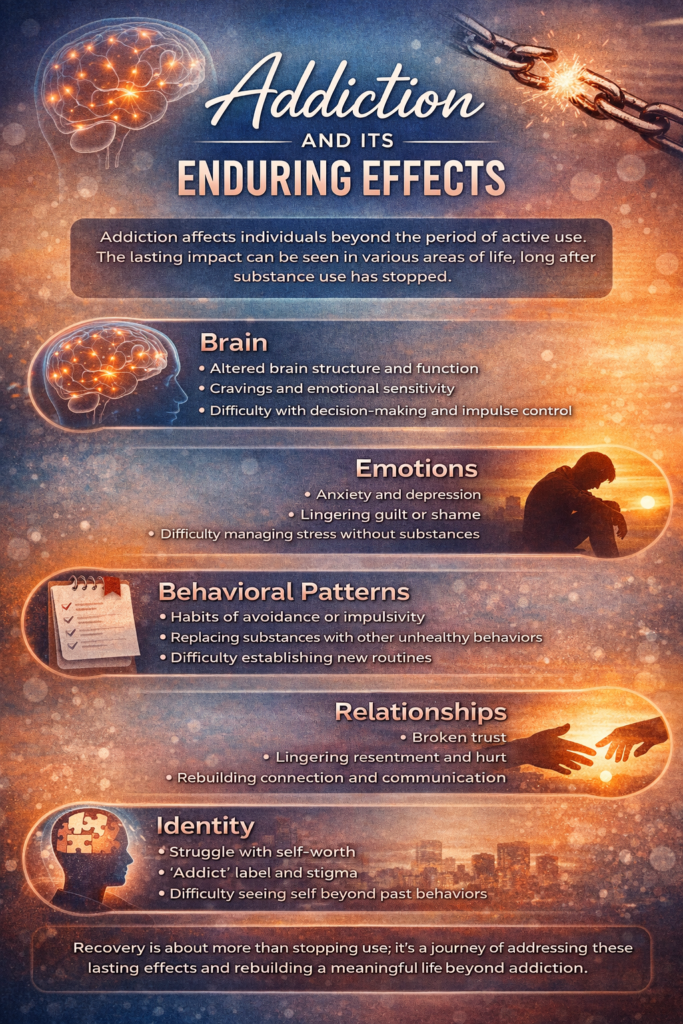
Addiction is often misunderstood as a temporary struggle—something that begins and ends with substance use. In reality, its effects extend far beyond the period of active use, leaving lasting imprints on the brain, body, relationships, and sense of self. Even after recovery begins, individuals may continue to experience emotional, cognitive, and social challenges shaped by their past experiences. Understanding these enduring effects is essential, not to reinforce stigma, but to promote awareness, compassion, and more effective support systems.
The Lasting Impact on the Brain
Substance use alters brain structure and function, particularly in areas related to reward, decision-making, and impulse control. Over time, these changes can affect how individuals respond to stress, experience pleasure, and regulate behavior. Even in recovery, the brain may take time to heal, which is why cravings, emotional sensitivity, or difficulty with focus can persist. This does not indicate failure—it reflects the biological reality of recovery.
Emotional and Psychological Effects
Addiction often coexists with emotional struggles such as anxiety, depression, and unresolved trauma. These challenges may not disappear when substance use stops. In fact, many individuals face them more directly in recovery, without the buffer substances once provided. Feelings of guilt, shame, or low self-worth can also linger, reinforcing negative self-perceptions if not addressed.
However, recovery also creates space for emotional growth. With time and support, individuals can develop healthier coping mechanisms, emotional awareness, and resilience.
Impact on Relationships
Relationships are frequently strained during active addiction. Trust may be broken, communication disrupted, and roles within families or friendships altered. Even after recovery begins, rebuilding these relationships takes time, consistency, and effort from all parties involved.
Enduring effects in relationships may include:
- difficulty rebuilding trust
- fear of relapse among loved ones
- lingering resentment or hurt
Despite these challenges, recovery also offers an opportunity to rebuild stronger, more honest connections based on accountability and growth.
Identity and Self-Perception
One of the most profound lasting effects of addiction is its impact on identity. Individuals may continue to see themselves through the lens of past behavior, even after making significant progress. Labels such as “addict” or “failure” can become internalized, making it difficult to move forward.
This is where reframing identity becomes crucial. Recovery is not just about stopping substance use—it is about redefining who you are beyond your past.
Behavioral Patterns and Habits
Addiction often establishes patterns of avoidance, impulsivity, or reliance on external coping mechanisms. These patterns can persist even after substances are no longer used. Without conscious effort, individuals may find themselves replacing one behavior with another form of escape.
Breaking these patterns requires:
- awareness of triggers
- development of healthier coping strategies
- consistent practice of new behaviors
Over time, these new patterns can replace old ones, supporting long-term stability.
Social and Environmental Effects
Addiction can disrupt education, employment, and social stability. Individuals in recovery may face challenges such as rebuilding careers, securing housing, or reestablishing social networks. Additionally, societal stigma can create barriers to opportunities and acceptance.
Supportive environments and access to resources play a key role in overcoming these challenges and fostering long-term recovery.
Hope and the Capacity for Change
While the enduring effects of addiction are real, they are not permanent limitations. The brain has the capacity to adapt, relationships can be repaired, and identity can be reshaped. Recovery is a process of gradual change, where each step forward builds a foundation for a healthier future.
Understanding the long-term impact of addiction is not about focusing on damage—it is about recognizing the complexity of recovery and the strength required to move through it.
Conclusion: Beyond the Effects
Addiction may leave lasting effects, but it does not define the future. With time, support, and intentional effort, individuals can move beyond these challenges and build meaningful, fulfilling lives. The enduring effects of addiction are part of the story—but they are not the ending.
Recovery is not just about what was lost.
It is about what can still be gained.
Self-Management Strategies for Understanding Addiction and Its Enduring Effects
Addiction does not end when substance use stops. Its effects—on the brain, emotions, behavior, and identity—can persist long into recovery. Understanding these enduring effects is essential, but awareness alone is not enough. Individuals must also learn how to manage these challenges in daily life. This is where self-management becomes critical.
Self-management strategies empower individuals to respond to lingering effects with intention rather than reaction. They help transform recovery from a passive process into an active, ongoing practice of growth and stability.
Why Self-Management Matters
The long-term effects of addiction—such as cravings, emotional instability, or negative thinking—can feel overwhelming if left unaddressed. Without strategies to manage them, individuals may become discouraged or vulnerable to relapse.
Self-management provides:
- structure and stability
- tools for emotional and cognitive regulation
- a sense of control and self-efficacy
It shifts the focus from “Why am I still struggling?” to “How can I respond effectively to these challenges?”
1. Building Awareness of Triggers and Patterns
Understanding enduring effects begins with awareness. Many responses—such as cravings or emotional reactions—are triggered by specific situations, thoughts, or environments.
Self-management involves:
- identifying personal triggers (stress, certain people, environments)
- recognizing early warning signs (irritability, restlessness, negative thinking)
- tracking patterns through journaling or reflection
Awareness creates a pause between trigger and response, allowing for more intentional choices.
2. Emotional Regulation Skills
One of the most persistent effects of addiction is difficulty managing emotions. Substances often served as a way to numb or escape, leaving a gap in coping skills.
Effective strategies include:
- grounding techniques (focusing on senses or present surroundings)
- deep or paced breathing
- naming emotions to reduce their intensity
Learning to sit with discomfort—rather than avoid it—builds emotional resilience over time.
3. Cognitive Restructuring: Challenging Negative Thinking
Enduring effects often include distorted thinking patterns such as:
- “I’ll never change.”
- “I’ve already messed up, so it doesn’t matter.”
Cognitive restructuring involves:
- identifying these thoughts
- questioning their accuracy
- replacing them with balanced, realistic perspectives
This process helps weaken the connection between negative thinking and harmful behavior.
4. Developing Healthy Routines
Structure is a powerful stabilizer in recovery. A lack of routine can increase vulnerability to stress and impulsive decisions.
Key elements of a supportive routine:
- consistent sleep and wake times
- regular meals
- scheduled activities that promote well-being (exercise, hobbies, meetings)
Routine reduces uncertainty and reinforces a sense of control over daily life.
5. Strengthening Coping Alternatives
Because addiction often replaces healthy coping mechanisms, recovery requires actively building new ones.
Examples include:
- physical activity to manage stress
- creative outlets such as writing or art
- connecting with supportive people
- practicing mindfulness or relaxation techniques
The goal is not to eliminate discomfort, but to respond to it in healthier ways.
6. Practicing Self-Compassion
A common enduring effect of addiction is lingering shame. Harsh self-judgment can undermine progress and reinforce negative identity.
Self-compassion involves:
- acknowledging mistakes without defining yourself by them
- treating yourself with the same understanding you would offer others
- recognizing that setbacks are part of growth
This creates a mental environment where change is sustainable.
7. Setting Realistic, Value-Based Goals
Recovery can feel overwhelming if expectations are unrealistic. Setting achievable goals helps build confidence and momentum.
Effective goal-setting includes:
- focusing on small, manageable steps
- aligning goals with personal values (e.g., stability, connection, growth)
- celebrating progress, not just outcomes
Each goal achieved reinforces a sense of capability and forward movement.
8. Seeking and Maintaining Support
Self-management does not mean doing everything alone. External support enhances internal efforts.
This may include:
- therapy or counseling
- peer support groups
- trusted friends or family members
Support systems provide accountability, encouragement, and perspective during difficult moments.
Conclusion: Managing the Effects, Shaping the Future
The enduring effects of addiction are real, but they are manageable. Through self-management strategies, individuals can learn to navigate challenges with awareness, intention, and resilience.
Recovery is not about eliminating every difficulty—it is about developing the skills to respond differently. Over time, these responses reshape not only behavior, but also identity.
You are not defined by the lasting effects of addiction.
You are defined by how you choose to manage them—and how you continue to grow beyond them.
Family Support Strategies for Understanding Addiction and Its Enduring Effects
Addiction does not simply disappear when substance use ends. Its effects often continue to influence emotions, behaviors, relationships, and overall functioning long into recovery. For families, this can be confusing and, at times, frustrating—especially when expectations of “returning to normal” are not immediately met. Understanding the enduring effects of addiction is essential, but equally important is learning how to respond to them in supportive and constructive ways.
Family support is not about fixing the individual; it is about creating an environment that promotes stability, understanding, and long-term healing.
Why Family Understanding Matters
When families recognize that addiction has lasting psychological and neurological effects, they are less likely to interpret ongoing challenges as a lack of effort or motivation. This shift in perspective can reduce blame and increase empathy.
Supportive family involvement helps:
- reduce conflict and misunderstanding
- create emotional safety
- reinforce recovery efforts
- improve long-term outcomes
Understanding replaces frustration with patience—and patience is critical in recovery.
1. Educate Yourself About Addiction’s Long-Term Effects
One of the most important steps families can take is to learn about how addiction affects the brain, behavior, and emotional regulation over time.
This includes understanding:
- why cravings may still occur
- why mood swings or anxiety may persist
- why decision-making and impulse control may take time to improve
Education helps families respond with insight rather than judgment.
2. Adjust Expectations: Recovery Is Not Immediate
A common challenge is expecting rapid or complete change once substance use stops. In reality, recovery is gradual, and progress may be uneven.
Healthy expectations involve:
- recognizing that setbacks can occur
- valuing progress over perfection
- understanding that healing takes time
Adjusting expectations prevents unnecessary disappointment and pressure.
3. Communicate with Empathy, Not Criticism
The way families communicate can either support recovery or reinforce shame. Criticism and blame may increase stress, which can heighten vulnerability to relapse.
Supportive communication includes:
- using calm, nonjudgmental language
- expressing concern without accusation
- listening actively and validating feelings
For example:
“I see you’re having a hard time—how can I support you?” instead of “Why are you acting like this again?”
4. Set Healthy Boundaries
Support does not mean removing all limits. Boundaries are essential for both the individual in recovery and family members.
Effective boundaries:
- are clear and consistent
- protect the well-being of everyone involved
- encourage responsibility without enabling harmful behavior
Boundaries create structure, which supports long-term stability.
5. Reinforce Progress and Effort
Because the enduring effects of addiction can slow progress, recognizing effort becomes especially important.
Families can:
- acknowledge small improvements
- highlight positive changes in behavior
- celebrate milestones, no matter how minor they seem
This reinforces a sense of capability and motivates continued growth.
6. Avoid Personalizing Ongoing Struggles
It is easy for family members to feel hurt or take setbacks personally. However, many ongoing challenges are part of the recovery process, not intentional actions against loved ones.
Reframing helps:
- from “They don’t care about us” → “They are still learning how to cope and adjust.”
This perspective reduces emotional reactivity and supports more constructive responses.
7. Encourage Healthy Coping and Independence
Families can support recovery by encouraging the development of healthy coping strategies while also promoting independence.
This might include:
- supporting therapy or support group participation
- encouraging engagement in meaningful activities
- allowing space for personal responsibility and decision-making
Recovery strengthens when individuals feel capable of managing their own lives.
8. Take Care of Yourself as a Family Member
Supporting someone through recovery can be emotionally demanding. Family members also need support, boundaries, and self-care.
Important practices include:
- seeking counseling or family support groups
- maintaining personal interests and routines
- acknowledging and addressing your own stress
When families are supported, they are better able to provide stable, consistent support.
Conclusion: Supporting the Process, Not Just the Outcome
Understanding the enduring effects of addiction changes how families approach recovery. Instead of expecting immediate transformation, they begin to see recovery as a process that requires time, patience, and ongoing support.
Family support does not eliminate challenges—but it can make those challenges more manageable. By responding with education, empathy, and healthy boundaries, families become part of the solution rather than an additional source of stress.
Recovery is not just an individual journey.
It is a shared process—strengthened by families who choose to understand, support, and grow alongside it.
Community Resource Strategies for Understanding Addiction and Its Enduring Effects
Addiction leaves lasting effects that extend beyond the individual, influencing mental health, relationships, employment, and overall stability. While personal effort and family support are essential, recovery is significantly strengthened by access to community resources. These resources not only provide practical assistance but also help individuals and families better understand and manage the long-term impact of addiction.
Community resource strategies focus on connecting individuals to systems of support that promote education, stability, and long-term growth. When used effectively, they transform recovery from an isolated struggle into a supported, sustainable process.
Why Community Resources Matter
The enduring effects of addiction—such as emotional dysregulation, cognitive challenges, and social instability—often require more than individual coping strategies. Community resources provide structured support that addresses these complexities.
They help:
- bridge gaps in care and understanding
- reduce isolation and stigma
- provide access to education and treatment
- support long-term recovery and reintegration
Recovery becomes more manageable when individuals are not navigating it alone.
1. Accessing Education-Based Programs
Understanding addiction is a key step in managing its long-term effects. Community programs often provide educational workshops for both individuals and families.
These programs may cover:
- the neurological impact of addiction
- coping strategies for cravings and emotional regulation
- relapse prevention techniques
Education reduces misconceptions and empowers individuals to respond more effectively to ongoing challenges.
2. Utilizing Peer Support Networks
Peer support groups are one of the most accessible and impactful community resources. They offer a connection with others who share similar experiences, which can normalize the enduring effects of addiction.
Benefits include:
- shared understanding and reduced isolation
- practical advice from lived experience
- accountability and encouragement
Peer networks reinforce the idea that recovery—and its challenges—is a shared journey.
3. Integrating Mental Health Services
Addiction’s long-term effects often include anxiety, depression, or unresolved trauma. Community-based mental health services provide ongoing support for these issues.
Key services include:
- counseling or therapy
- outpatient treatment programs
- crisis intervention resources
Addressing mental health alongside addiction is critical for long-term stability.
4. Employment and Vocational Support
Addiction can disrupt career paths and financial stability. Community resources focused on employment help individuals regain independence and purpose.
These may include:
- job training programs
- resume-building workshops
- supported employment services
Stable employment not only improves quality of life but also reinforces a positive and functional identity.
5. Housing and Stability Resources
Safe and stable housing is foundational to recovery. Without it, managing the enduring effects of addiction becomes significantly more difficult.
Community strategies may involve:
- transitional or sober living housing
- assistance with securing long-term housing
- support services within housing programs
Stability in living conditions supports consistency in recovery efforts.
6. Promoting Accessible and Inclusive Services
Not all individuals have equal access to resources. Effective community strategies prioritize inclusivity by reducing barriers such as cost, transportation, or stigma.
This can include:
- low-cost or sliding-scale services
- virtual support options
- culturally responsive programs
Accessibility ensures that support reaches those who need it most.
7. Encouraging Community Engagement and Contribution
Recovery is strengthened when individuals feel connected and valued. Community resources that encourage participation—such as volunteering or mentorship—help individuals move from receiving support to contributing.
This shift:
- builds confidence and purpose
- reinforces a positive identity
- strengthens social connections
Contribution transforms recovery into a meaningful, outward-focused experience.
8. Coordinating Care Across Systems
The enduring effects of addiction often require support from multiple systems—healthcare, mental health, housing, and employment. Coordinated care ensures that these services work together rather than in isolation.
Effective coordination:
- reduces gaps in support
- improves communication between providers
- creates a more seamless recovery experience
When systems are aligned, individuals receive more comprehensive and consistent care.
Conclusion: Strength in Connection
Understanding addiction’s enduring effects is not just about recognizing challenges—it’s about building a network that can respond to them. Community resources provide the structure, education, and support necessary to navigate recovery in a sustainable way.
Recovery is not meant to be done alone.
It is strengthened through connection—through systems, services, and communities that work together to support growth, stability, and long-term change.
When individuals are supported by their communities, the lasting effects of addiction become more manageable—and the path forward becomes clearer.
Frequently Asked Questions
Here are some common questions:
1. What are the “enduring effects” of addiction?
Enduring effects refer to the long-term physical, psychological, and social consequences that remain even after substance use has stopped. These can include changes in brain function, difficulties with emotional regulation, behavioral patterns, and strained relationships.
2. Why do the effects of addiction last even after quitting?
Addiction alters brain structure and chemistry, particularly in areas related to reward, decision-making, and impulse control. These changes do not reverse immediately, which is why individuals may continue to experience cravings, emotional challenges, or cognitive difficulties during recovery.
3. Are these long-term effects permanent?
Not necessarily. While some effects may persist for extended periods, many improve over time with consistent recovery efforts, therapy, and healthy lifestyle changes. The brain has the ability to adapt and heal—a process known as neuroplasticity.
4. What are the common psychological effects of addiction?
Common psychological effects include:
- anxiety and depression
- lingering guilt or shame
- difficulty coping with stress
- low self-esteem
These are often more noticeable in recovery because substances are no longer used to numb or avoid these feelings.
5. How does addiction affect the brain long-term?
Addiction can:
- disrupt the brain’s reward system
- impair decision-making and judgment
- increase sensitivity to stress
- reduce impulse control
These effects can contribute to ongoing challenges in behavior and emotional regulation.
6. Why do cravings still happen after stopping substance use?
Cravings are linked to changes in the brain’s reward pathways and learned associations between substances and certain triggers (e.g., stress, environments, or emotions). These associations can remain even after prolonged abstinence.
7. How does addiction impact relationships over time?
Addiction often leads to broken trust, communication issues, and emotional strain. Even in recovery, relationships may require time and consistent effort to rebuild, as both individuals and loved ones adjust to new dynamics.
8. Can addiction affect identity and self-perception?
Yes. Many individuals internalize negative labels or beliefs about themselves during addiction. These perceptions can persist in recovery, making it difficult to see oneself beyond past behaviors. Rebuilding identity is a key part of long-term recovery.
9. What behavioral patterns can continue after addiction?
Some individuals may experience:
- impulsivity
- avoidance of stress or responsibility
- difficulty establishing routines
- replacing substance use with other unhealthy behaviors
Recognizing and addressing these patterns is important for sustained recovery.
10. How can someone manage the lasting effects of addiction?
Management strategies include:
- therapy or counseling
- developing healthy coping skills
- maintaining structured routines
- engaging in support groups
- practicing self-awareness and reflection
These approaches help individuals respond to challenges more effectively.
11. What role does support play in addressing enduring effects?
Support from family, peers, and professionals provides encouragement, accountability, and understanding. It also helps reduce isolation and reinforces positive changes, making it easier to manage long-term challenges.
12. Is relapse a sign that recovery has failed?
No. Relapse can be part of the recovery process for some individuals. It often reflects the ongoing nature of addiction’s effects rather than a lack of effort or failure. What matters is how the individual responds and continues moving forward.
13. Why is it important to understand these long-term effects?
Understanding the enduring effects helps:
- set realistic expectations for recovery
- reduce stigma and self-blame
- improve coping and support strategies
- promote patience and persistence
It shifts the perspective from “Why am I still struggling?” to “What is happening, and how can I manage it?”
14. How long do the effects of addiction typically last?
The duration varies depending on factors such as the substance used, length of use, individual biology, and level of support. Some effects may improve within months, while others may take years to fully resolve.
15. Can people fully recover from addiction’s long-term effects?
Many individuals achieve significant recovery and lead stable, fulfilling lives. While some challenges may remain, they often become manageable with time, support, and continued personal growth.
Conclusion
The enduring effects of addiction are a reminder that recovery is an ongoing process, not a single event. While these effects can present challenges, they also offer opportunities for growth, resilience, and transformation. With time, support, and intentional effort, individuals can learn to manage these lasting impacts and build meaningful, stable lives. Recognizing the complexity of addiction allows for greater compassion—both from others and from oneself—and reinforces the understanding that healing is gradual. Ultimately, addiction may leave a lasting imprint, but it does not determine the direction of the future.
Video: