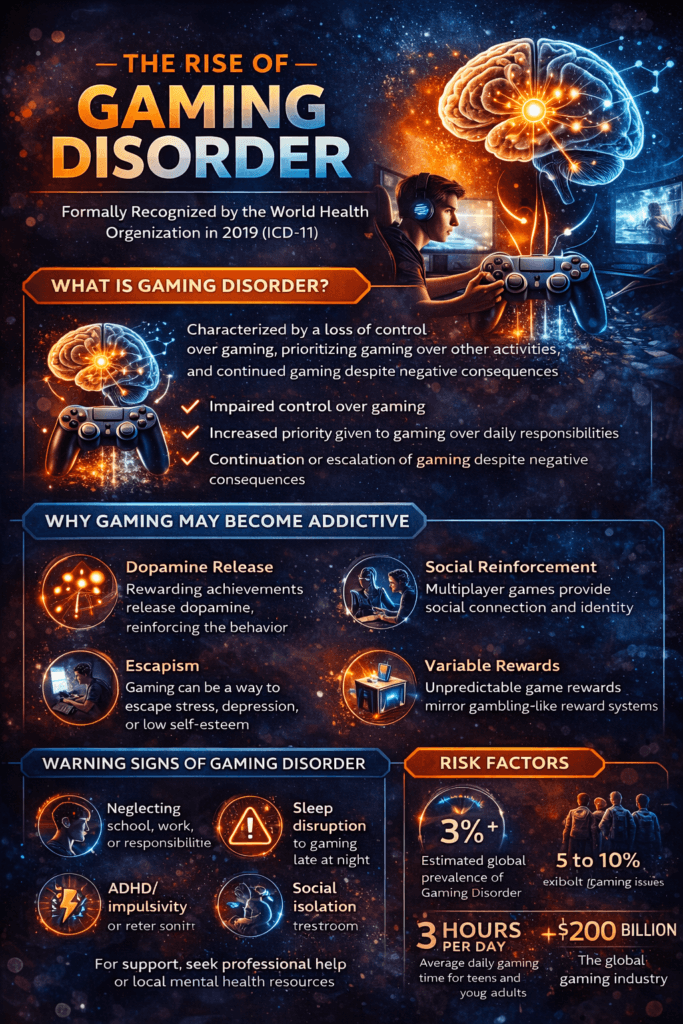
The rise of Gaming Disorder reflects the rapid transformation of digital entertainment in the 21st century. What was once a casual recreational activity has evolved into an immersive, socially integrated, and highly engineered experience designed to maximize engagement. With advanced reward systems, online multiplayer platforms, and constant accessibility through mobile devices, gaming now occupies a central role in many individuals’ daily lives. In 2019, the World Health Organization formally recognized Gaming Disorder in the International Classification of Diseases (ICD-11), highlighting growing global concern about patterns of impaired control, excessive prioritization of gaming, and continued play despite negative consequences. Understanding this phenomenon requires examining not only individual behavior, but also the neurobiological, psychological, and technological forces shaping modern gaming culture.
The Rise of Gaming Disorder
When Digital Play Crosses the Line into Psychological Dependence
Video gaming has evolved from a niche hobby into a global cultural and economic force. Competitive esports fill arenas, multiplayer platforms connect millions across continents, and immersive story-driven games rival Hollywood productions. For most individuals, gaming is a form of entertainment, stress relief, and even social connection. However, for a growing subset of players, gaming has shifted from recreation to compulsion — leading to what is now recognized as Gaming Disorder.
In 2019, the World Health Organization officially included Gaming Disorder in the International Classification of Diseases (ICD-11), marking a significant milestone in behavioral addiction research. This recognition sparked global debate, but it also validated concerns from clinicians and families who had witnessed severe impairment linked to excessive gaming.
What Is Gaming Disorder?
Gaming Disorder is characterized by:
- Impaired control over gaming
- Increasing priority given to gaming over other activities
- Continuation or escalation despite negative consequences
For diagnosis under ICD-11 criteria, the pattern must result in significant impairment in personal, family, social, educational, or occupational functioning, typically over a 12-month period.
It is important to distinguish high engagement from disorder. Spending many hours gaming does not automatically indicate addiction. The defining factor is loss of control and functional impairment, not time alone.
Why Is Gaming So Addictive?
Modern games are intentionally designed to maximize engagement. Several psychological mechanisms contribute to compulsive gaming patterns:
1. Dopamine Reward Loops
Games provide frequent rewards — points, achievements, rare items, and social recognition. These intermittent reinforcement schedules mirror those used in gambling systems, increasing compulsive play.
2. Social Reinforcement
Multiplayer platforms offer belonging, identity, and community. For individuals experiencing social anxiety or isolation, gaming may feel safer than face-to-face interaction.
3. Escapism and Emotional Regulation
Gaming can temporarily relieve stress, depression, loneliness, or low self-esteem. Over time, it may become a primary coping strategy.
4. Variable Reward Structures
Loot boxes, ranking systems, daily rewards, and unpredictable outcomes activate anticipation pathways in the brain, sustaining engagement.
Who Is Most at Risk?
Certain factors increase vulnerability:
- Adolescence (developing impulse control systems)
- ADHD
- Depression or anxiety disorders
- Trauma history
- Social isolation
- Low self-esteem
- Poor family boundaries around screen use
Neurodevelopmentally, the prefrontal cortex — responsible for impulse control and long-term planning — continues maturing into early adulthood. This makes younger individuals particularly sensitive to high-reward digital environments.
Signs of Problematic Gaming
Common warning signs include:
- Neglecting school, work, or responsibilities
- Sleep disruption due to late-night gaming
- Irritability when unable to play
- Lying about time spent gaming
- Withdrawal from offline relationships
- Decline in hygiene or physical health
Severe cases may involve academic failure, job loss, or major strain on relationships.
The Debate Around Gaming Disorder
The classification of Gaming Disorder remains controversial. Some researchers argue that excessive gaming is often a symptom of underlying mental health conditions rather than a standalone disorder. Others caution against pathologizing normal enthusiasm in a digital age.
However, clinicians emphasize that for a minority of individuals, the impairment is real and severe. Recognition allows for structured assessment and intervention rather than dismissal.
Treatment and Recovery
Effective interventions typically include:
- Cognitive Behavioral Therapy (CBT)
- Family therapy (especially for adolescents)
- Treatment of co-occurring conditions
- Structured screen-time limits
- Development of alternative reward activities
- Social skills training
The goal is not necessarily total abstinence from gaming, but restoration of balance and control.
Cultural and Technological Context
The rapid growth of mobile gaming, streaming platforms, and competitive esports has normalized long gaming sessions. Algorithms track engagement data and optimize for retention, increasing exposure to reinforcing stimuli.
The global gaming industry generates billions annually, meaning economic incentives favor prolonged engagement. This raises ethical questions about design responsibility and consumer protection.
Final Reflection
The rise of Gaming Disorder reflects broader changes in how humans interact with technology. Gaming itself is not inherently harmful; it can enhance problem-solving skills, social connection, and stress relief. However, when digital play becomes compulsive and begins to replace essential life activities, intervention becomes necessary.
Understanding Gaming Disorder requires nuance — acknowledging both the benefits of gaming culture and the legitimate risks of behavioral dependence. With awareness, early identification, and structured support, individuals can regain balance and reestablish healthy engagement with digital environments.
Self-Management Strategies in the Rise of Gaming Disorder
Practical Tools for Regaining Digital Balance in an Always-Connected World
As gaming becomes more immersive, socially integrated, and reward-driven, concerns about Gaming Disorder have increased. Recognized by the World Health Organization in the ICD-11, Gaming Disorder is characterized by impaired control over gaming, prioritizing gaming over essential life activities, and continuing to play despite negative consequences.
While professional treatment may be necessary in severe cases, many individuals can benefit from structured self-management strategies. The goal is not to demonize gaming, but to restore control, balance, and intentional engagement.
Below are evidence-informed self-regulation approaches grounded in psychology and behavioral science.
1. Increase Awareness Through Behavioral Tracking
Addictive patterns thrive on automatic behavior. Awareness interrupts autopilot.
Strategy:
- Track total daily gaming time.
- Record emotional state before and after playing.
- Identify triggers (stress, boredom, social conflict, loneliness).
- Note missed responsibilities due to gaming.
Many devices now provide built-in screen-time reports. Reviewing this data weekly can reveal discrepancies between perceived and actual usage.
Why it works: Self-monitoring activates executive functioning and reduces unconscious habit loops.
2. Use Structured Time Limits
Gaming often extends beyond intended durations due to “just one more match” thinking.
Strategy:
- Set a predetermined daily or weekly gaming cap.
- Use external timers or parental control apps (even for adults).
- Schedule gaming after responsibilities are completed.
- Implement a fixed “digital curfew” before bedtime.
Pro Tip: Avoid relying solely on willpower. Environmental constraints are more effective than motivation alone.
3. Apply the Delay Technique for Urges
Gaming urges often peak quickly and fade if not acted on immediately.
Strategy:
- When the urge to play arises outside scheduled time, delay for 10–15 minutes.
- Engage in an alternative activity (e.g., a short walk, stretching, hydration, or breathing exercises).
- Reassess whether gaming is aligned with current priorities.
Urges function like waves — they rise, peak, and fall. Delaying builds impulse control.
4. Address Emotional Triggers
For many individuals, gaming serves as a form of emotional regulation.
Common emotional drivers:
- Stress relief
- Escapism from academic or work pressure
- Social anxiety
- Loneliness
- Low mood
Strategy:
- Identify the specific emotion prompting gaming.
- Label it clearly (“I feel overwhelmed,” not just “I feel bad.”)
- Develop alternative coping tools:
- Exercise
- Journaling
- Talking with a friend
- Creative outlets
- Mindfulness practices
Gaming should be entertainment — not the only coping mechanism.
5. Rebuild Healthy Reward Systems
Games are powerful because they provide structured rewards: levels, points, achievements, and social status.
To reduce dependency, replicate reward structures offline.
Strategy:
- Set small daily goals (exercise reps, study milestones).
- Track progress visually.
- Celebrate achievements.
- Join clubs or teams for social reinforcement.
When real-world achievements feel rewarding, digital rewards lose dominance.
6. Optimize Sleep Hygiene
Late-night gaming disrupts circadian rhythms, increasing irritability and impulsivity.
Strategy:
- Establish a consistent bedtime.
- Avoid gaming at least 60 minutes before sleep.
- Remove gaming devices from the bedroom if necessary.
- Replace nighttime gaming with a calming wind-down routine.
Improved sleep enhances impulse control and emotional regulation.
7. Modify the Environment
Behavior is heavily cue-driven.
Strategy:
- Move consoles out of bedrooms.
- Turn off non-essential gaming notifications.
- Uninstall highly triggering games temporarily.
- Log out of gaming platforms after each session.
Reducing environmental cues reduces automatic engagement.
8. Strengthen Social Accountability
Isolation increases gaming reliance.
Strategy:
- Inform trusted friends or family about your goals.
- Schedule in-person activities.
- Join structured offline communities.
- Consider peer support groups if gaming is severe.
Accountability increases follow-through and reduces secrecy.
9. Know When to Seek Professional Help
Self-management may not be sufficient if:
- Gaming significantly interferes with school or work.
- There are co-occurring mental health disorders.
- Attempts to reduce gaming repeatedly fail.
- There is severe sleep disruption or social withdrawal.
Cognitive Behavioral Therapy (CBT) and family-based interventions have shown promising outcomes for Gaming Disorder.
Final Reflection
The rise of Gaming Disorder reflects the power of modern digital design and the human brain’s sensitivity to reward systems. However, problematic gaming is not a moral failure — it is often an attempt to regulate emotions or seek belonging.
Self-management strategies work best when they focus on awareness, structure, emotional regulation, and alternative reward systems. The objective is not complete abstinence for most individuals, but intentional, balanced engagement.
Gaming can remain part of a healthy life — as long as control remains in the player’s hands, not the algorithm’s.
Family Support Strategies in the Rise of Gaming Disorder
Guiding Healthy Digital Habits Without Escalating Conflict
As gaming becomes increasingly immersive and socially integrated, concerns about Gaming Disorder have grown. Recognized by the World Health Organization in the ICD-11, Gaming Disorder is characterized by impaired control over gaming, prioritizing gaming over daily responsibilities, and continuing to play despite negative consequences.
For families, the challenge is complex. Gaming can provide social connection, cognitive stimulation, and recreation. However, when gaming begins to interfere with school, work, sleep, relationships, or mental health, family involvement becomes essential.
Effective family support focuses on structure, communication, and emotional safety — not control or punishment.
1. Educate the Family About Gaming Disorder
Before intervening, families should understand:
- The difference between high engagement and disorder
- The role of dopamine and reward systems
- How gaming can function as emotional regulation
- The impact of variable reward structures and online social dynamics
Education reduces moral judgment (“You’re lazy”) and replaces it with informed concern (“I’m worried about how this is affecting you.”).
2. Separate the Person From the Behavior
Labeling a child or partner as “addicted” or “irresponsible” can increase defensiveness and secrecy.
Instead of:
- “You care more about games than your family.”
Try:
- “I’ve noticed you seem stressed when you can’t play. Can we talk about what’s going on?”
This approach preserves trust and attachment — both critical protective factors.
3. Establish Clear and Collaborative Boundaries
Rigid, unilateral restrictions often lead to power struggles. Collaborative rule-setting increases compliance.
Healthy Boundary Examples:
- Gaming only after homework or work responsibilities
- Fixed daily or weekly time limits
- No gaming one hour before bedtime
- Devices are stored outside bedrooms at night
- Screen-free family meals
When possible, involve the gamer in creating these rules. Ownership increases accountability.
4. Monitor Without Micromanaging
Excessive surveillance can damage trust, but a total absence of oversight can enable escalation.
Balanced monitoring may include:
- Reviewing screen-time reports
- Checking sleep patterns
- Discussing online interactions
- Observing mood changes
The goal is safety and well-being, not control.
5. Address Underlying Emotional Needs
Gaming often fulfills unmet needs such as:
- Belonging
- Achievement
- Escape from stress
- Identity formation
- Competence
Families can ask:
- “What do you enjoy most about gaming?”
- “What does it help you feel?”
Then work to create real-world alternatives that meet similar needs — sports teams, creative activities, clubs, part-time work, or social groups.
6. Model Healthy Technology Use
Children and adolescents observe adult behavior closely. If parents spend excessive time on phones or screens, limits may appear hypocritical.
Model:
- Screen-free evenings
- Balanced digital engagement
- Emotional coping without devices
- Consistent sleep routines
Family culture influences digital habits more than lectures.
7. Avoid the Punishment-Only Approach
Sudden confiscation of devices without discussion can intensify conflict and secrecy.
Instead:
- Use consequences tied to responsibilities (e.g., incomplete homework reduces gaming privileges).
- Emphasize restoration rather than retaliation.
- Reinforce positive behaviors with privileges.
Consistency is more effective than emotional reactions.
8. Encourage Professional Support When Needed
Family intervention is crucial, but some situations require clinical care.
Consider professional help if:
- Academic failure is occurring
- Severe sleep deprivation is present
- There is aggression when gaming is restricted
- Co-occurring depression, anxiety, or ADHD symptoms are evident
- Social withdrawal becomes extreme
Family therapy can be especially beneficial when communication patterns contribute to escalation.
9. Maintain Relationship Connection
Connection is protective.
- Schedule shared activities not centered on screens.
- Validate emotions even when setting limits.
- Express unconditional support, separate from behavioral concerns.
When the relationship remains strong, boundary-setting feels less like rejection and more like guidance.
Final Reflection
The rise of Gaming Disorder reflects broader technological shifts — immersive design, social integration, and reward-driven systems. Families are not powerless in this environment.
Effective support requires:
- Education rather than accusation
- Collaboration rather than control
- Boundaries rather than chaos
- Compassion rather than shame
Gaming can remain a healthy part of life when balanced within responsibilities and relationships. Family systems that prioritize structure, empathy, and consistency create the strongest foundation for sustainable digital well-being.
Community Resource Strategies in the Rise of Gaming Disorder
Building Collective Solutions in a Digitally Immersive Era
As gaming technology advances, so does its psychological impact. The recognition of Gaming Disorder by the World Health Organization in the ICD-11 reflects growing global concern about compulsive gaming behaviors that impair education, employment, relationships, and mental health.
While individual and family strategies are essential, sustainable prevention and recovery also require community-level intervention. Gaming Disorder does not develop in isolation — it emerges within digital ecosystems, peer cultures, and rapidly expanding technology markets. Community resources provide structure, accountability, education, and early intervention.
Below are key community-based strategies that help address the rise of Gaming Disorder.
1. School-Based Prevention and Education Programs
Schools are critical environments for early detection and prevention.
Effective initiatives include:
- Digital literacy education (understanding algorithms and reward systems)
- Curriculum modules on behavioral addiction
- Workshops on time management and impulse control
- School counselor screening for excessive gaming
- Parent education seminars
When students learn how games are designed to maximize engagement, they are better equipped to self-regulate.
2. Community Mental Health Services
Local clinics and nonprofit agencies can provide:
- Cognitive Behavioral Therapy (CBT) for impulse control
- Family therapy
- Treatment for co-occurring depression, anxiety, or ADHD
- Group therapy for adolescents
Accessible, sliding-scale services reduce barriers to care, particularly for underserved families.
3. Youth and Recreation Programs
Gaming often fulfills needs for belonging, achievement, and stimulation. Community programs can provide healthier alternatives:
- After-school sports leagues
- Arts and music programs
- Coding clubs with balanced digital guidelines
- Volunteer programs
- Outdoor adventure groups
Structured activities diversify reward systems and reduce reliance on digital environments.
4. Peer Support and Recovery Groups
Peer-led groups offer shared accountability and reduce stigma.
Examples include:
- Adolescent behavioral addiction support groups
- General addiction recovery programs that include behavioral addictions
- Community-led digital wellness circles
Group-based interventions normalize struggles and provide collective reinforcement for change.
5. Public Awareness Campaigns
Communities can host:
- Digital wellness awareness weeks
- Public seminars on Gaming Disorder
- Social media campaigns about healthy screen habits
- Collaboration with pediatricians to distribute educational materials
Public awareness reduces denial and encourages early intervention.
6. Collaboration with Healthcare Providers
Primary care physicians, pediatricians, and school nurses often notice early warning signs such as:
- Sleep disruption
- Academic decline
- Mood instability
- Social withdrawal
Community training for healthcare providers improves screening and referral systems.
7. Policy and Advocacy Initiatives
At the community and governmental level, policy efforts may include:
- Regulations on loot boxes and gambling-like mechanics
- Age-appropriate advertising standards
- Transparency requirements for in-game purchases
- Funding for digital wellness research
- Grants for youth recreation programs
Public policy shapes digital ecosystems and can reduce exploitative design practices.
8. Partnerships with Gaming Organizations
Communities can collaborate with:
- Local esports organizations
- Game developers
- Internet cafés
- Youth gaming clubs
Partnerships can promote:
- Scheduled breaks
- Balanced competition guidelines
- Educational messages integrated into events
- Responsible gaming initiatives
Rather than opposing gaming culture, communities can work within it to promote health.
Why Community-Level Intervention Matters
Gaming Disorder reflects a broader cultural shift toward immersive digital engagement. Individual willpower alone cannot counteract highly engineered reward systems supported by billion-dollar industries.
Community resources provide:
- Early detection
- Affordable intervention
- Structured alternatives
- Reduced stigma
- Shared accountability
Social environments either reinforce or regulate behavior. Community strategy determines which direction prevails.
Final Reflection
The rise of Gaming Disorder highlights the intersection of technology, psychology, and public health. While gaming can be beneficial and enriching, unchecked immersion can lead to significant impairment for vulnerable individuals.
Effective solutions require collective action — schools, families, healthcare systems, policymakers, and gaming communities working together.
Digital balance is not solely an individual responsibility. It is a community-wide commitment to promoting healthy engagement in an increasingly virtual world.
Frequently Asked Questions
Here are some common questions:
1. What is Gaming Disorder?
Gaming Disorder is a behavioral condition characterized by impaired control over gaming, increasing priority given to gaming over other activities, and continued gaming despite negative consequences. In 2019, the World Health Organization officially included Gaming Disorder in the International Classification of Diseases (ICD-11), recognizing it as a diagnosable mental health condition.
2. Does playing video games for many hours mean someone has Gaming Disorder?
Not necessarily. High engagement alone does not equal addiction. The key distinction is loss of control and functional impairment. If gaming interferes with school, work, sleep, relationships, or mental health—and the individual cannot reduce play despite consequences—it may indicate a disorder.
3. Why has Gaming Disorder become more common?
Several factors contribute to its rise:
- Advanced reward systems designed to maximize engagement
- Online multiplayer environments that provide social identity and belonging
- 24/7 accessibility through smartphones and high-speed internet
- Algorithm-driven personalization
- Competitive ranking systems and in-game rewards
Modern games are intentionally designed to sustain attention and encourage repeated play.
4. What makes gaming addictive from a psychological perspective?
Gaming activates the brain’s dopamine reward system. Achievements, leveling up, unpredictable rewards, and social validation trigger dopamine release. Variable reward schedules—similar to those used in gambling—reinforce repeated behavior and increase compulsive play.
5. Who is most at risk for Gaming Disorder?
Risk factors include:
- Adolescence (developing impulse control systems)
- ADHD
- Depression and anxiety disorders
- Trauma exposure
- Social isolation
- Low self-esteem
- Poor family structure around screen use
Young individuals are particularly vulnerable due to ongoing brain development.
6. What are the warning signs?
Common warning signs include:
- Neglecting school, work, or household responsibilities
- Sleep disruption due to late-night gaming
- Irritability or aggression when unable to play
- Lying about gaming time
- Withdrawal from offline relationships
- Declining academic or job performance
Severe cases may lead to significant social or occupational impairment.
7. Is Gaming Disorder the same as internet addiction?
Not exactly. While related, Gaming Disorder specifically focuses on compulsive gaming behavior. Internet addiction may involve broader online activities such as social media, streaming, or browsing. Gaming Disorder is more narrowly defined.
8. Can Gaming Disorder occur without other mental health conditions?
Yes, but it often co-occurs with conditions such as depression, anxiety, or ADHD. In many cases, excessive gaming may begin as a coping mechanism for underlying emotional distress.
9. Is gaming always harmful?
No. Gaming can improve cognitive skills, problem-solving, teamwork, and stress relief. The issue arises when gaming becomes compulsive and replaces essential life activities. Balanced gaming is not inherently harmful.
10. How is Gaming Disorder treated?
Treatment approaches may include:
- Cognitive Behavioral Therapy (CBT)
- Family therapy (especially for adolescents)
- Treatment of underlying mental health conditions
- Structured screen-time management
- Development of alternative reward systems
- Social skills training
In many cases, the goal is balanced use rather than complete abstinence.
11. Can someone recover from Gaming Disorder?
Yes. With structured intervention, awareness, and support, individuals can regain control and develop healthier digital habits. Recovery involves rebuilding offline routines, emotional regulation skills, and social engagement.
12. What role do families play?
Families play a critical role in prevention and intervention by:
- Setting consistent screen-time boundaries
- Modeling healthy technology use
- Maintaining open communication
- Encouraging offline activities
- Seeking professional help when needed
Supportive structure is more effective than punishment alone.
13. Should gaming companies be held responsible?
There is an ongoing debate. Critics argue that loot boxes, variable rewards, and engagement-maximizing algorithms increase addictive potential. Others emphasize personal responsibility. This remains a policy and ethical discussion at both national and global levels.
14. When should professional help be sought?
Professional help is recommended if:
- Gaming severely disrupts daily functioning
- There are symptoms of depression or anxiety
- Attempts to reduce gaming repeatedly fail
- There is extreme social withdrawal or aggression
- Academic or job performance declines significantly
Early intervention improves long-term outcomes.
Conclusion
Gaming Disorder does not suggest that gaming itself is inherently harmful; rather, it underscores the risks that emerge when immersive digital environments intersect with vulnerable psychological factors. Loss of control, emotional reliance on gaming, and functional impairment are the defining features that separate healthy engagement from disorder. As gaming continues to expand in cultural and economic influence, balanced approaches are essential—combining personal responsibility, family guidance, community support, and thoughtful policy discussions. By increasing awareness and promoting digital literacy, society can preserve the benefits of gaming while reducing the potential for harm. The rise of Gaming Disorder ultimately calls for nuanced understanding, prevention-focused strategies, and compassionate intervention.
Video: Gaming Addiction Took Over His Entire Life 😱 #storytime