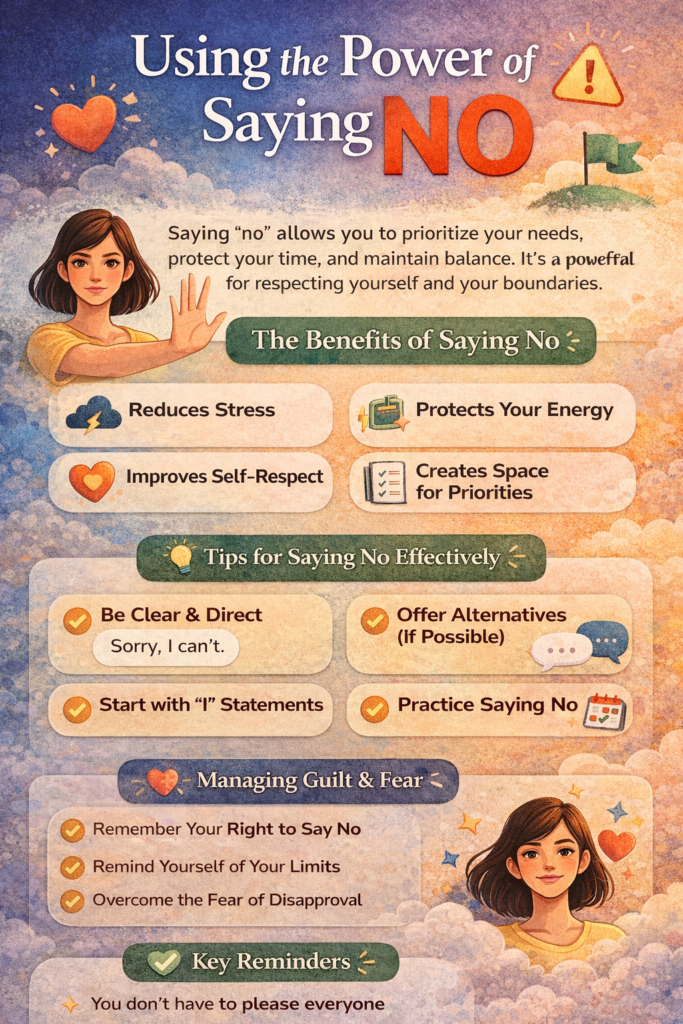
Saying “no” is a simple word, yet it carries significant emotional weight. Many people struggle to use it because of fear—fear of disappointing others, creating conflict, or being perceived as selfish. However, learning to say no is a powerful act of self-awareness and self-respect. It allows individuals to set boundaries, protect their time and energy, and make choices that align with their values. Understanding and embracing the power of saying no is an essential step toward healthier relationships, improved mental well-being, and a more balanced life.
✋ The Power of Saying No: Reclaiming Your Time, Energy, and Self-Worth
Saying “no” can feel uncomfortable, especially if you’re used to putting others first or avoiding conflict. Many people worry about disappointing others, being seen as selfish, or damaging relationships. But the truth is, learning to say no is one of the most powerful skills you can develop for your mental, emotional, and even physical well-being. It’s not about rejection—it’s about protection: protecting your time, your energy, and your sense of self.
🧠 Why Saying No Feels So Difficult
For many, saying no triggers guilt or anxiety.
Common reasons include:
- Fear of disappointing others
- Desire to be liked or accepted
- Habit of people-pleasing
- Belief that saying no is selfish
These patterns often develop over time, but they can be unlearned with awareness and practice.
⚖️ The Hidden Cost of Always Saying Yes
Constantly saying yes can lead to burnout and resentment.
You might experience:
- Emotional exhaustion
- Feeling overwhelmed or stretched too thin
- Loss of personal time and boundaries
- Frustration or resentment toward others
When you say yes to everything, you may be saying no to your own needs.
💪 Why Saying No Is a Form of Self-Respect
Saying no is not selfish—it’s a boundary.
It allows you to:
- Prioritize what truly matters to you
- Protect your mental and emotional energy
- Maintain balance in your life
- Show others how to respect your limits
Healthy boundaries are essential for healthy relationships.
🗣️ How to Say No with Confidence
You don’t need long explanations or excuses. Clear and respectful communication is enough.
Simple ways to say no:
- “I can’t commit to that right now.”
- “I appreciate the offer, but I’ll have to pass.”
- “I need to focus on my priorities at the moment.”
Confidence grows with practice.
🌿 Letting Go of Guilt
Feeling guilty at first is normal—but it doesn’t mean you’re doing something wrong.
Remind yourself:
- You are allowed to have limits
- You don’t need to justify every decision
- Saying no to others is often saying yes to yourself
Over time, the guilt fades as self-respect grows.
🧩 Building Stronger Boundaries
Saying no becomes easier when you understand your own limits.
Ask yourself:
- What do I realistically have time and energy for?
- What aligns with my values and goals?
- What feels like too much right now?
Clarity makes decisions simpler.
🤝 The Impact on Relationships
Healthy relationships respect boundaries.
When you say no:
- You create more honest and balanced interactions
- Others learn to respect your limits
- You reduce resentment and improve communication
The right people will understand—and respect—you more for it.
🌱 Final Thoughts
The power of saying no lies in its ability to help you live more intentionally. It allows you to protect your well-being, honor your needs, and create space for what truly matters. While it may feel uncomfortable at first, it becomes easier—and more empowering—with time. Saying no isn’t about shutting others out; it’s about showing up for yourself in a healthier, more balanced way.
✋ Taking Control: Self-Management Strategies to Harness the Power of Saying No
Saying “no” is more than just a response—it’s a skill rooted in self-awareness, confidence, and personal boundaries. For many people, it doesn’t come naturally. Guilt, fear of rejection, or the desire to please others can make it difficult to set limits. But through intentional self-management strategies, you can learn to say no in a way that protects your well-being while still maintaining healthy relationships. Mastering this skill allows you to take control of your time, energy, and life.
🧠 Build Self-Awareness
The foundation of saying no starts with understanding yourself.
Ask:
- What are my priorities right now?
- What drains my energy?
- What truly matters to me?
When you’re clear on your values and limits, it becomes easier to recognize when something doesn’t align—and when to say no.
⚖️ Set Clear Personal Boundaries
Self-management involves defining what you will and won’t accept.
Start by:
- Identifying your limits (time, energy, emotional capacity)
- Deciding what commitments are realistic
- Being honest with yourself about what feels overwhelming
Boundaries serve as guidelines that help you make decisions with confidence.
💭 Reframe Your Thinking About “No.”
Many people associate saying no with negativity—but it’s actually a positive, protective action.
Shift your mindset:
- Saying no = respecting your needs
- Saying no = preventing burnout
- Saying no = making space for what matters
This mental shift reduces guilt and builds confidence.
🗣️ Practice Assertive Communication
Learning how to say no clearly and respectfully is key.
Try:
- “I’m not able to take that on right now.”
- “I appreciate you asking, but I’ll have to decline.”
- “I need to focus on other priorities.”
Keep it simple—no long explanations are required.
🌿 Manage Guilt and Discomfort
Feeling uncomfortable when you start saying no is normal.
Helpful reminders:
- You’re not responsible for everyone else’s expectations
- Discomfort is part of growth
- Saying no doesn’t make you a bad person
Over time, the discomfort decreases as confidence increases.
🧩 Pause Before Responding
Instead of saying yes automatically, give yourself time to decide.
You can say:
- “Let me think about it.”
- “I’ll get back to you.”
This pause allows you to make intentional choices rather than reactive ones.
🔄 Stay Consistent with Your Boundaries
Consistency strengthens self-management.
Practice:
- Following through on your decisions
- Not over-explaining or backtracking
- Respecting your own limits as much as you respect others.’
The more consistent you are, the easier it becomes.
🤝 Balance Kindness with Self-Respect
You can be kind and still say no.
For example:
- Acknowledge the request
- Decline respectfully
- Offer an alternative if appropriate
This maintains relationships while honoring your boundaries.
🌱 Final Thoughts
Learning to say no is a powerful form of self-management that supports your mental, emotional, and physical well-being. It allows you to live with intention, avoid burnout, and build healthier relationships. While it may feel challenging at first, each time you choose to honor your limits, you strengthen your confidence and self-respect. Over time, saying no becomes not just easier—but empowering.
👨👩👧👦 Stronger Together: Family Support Strategies for Using the Power of Saying No
Saying “no” can be challenging, especially within family dynamics where expectations, obligations, and emotions are deeply connected. However, families can play a crucial role in helping each other develop healthy boundaries. By encouraging open communication, mutual respect, and emotional support, families can create an environment where saying no is seen not as rejection but as a healthy and necessary act of self-care.
🧠 Normalize Boundaries Within the Family
Families set the tone for how boundaries are viewed and respected.
Supportive families:
- Recognize that everyone has limits
- Understand that saying no is not disrespectful
- Encourage individual needs alongside family responsibilities
When boundaries are normalized, saying no feels safer and more acceptable.
❤️ Encourage Open and Honest Communication
Clear communication helps prevent misunderstandings and resentment.
Families can:
- Create space for members to express their needs
- Listen without judgment or pressure
- Respect decisions without forcing explanations
This builds trust and emotional safety.
🗣️ Model Healthy “No” Behavior
Family members, especially parents or caregivers, influence how others learn to set boundaries.
Modeling includes:
- Saying no respectfully and calmly
- Explaining decisions without over-justifying
- Demonstrating that it’s okay to prioritize personal well-being
Seeing this in action makes it easier for others to follow.
⚖️ Respect Each Other’s Limits
Support means honoring boundaries—even when they’re inconvenient.
Families should:
- Avoid guilt-tripping or pressuring
- Accept “no” without taking it personally
- Understand that limits are not a rejection of love
Respect strengthens relationships rather than weakening them.
🌿 Reduce Guilt Around Saying No
Many people struggle with guilt when setting boundaries with family.
Families can help by:
- Reassuring each other that it’s okay to say no
- Avoiding phrases that induce guilt (“You never help,” “You should…”)
- Encouraging balance between helping others and self-care
This helps shift the mindset from obligation to choice.
🧩 Support Decision-Making Skills
Family members can guide each other in making thoughtful choices.
Encourage:
- Taking time before agreeing to commitments
- Thinking about personal capacity and priorities
- Reflecting on whether something feels manageable
This promotes intentional rather than automatic responses.
🤝 Balance Support with Independence
Healthy families support each other without over-relying on one person.
This includes:
- Sharing responsibilities fairly
- Avoiding over-dependence on one family member
- Encouraging independence and self-respect
Balance prevents burnout and resentment.
🌱 Be Patient with Growth
Learning to say no is a process, especially for those who are used to saying yes.
Families can:
- Be patient with each other’s progress
- Celebrate small steps toward boundary-setting
- Offer encouragement rather than criticism
Growth takes time, and support makes it easier.
💬 Final Thoughts
The power of saying no becomes even stronger when supported by a healthy family environment. When families encourage boundaries, respect individual needs, and communicate openly, they create a space where everyone can thrive. Saying no is not about distancing from loved ones—it’s about showing up in a more balanced, authentic, and sustainable way. With family support, this skill becomes not only easier but empowering for everyone involved.
🌍 Community Support: Strategies to Empower the Power of Saying No
Saying “no” is a personal skill—but it is also shaped by the environment around you. Communities play a powerful role in either reinforcing people-pleasing behaviors or encouraging healthy boundaries. When communities promote respect, balance, and self-care, individuals feel more confident setting limits without guilt. By leveraging community resources and support systems, people can learn, practice, and strengthen the ability to say no in a healthy and empowering way.
🧠 Community Education on Boundaries
Education helps normalize the idea that saying no is healthy—not selfish.
Communities can support this by:
- Offering workshops on boundaries and assertiveness
- Providing educational materials on mental health and self-care
- Hosting seminars on stress management and burnout prevention
Learning in a group setting helps individuals feel validated and less alone.
🤝 Support Groups and Peer Networks
Peer support creates a safe space to practice and reinforce boundary-setting.
Benefits include:
- Sharing experiences about saying no
- Learning from others’ challenges and successes
- Gaining encouragement and accountability
Hearing others set boundaries can inspire confidence.
🏫 Workplace and Organizational Support
Many people struggle to say no in professional or structured environments.
Communities can help by:
- Promoting healthy workplace cultures
- Encouraging reasonable workloads and clear expectations
- Offering training on communication and assertiveness
Supportive environments reduce fear around setting limits.
🧘 Wellness and Self-Care Programs
Community wellness initiatives can strengthen emotional resilience.
Examples include:
- Mindfulness and stress-reduction classes
- Time management and life balance workshops
- Mental health awareness programs
These resources help individuals recognize when they need to say no.
💻 Online Communities and Resources
Digital platforms provide accessible support for boundary-setting skills.
Helpful tools:
- Online forums focused on self-growth
- Educational videos and courses
- Apps that promote self-care and habit-building
Online spaces allow people to learn and practice at their own pace.
📢 Promoting a Culture of Respect
Communities influence how boundaries are perceived and respected.
A supportive culture:
- Encourages saying no without guilt or pressure
- Discourages overcommitment and burnout
- Values balance over constant productivity
When saying no is normalized, individuals feel safer doing it.
🧩 Resources for High-Demand Environments
Some individuals face extra pressure to say yes (e.g., caregivers, students, employees).
Communities can offer:
- Counseling and support services
- Time management resources
- Programs that address burnout and overload
These supports help individuals protect their energy.
🌱 Building Empowered Communities
Ultimately, communities can help individuals feel confident in their choices.
This includes:
- Encouraging self-respect and personal boundaries
- Supporting mental and emotional well-being
- Creating environments where “no” is understood and respected
💬 Final Thoughts
The power of saying no becomes even stronger when supported by a healthy community. Through education, peer support, and a culture that respects boundaries, communities can empower individuals to protect their time, energy, and well-being. Saying no is not about rejecting others—it’s about creating space for a more balanced, intentional, and fulfilling life.
Frequently Asked Questions
Here are some common questions:
Why is saying “no” so difficult?
Answer:
Saying no can be difficult because many people fear disappointing others, creating conflict, or being seen as selfish. Social expectations and people-pleasing habits can also make it feel uncomfortable to set boundaries.
Is saying no selfish?
Answer:
No. Saying no is a form of self-respect, not selfishness. It allows you to protect your time, energy, and mental health so you can show up more fully in the areas that truly matter.
What are the benefits of saying no?
Answer:
Saying no helps you:
- Reduce stress and overwhelm
- Protect your energy
- Focus on your priorities
- Build healthier relationships
- Improve self-respect and confidence
How do I say no without feeling guilty?
Answer:
- Remind yourself that your needs matter
- Understand that you can’t do everything
- Practice saying no in small situations
- Reframe guilt as a sign of growth
Guilt is normal at first, but it decreases with practice.
What is the best way to say no politely?
Answer:
Keep it simple and respectful:
- “I can’t commit to that right now.”
- “I appreciate you asking, but I’ll have to pass.”
- “I need to focus on my priorities.”
You don’t need to over-explain or justify your decision.
What if people get upset when I say no?
Answer:
Some people may react negatively, especially if they’re used to you always saying yes. However, healthy relationships will respect your boundaries. Their reaction does not mean your boundary is wrong.
How can I get better at saying no?
Answer:
- Start with low-pressure situations
- Practice assertive communication
- Pause before agreeing to requests
- Stay consistent with your boundaries
Like any skill, it improves with repetition.
Can saying no improve mental health?
Answer:
Yes. Saying no reduces stress, prevents burnout, and helps you maintain emotional balance. It allows you to prioritize self-care and avoid overcommitment.
Is it okay to say no to family or close friends?
Answer:
Yes. Boundaries are important in all relationships, including close ones. Saying no helps maintain balance and prevents resentment, even within families.
Should I offer an explanation when I say no?
Answer:
You can, but it’s not required. A brief explanation is fine, but over-explaining can weaken your boundary. A clear and respectful “no” is enough.
What if I feel pressured to say yes?
Answer:
Take a pause:
- “Let me think about it.”
- “I’ll get back to you.”
This gives you time to make a thoughtful decision rather than react automatically.
Conclusion
Using the power of saying no is not about rejecting others—it’s about honoring yourself. When you set clear boundaries and make intentional decisions, you create space for what truly matters. Over time, saying no becomes less about discomfort and more about empowerment, helping you build confidence, reduce stress, and maintain healthier relationships. By recognizing your limits and respecting your needs, you can live more authentically and create a life that reflects your priorities and well-being.
Video: