Addiction often disrupts the ability to communicate effectively, leading to patterns of misunderstanding, defensiveness, and emotional disconnection. In this environment, individuals may feel unheard, invalidated, or isolated—both from others and from themselves. The power of mirroring offers a way to interrupt these patterns by fostering intentional listening, emotional awareness, and mutual understanding. By reflecting thoughts, feelings, and experiences with accuracy and empathy, mirroring creates a bridge between disconnection and connection, making it a valuable tool in the recovery process.
The Power of Mirroring in Addiction Recovery: Building Trust, Awareness, and Connection
Addiction often creates disconnection—between individuals and their emotions, their relationships, and even their sense of self. Communication becomes strained, trust erodes, and interactions may feel reactive or guarded. In recovery, rebuilding connection is essential, and one powerful yet often overlooked tool is mirroring. Mirroring, the act of reflecting another person’s words, emotions, or behaviors, can foster understanding, reduce conflict, and strengthen relationships. When used intentionally, it becomes a key skill in both personal growth and relational healing.
What Is Mirroring?
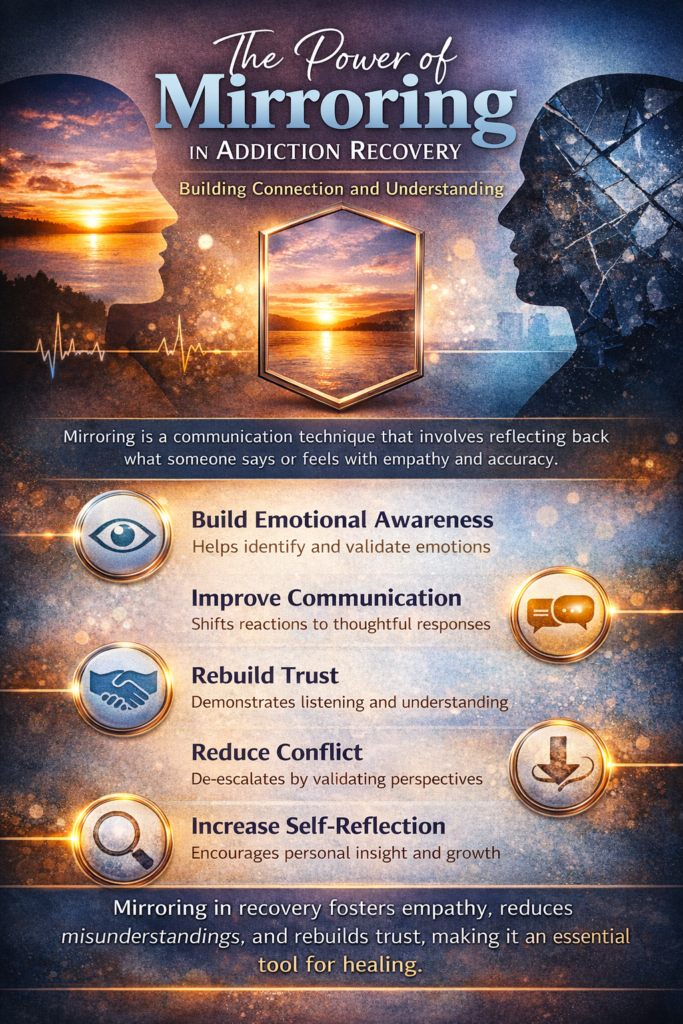
Mirroring is a communication technique where one person reflects back what they observe or hear from another. This can be verbal (repeating or summarizing what someone said) or nonverbal (matching tone, body language, or emotional expression).
For example:
- “What I’m hearing is that you felt overwhelmed and alone today.”
- Matching a calm tone when someone is speaking softly
Mirroring is not about imitation—it’s about understanding and connection.
Why Mirroring Matters in Addiction Recovery
In addiction, communication is often shaped by defensiveness, avoidance, or emotional intensity. Mirroring helps interrupt these patterns by slowing down interactions and creating space for clarity.
It supports recovery by:
- Increasing emotional awareness
- Reducing misunderstandings
- Helping individuals feel heard and validated
- Decreasing reactive or impulsive communication
When people feel understood, they are less likely to escalate conflict or withdraw.
1. Building Emotional Awareness
Many individuals in recovery are learning how to identify and express emotions without substances. Mirroring helps bring those emotions into focus.
By reflecting feelings, individuals can:
- Better understand their own emotional experiences
- Recognize patterns in their reactions
- Feel validated rather than dismissed
This awareness is a key part of long-term change.
2. Strengthening Communication Skills
Mirroring shifts communication from reacting to responding. Instead of immediately defending or correcting, individuals take time to understand.
This leads to:
- More thoughtful responses
- Fewer misunderstandings
- Increased clarity in conversations
It creates a foundation for healthier communication patterns.
3. Rebuilding Trust in Relationships
Addiction often damages trust through secrecy and inconsistency. Mirroring helps rebuild trust by demonstrating presence and attentiveness.
When someone feels truly heard:
- They are more likely to open up
- Emotional safety increases
- Defensive barriers begin to lower
Trust grows through consistent, respectful interactions.
4. Reducing Conflict and Reactivity
Many conflicts escalate because people feel misunderstood. Mirroring helps de-escalate by validating the other person’s perspective before responding.
This can:
- Slow down heated conversations
- Prevent misinterpretation
- Encourage problem-solving rather than arguing
It turns conflict into an opportunity for connection.
5. Supporting Self-Reflection
Mirroring is not only used with others—it can also be applied internally. Individuals can “mirror” their own thoughts and feelings by intentionally reflecting on them.
This might involve:
- Journaling emotions and experiences
- Asking, “What am I really feeling right now?”
- Noticing patterns without judgment
Self-mirroring builds insight and self-regulation.
6. Practicing Mirroring in Daily Life
Mirroring is a skill that improves with practice. Simple ways to use it include:
- Summarizing what someone says before responding
- Reflecting emotions (“It sounds like you’re frustrated”)
- Matching tone and pace in conversations
Consistency is key. Over time, it becomes a natural part of communication.
Moving Toward Connection
The power of mirroring lies in its simplicity. It does not require complex techniques—just attention, patience, and intention. In recovery, where connection and understanding are essential, this skill can transform interactions and relationships.
Final Thoughts
Addiction often creates distance, but recovery is about rebuilding connection—both with others and within oneself. Mirroring offers a practical and powerful way to bridge that gap. By fostering understanding, reducing conflict, and strengthening trust, it supports not only communication but also healing.
In a process that can often feel overwhelming, mirroring reminds us of something simple but profound: being heard is a powerful step toward recovery.
Intentional Connection: Self-Management Strategies for Using the Power of Mirroring in Addiction Recovery
In addiction recovery, communication often needs to be rebuilt from the ground up. Years of avoidance, defensiveness, or emotional disconnection can make even simple conversations feel difficult. Mirroring offers a powerful way to restore understanding and connection—but like any skill, it requires intentional practice. Self-management plays a key role in using mirroring effectively, helping individuals slow down, stay present, and respond with awareness rather than reaction.
Why Self-Management Matters in Mirroring
Mirroring is not just a communication technique—it’s a regulated response. Without self-management, individuals may:
- Interrupt or react defensively
- Misinterpret what is being said
- Focus on responding rather than understanding
Self-management allows individuals to pause, listen, and reflect accurately. It transforms mirroring from a technique into a meaningful tool for connection.
1. Practicing the Pause Before Responding
One of the most important self-management skills in mirroring is learning to pause. In addiction, reactions are often immediate and driven by emotion.
Practicing the pause means:
- Taking a breath before speaking
- Resisting the urge to interrupt or defend
- Giving yourself time to fully process what was said
This creates space for intentional rather than impulsive communication.
2. Managing Emotional Triggers
Mirroring can be difficult when emotions are intense. If someone feels criticized, hurt, or overwhelmed, they may struggle to reflect accurately.
Self-management strategies include:
- Noticing when you feel triggered
- Using grounding techniques (breathing, stepping away briefly)
- Returning to the conversation when calmer
Emotional regulation makes mirroring more effective and authentic.
3. Focusing on Understanding, Not Defending
A common barrier to mirroring is the urge to defend oneself. Self-management involves shifting the goal from “being right” to “understanding.”
This looks like:
- Listening without planning your response
- Reflecting on what the other person said before sharing your perspective
- Letting go of the need to immediately correct or justify
Understanding builds connection—defensiveness creates distance.
4. Using Clear and Accurate Reflection
Effective mirroring requires attention and clarity. Self-management helps individuals stay focused and avoid distortion.
Helpful practices include:
- Summarizing key points (“What I hear you saying is…”)
- Reflecting emotions (“It sounds like you felt hurt”)
- Asking for clarification if unsure
Accuracy shows respect and helps prevent misunderstandings.
5. Monitoring Tone and Body Language
Mirroring is not only verbal—it also involves nonverbal communication. Self-management includes being aware of how you present yourself.
This involves:
- Maintaining a calm and open tone
- Using appropriate eye contact
- Avoiding dismissive or defensive body language
Nonverbal cues can either reinforce or undermine the message.
6. Practicing Consistency in Daily Interactions
Mirroring becomes more effective with repetition. Self-management means intentionally practicing the skill, even in small, everyday conversations.
This might include:
- Reflecting back during casual discussions
- Using mirroring during moments of mild conflict
- Building the habit of listening before responding
Consistency turns mirroring into a natural communication style.
7. Reflecting on Your Own Communication Patterns
Self-management also involves self-reflection. After conversations, individuals can evaluate how they communicated.
Questions to consider:
- Did I truly listen, or was I focused on responding?
- Did I reflect accurately?
- Where did I become reactive?
This awareness helps improve future interactions.
Moving Toward Intentional Communication
Using mirroring effectively requires more than knowing what to say—it requires managing how you show up in the moment. Through self-management, individuals learn to slow down, stay present, and engage with others in a more thoughtful and connected way.
Final Thoughts
The power of mirroring lies in its ability to foster understanding and trust—but only when used intentionally. Self-management provides the foundation for this process, allowing individuals to move from reactive communication to meaningful connection.
In addiction recovery, where rebuilding relationships is essential, mirroring becomes more than a skill—it becomes a pathway to healing. And with practice, patience, and awareness, it can transform not only how we communicate, but how we relate to others and ourselves.
Reflecting to Heal: Family Support Strategies Using the Power of Mirroring in Addiction Recovery
Addiction often disrupts communication within families, creating patterns of misunderstanding, defensiveness, and emotional distance. Conversations can quickly become reactive, with family members feeling unheard or invalidated. In recovery, rebuilding healthy communication is essential—and one of the most effective tools families can use is mirroring. When combined with intentional support strategies, mirroring helps families create a space of understanding, reduce conflict, and strengthen connection during the healing process.
Why Mirroring Matters for Families in Recovery
Families impacted by addiction often develop communication habits rooted in survival—interrupting, fixing, blaming, or avoiding. Mirroring shifts these patterns by encouraging listening, reflection, and emotional validation.
For families, mirroring helps:
- Reduce misunderstandings and miscommunication
- Create emotional safety
- De-escalate conflict
- Strengthen trust and connection
It allows each person to feel seen and heard, which is critical in recovery.
1. Creating a Safe Space for Expression
Before mirroring can be effective, families must create an environment where open communication feels safe.
This includes:
- Setting aside time for calm, intentional conversations
- Avoiding interruptions or distractions
- Agreeing to listen without immediate judgment or correction
A safe space encourages honesty and vulnerability.
2. Listening to Understand, Not to React
One of the most important family strategies is shifting the focus from reacting to understanding.
Families can practice:
- Letting each person fully finish speaking
- Avoiding immediate advice or criticism
- Focusing on what is being said rather than preparing a response
This sets the foundation for effective mirroring.
3. Reflecting Emotions and Experiences
Mirroring involves reflecting both the content and the emotion behind what is being shared.
Examples include:
- “It sounds like you felt really hurt when that happened.”
- “What I hear you saying is that you’ve been feeling overwhelmed lately.”
This validation helps reduce defensiveness and builds emotional connection.
4. Reducing Blame and Defensiveness
In families affected by addiction, conversations can quickly turn into blame or justification. Mirroring helps interrupt this cycle.
Instead of responding with:
- “That’s not what happened.”
Families can respond with: - “I hear that you experienced it that way.”
This approach acknowledges perspective without escalating conflict.
5. Supporting Accountability Through Reflection
Mirroring can also support accountability in a non-confrontational way.
For example:
- “I hear you saying you want to stay committed to recovery, but you’re struggling with consistency.”
This reflects reality while encouraging awareness, without shaming or attacking.
6. Practicing Patience and Repetition
Mirroring is a skill that takes time to develop. Families may initially feel awkward or unnatural using it.
Helpful reminders:
- It’s okay if it doesn’t feel perfect at first
- Consistency matters more than perfection
- Practice in low-stress situations before using it in conflict
Over time, it becomes more natural and effective.
7. Balancing Support with Boundaries
While mirroring fosters understanding, it does not replace boundaries. Families can still maintain limits while communicating with empathy.
For example:
- “I understand you’re feeling overwhelmed, and I also need to maintain this boundary.”
This balance supports both connection and accountability.
Moving Toward Healthier Family Communication
When families use mirroring consistently, communication begins to shift. Conversations become less reactive and more intentional. Individuals feel safer expressing themselves, and relationships begin to rebuild on a foundation of understanding.
Final Thoughts
The power of mirroring in family recovery lies in its ability to transform how people relate to one another. It replaces judgment with curiosity, defensiveness with understanding, and distance with connection.
In the context of addiction recovery, where trust and communication often need to be rebuilt, mirroring becomes more than a technique—it becomes a pathway to healing. With patience, practice, and intention, families can use this skill to support not only recovery but also deeper and more meaningful relationships moving forward.
Building Connection Through Community: Using Mirroring as a Recovery Strategy in Addiction
Addiction often isolates individuals, limiting meaningful connections and reinforcing patterns of misunderstanding and emotional distance. In recovery, rebuilding connections is essential—not only within relationships but also within the broader community. One powerful yet underutilized tool in this process is mirroring. When combined with community resources such as support groups, therapy, and peer networks, mirroring can strengthen communication, foster trust, and create a sense of belonging that supports long-term recovery.
Why Community Matters in Practicing Mirroring
Mirroring is most effective when practiced consistently, and community settings provide the ideal environment for this. In isolation, it can be difficult to develop new communication skills. In the community, individuals have opportunities to:
- Practice real-time communication
- Receive feedback and validation
- Observe healthy interaction patterns
- Build confidence in expressing and understanding emotions
Community transforms mirroring from a concept into a lived experience.
1. Using Mirroring in Support Groups
Support groups are one of the most effective places to practice mirroring. These environments are built on shared experiences and mutual respect.
Participants can:
- Reflect on what others share during discussions
- Validate emotions without trying to fix them
- Practice listening without interrupting
This creates a culture of understanding and helps individuals feel heard and accepted.
2. Learning Mirroring in Group Therapy
Group therapy provides structured guidance for developing communication skills, such as mirroring. Facilitators often model and teach these techniques directly.
Benefits include:
- Guided practice with professional feedback
- Opportunities to role-play difficult conversations
- Increased awareness of communication patterns
This structured setting helps individuals refine their skills more quickly.
3. Building Peer Accountability Through Reflection
Mirroring can strengthen accountability within recovery communities. When peers reflect on each other’s words and behaviors, it increases awareness without confrontation.
For example:
- “I hear you saying you want to stay sober, but you’re feeling tempted this week.”
This approach supports honesty and self-reflection while maintaining respect.
4. Observing Healthy Communication Models
Community environments expose individuals to others who are further along in recovery. Observing how others use mirroring and communicate effectively can be a powerful learning tool.
This includes:
- Watching how others validate emotions
- Noticing calm, non-reactive responses
- Learning how to navigate conflict respectfully
Modeling helps individuals internalize healthier ways of interacting.
5. Practicing Mirroring in Recovery-Based Activities
Mirroring is not limited to formal settings—it can be practiced in everyday interactions within the recovery community.
This might include:
- Conversations before or after meetings
- Peer check-ins
- Informal discussions during activities
These moments provide low-pressure opportunities to build the skill.
6. Strengthening Connection and Belonging
One of the most important benefits of mirroring in community settings is the sense of connection it creates. Feeling understood reduces isolation, which is a major risk factor in addiction.
Through mirroring, individuals:
- Feel validated and accepted
- Build trust with others
- Develop deeper, more meaningful relationships
Connection becomes a protective factor in recovery.
7. Maintaining Consistency Through Community Engagement
Like any skill, mirroring improves with repetition. Community involvement provides ongoing opportunities to practice and maintain this skill.
Strategies include:
- Attending meetings regularly
- Participating actively in discussions
- Seeking feedback from peers and facilitators
Consistency helps turn mirroring into a natural part of communication.
Moving Toward Connection Through Community
The combination of mirroring and community support creates a powerful pathway for healing. It allows individuals to move beyond isolation and into meaningful interaction, where understanding replaces judgment, and connection replaces disconnection.
Final Thoughts
Addiction may isolate, but recovery reconnects—and community is at the center of that process. By using mirroring within community resources, individuals can develop stronger communication skills, build trust, and experience a deeper sense of belonging.
Mirroring is more than a technique; it is a way of relating. And when practiced within a supportive community, it becomes a powerful tool for lasting recovery and meaningful human connection.
Frequently Asked Questions
Here are some common questions:
1. What is mirroring in addiction recovery?
Mirroring is a communication technique where you reflect back what someone says or feels to show understanding. It can involve repeating words, summarizing, or acknowledging emotions.
2. Why is mirroring important in addiction recovery?
Mirroring helps rebuild:
- Trust
- Communication
- Emotional connection
It allows individuals to feel heard and understood, which is essential for healing.
3. How does mirroring improve communication?
Mirroring slows conversations down and shifts focus from reacting to understanding. Instead of immediately responding, you first reflect on what the other person said, reducing misunderstandings and conflict.
4. Can mirroring help reduce conflict?
Yes. Many conflicts escalate because people feel misunderstood. Mirroring:
- Validates the other person’s experience
- Reduces defensiveness
- De-escalates emotional reactions
5. What does effective mirroring sound like?
Examples include:
- “What I hear you saying is…”
- “It sounds like you felt…”
- “So you’re saying that…”
The goal is clarity and understanding—not repeating word-for-word.
6. Is mirroring the same as agreeing?
No. Mirroring is about understanding, not agreeing. You can reflect someone’s feelings or perspective without sharing the same viewpoint.
7. Why is mirroring difficult for people in recovery?
It can be challenging because:
- Emotions may feel intense
- There may be a habit of reacting quickly
- Defensiveness or shame may interfere
Mirroring requires slowing down and managing these reactions.
8. How does mirroring build emotional awareness?
By reflecting emotions, individuals become more aware of:
- What they are feeling
- What others are feeling
- Patterns in communication
This awareness is key to long-term recovery.
9. Can mirroring be used in relationships affected by addiction?
Yes, it is especially helpful in relationships. It:
- Rebuilds trust
- Improves communication
- Creates emotional safety
It’s commonly used in couples and family therapy.
10. How can I practice mirroring daily?
You can start by:
- Listening fully before responding
- Summarizing what someone said
- Reflecting emotions during conversations
Practice in low-stress situations first.
11. What role does emotional regulation play in mirroring?
A major one. If emotions are too intense, it’s hard to mirror accurately. Learning to:
- Pause
- Breathe
- Stay calm
helps make mirroring more effective.
12. Can mirroring help with self-awareness?
Yes. You can “mirror” yourself by:
- Journaling thoughts and feelings
- Reflecting on your reactions
- Asking yourself what you’re experiencing
This builds insight and self-control.
13. What are common mistakes when using mirroring?
Common mistakes include:
- Mocking or mimicking instead of reflecting
- Adding judgment or interpretation
- Rushing through the process
- Using it mechanically instead of genuinely
Authenticity is key.
14. How long does it take to get better at mirroring?
It takes practice. Initially, it may feel awkward, but over time, it becomes more natural and effective with consistent use.
15. What is the biggest benefit of mirroring in recovery?
The biggest benefit is connection. Mirroring helps people feel seen, heard, and understood—something that is often missing in addiction. That connection becomes a foundation for trust, healing, and lasting recovery.
Conclusion
The power of mirroring in addiction recovery lies in its ability to transform how individuals relate to themselves and others. It shifts communication from reactive to intentional, from defensive to understanding. While simple in concept, its impact can be profound—helping rebuild trust, reduce conflict, and strengthen emotional connection. As individuals and families practice mirroring consistently, they move closer to a recovery process grounded not just in sobriety, but in meaningful, authentic relationships.
Video: