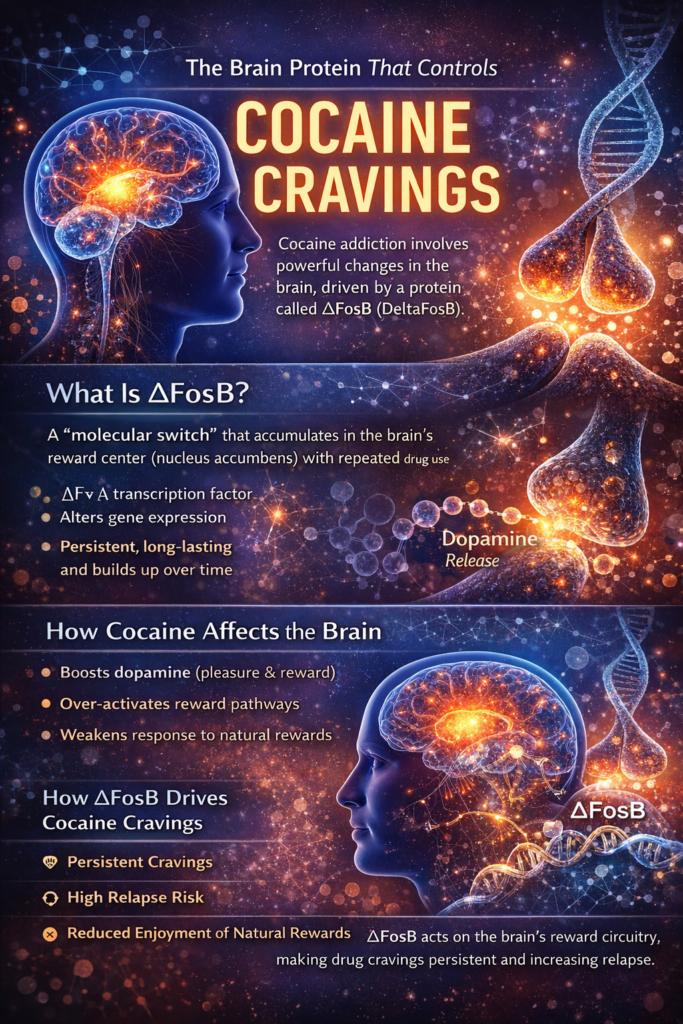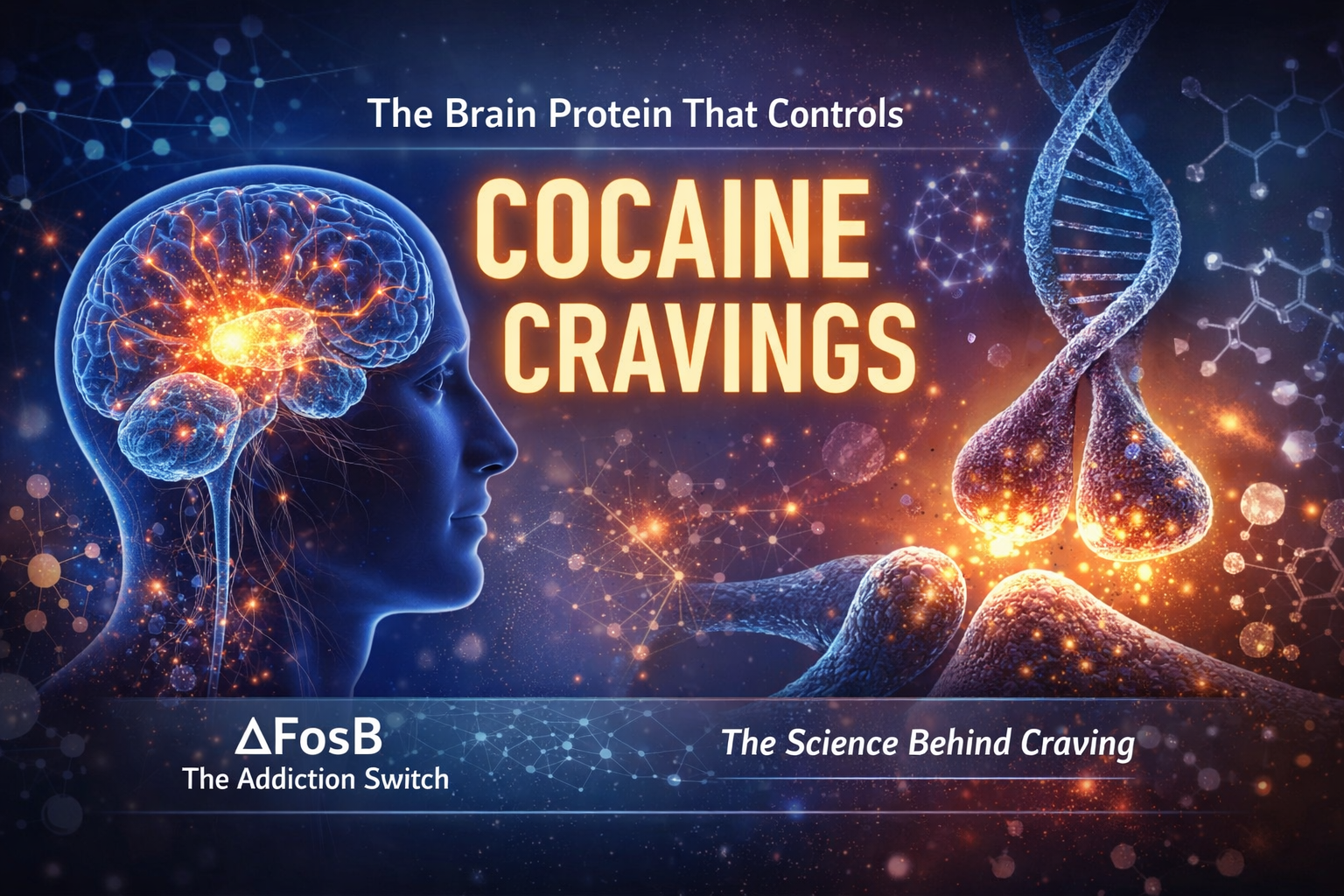
Cocaine addiction is driven by complex changes in brain function that extend far beyond simple behavior or choice. One of the most important discoveries in addiction neuroscience is the role of a protein called ΔFosB (DeltaFosB), which accumulates in the brain’s reward system with repeated drug use. Acting as a transcription factor, ΔFosB alters gene expression in regions such as the nucleus accumbens, strengthening neural pathways associated with reward, motivation, and drug-seeking behavior. These long-lasting changes help explain why cocaine cravings can persist even after periods of abstinence, making relapse a significant challenge and highlighting the biological basis of addiction.
The Brain’s Addiction Switch: How a Protein Controls Cocaine Cravings
Cocaine addiction is not simply a matter of willpower—it is deeply rooted in changes within the brain. One of the most important discoveries in addiction neuroscience is the role of a protein called ΔFosB (DeltaFosB), often described as a “molecular switch” that drives long-term craving and addictive behavior. Understanding how this brain protein works provides valuable insight into why cocaine cravings can persist long after use has stopped—and how future treatments might target these underlying mechanisms.
What Is ΔFosB?
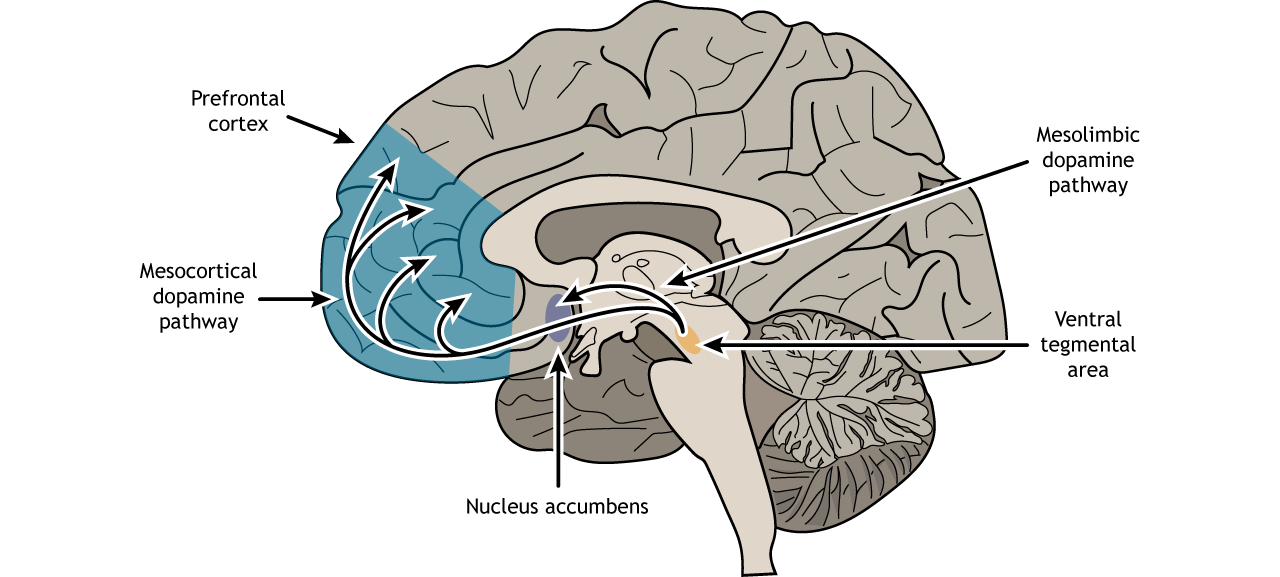
ΔFosB is a transcription factor, meaning it helps control how certain genes are turned on or off in the brain. It accumulates in key areas involved in reward and motivation, particularly the nucleus accumbens, a central part of the brain’s reward system.
Unlike many other proteins, ΔFosB builds up gradually with repeated drug exposure and can remain active for long periods—even after drug use has stopped.
How Cocaine Affects the Brain
Cocaine increases levels of dopamine, a neurotransmitter associated with pleasure and reward. Over time, repeated exposure leads to:
- Changes in how reward pathways function
- Increased sensitivity to drug-related cues
- Reduced responsiveness to natural rewards
This is where ΔFosB plays a critical role—it helps lock in these changes, making them more persistent.
How ΔFosB Drives Cocaine Cravings
As ΔFosB accumulates, it alters gene expression in ways that:
- Increase sensitivity to cocaine and drug cues
- Strengthen neural pathways associated with drug-seeking behavior
- Promote long-term changes in brain structure and function (neuroplasticity)
These changes can lead to:
- Persistent cravings
- Heightened risk of relapse
- Difficulty experiencing pleasure from everyday activities
In essence, ΔFosB helps transform short-term drug use into long-term addiction.
Why Cravings Persist After Quitting
One of the most challenging aspects of cocaine addiction is that cravings can continue long after a person stops using. This is partly because:
- ΔFosB remains active in the brain for extended periods
- Environmental cues (places, people, stress) can reactivate these pathways
- The brain has been “rewired” to prioritize drug-related rewards
This explains why relapse is common and why recovery often requires ongoing support.
Implications for Treatment
Understanding ΔFosB opens the door to new treatment possibilities:
- Targeting molecular pathways to reduce craving intensity
- Developing medications that reverse or regulate these brain changes
- Combining biological treatments with behavioral therapies
Current treatments still rely heavily on:
- Cognitive behavioral therapy (CBT)
- Contingency management
- Support systems and recovery programs
But future therapies may directly address the biological roots of craving.
The Bigger Picture: Addiction as a Brain Disease
The discovery of ΔFosB reinforces the idea that addiction is not a moral failing, but a chronic brain condition involving lasting biological changes. This perspective:
- Reduces stigma
- Encourages evidence-based treatment
- Promotes compassion and understanding
Final Thoughts
The brain protein ΔFosB plays a powerful role in driving cocaine cravings by reshaping the brain’s reward system and reinforcing addictive behaviors. While this makes recovery challenging, it also provides a clearer target for future treatments.
By understanding the science behind addiction, we move closer to more effective interventions—and a more compassionate approach to helping individuals regain control over their lives.
Understanding and Managing Cravings: Self-Management Strategies for Brain-Based Cocaine Addiction
Cocaine addiction is driven not only by behavior but also by powerful biological changes in the brain. One key factor is a protein called ΔFosB (DeltaFosB), which builds up in the brain’s reward system with repeated drug use and contributes to long-lasting cravings. While this may sound discouraging, understanding how the brain works can actually empower individuals to take control of their recovery.
Self-management strategies help bridge the gap between brain science and real-life recovery, allowing individuals to better understand cravings and respond to them effectively.
Why Self-Management Matters in Brain-Based Addiction
Addiction-related changes—like those driven by ΔFosB—can make cravings feel automatic and overwhelming. Self-management helps individuals:
- Recognize cravings as brain-driven, not personal failure
- Develop tools to respond instead of react
- Build new, healthier neural pathways over time
- Stay engaged in long-term recovery
Understanding the biology behind cravings can reduce shame and increase motivation.
Understanding the Brain and Cravings
ΔFosB accumulates in the reward system of the brain, strengthening connections that link cocaine use with pleasure and reinforcement. Over time:
- Triggers (people, places, stress) activate these pathways
- Cravings become more automatic
- Natural rewards feel less satisfying
The good news is that the brain is capable of neuroplasticity, meaning it can change and adapt with new behaviors.
Key Self-Management Strategies
1. 📘 Learn the Science Behind Your Cravings
Understanding ΔFosB and brain changes helps you:
- Reframe cravings as biological signals
- Reduce self-blame
- Stay motivated during difficult moments
Knowledge turns confusion into clarity—and empowers better choices.
2. 📊 Track Triggers and Craving Patterns
Keeping a daily log can help you identify:
- Situations that trigger cravings
- Times of day when urges are strongest
- Emotional states (stress, boredom, loneliness)
Recognizing patterns allows you to anticipate and prepare rather than react.
3. 🧘 Practice “Pause and Respond” Techniques
Cravings often pass if you don’t act on them immediately. Try:
- Deep breathing (inhale 4 seconds, exhale 6 seconds)
- Grounding exercises (focus on your surroundings)
- Waiting 10–15 minutes before making a decision
This helps interrupt automatic brain responses.
4. 🔄 Replace Old Habits with New Rewards
Since ΔFosB strengthens reward pathways, it’s important to build new ones:
- Exercise
- Hobbies or creative activities
- Social connection
- Healthy routines
These activities gradually retrain the brain to find reward in healthier ways.
5. 🗣️ Stay Connected and Communicate
Self-management includes reaching out when needed. Talk to:
- Therapists or counselors
- Support groups
- Trusted friends or family
Sharing experiences reduces isolation and reinforces accountability.
6. ⚖️ Set Realistic Expectations
Because ΔFosB-related changes can persist:
- Cravings may come and go over time
- Recovery is gradual, not immediate
- Setbacks may happen
Progress is still happening—even when it feels slow.
Challenges to Expect
Even with strong self-management:
- Triggers can feel intense
- Motivation may fluctuate
- Environmental cues can reactivate cravings
These challenges are part of the recovery process—not signs of failure.
The Bigger Picture: Rewiring the Brain
Self-management is not just about avoiding relapse—it’s about actively reshaping the brain. Each time you:
- Resist a craving
- Choose a healthier behavior
- Practice coping strategies
You weaken old pathways and strengthen new ones.
Final Thoughts
The discovery of ΔFosB shows that cocaine cravings are deeply rooted in brain biology—but it also highlights the brain’s ability to change. Self-management strategies give individuals the tools to work with their brain, not against it.
Recovery is not about eliminating cravings overnight—it’s about learning how to understand them, manage them, and gradually take back control.
Supporting Recovery at Home: Family Strategies for Understanding Brain-Based Cocaine Cravings
When a loved one struggles with cocaine addiction, families often feel confused, frustrated, or even helpless—especially when cravings persist despite efforts to stop. What many people don’t realize is that these cravings are not simply a matter of choice; they are driven by real biological changes in the brain. One key factor is a protein called ΔFosB (DeltaFosB), which accumulates with repeated drug use and strengthens the brain’s craving and reward pathways.
Understanding this brain-based mechanism can transform how families approach support—shifting from blame to empathy and from frustration to effective involvement.
Why Family Understanding Matters
ΔFosB contributes to long-lasting changes in the brain that:
- Increase sensitivity to drug-related cues
- Strengthen craving pathways
- Make relapse more likely, even after periods of abstinence
When families understand that cravings are biologically driven, they are more likely to respond with compassion instead of judgment.
Key Family Support Strategies
1. 📘 Educate Yourself About Brain-Based Addiction
Learning about ΔFosB and the brain’s reward system helps families:
- Recognize addiction as a medical condition
- Reduce stigma and misconceptions
- Better understand why cravings persist
This knowledge builds patience and realistic expectations.
2. 🗣️ Communicate with Empathy, Not Blame
Cravings can make individuals feel ashamed or discouraged. Supportive communication includes:
- Listening without interrupting or criticizing
- Avoiding statements like “just stop” or “try harder.”
- Using encouraging language
For example:
Instead of “Why can’t you control it?”
Try “I know this is hard—how can I support you?”
3. 🏡 Help Reduce Environmental Triggers
Since ΔFosB makes the brain more sensitive to triggers, families can:
- Help avoid high-risk environments or situations
- Reduce stress and conflict at home
- Encourage structured daily routines
A stable environment can reduce the intensity of cravings.
4. 🤝 Encourage Healthy Coping Strategies
Families can support activities that help “rewire” the brain, such as:
- Exercise or outdoor activities
- Therapy or counseling
- Mindfulness and stress management
- Creative or social activities
These reinforce healthier reward pathways.
5. 🧠 Understand That Recovery Takes Time
Because ΔFosB-related changes can last for months or longer:
- Cravings may come and go
- Progress may feel slow
- Setbacks can occur
Families should focus on long-term support, not quick fixes.
6. ⚖️ Set Healthy Boundaries
Support does not mean enabling harmful behavior. Families should:
- Be clear about expectations
- Avoid covering up or minimizing substance use
- Protect their own well-being
Healthy boundaries create accountability while maintaining care.
Challenges Families May Face
Supporting someone with brain-based addiction can be difficult:
- Frustration when cravings persist
- Emotional exhaustion or burnout
- Misunderstanding relapse as failure
Seeking support—such as family counseling or support groups—can help families stay resilient.
The Bigger Picture: From Blame to Understanding
Understanding the role of ΔFosB shifts the perspective on addiction. Instead of seeing cravings as a lack of effort, families can recognize them as deeply rooted brain changes that require time, support, and consistent effort to overcome.
Final Thoughts
You don’t need to be a neuroscientist to make a difference. By learning, listening, and supporting without judgment, families can help their loved ones navigate cravings and build a path toward recovery.
Addiction may begin in the brain—but recovery is strengthened through connection, understanding, and support.
Community Understanding Matters: Resource Strategies for Brain-Based Cocaine Cravings
Cocaine addiction is often misunderstood as a lack of willpower, but modern neuroscience shows that it is deeply rooted in biological changes within the brain. One key factor is a protein called ΔFosB (DeltaFosB), which accumulates with repeated drug use and strengthens craving and reward pathways. These changes can make cravings persistent and relapse more likely—even after someone has stopped using.
Because of this, addressing cocaine addiction requires more than individual effort. Community resources play a vital role in helping individuals and families understand the science behind cravings and access the support needed for recovery.
Why Community Awareness Is Important
When communities understand that cravings are driven by brain changes like ΔFosB, they can:
- Reduce stigma around addiction
- Promote evidence-based treatment
- Encourage individuals to seek help
- Support long-term recovery efforts
Education transforms addiction from a moral issue into a public health and neuroscience issue.
Key Community Resource Strategies
1. 📢 Promote Public Education on Brain-Based Addiction
Community programs can provide:
- Workshops explaining how addiction affects the brain
- Educational materials about proteins like ΔFosB and craving pathways
- Awareness campaigns that normalize seeking treatment
Clear, science-based education helps people understand why cravings happen.
2. 🏥 Expand Access to Treatment and Support Services
Communities should support access to:
- Addiction treatment programs
- Mental health counseling
- Outpatient and residential care
Because ΔFosB-related changes can persist, ongoing care is essential for managing cravings and preventing relapse.
3. 🤝 Integrate Peer Support Programs
Peer support groups allow individuals to:
- Share experiences with cravings and recovery
- Learn coping strategies from others
- Feel less isolated
Hearing from others who understand brain-based cravings can be incredibly validating.
4. 📋 Provide Case Management and Navigation Services
Navigating treatment can be overwhelming. Community case managers can help individuals:
- Find appropriate treatment programs
- Coordinate care across providers
- Access housing, employment, and social services
These supports address the broader factors that influence recovery.
5. 🏫 Reduce Stigma Through Community Engagement
Stigma is a major barrier to treatment. Communities can:
- Promote addiction as a chronic brain condition
- Encourage open, nonjudgmental conversations
- Share recovery success stories
Reducing stigma makes it easier for individuals to seek and stay in care.
6. 🧠 Support Programs That Build Healthy Alternatives
Since ΔFosB strengthens drug-related reward pathways, communities can help by offering:
- Recreational programs (sports, arts, hobbies)
- Job training and education opportunities
- Social engagement activities
These programs help individuals build new, healthier reward systems.
Challenges to Consider
Community efforts may face:
- Limited funding for addiction services
- Lack of awareness about neuroscience-based addiction
- Persistent stigma and misinformation
Overcoming these barriers requires collaboration between healthcare systems, policymakers, and community organizations.
The Bigger Picture: Community as a Catalyst for Change
Understanding that a brain protein like ΔFosB contributes to cocaine cravings changes how communities respond to addiction. Instead of blaming, communities can focus on education, support, and access to care.
Final Thoughts
Cocaine cravings are not just psychological—they are deeply biological. Community resource strategies that emphasize education, support, and accessibility can help individuals better understand their experiences and stay engaged in recovery.
When communities come together to address addiction as a brain-based condition, they create environments where recovery is not only possible—but supported at every level.
Frequently Asked Questions
Here are some common questions:
1. What is ΔFosB?
Answer:
ΔFosB (DeltaFosB) is a protein in the brain that regulates gene expression. It acts as a transcription factor, meaning it can turn certain genes on or off. It accumulates in areas of the brain linked to reward and motivation, especially with repeated drug use.
2. Where in the brain does ΔFosB act?
Answer:
ΔFosB primarily builds up in the nucleus accumbens, a key part of the brain’s reward system. This region plays a major role in:
- Pleasure
- Motivation
- Reinforcement of behaviors
3. How does cocaine affect ΔFosB levels?
Answer:
Repeated cocaine use causes ΔFosB to accumulate over time. Unlike many proteins that break down quickly, ΔFosB is long-lasting, which allows it to create persistent changes in the brain.
4. How does ΔFosB contribute to cocaine cravings?
Answer:
ΔFosB changes how genes are expressed in the brain, which:
- Strengthens drug-related reward pathways
- Increases sensitivity to cocaine and triggers
- Reinforces drug-seeking behavior
This leads to stronger and more persistent cravings.
5. Why do cravings continue even after stopping cocaine?
Answer:
ΔFosB remains active in the brain for extended periods, even after drug use stops. This means:
- Brain pathways linked to cocaine are still strengthened
- Triggers (stress, environments, people) can reactivate cravings
6. Does ΔFosB affect anything besides drug cravings?
Answer:
Yes. ΔFosB can also:
- Reduce sensitivity to natural rewards (like food or social interaction)
- Alter motivation and mood
- Influence other addictive behaviors
7. Is ΔFosB unique to cocaine addiction?
Answer:
No. ΔFosB is involved in multiple forms of addiction, including:
- Other substances (e.g., opioids, alcohol)
- Behavioral addictions (e.g., gambling)
It plays a general role in reinforcing repeated behaviors.
8. Is addiction just caused by ΔFosB?
Answer:
No. Addiction is complex and involves:
- Multiple brain systems
- Environmental factors
- Psychological and social influences
ΔFosB is one important piece, but not the only factor.
9. Can ΔFosB levels return to normal?
Answer:
Over time, ΔFosB levels can decrease, but this process may be slow. Recovery involves:
- Abstinence from substances
- Behavioral changes
- Support and treatment
The brain can gradually rebalance through neuroplasticity.
10. Are there treatments that target ΔFosB?
Answer:
Currently, there are no widely available treatments that directly target ΔFosB. However, research is ongoing to develop:
- Medications that affect related pathways
- Therapies that help reverse brain changes
11. How does this research help people in recovery?
Answer:
Understanding ΔFosB helps:
- Explain why cravings are strong and persistent
- Reduce stigma (addiction is biological, not just behavioral)
- Guide the development of new treatments
12. Does this mean people have no control over cravings?
Answer:
No. While ΔFosB influences cravings, people can still:
- Learn coping strategies
- Avoid triggers
- Build new habits
The brain can change with time and effort.
13. What role does neuroplasticity play?
Answer:
Neuroplasticity is the brain’s ability to change and adapt. Through recovery:
- New, healthier pathways can form
- Old drug-related pathways can weaken
This is why long-term recovery is possible.
14. Why is relapse common in cocaine addiction?
Answer:
Relapse is often linked to:
- Persistent ΔFosB activity
- Triggered brain pathways
- Environmental cues
This does not mean failure—it reflects the biological nature of addiction.
15. How can someone manage cravings linked to ΔFosB?
Answer:
Helpful strategies include:
- Therapy (e.g., CBT)
- Avoiding triggers
- Building healthy routines
- Support groups
These approaches help weaken craving pathways over time.
16. Does stress affect ΔFosB and cravings?
Answer:
Yes. Stress can activate brain pathways associated with addiction, making cravings stronger and increasing relapse risk.
17. Why is this research important for the future?
Answer:
It may lead to:
- More targeted addiction treatments
- Better understanding of long-term recovery
- Improved prevention strategies
18. What is the key takeaway?
Answer:
Cocaine cravings are not just psychological—they are driven by real, lasting changes in the brain, including the activity of ΔFosB. Understanding this helps shift addiction from a moral issue to a medical and scientific condition.
Conclusion
The role of ΔFosB in controlling cocaine cravings underscores the importance of understanding addiction as a brain-based condition rather than a failure of willpower. By driving long-term changes in the brain’s reward circuitry, this protein contributes to persistent cravings and increased vulnerability to relapse. Recognizing these mechanisms not only reduces stigma but also opens the door for more targeted and effective treatments that address the underlying biology of addiction. As research continues to evolve, insights into ΔFosB and similar processes may lead to innovative strategies that support long-term recovery and improved outcomes for individuals affected by cocaine use disorder.
Video: