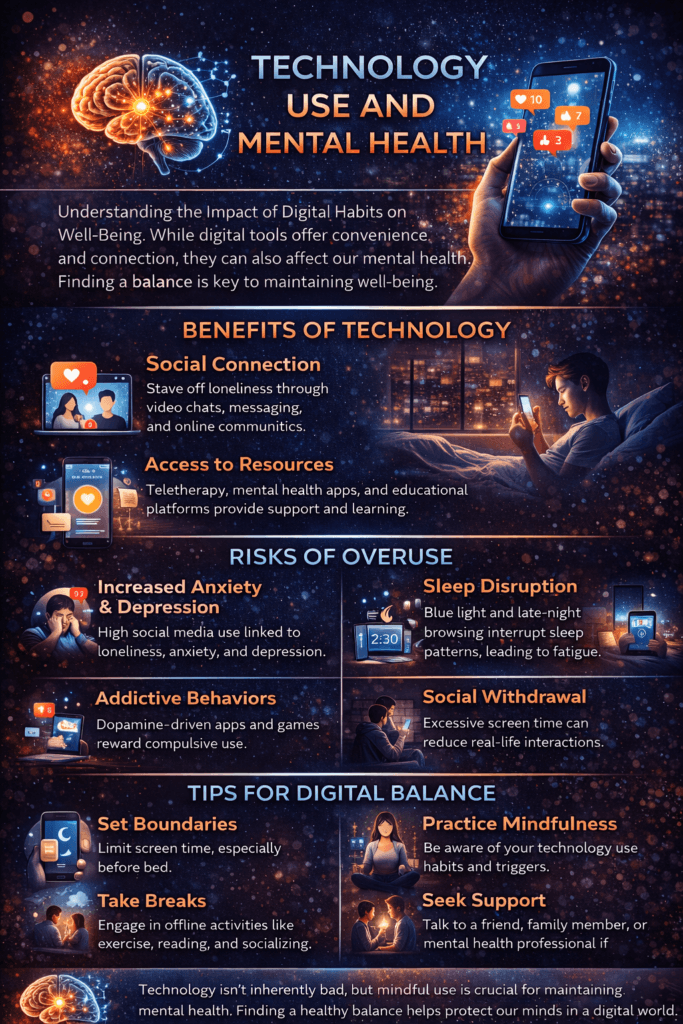
Technology plays a central role in modern life, shaping how people communicate, work, learn, and relax. While smartphones, social media, and digital platforms provide connection and convenience, excessive or unstructured use can contribute to anxiety, depression, sleep disruption, and attention difficulties. Understanding technology’s impact on mental health requires a balanced view that recognizes both its benefits and the risks of overuse.
Technology Use and Mental Health
Navigating the Digital Age with Awareness and Balance
Technology has become deeply embedded in modern life. Smartphones, social media platforms, streaming services, online gaming, and remote work tools shape how we communicate, learn, work, and relax. While digital innovation has expanded access to information and connection, it has also introduced new challenges for psychological well-being. Understanding the relationship between technology use and mental health requires nuance — recognizing both its benefits and its risks.
The Benefits of Technology for Mental Health
Technology is not inherently harmful. In many cases, it enhances well-being:
1. Social Connection
Video calls, messaging apps, and online communities help individuals maintain relationships across distance. For people who are geographically isolated or physically limited, digital communication reduces loneliness.
2. Access to Mental Health Resources
Teletherapy, mental health apps, and online psychoeducation platforms increase access to care. Individuals who once faced barriers such as stigma, transportation, or cost may now find support more easily.
3. Educational and Professional Opportunities
Remote learning and digital workspaces allow flexibility and skill development. For many, technology improves productivity and career mobility.
4. Creative Expression
Digital platforms enable artistic creation, content production, and collaborative projects that foster identity and self-expression.
When used intentionally, technology can support resilience, learning, and connection.
The Psychological Risks of Excessive Technology Use
Problems arise when technology use becomes excessive, compulsive, or emotionally dependent.
1. Increased Anxiety and Depression
Excessive social media use has been associated with higher levels of anxiety, depressive symptoms, and negative self-comparison. Curated online identities can distort perceptions of reality and self-worth.
2. Sleep Disruption
Blue light exposure and late-night scrolling interfere with circadian rhythms, reducing sleep quality and increasing irritability and mood instability.
3. Attention Fragmentation
Constant notifications fragment focus, impair deep work, and increase cognitive fatigue. Over time, this may reduce productivity and increase stress.
4. Behavioral Addictions
Certain digital behaviors — gaming, social media scrolling, online shopping — can activate dopamine reward pathways, reinforcing repetitive engagement and impairing impulse control.
5. Social Withdrawal
Paradoxically, excessive online engagement can reduce in-person interaction, contributing to loneliness and weakened social skills.
Why Technology Is So Engaging
Digital platforms are designed to maximize engagement. Algorithms analyze user behavior to personalize content and sustain attention. Features such as likes, comments, streaks, ranking systems, and notifications activate the brain’s reward circuitry.
Intermittent reinforcement — unpredictable rewards delivered at variable intervals — is particularly powerful. This mechanism, commonly used in gaming and social media design, increases habitual checking behaviors.
Understanding this design psychology reduces self-blame and increases informed decision-making.
Who Is Most Vulnerable?
Certain populations may be more sensitive to negative mental health effects:
- Adolescents (developing impulse control systems)
- Individuals with ADHD
- Those experiencing depression or anxiety
- People facing social isolation
- Individuals with low self-esteem
Adolescence is especially critical because identity formation and social comparison are heightened during this stage.
Signs of Problematic Technology Use
Warning signs may include:
- Difficulty limiting screen time
- Neglect of responsibilities
- Sleep disruption
- Irritability when offline
- Constant checking behaviors
- Reduced face-to-face interaction
- Increased anxiety after social media use
The key factor is not usage alone, but whether technology use interferes with functioning and well-being.
Strategies for Healthy Digital Balance
Promoting healthy technology use involves intentional boundaries:
1. Set Structured Screen Time
Establish device-free periods, particularly before bedtime.
2. Practice Digital Mindfulness
Ask: “Why am I picking up this device right now?” Awareness interrupts automatic behavior.
3. Turn Off Nonessential Notifications
Reducing alerts lowers stress and attention fragmentation.
4. Create Screen-Free Zones
Bedrooms and family meals are ideal device-free spaces.
5. Diversify Reward Systems
Engage in offline activities such as exercise, hobbies, social gatherings, or creative projects.
6. Prioritize Sleep Hygiene
Avoid screens at least 60 minutes before sleep.
The Importance of Balanced Perspective
Technology is not the enemy of mental health. It is a tool. Its impact depends on how it is used, the individual’s vulnerability factors, and the presence of boundaries.
Demonizing technology overlooks its capacity to connect, educate, and support. Ignoring its risks overlooks genuine psychological harm in cases of overuse.
Final Reflection
The relationship between technology use and mental health is complex, evolving, and deeply intertwined with modern life. As digital environments continue to expand, the challenge is not to eliminate technology, but to engage with it intentionally and responsibly.
Awareness, structured limits, and emotional self-regulation are essential in maintaining digital balance. By shifting from reactive consumption to mindful use, individuals can harness the benefits of technology while protecting their psychological well-being.
Self-Management Strategies for Technology Use and Mental Health
Building Digital Balance in a Hyperconnected World
Technology is woven into nearly every aspect of daily life — from work and education to entertainment and social interaction. While digital tools offer connection and convenience, excessive or unstructured use can contribute to anxiety, sleep disruption, reduced concentration, and emotional fatigue. The goal of self-management is not to eliminate technology, but to use it intentionally rather than compulsively.
Below are evidence-informed strategies to help individuals regulate technology use while protecting mental health.
1. Increase Awareness Through Digital Self-Monitoring
Behavioral change begins with awareness.
Practical Steps:
- Review daily or weekly screen-time reports.
- Identify peak usage periods.
- Track emotional states before and after device use.
- Notice which apps consume the most time.
Often, individuals underestimate their actual screen time. Objective tracking activates self-regulation and reduces automatic scrolling.
2. Set Structured Time Boundaries
Unrestricted access increases impulsive checking behaviors.
Practical Strategies:
- Designate device-free hours (e.g., first hour after waking, last hour before bed).
- Use app timers or digital wellbeing settings.
- Schedule intentional “online blocks” rather than continuous access.
- Establish one full or partial “digital detox” period weekly.
Boundaries reduce decision fatigue and protect cognitive bandwidth.
3. Optimize Sleep Hygiene
Late-night screen exposure disrupts circadian rhythms and melatonin production.
Recommendations:
- Stop screen use at least 60 minutes before bedtime.
- Remove devices from the bedroom if possible.
- Replace scrolling with calming rituals (reading, journaling, stretching).
- Use night-mode settings to reduce blue light if necessary.
Improved sleep enhances mood stability and impulse control.
4. Practice Digital Mindfulness
Many technology habits are driven by unconscious triggers.
Before picking up a device, pause and ask:
- What am I feeling right now?
- What am I hoping this will provide?
- Is this aligned with my current priorities?
Common triggers include boredom, stress, loneliness, and procrastination. Recognizing emotional drivers reduces compulsive use.
5. Reduce Environmental Cues
Technology use is often cue-dependent.
Modify the Environment:
- Turn off nonessential notifications.
- Remove social media apps from the home screen.
- Keep phones out of reach during focused work.
- Create screen-free spaces (e.g., a dining table or study desk).
Environmental design reduces reliance on willpower.
6. Rebuild Offline Reward Systems
Digital platforms provide quick dopamine rewards through likes, notifications, and content updates. To balance this:
- Engage in physical exercise.
- Pursue creative hobbies.
- Strengthen face-to-face social interactions.
- Practice mindfulness or meditation.
- Set small daily achievement goals offline.
Diversifying reward sources decreases psychological dependency on screens.
7. Address Emotional Regulation Skills
Excessive technology use often functions as emotional avoidance.
Develop alternative coping strategies for:
- Stress (deep breathing, movement)
- Loneliness (calling a friend)
- Anxiety (grounding exercises)
- Boredom (structured task lists)
Technology should supplement coping — not replace it.
8. Strengthen Attention and Focus
Constant digital interruptions fragment attention.
Try:
- The Pomodoro technique (25 minutes focused work, 5-minute break).
- Single-tasking rather than multitasking.
- “Notification batching” — checking messages at designated times.
- Using focus apps that block distractions.
Training sustained attention improves productivity and reduces stress.
9. Seek Professional Support if Needed
If technology use leads to:
- Significant anxiety or depression
- Sleep deprivation
- Academic or occupational decline
- Relationship strain
- Inability to reduce usage despite attempts
Professional counseling may be beneficial. Cognitive Behavioral Therapy (CBT) can help address underlying thought patterns and behavioral reinforcement cycles.
Final Reflection
Technology is not inherently harmful — it is a powerful tool shaped by how we use it. Self-management strategies emphasize awareness, structure, emotional regulation, and balanced reward systems.
Digital wellness is not about perfection or complete abstinence. It is about intentional engagement. By shifting from reactive scrolling to mindful usage, individuals can protect their mental health while still benefiting from the opportunities technology provides.
Healthy technology use is not defined by the absence of screens — but by the presence of control.
Family Support Strategies for Technology Use and Mental Health
Creating a Healthy Digital Environment at Home
Technology is now embedded in family life — from school assignments and remote work to entertainment and social connection. While digital tools offer undeniable benefits, unstructured or excessive use can contribute to sleep disruption, anxiety, attention difficulties, and social withdrawal. Families play a critical role in shaping how technology is used and its impact on mental health.
Healthy digital habits are not built through control alone, but through structure, modeling, communication, and emotional support. Below are evidence-informed family strategies that promote balanced technology use while protecting psychological well-being.
1. Establish Clear and Consistent Digital Boundaries
Children and adolescents benefit from predictable structure.
Practical Guidelines:
- Set daily or weekly screen-time limits.
- Create device-free zones (e.g., dining table, bedrooms).
- Establish a digital curfew before bedtime.
- Require responsibilities (homework, chores) before recreational screen time.
Consistency reduces negotiation fatigue and prevents conflict escalation.
2. Model Healthy Technology Use
Children are more influenced by what they observe than what they are told.
Parents and caregivers can model:
- Putting phones away during conversations.
- Avoiding screens during meals.
- Taking intentional digital breaks.
- Managing work-related technology boundaries.
When adults demonstrate balanced habits, limits feel less punitive and more collaborative.
3. Maintain Open Communication About Digital Experiences
Rather than focusing solely on restrictions, families should discuss:
- What platforms are being used?
- What do children enjoy about them?
- Have they experienced cyberbullying or online pressure?
- How do they feel after using certain apps?
Curiosity reduces defensiveness. Open dialogue builds trust and allows early identification of emotional distress.
4. Protect Sleep and Mental Recovery Time
Late-night screen use is strongly associated with mood instability, irritability, and poor concentration.
Family Strategies:
- Remove devices from bedrooms at night.
- Use charging stations outside sleeping areas.
- Encourage wind-down routines (reading, stretching, journaling).
- Prioritize consistent bedtimes.
Sleep is a foundational protective factor for mental health.
5. Encourage Offline Activities and Social Interaction
Technology often fulfills needs for entertainment, belonging, and achievement. Families can diversify these rewards by:
- Scheduling regular outdoor activities.
- Encouraging sports or creative hobbies.
- Hosting screen-free family nights.
- Supporting community involvement.
When offline activities are engaging and rewarding, screens lose their dominance.
6. Teach Emotional Regulation Skills
Excessive technology use often functions as emotional avoidance.
Families can teach children to identify and manage emotions by:
- Naming feelings clearly (“You seem frustrated.”).
- Practicing coping skills (deep breathing, movement).
- Problem-solving together.
- Encouraging direct communication instead of retreating into devices.
Technology should supplement emotional coping — not replace it.
7. Monitor Without Micromanaging
Over-surveillance can damage trust, while no supervision increases risk.
Balanced monitoring includes:
- Reviewing screen-time reports together.
- Discussing online safety and privacy.
- Checking for behavioral changes (sleep, mood, school performance).
Focus on well-being rather than punishment.
8. Recognize Warning Signs of Problematic Use
Families should be attentive to:
- Sleep disruption
- Irritability when devices are removed
- Withdrawal from in-person interaction
- Decline in academic performance
- Increased anxiety or depressive symptoms
If these signs persist, professional support may be appropriate.
9. Seek Professional Support When Necessary
If technology use significantly interferes with functioning, family counseling or individual therapy can help address:
- Underlying anxiety or depression
- Attention difficulties
- Family communication patterns
- Emerging behavioral addictions
Early intervention improves outcomes and prevents escalation.
Final Reflection
Technology is not inherently harmful — but it requires intentional structure within the family system. When families combine clear boundaries, healthy modeling, emotional openness, and offline engagement, they create an environment where digital tools enhance life rather than dominate it.
Healthy technology habits are built through connection, not control. By fostering communication, consistency, and compassion, families can support mental health while navigating the realities of a digitally connected world.
Community Resource Strategies for Technology Use and Mental Health
Building Collective Support for Healthy Digital Living
Technology shapes how communities learn, work, communicate, and socialize. While digital tools increase access to information and connection, excessive or unstructured use can contribute to anxiety, depression, sleep disruption, attention problems, and social isolation. Because technology is embedded in schools, workplaces, healthcare systems, and entertainment industries, promoting digital wellness requires more than individual effort — it requires community-wide strategies.
Community resources play a vital role in prevention, education, early intervention, and support. Below are key strategies communities can implement to protect and strengthen mental health in a technology-driven era.
1. School-Based Digital Literacy Programs
Schools are central to shaping technology habits among children and adolescents.
Effective school initiatives include:
- Digital literacy education (understanding algorithms and persuasive design)
- Lessons on social media comparison and self-esteem
- Screen-time management workshops
- Anti-cyberbullying campaigns
- Mindfulness and attention training programs
When students understand how platforms are engineered to capture attention, they are better equipped to regulate their use.
2. Community Mental Health Services
Local clinics and nonprofit organizations can provide:
- Therapy for anxiety, depression, or technology-related behavioral concerns
- Group counseling for digital overuse
- Family therapy focused on technology boundaries
- Screening and early intervention programs
Accessible, sliding-scale services increase equity in mental health care.
3. Public Awareness Campaigns
Community awareness initiatives can reduce stigma and increase education.
Examples include:
- Digital wellness awareness weeks
- Public lectures by mental health professionals
- Social media campaigns promoting healthy screen habits
- Parent training seminars on adolescent technology use
When digital health becomes a public conversation, individuals are more likely to seek help early.
4. Youth and Recreational Programs
Excessive technology use often replaces offline stimulation and a sense of belonging. Community programs can provide alternatives:
- Sports leagues
- Arts and music workshops
- Volunteer programs
- Outdoor adventure clubs
- Community service projects
Structured activities diversify sources of reward and reduce dependence on digital engagement.
5. Workplace Digital Wellness Policies
Employers can promote mental health by:
- Encouraging email boundaries after work hours
- Limiting unnecessary digital meetings
- Offering mental health days
- Providing employee assistance programs (EAPs)
- Hosting workshops on stress and screen fatigue
Workplace culture significantly influences adult technology habits.
6. Healthcare Provider Involvement
Primary care providers, pediatricians, and nurses can screen for:
- Sleep disruption
- Anxiety related to social media
- Attention difficulties
- Behavioral overuse of digital platforms
Community training for healthcare professionals increases early detection.
7. Libraries and Community Centers as Digital Balance Hubs
Local libraries and community centers can host:
- Screen-free community events
- Workshops on mindful technology use
- Support groups for parents
- After-school enrichment programs
These institutions often serve as accessible, trusted community anchors.
8. Policy and Advocacy Initiatives
At a broader level, community advocacy can address:
- Transparent data usage policies
- Regulation of addictive design features
- Age-appropriate digital protections
- Funding for research on technology and mental health
- Public investment in youth programs
Public policy shapes the digital ecosystem and influences community norms.
Why Community Strategies Matter
Technology use is not simply a private issue. It is influenced by school expectations, workplace demands, peer culture, marketing strategies, and public infrastructure. Without community-level interventions, individuals are left to navigate highly engineered digital environments on their own.
Community resources provide:
- Education
- Prevention
- Early intervention
- Affordable treatment
- Structured alternatives
- Social accountability
Collective action strengthens resilience.
Final Reflection
Promoting healthy technology use is a shared responsibility. While individuals and families play essential roles, community systems determine whether digital engagement enhances well-being or contributes to psychological strain.
Through coordinated efforts across schools, healthcare systems, workplaces, recreation programs, and policy initiatives, communities can foster digital environments that support — rather than undermine — mental health.
In a world shaped by screens, community support is the foundation of sustainable digital balance.
Frequently Asked Questions
Here are some common questions:
1. How does technology affect mental health?
Technology can have both positive and negative effects. It can enhance social connection, increase access to mental health resources, and support education and productivity. However, excessive or unstructured use may contribute to anxiety, depression, sleep disruption, attention difficulties, and social comparison.
2. Is technology inherently harmful?
No. Technology itself is neutral. Its impact depends on how, when, and why it is used. Intentional, balanced engagement is generally beneficial, while compulsive or emotionally dependent use can negatively affect well-being.
3. Can social media increase anxiety or depression?
Research suggests that heavy social media use is associated with higher levels of anxiety and depressive symptoms in some individuals. Contributing factors include social comparison, cyberbullying, unrealistic body image standards, and constant exposure to curated lifestyles.
4. Why is technology so hard to put down?
Digital platforms are designed to maximize engagement. Features such as notifications, likes, streaks, and personalized content activate the brain’s dopamine reward system. Variable rewards—unpredictable likes or updates—reinforce repeated checking behaviors.
5. How does technology impact sleep?
Blue light from screens suppresses melatonin production, delaying sleep onset. Late-night scrolling or gaming can also increase mental stimulation, making it harder to relax. Poor sleep is strongly linked to mood instability, irritability, and decreased concentration.
6. Who is most vulnerable to negative mental health effects?
Certain populations may be more vulnerable, including:
- Adolescents (due to ongoing brain development)
- Individuals with ADHD
- Those experiencing depression or anxiety
- People who feel socially isolated
- Individuals with low self-esteem
Adolescents are particularly sensitive to social comparison and peer validation online.
7. What are the warning signs of problematic technology use?
Common warning signs include:
- Difficulty limiting screen time
- Irritability when offline
- Sleep disruption
- Decline in academic or work performance
- Withdrawal from in-person relationships
- Using devices to avoid emotions or responsibilities
The key indicator is functional impairment, not just hours of use.
8. Can technology ever improve mental health?
Yes. Technology can:
- Connect individuals to support networks
- Provide teletherapy services
- Offer mental health apps and coping tools
- Reduce loneliness through communication
- Facilitate educational and creative opportunities
When used mindfully, it can strengthen resilience and access to care.
9. What is digital burnout?
Digital burnout refers to emotional exhaustion caused by prolonged screen exposure, constant notifications, remote work fatigue, and information overload. Symptoms may include irritability, mental fatigue, reduced motivation, and difficulty concentrating.
10. How can someone create healthier technology habits?
Strategies include:
- Setting screen-time limits
- Creating device-free zones
- Turning off nonessential notifications
- Avoiding screens before bedtime
- Engaging in offline hobbies
- Practicing digital mindfulness (asking why you’re using a device)
Small, consistent changes are more sustainable than extreme restrictions.
11. Should parents limit their children’s screen time?
Yes, but with balance. Clear boundaries, open communication, and modeling healthy technology use are more effective than strict punishment. Parents should also discuss online safety, cyberbullying, and emotional experiences related to digital platforms.
12. When should someone seek professional help?
Professional help may be appropriate if:
- Technology use significantly interferes with daily life
- There are symptoms of anxiety or depression
- Sleep is severely disrupted
- Attempts to reduce screen time repeatedly fail
- Social withdrawal becomes extreme
Therapy can help address both behavioral patterns and underlying emotional triggers.
13. Is a “digital detox” necessary?
A full digital detox is not always required. For many people, structured boundaries and mindful use are more realistic and sustainable than complete abstinence. However, short breaks from screens can reset habits and improve awareness.
14. How can workplaces support mental health related to technology use?
Employers can:
- Encourage email boundaries outside work hours
- Reduce unnecessary digital meetings
- Promote mental health days
- Provide employee assistance programs (EAPs)
- Offer digital wellness training
Organizational culture plays a significant role in technology-related stress.
Final Thought
Technology is an essential part of modern life, but balance is critical. By understanding its psychological effects, recognizing warning signs, and implementing structured strategies, individuals and families can benefit from digital tools while protecting mental well-being. Awareness and intentional use—not avoidance—are the foundations of healthy technology engagement.
Conclusion
The connection between technology use and mental health is complex and evolving. Technology itself is not inherently harmful; rather, its impact depends on how, when, and why it is used. Intentional engagement, structured boundaries, and emotional awareness are essential in maintaining digital balance. By promoting digital literacy, healthy habits, and supportive family and community environments, individuals can harness the advantages of technology while minimizing its psychological risks. Ultimately, protecting mental health in a digital age requires mindful use, informed decision-making, and a commitment to balance rather than avoidance.
Video: This Is Why You Feel So Anxious #TechAndMentalHealth #DigitalDetox #StressRelief