Talking to children about addiction can feel difficult, but it’s one of the most important conversations families can have. Children are naturally curious, and they’re exposed early to messages about alcohol, drugs, and coping through media, peers, or family life. Addressing addiction in an honest, age-appropriate way helps them understand it as a health condition, not a moral failure. Open conversations build trust, emotional awareness, and resilience—equipping children to make informed choices and respond compassionately to others. However, stigma often prevents these discussions, as many families fear judgment, misunderstanding, or saying the wrong thing. Overcoming that silence begins with education, empathy, and the belief that knowledge protects more than it harms.
How to Talk to Kids About Addiction
Building Understanding, Safety, and Trust Through Honest Conversation
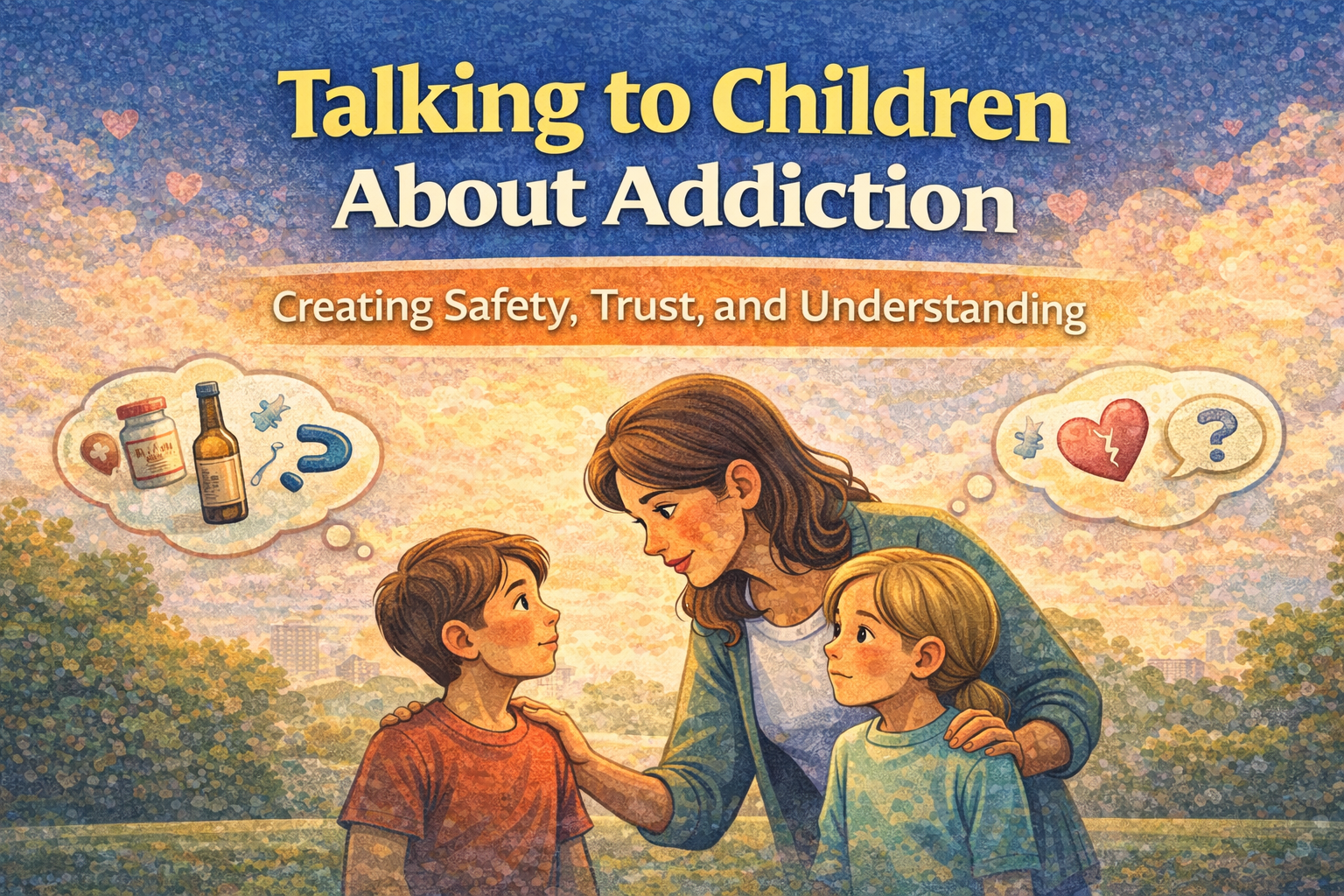
Addiction affects many families and communities, yet it is often a difficult topic to discuss with children. Whether a child has witnessed addiction in the family, heard about drugs at school, or seen substance use in media, curiosity and confusion naturally arise. Avoiding the conversation can leave children to form their own interpretations, which may be inaccurate or frightening. Learning how to talk to kids about addiction in an age-appropriate, honest, and supportive way builds trust, emotional safety, and long-term prevention.
Why These Conversations Matter
Children who understand addiction as a health issue — rather than a moral failure — are more likely to develop empathy, seek help when needed, and make informed decisions later in life. Early conversations also reduce shame, secrecy, and fear if addiction exists within the family.
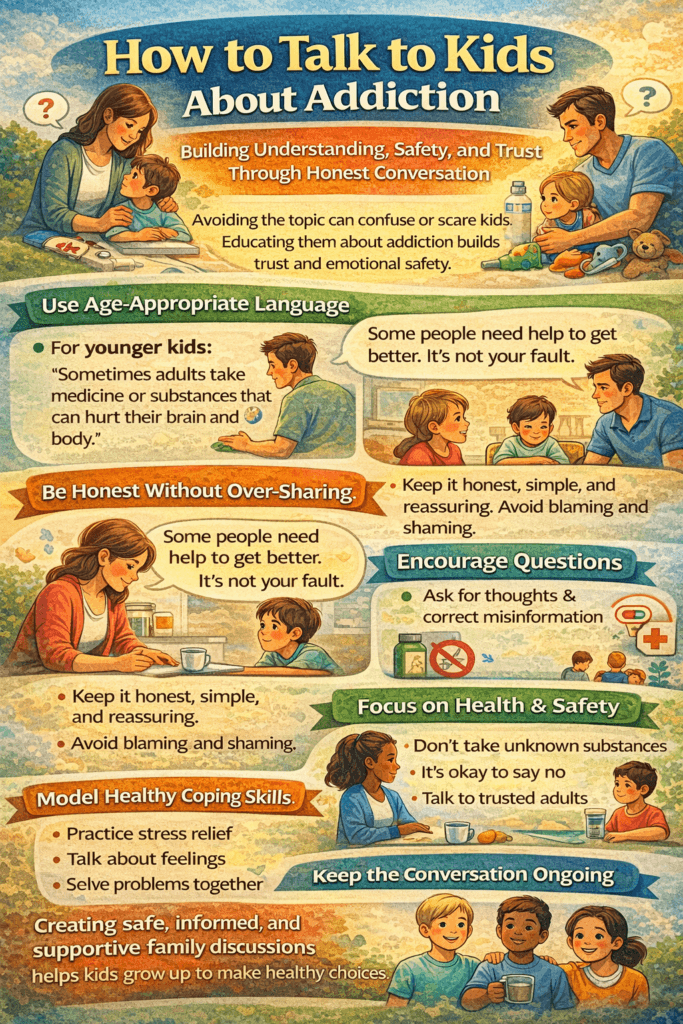
Start With Age-Appropriate Language
Young children need simple explanations. Teens can handle more detailed discussions. The goal is clarity without overwhelming detail.
For younger children:
“Sometimes adults take medicine or substances that can hurt their brain and body. When that happens, they need help from doctors.”
For older children and teens:
“Addiction happens when someone cannot stop using a substance even when it causes harm. It changes how the brain works.”
Avoid graphic details. Focus on safety and care.
Be Honest Without Over-Sharing
Children need truthful answers, but they do not need adult-level information about family trauma, conflict, or past events. Share facts calmly and answer questions directly. If addiction exists in the family, reassure them that they are not to blame.
Encourage Questions
Invite curiosity. Ask:
“What have you heard about drugs or alcohol?”
“What questions do you have?”
This helps correct misinformation early.
Focus on Health and Safety
Frame addiction as a health condition that affects the brain and behavior. Discuss ways to stay safe:
Not taking unknown substances
Saying no to peer pressure
Talking to trusted adults when worried
Prevention grows from understanding, not fear.
Model Healthy Coping Skills
Children learn more from behavior than words. Demonstrating stress management, emotional expression, and problem-solving teaches them healthier coping strategies.
Address Emotions
If addiction has affected the family, children may feel confused, scared, or angry. Acknowledge these feelings and reassure them that help exists and that they are safe.
Keep the Conversation Ongoing
One talk is not enough. Revisit the topic as children grow. Adjust explanations with age and maturity.
When to Seek Support
If a child shows anxiety, withdrawal, behavior changes, or fear related to addiction in the home, consider speaking with a school counselor, pediatrician, or family therapist.
Final Thought
Talking to kids about addiction is not about having the perfect words — it is about creating a safe space for honesty, trust, and learning. When children feel informed, supported, and emotionally secure, they grow into adults who can make healthy choices and seek help without shame.
Why It Is Important to Discuss Addiction With Children
Replacing Fear and Silence With Understanding and Safety
Children are naturally observant. They notice changes in behavior, mood, routines, and family dynamics — even when adults try to hide difficulties. When addiction exists in a family or community but is never explained, children are left to form their own interpretations, which often leads to fear, confusion, or self-blame. Honest, age-appropriate conversations protect children emotionally and support long-term prevention.
1. Reduces Fear and Confusion
Without explanation, children may think they caused a parent’s behavior or that something is dangerously wrong but unspoken. Simple, truthful information provides reassurance and emotional security.
2. Prevents Self-Blame
Many children internalize addiction-related problems. Discussing addiction openly helps them understand that addiction is a health condition — not their fault.
3. Builds Trust in the Family
When adults communicate honestly, children feel safe asking questions and sharing concerns. This strengthens long-term family connections.
4. Encourages Healthy Coping Skills
Conversations about addiction naturally open discussions about stress, emotions, and problem-solving — teaching children how to manage challenges without harmful behaviors.
5. Promotes Early Prevention
Children who learn accurate information about addiction are less likely to experiment with substances later. Knowledge protects future decision-making.
6. Reduces Stigma
Talking openly teaches children that addiction is a medical and mental-health issue — not a moral failure — reducing shame in seeking help later in life.
7. Helps Children Feel Emotionally Safe
When children understand what is happening around them, anxiety decreases and emotional resilience increases.
8. Encourages Help-Seeking Behavior
Kids who grow up knowing it is okay to talk about difficult topics are more likely to ask for support when they need it.
Final Thought
Discussing addiction with children is not about burdening them with adult problems — it is about giving them truth in a safe, supportive way. When children are informed, reassured, and emotionally supported, they grow into adults who make healthy choices and seek help without fear or shame.
The Stigma of Discussing Addiction With Children
Why Families Avoid the Conversation — and Why That Needs to Change
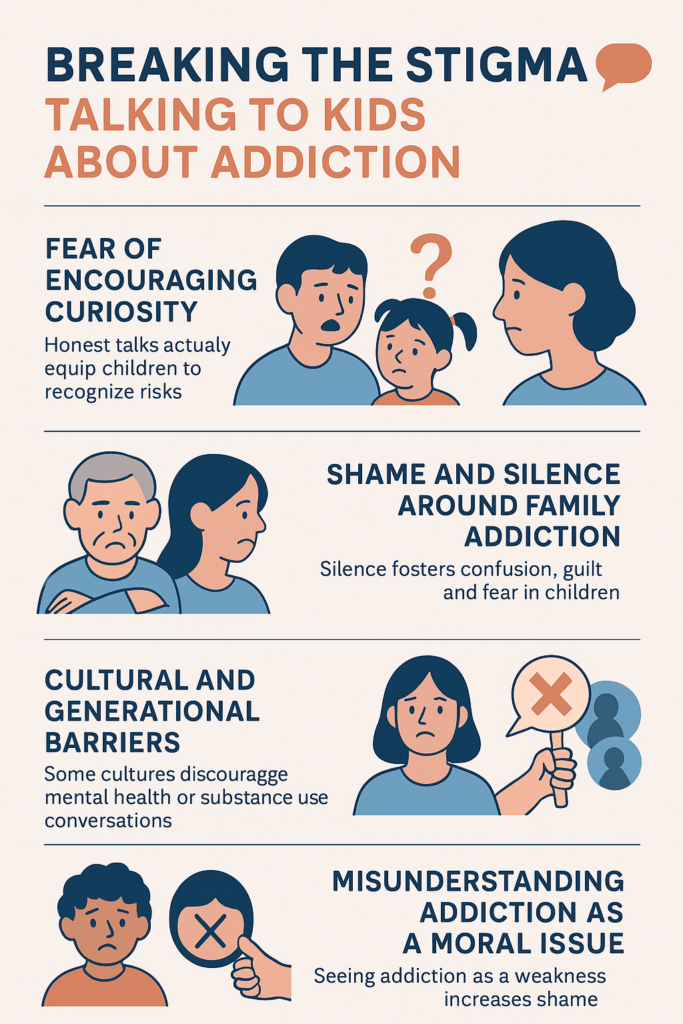
Addiction is often surrounded by silence, shame, and misunderstanding. When children are involved, many parents and caregivers feel unsure, fearful, or embarrassed to talk about it. This hesitation creates stigma — the belief that addiction is something to hide rather than a health issue to understand. Unfortunately, avoiding these conversations can leave children confused, anxious, and vulnerable to misinformation.
Sources of Stigma
Shame and Guilt
Families may feel responsible for addiction in the home and fear being judged. This leads to secrecy instead of open discussion.
Fear of Scaring Children
Adults worry that talking about addiction will frighten kids or expose them to adult problems too early.
Misbelief That Children “Won’t Understand”
Some believe kids are too young to grasp addiction, underestimating their ability to process honest, age-appropriate explanations.
Cultural and Social Judgment
Addiction is still viewed by many as a moral failure rather than a medical condition, increasing embarrassment.
Fear of Legal or Social Consequences
Parents may fear intervention by authorities or social services if addiction is disclosed.
Effects of Stigma on Children
When addiction is hidden:
Children may blame themselves
They may feel isolated or confused
They may develop anxiety or mistrust
They may believe addiction is something shameful
They may lack the knowledge to make healthy choices later
Silence often causes more harm than age-appropriate honesty.
Breaking the Stigma
Open, compassionate, and factual conversations:
Teach children that addiction is a health condition
Normalize asking for help
Build trust in family relationships
Encourage prevention and safety awareness
Reduce shame in future help-seeking
Final Thought
Discussing addiction with children is not about revealing adult details — it is about replacing secrecy with understanding. When families and communities treat addiction as a topic of health rather than shame, children grow up informed, emotionally secure, and empowered to make healthy choices.
Community Resource Strategies for Talking to Kids About Addiction
Creating Supportive Environments for Honest and Healthy Conversations
Talking to children about addiction is easier and more effective when families are supported by schools, healthcare systems, and community programs. Community resources help parents, caregivers, and educators provide age-appropriate education, emotional support, and early prevention tools that protect children from misinformation, fear, and stigma.
1. School-Based Education Programs
Schools can offer:
Drug and alcohol education curricula
Life-skills and emotional-regulation classes
Peer-support and mentorship programs
Safe spaces for children to ask questions
Early school education normalizes honest, stigma-free conversations.
2. Parent Education Workshops
Community centers, libraries, and health departments often provide:
Workshops on how to talk to kids about addiction
Guidance on age-appropriate language
Strategies for answering difficult questions
These programs empower parents with confidence and skills.
3. Pediatric and Healthcare Provider Support
Pediatricians and family doctors can:
Screen children for stress related to family addiction
Offer guidance on developmentally appropriate explanations
Refer families to counseling if needed
Healthcare settings provide trusted professional guidance.
4. Family Counseling Services
Community mental health centers offer:
Family therapy
Child-focused counseling
Support for families affected by addiction
These services help children process emotions safely.
5. Youth Support Groups
Programs such as:
Alateen
Children of Addiction support groups
School-based peer groups
allow kids to share experiences with others who understand.
6. Faith-Based and Cultural Community Programs
Churches, cultural centers, and youth organizations often provide:
Trusted mentors
Safe discussion spaces
Values-based education on health and coping
These spaces foster belonging and guidance.
7. Public Awareness Campaigns
Community addiction-prevention campaigns provide:
Kid-friendly educational materials
Parent toolkits
Online videos and storybooks
Accessible media reinforces accurate information.
8. Library and Online Resource Hubs
Public libraries and community websites may offer:
Recommended children’s books about addiction
Parent reading guides
Links to reputable prevention websites
Easy access to reliable information reduces confusion.
9. Crisis and Helpline Services
Hotlines and text-lines give children and parents:
Immediate emotional support
Confidential guidance
Referral to local services
Important for families facing active addiction.
10. Recovery Community Outreach Programs
Recovery organizations often provide:
Family-friendly community events
Open recovery meetings
Educational family nights
These normalize recovery and reduce shame.
Community Connection Protects Children
When communities provide education, counseling, mentorship, and safe spaces, children learn that addiction is a health issue — not a secret or a source of fear. Supported families raise informed, resilient kids who know how to ask for help and make healthy choices.
Frequently Asked Questions
Here are some common questions:
1. At what age should I start talking to my child about addiction?
Conversations can begin as early as preschool age using simple, age-appropriate language. Early discussions focus on health and safety, while more detailed explanations can be added as children mature.
2. Will talking about addiction put ideas in my child’s head?
No. Research shows that honest, age-appropriate education actually reduces curiosity-driven experimentation later. Silence and secrecy create more confusion than education does.
3. How do I explain addiction in simple terms?
For young children:
“Sometimes people take things that can make their brains sick and make it hard for them to stop. Doctors help them get better.”
For older children:
“Addiction happens when someone keeps using a substance even when it causes harm because their brain becomes dependent on it.”
4. Should I tell my child if a family member has an addiction?
If addiction affects the child’s life, honesty is best. Share information calmly, avoid blaming language, and reassure the child that they are safe and not responsible for the problem.
5. How much detail is too much?
Children need truth, not trauma details. Avoid graphic stories, adult relationship conflicts, or legal issues. Focus on health, safety, and reassurance.
6. What if my child becomes upset or anxious?
Acknowledge feelings:
“It makes sense to feel worried.”
Offer reassurance and remind them that adults are handling the situation and they are safe.
7. How do I answer if my child asks if addiction is their fault?
Be direct:
“This is never your fault. Addiction is a health problem that adults need help with.”
8. What if I don’t know how to answer a question?
It’s okay to say:
“That’s a good question. Let me find the right answer, and we’ll talk again.”
Honesty builds trust.
9. How often should I talk about addiction?
Make it an ongoing conversation. Short, open discussions over time work better than one serious talk.
10. How can I teach my child to stay safe?
Teach:
Don’t take unknown substances
Say no to peer pressure
Talk to a trusted adult if worried
Safety messages empower prevention.
11. Can these conversations help prevent addiction later?
Yes. Children who learn accurate information, emotional coping skills, and trust in adults are significantly less likely to misuse substances in adolescence.
12. When should I seek professional help for my child?
Seek help if your child shows:
Excessive anxiety
Withdrawal from friends
Behavior changes
Fear related to family addiction
A school counselor or family therapist can help.
Conclusion
Discussing addiction with children breaks cycles of fear and misinformation that silence often reinforces. It replaces stigma with understanding and creates a foundation for emotional health, empathy, and prevention. When families speak openly about addiction—its challenges, recovery, and hope—they teach children that it’s safe to ask questions and seek help. These conversations don’t promote risk; they promote strength. By normalizing open dialogue, parents and caregivers help shape a future generation that views addiction through compassion, not shame, and values recovery as a sign of courage, not weakness.
Video: Kids can sense addiction even when you don’t talk about it #FamilyFirst #Parenting