Spiritual malaise is a common yet often overlooked dimension of addiction that affects many individuals during active substance use and throughout recovery. It is experienced as a deep sense of emptiness, loss of meaning, inner disconnection, or spiritual fatigue that persists even after physical withdrawal and psychological stabilization. Addiction can erode a person’s sense of identity, values, and purpose, leaving them uncertain about who they are and what their life is for once substances are removed. In addiction therapy and recovery, acknowledging spiritual malaise is essential, as unaddressed feelings of meaninglessness and disconnection can undermine motivation, emotional resilience, and long-term recovery outcomes.
Spiritual Malaise in Addiction Therapy and Recovery
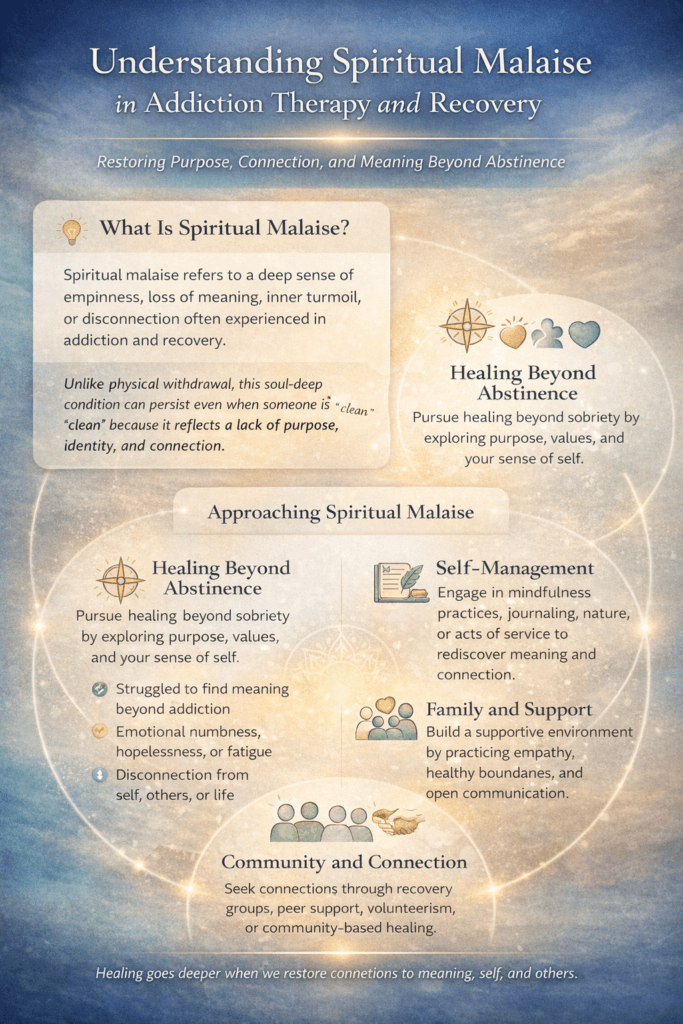
Spiritual malaise is a quiet but powerful experience often present in addiction. It refers to a deep sense of emptiness, loss of meaning, disconnection, or inner unrest that persists even when immediate physical needs are met. In addiction therapy and recovery, this condition is frequently encountered but not always named, despite its significant influence on relapse risk and long-term healing.
Many individuals entering recovery describe feeling hollow, disconnected from themselves, others, or any sense of purpose. Substances often serve as a temporary substitute for meaning, comfort, or belonging. When substance use stops, the unresolved spiritual void can surface more intensely. Without addressing this inner struggle, recovery may feel like abstinence without fulfillment.
Spiritual malaise does not imply religion, nor does it require belief in a higher power. Instead, it reflects a disruption in meaning, values, identity, and connection. Addiction can fracture a person’s relationship with themselves, distort moral grounding, and erode trust in life or others. Shame, guilt, grief, and unresolved trauma often deepen this disconnection, reinforcing feelings of hopelessness or existential fatigue.
Effective addiction therapy recognizes that recovery involves more than symptom control. Addressing spiritual malaise means helping individuals reconnect with purpose, values, and inner direction. This can be achieved through reflective practices, mindfulness, values clarification, service to others, creative expression, nature-based healing, or narrative therapy that helps people reconstruct their life story beyond addiction.
When individuals rediscover meaning, recovery becomes something they move toward, not merely something they avoid losing. Purpose strengthens resilience, improves emotional regulation, and supports sustained behavioral change. It also helps individuals tolerate distress without returning to substances for relief.
In recovery, healing the spirit is not a final step—it is a parallel process that evolves alongside physical and psychological treatment. By acknowledging and addressing spiritual malaise, addiction therapy becomes more humane, comprehensive, and effective. Recovery then transitions from survival to growth, and from abstinence to a life worth protecting.
Self-Management Strategies for Spiritual Malaise in Addiction Therapy and Recovery
Spiritual malaise in addiction recovery often appears as emptiness, loss of direction, emotional numbness, or a sense that life lacks meaning even after substance use has stopped. While therapy and support systems are essential, self-management strategies are critical to addressing this inner disconnection. These strategies empower individuals to actively participate in healing the spiritual dimension of recovery rather than waiting for motivation or clarity to return on its own.
One foundational self-management strategy is values clarification. Addiction frequently pulls individuals away from what matters most to them, creating internal conflict and shame. Identifying personal values—such as honesty, family, service, creativity, or growth—helps restore an internal compass. When daily choices align with values, recovery gains meaning beyond abstinence, reducing the sense of spiritual emptiness.
Mindfulness and reflective practices are also powerful tools. Spiritual malaise thrives in disconnection and avoidance. Practices such as meditation, breath awareness, prayer, or quiet reflection help individuals reconnect with themselves and tolerate uncomfortable emotions without escaping through substances. Over time, mindfulness builds emotional awareness, self-compassion, and a sense of inner stability.
Journaling and narrative work support meaning-making by helping individuals process guilt, grief, and identity loss associated with addiction. Writing allows people to examine their past honestly while also redefining their future. Reframing one’s story—from failure to survival and growth—can reduce existential distress and foster hope.
Service and purposeful action are additional self-management strategies that counter spiritual malaise. Acts of service, peer support, volunteering, or mentoring shift focus outward and restore a sense of usefulness and belonging. Purposeful contribution reinforces self-worth and reconnects individuals to something larger than themselves.
Connection with nature, creative expression, and routine-based rituals also support spiritual well-being. Time outdoors, art, music, movement, or simple daily rituals can ground individuals in the present and reintroduce moments of meaning and peace. These practices do not require perfection—consistency and intention matter more than intensity.
Self-management strategies for spiritual malaise are not replacements for therapy but essential complements. When individuals actively engage in practices that restore meaning, connection, and values, recovery becomes more sustainable. Addressing spiritual malaise through self-management transforms recovery from a struggle to “stay clean” into a purposeful process of rebuilding a meaningful life.
Family Support Strategies for Spiritual Malaise in Addiction Therapy and Recovery
Spiritual malaise in addiction recovery often extends beyond the individual and quietly affects the entire family system. It can show up as emotional distance, loss of shared meaning, hopelessness, or a sense that life has been fractured by addiction. While therapy focuses on the individual, family support plays a powerful role in addressing spiritual malaise by restoring connection, purpose, and emotional safety within the recovery process.
One of the most important family support strategies is practicing presence without pressure. Loved ones often want to fix pain quickly, but spiritual malaise cannot be forced away. Consistent, nonjudgmental presence communicates safety and acceptance. Listening without interrupting, minimizing, or offering immediate solutions allows the recovering individual to feel seen and valued, thereby helping to rebuild inner trust and meaning.
Encouraging values-based living is another key strategy. Families can support recovery by reinforcing shared values such as honesty, responsibility, compassion, and growth. This may involve modeling these values in daily interactions, acknowledging progress rather than perfection, and celebrating efforts aligned with recovery goals. When families reflect values consistently, they help restore a moral and emotional framework that addiction often disrupts.
Creating opportunities for shared meaning also helps counter spiritual malaise. Simple rituals like shared meals, weekly check-ins, walks, gratitude practices, or faith-based activities—when appropriate—can reestablish connection and purpose. These moments remind individuals that they belong and that their life has meaning beyond their past struggles.
Education and understanding are essential family tools. Learning about addiction as a chronic, treatable condition reduces blame and shame. When families understand that spiritual malaise is a common part of recovery—not a failure—they can respond with patience rather than fear or frustration. This understanding fosters a more compassionate and supportive home environment.
Families can also support spiritual healing by encouraging autonomy while maintaining healthy boundaries. Supporting recovery does not mean controlling it. Respecting the individual’s recovery path, beliefs, and pace helps restore a sense of agency and self-worth, which are often damaged by addiction.
Finally, families must attend to their own spiritual and emotional well-being. Burnout, resentment, and grief within the family can unintentionally reinforce spiritual disconnection. Family therapy, support groups, and self-care practices help loved ones heal alongside the individual in recovery.
When families approach spiritual malaise with empathy, patience, and intentional support, they become a powerful source of healing. Family involvement transforms recovery into a shared journey of restoration—one where meaning, connection, and hope are gradually rebuilt together.
Community Resource Strategies for Spiritual Malaise in Addiction Therapy and Recovery
Spiritual malaise in addiction recovery often reflects a deeper disconnection from meaning, belonging, and purpose. While therapy and family support are essential, community resources play a unique and powerful role in addressing this inner emptiness. Communities offer something individuals cannot restore alone: shared meaning, collective identity, and opportunities to reconnect with life beyond addiction.
One of the most effective community strategies is peer-based recovery support. Recovery groups, peer mentoring programs, and recovery community centers provide spaces where individuals feel understood without explanation or judgment. Shared lived experience reduces isolation and normalizes spiritual struggles that often emerge after substance use ends. Feeling part of a recovery community helps individuals rediscover a sense of belonging, which is central to healing spiritual malaise.
Faith-based and spiritually inclusive community programs can also support recovery when aligned with the individual’s beliefs. These may include churches, meditation groups, spiritual discussion circles, or interfaith recovery meetings. Importantly, effective programs respect autonomy and avoid imposing belief systems. Their value lies in offering reflection, hope, and meaning rather than doctrine.
Volunteerism and service-oriented community resources are another powerful strategy. Addiction often erodes a person’s sense of usefulness and worth. Community service opportunities—such as food banks, outreach programs, recovery advocacy, or mentorship—allow individuals to contribute in meaningful ways. Service helps transform recovery from self-focus to purpose-driven living, which directly counteracts spiritual emptiness.
Community education and recovery-friendly spaces also matter. Libraries, community colleges, wellness centers, and nonprofits that offer classes, support groups, or creative outlets provide structure and opportunities for growth. Learning, creativity, and skill-building help individuals reconnect with curiosity and identity beyond addiction.
Access to culturally responsive and inclusive resources is critical. Spiritual malaise may be intensified when individuals feel unseen or misunderstood due to cultural, racial, or social identity differences. Communities that honor diversity and lived experience foster deeper trust and engagement, making spiritual healing more accessible and sustainable.
Finally, community resources help reinforce long-term recovery by offering continuity. Therapy may end, and family dynamics may fluctuate, but community connections provide ongoing support, accountability, and meaning. These resources remind individuals that recovery is not just about avoiding substances—it is about rejoining life.
When community resources are integrated into addiction therapy and recovery, they help heal spiritual malaise by restoring connection, purpose, and hope. Recovery then becomes a shared process, rooted not only in personal change but in collective support and belonging.
Frequently Asked Questions
Here are some common questions:
What is spiritual malaise in addiction recovery?
Spiritual malaise refers to a deep sense of emptiness, loss of meaning, inner disconnection, or existential distress that often emerges during addiction and recovery. It is not about religion but about feeling disconnected from purpose, values, identity, or a sense of direction in life.
Is spiritual malaise the same as depression?
No. While spiritual malaise and depression can overlap, they are not the same. Depression is a clinical mood disorder involving persistent sadness and functional impairment, whereas spiritual malaise centers on meaning, purpose, and connection. A person may experience spiritual malaise without meeting criteria for depression, and vice versa.
Why does spiritual malaise often appear after sobriety begins?
Substances often mask emotional pain and existential discomfort. When substance use stops, unresolved questions about identity, purpose, guilt, and direction can surface. Recovery removes the coping mechanism, revealing the underlying spiritual distress that was previously numbed.
Does spiritual malaise mean someone lacks faith or belief?
No. Spiritual malaise is not a failure of faith or belief. It can occur in religious, spiritual, agnostic, or secular individuals. It reflects disruption in meaning and connection, not the absence of belief in a higher power.
How does spiritual malaise affect relapse risk?
When individuals feel empty, purposeless, or disconnected, they are more vulnerable to relapse as substances may seem like a way to escape discomfort or restore a sense of relief. Addressing spiritual malaise strengthens motivation and emotional resilience, reducing the risk of relapse.
Can addiction therapy address spiritual malaise without being religious?
Yes. Many evidence-informed approaches address spiritual malaise without religion, including values clarification, mindfulness, acceptance-based therapies, narrative therapy, purpose-focused counseling, and service-oriented recovery models.
What are common signs of spiritual malaise in recovery?
Common signs include feeling numb or hollow, questioning the point of sobriety, loss of motivation, identity confusion, persistent guilt or shame, disconnection from others, and difficulty experiencing hope or fulfillment even when life appears stable.
How can individuals self-manage spiritual malaise?
Self-management strategies include reflective journaling, mindfulness or meditation, values-based goal setting, creative expression, spending time in nature, acts of service, and building meaningful daily routines aligned with personal values.
What role do families play in addressing spiritual malaise?
Families support healing by offering nonjudgmental presence, encouraging values-based living, creating shared meaning through rituals or connection, respecting autonomy, and participating in education or family therapy to reduce shame and misunderstanding.
How do community resources help with spiritual malaise?
Community resources provide a sense of belonging, shared meaning, and continuity of support. Peer recovery groups, recovery community centers, volunteering opportunities, faith-inclusive programs, and culturally responsive services help individuals reconnect with purpose and identity beyond addiction.
Is spiritual malaise a permanent condition?
No. Spiritual malaise is often a transitional phase in recovery. With intentional support, reflection, and connection, individuals can rebuild meaning and purpose. Healing occurs gradually and evolves alongside emotional and psychological recovery.
Why is addressing spiritual malaise important for long-term recovery?
Recovery is most sustainable when individuals are not only abstinent but also fulfilled. Addressing spiritual malaise transforms recovery from avoiding substances into building a life with meaning, direction, and hope—key factors in long-term success.
Conclusion
Addressing spiritual malaise in addiction therapy and recovery allows healing to move beyond symptom management and toward true restoration of the whole person. When meaning, values, and inner connection are intentionally explored alongside clinical treatment, recovery becomes more sustainable and fulfilling. By integrating therapeutic support with personal reflection, family involvement, and community connection, individuals can rebuild a sense of purpose and belonging that supports lasting change. Healing the spiritual dimension of addiction transforms recovery from merely surviving without substances into living with intention, hope, and a renewed sense of direction.
Video: That Void Stays Until You Do This #SobrietyJourney #SpiritualHealing #RecoveryTips