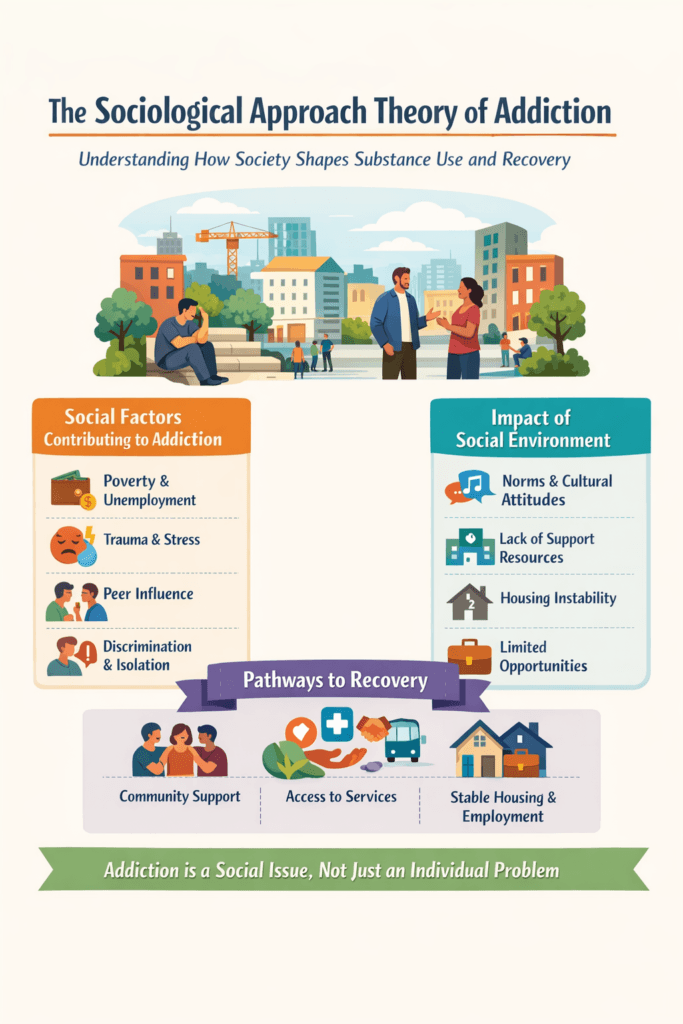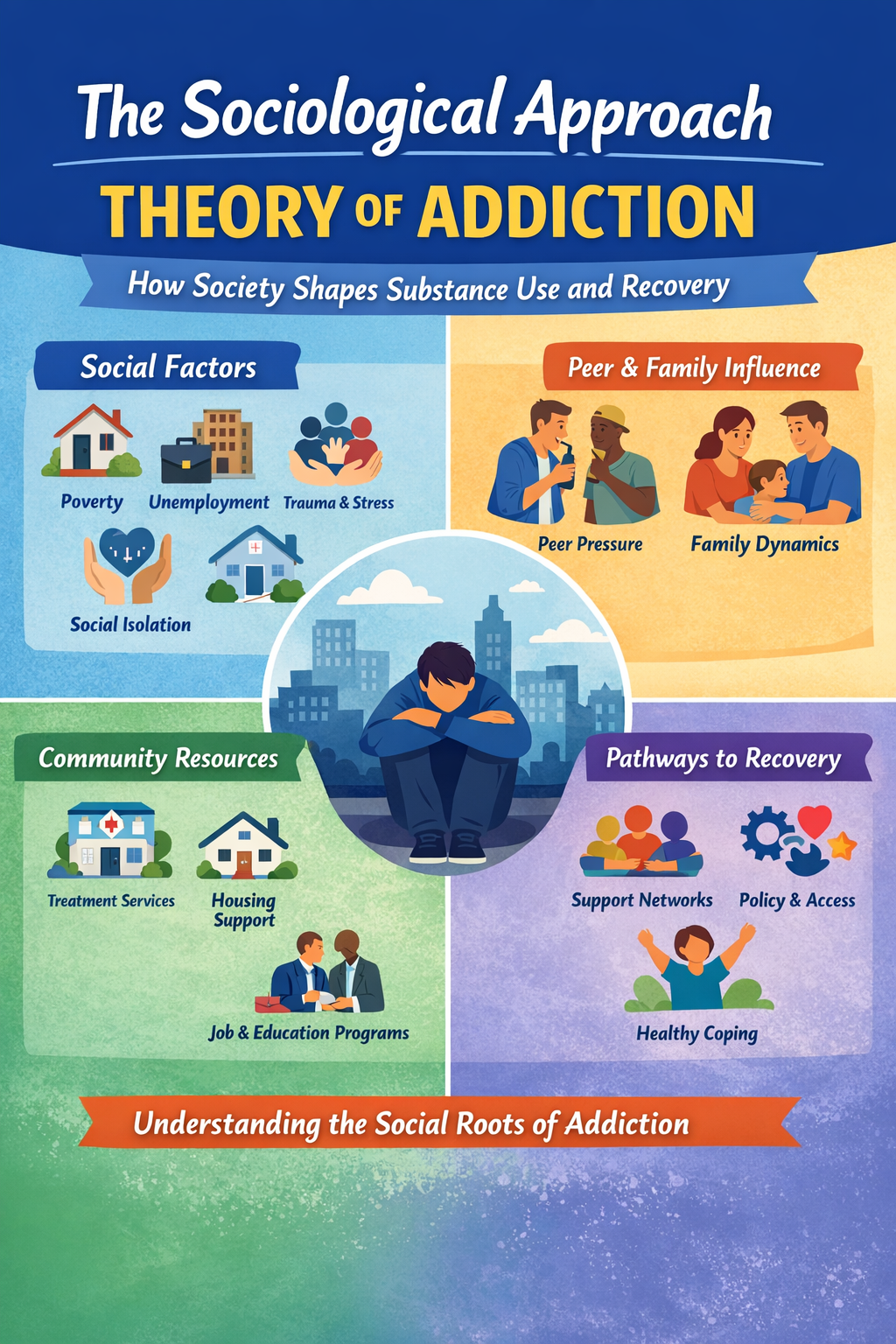
The Sociological Approach Theory of Addiction explains substance use as a result of social environments rather than individual choice alone. It highlights how family dynamics, peer influence, cultural norms, economic conditions, and access to resources shape addiction risk. By focusing on social stressors like poverty, discrimination, and isolation, this approach shifts the focus from blame to understanding and emphasizes recovery as a process supported by stable, connected communities.
Sociological Approach Theory of Addiction: How Society Shapes Substance Use and Recovery
The Sociological Approach Theory of Addiction explains substance use not simply as an individual problem, but as a response to social environments, cultural norms, and structural conditions. This perspective argues that addiction develops and persists within a broader social context shaped by family systems, peer groups, economic conditions, community resources, and societal expectations. Rather than asking only “What’s wrong with the person?” the sociological approach asks “What’s happening around the person?”
From this viewpoint, factors such as poverty, unemployment, housing instability, discrimination, trauma exposure, and limited access to healthcare increase vulnerability to addiction. Communities experiencing chronic stress and limited opportunity often show higher rates of substance use, not because of moral weakness, but because substances may temporarily relieve stress, numb emotional pain, or provide a sense of belonging. Social isolation and marginalization further intensify risk, making addiction a symptom of deeper social inequities.
Peer influence and cultural norms also play a powerful role. Substance use behaviors can be learned, normalized, and reinforced within social groups. When drug or alcohol use is common or socially rewarded, it becomes easier to adopt and harder to stop. Conversely, communities that promote connection, accountability, and healthy coping behaviors tend to show stronger recovery outcomes. This highlights how social learning and group identity shape both addiction and healing.
The sociological approach also reframes recovery. Sustainable recovery is not achieved through willpower alone, but through improved social conditions. Stable housing, employment opportunities, supportive relationships, accessible treatment, and community-based resources are essential. Policies that reduce stigma, expand healthcare access, and strengthen community supports are viewed as critical components of addiction prevention and recovery.
Ultimately, the Sociological Approach Theory of Addiction emphasizes compassion and systemic responsibility. It reminds us that addiction is not only a personal struggle, but a social issue requiring collective solutions. By addressing the environments in which people live, work, and connect, society can reduce addiction risk and create pathways where recovery is not only possible, but sustainable.
Self-Management Strategies for Recovery Using the Sociological Approach to Addiction
The Sociological Approach Theory of Addiction emphasizes that substance use and recovery are deeply influenced by social environments, relationships, and structural conditions. From a self-management perspective, this means recovery is strengthened not only by changing individual behaviors but by intentionally reshaping daily social interactions, routines, and environments. Self-management within this framework focuses on building supportive connections, reducing exposure to harmful social influences, and actively engaging with healthier community systems.
One key self-management strategy is intentional social restructuring. This involves evaluating social circles and reducing time spent in environments where substance use is normalized or encouraged. Individuals can replace these spaces with recovery-oriented groups, faith-based communities, volunteer organizations, or hobby-based networks that reinforce sobriety and accountability. Actively choosing supportive environments helps counteract social pressures that often sustain addiction.
Another essential strategy is building social capital through routine participation. Establishing consistent schedules that include work, education, peer support meetings, exercise groups, or community events increases stability and predictability. These routines reduce isolation and create positive social expectations, both of which are protective factors against relapse. Over time, regular engagement helps shift identity from “someone struggling with addiction” to “someone connected and contributing.”
Boundary setting is also central to self-management within the sociological model. This includes learning to say no, limiting exposure to high-risk social situations, and clearly communicating recovery needs to family and peers. Boundaries protect recovery while allowing individuals to remain socially engaged in healthier ways. Practicing assertive communication strengthens autonomy and reduces social stress.
The sociological approach also encourages the development of resource navigation as a self-management skill. This may include seeking housing assistance, employment support, transportation services, or healthcare access. Learning how to use community resources empowers individuals to reduce environmental stressors that often drive substance use. Managing these practical needs supports long-term recovery by stabilizing daily life.
Ultimately, self-management strategies grounded in the Sociological Approach Theory of Addiction recognize that recovery thrives on connection rather than isolation. By actively shaping social environments, strengthening supportive networks, and engaging with community structures, individuals can create conditions where recovery is sustainable, empowering, and socially reinforced.
Family Support Strategies for Recovery Using the Sociological Approach Theory of Addiction
The Sociological Approach Theory of Addiction recognizes addiction as a condition shaped by social environments, relationships, and shared experiences. Within this framework, families are one of the most powerful influences on both substance use and recovery. Family support strategies focus on transforming the home environment into a source of stability, connection, and accountability rather than stress, conflict, or stigma.
One of the most important family strategies is creating a recovery-supportive home culture. Families can openly discuss recovery goals, reduce substance-related triggers in the household, and model healthy coping behaviors. When recovery is normalized as a shared priority rather than an individual burden, it reduces shame and increases motivation. Consistent routines around meals, sleep, and family time help reinforce predictability and emotional safety.
Healthy communication is another core strategy. Families are encouraged to move away from blame, criticism, or secrecy and toward open, respectful dialogue. Using calm language, active listening, and “I” statements helps individuals in recovery feel understood rather than judged. This approach aligns with the sociological model by acknowledging that social interactions strongly influence emotional regulation and behavior.
Boundary setting within families is equally essential. Support does not mean control or rescuing. Families can set clear expectations around substance use, finances, and responsibilities while maintaining empathy and respect. Consistent boundaries reduce chaos and foster accountability, thereby supporting recovery without reinforcing dependence or conflict.
The sociological approach also highlights the value of shared engagement with external supports. Families can participate in family therapy, peer support groups, or educational programs together. These shared experiences reduce isolation, improve understanding of addiction, and help families learn healthier patterns of interaction. Involvement in community-based recovery resources strengthens the family’s collective resilience.
Ultimately, family support strategies rooted in the Sociological Approach Theory of Addiction recognize that healing occurs within relationships. When families actively create supportive environments, communicate effectively, and engage in shared recovery efforts, they become a powerful protective factor. By addressing addiction as a social and relational challenge, families help transform recovery into a sustainable, shared journey rather than a solitary struggle.
Community Resource Strategies for Recovery Using the Sociological Approach Theory of Addiction
The Sociological Approach Theory of Addiction emphasizes that addiction is shaped by social structures, community conditions, and access to resources. From this perspective, recovery is not solely an individual responsibility but a collective effort supported by strong, accessible community systems. Community resource strategies focus on reducing social stressors, increasing connection, and creating environments that support and sustain recovery.
One key strategy is expanding access to community-based treatment services. Local health centers, outpatient programs, medication-assisted treatment providers, and harm-reduction services play a critical role in meeting people where they are. When treatment is affordable, nearby, and culturally responsive, individuals are more likely to engage and remain in care. Communities that integrate addiction treatment into primary care and public health systems reduce stigma and improve outcomes.
Peer recovery support services are another cornerstone of the sociological approach. Recovery coaches, peer mentors, and support groups provide lived-experience guidance, social connection, and accountability. These services reduce isolation and help individuals rebuild their identity and sense of purpose within a supportive social network. Peer-led programs reinforce the idea that recovery is possible and socially reinforced, not a solitary struggle.
Addressing social determinants of health is also essential. Community strategies that provide stable housing, employment assistance, transportation, food security, and legal support directly reduce the environmental stressors that often drive substance use. Recovery-friendly workplaces, job training programs, and transitional housing create stability and restore dignity, making long-term recovery more attainable.
Education and stigma reduction initiatives further strengthen community-level recovery. Public awareness campaigns, school-based prevention programs, and community trainings help shift addiction from a moral failing to a shared public health issue. When communities understand addiction as socially influenced, compassion increases and barriers to care decrease.
Ultimately, community resource strategies rooted in the Sociological Approach Theory of Addiction recognize that recovery flourishes in supportive environments. By investing in accessible services, peer support, and social infrastructure, communities create pathways where individuals can heal, reconnect, and thrive. These collective efforts transform recovery into a sustainable, community-supported process rather than an individual burden.
Frequently Asked Questions
Here are some common questions:
What is the Sociological Approach Theory of Addiction?
The Sociological Approach Theory of Addiction explains addiction as a condition strongly influenced by social environments, relationships, cultural norms, and structural factors. It emphasizes that substance use develops within social contexts such as family dynamics, peer groups, community conditions, and socioeconomic stressors rather than being caused solely by individual choices or biology.
How does this theory differ from the disease model of addiction?
While the disease model focuses on brain chemistry and biological vulnerability, the sociological approach centers on external influences like poverty, trauma, discrimination, social isolation, and access to resources. Both models can complement each other, but the sociological approach highlights how environment and social systems shape addiction and recovery.
What social factors increase the risk of addiction?
Common risk factors include poverty, unemployment, housing instability, exposure to trauma, lack of social support, discrimination, and living in communities where substance use is normalized. These conditions increase stress and limit healthy coping options, making substance use more likely.
How does peer influence affect addiction?
Peers can normalize, encourage, or discourage substance use. Social groups often shape behaviors through shared norms and expectations. When substance use is accepted or rewarded within a peer group, it becomes harder to avoid. Conversely, recovery-oriented peer groups can strongly support sobriety.
What role does family play in this theory?
Families influence addiction through communication patterns, emotional support, boundaries, and stress levels. Supportive, stable family environments can protect against addiction and aid recovery, while conflict, instability, or substance use within the home can increase risk.
How does the sociological approach view recovery?
Recovery is seen as a socially supported process rather than an individual struggle. Stable housing, employment, access to healthcare, supportive relationships, and community engagement are considered essential for long-term recovery.
Why are community resources important in this model?
Community resources reduce environmental stressors and provide connection and stability. Access to treatment services, peer support, employment programs, housing assistance, and transportation helps address the social conditions that often drive substance use.
Does this theory remove personal responsibility?
No. The sociological approach does not eliminate personal responsibility but places it within a broader context. Individuals are encouraged to make healthy choices while society shares responsibility for creating environments that support recovery.
How does this approach reduce stigma?
By framing addiction as a response to social conditions rather than moral failure, the sociological approach promotes empathy and understanding. This reduces blame and encourages people to seek help without fear of judgment.
How can this theory improve addiction prevention?
Prevention efforts focus on strengthening communities, reducing inequality, improving education and employment opportunities, and increasing access to mental health and substance use services. Addressing social determinants lowers overall addiction risk.
Who benefits most from the sociological approach?
This approach is especially helpful for individuals affected by chronic stress, social marginalization, or limited access to resources. It also benefits families, communities, and policymakers by guiding systemic solutions rather than focusing solely on individual behavior.
Conclusion
The Sociological Approach Theory of Addiction highlights that lasting recovery requires more than personal determination; it depends on supportive social structures and equitable access to resources. When families, communities, and systems collaborate to reduce stigma, strengthen connections, and address the social determinants of health, recovery becomes more achievable and sustainable. This approach reinforces the idea that addiction is a shared societal challenge, not an individual failure. By improving environments and relationships, the sociological model offers a compassionate, inclusive framework that promotes prevention, recovery, and long-term well-being.
Video: The Sociological Approach Theory of Addiction