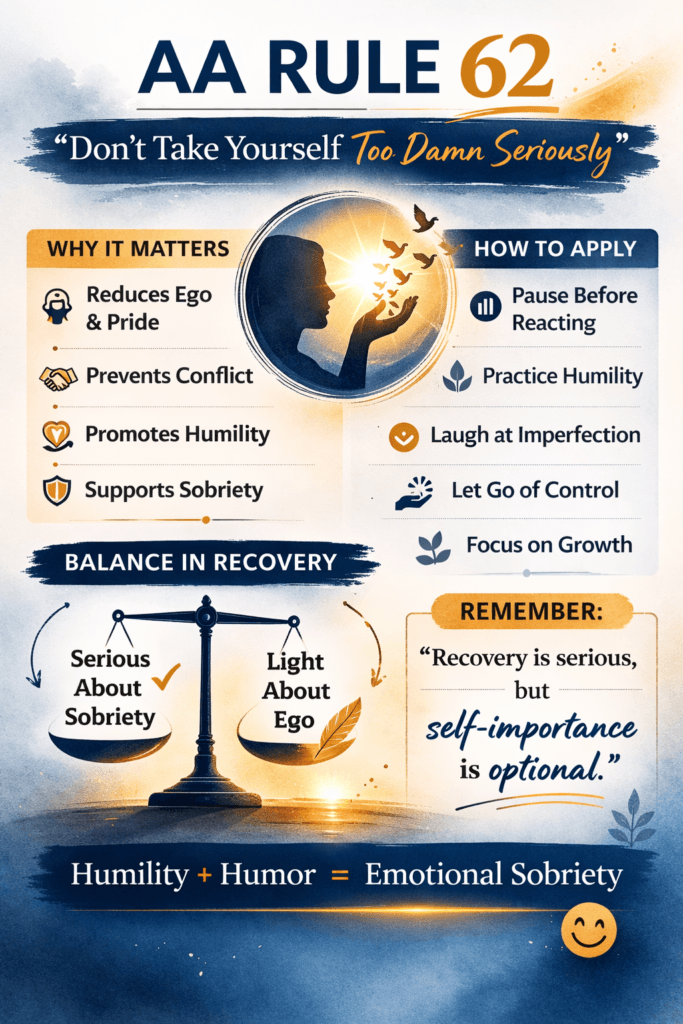
AA Rule 62 — “Don’t take yourself too damn seriously” — is an informal yet enduring principle within Alcoholics Anonymous. Though not part of the official Twelve Steps or Twelve Traditions, it reflects a core recovery value: humility. Originally coined to ease tension during early group conflicts, Rule 62 reminds members that ego, pride, and self-importance can undermine unity and personal growth. At its heart, the rule encourages perspective — taking sobriety seriously while releasing the rigidity and defensiveness that often accompany addiction. Psychologically, it promotes emotional flexibility, reduces shame, and fosters healthier relationships within recovery communities.
AA Rule 62
“Don’t Take Yourself Too Damn Seriously”
Within Alcoholics Anonymous (AA), there is an informal but widely quoted guideline known as Rule 62:
“Don’t take yourself too damn seriously.”
Although Rule 62 is not one of the official Twelve Steps or Twelve Traditions, it has become a powerful cultural principle within recovery communities. Its message may sound simple — even humorous — but psychologically, it carries profound significance for emotional sobriety and long-term recovery.
The Origin of Rule 62
The phrase is often attributed to early AA members who noticed how ego, pride, and self-importance could create unnecessary conflict in group settings. During a meeting filled with disagreements and tension, someone reportedly suggested that they adopt a rule:
Rule 62 — Don’t take yourself too damn seriously.
It became a humorous yet corrective reminder that excessive ego can threaten unity, relationships, and sobriety.
Psychological Meaning of Rule 62
At a deeper level, Rule 62 addresses several key recovery concepts:
1. Ego Reduction
Addiction is often fueled by ego-driven patterns:
- Defensiveness
- Pride
- Resentment
- Need for control
- Perfectionism
Taking oneself too seriously can amplify these tendencies. Rule 62 encourages humility — a core spiritual principle in AA.
2. Emotional Regulation
When individuals over-identify with their thoughts, mistakes, or conflicts, emotional reactivity increases. Humor and perspective reduce stress hormones and diffuse interpersonal tension.
3. Shame Reduction
Interestingly, “taking yourself too seriously” can also manifest as excessive self-criticism. Rule 62 gently counters both grandiosity and harsh self-judgment.
It reminds members:
- You are human.
- You will make mistakes.
- Growth does not require perfection.
Rule 62 and Emotional Sobriety
Recovery extends beyond abstinence. Emotional sobriety involves developing:
- Perspective
- Flexibility
- Self-awareness
- Humor
- Acceptance
Rule 62 supports emotional sobriety by softening rigidity. When members become overly intense about rules, roles, or recognition, this principle serves as a grounding tool.
How Rule 62 Applies in Daily Life
In Relationships
Instead of escalating minor conflicts, pause and ask:
- “Am I reacting from ego?”
- “Is this worth the intensity I’m giving it?”
In Personal Growth
When mistakes happen:
- Laugh gently at human imperfection.
- Learn rather than ruminate.
- Avoid catastrophizing.
In Service Work
AA emphasizes service. Rule 62 prevents service from becoming self-important or power-driven.
The Balance: Serious About Recovery, Light About Ego
Rule 62 does not mean minimizing addiction, relapse risk, or accountability. Recovery requires seriousness about sobriety.
Rather, it distinguishes between:
- Taking recovery seriously
- Taking oneself seriously
The first promotes growth.
The second can hinder it.
Why Humor Matters in Recovery
Research in psychology shows that appropriate humor:
- Reduces stress
- Strengthens social bonds
- Increases resilience
- Improves perspective-taking
Laughter in meetings is not denial — it is often a sign of healing.
Final Reflection
AA Rule 62 may be unofficial, but its wisdom is enduring. “Don’t take yourself too damn seriously” reminds individuals in recovery to practice humility, perspective, and compassion — toward others and themselves.
Sobriety is serious work.
Ego is optional.
Rule 62 invites balance: grounded commitment without rigidity, accountability without self-importance, and growth infused with grace.
In recovery — and in life — sometimes the healthiest response is a little humility and a gentle smile.
Self-Management Strategies Using AA Rule 62
“Don’t Take Yourself Too Damn Seriously” as a Tool for Emotional Sobriety
Within Alcoholics Anonymous, Rule 62 is a well-known informal guideline:
“Don’t take yourself too damn seriously.”
Although not part of the official Twelve Steps, Rule 62 carries significant psychological value. It addresses ego, rigidity, shame, and emotional reactivity — all of which can threaten sobriety and mental health. When applied intentionally, Rule 62 becomes a powerful self-management strategy for maintaining emotional balance in recovery.
Below are structured ways for individuals to use Rule 62 as a daily regulatory tool.
1. Use Rule 62 to Interrupt Ego-Driven Reactions
Ego often shows up as:
- Defensiveness
- Needing to be right
- Overreacting to criticism
- Taking feedback personally
- Holding grudges
Self-Management Practice:
When emotionally triggered, pause and ask:
- “Am I reacting from ego or from principle?”
- “Is this about growth, or about being right?”
- “Would Rule 62 suggest I lighten up here?”
This pause strengthens impulse control and reduces unnecessary conflict.
2. Apply Rule 62 to Perfectionism
Many individuals in recovery struggle with all-or-nothing thinking:
- “If I make a mistake, I’ve failed.”
- “I should be further along.”
- “Everyone is judging me.”
Taking oneself too seriously can turn minor setbacks into identity crises.
Self-Management Practice:
- View mistakes as data, not definitions.
- Replace harsh self-criticism with humor and perspective.
- Remind yourself: growth is iterative, not linear.
Rule 62 reduces shame by humanizing imperfection.
3. Reduce Catastrophic Thinking
Addiction recovery often heightens emotional sensitivity. Small problems can feel overwhelming.
Self-Management Practice:
- Ask: “Will this matter in a week? A month?”
- Scale the problem from 1–10.
- Practice cognitive reframing.
Rule 62 encourages perspective. Not every discomfort is a disaster.
4. Use Humor as Emotional Regulation
Appropriate humor lowers stress hormones and increases resilience.
In meetings, laughter often signals connection and healing.
Self-Management Practice:
- Share experiences honestly, including the absurd parts.
- Allow yourself to laugh at past ego-driven behaviors.
- Avoid sarcasm or humor that deflects accountability.
Humility plus humor creates emotional flexibility.
5. Prevent Service Burnout
In recovery communities, service work is central. However, over-identifying with roles can create stress or control issues.
Self-Management Practice:
- Remember: you are part of the group, not its savior.
- Delegate when necessary.
- Accept that outcomes are not fully controllable.
Rule 62 protects humility within leadership.
6. Balance Accountability with Compassion
Rule 62 does not mean minimizing responsibility. It does not excuse relapse or harmful behavior.
Instead, it promotes:
- Honest self-inventory
- Amends when needed
- Growth without self-condemnation
Self-management requires both seriousness about sobriety and gentleness toward oneself.
7. Daily Reflection Exercise Using Rule 62
At the end of the day, reflect:
- Where did I take myself too seriously today?
- Did ego interfere with connection?
- Could I have responded with more humility?
- Did I judge myself too harshly?
This reflective process strengthens emotional sobriety.
The Psychological Benefits of Rule 62
Using Rule 62 consistently can:
- Reduce resentment
- Improve relationships
- Increase emotional flexibility
- Lower stress reactivity
- Strengthen humility
- Decrease shame
It transforms recovery from rigid self-monitoring into balanced self-awareness.
Final Reflection
Rule 62 reminds individuals in recovery that sobriety is serious — but self-importance is optional. When ego softens, connection grows. When rigidity relaxes, growth accelerates.
Self-management using Rule 62 is about perspective. It invites individuals to:
- Stay accountable
- Stay humble
- Stay teachable
- And occasionally, smile at their own humanity
In recovery, progress flourishes when seriousness about sobriety is paired with lightness about self.
Family Support Strategies Using AA Rule 62
“Don’t Take Yourself Too Damn Seriously” in Family Recovery Dynamics
Within Alcoholics Anonymous, Rule 62 — “Don’t take yourself too damn seriously” — serves as a reminder to reduce ego, rigidity, and unnecessary conflict. While originally rooted in group unity, this principle has powerful applications within family systems affected by addiction.
Recovery does not occur in isolation. Families often carry resentment, fear, hypervigilance, or overcontrol long after sobriety begins. Applying Rule 62 within the family context can reduce tension, increase emotional safety, and promote long-term healing.
Below are structured family support strategies grounded in the spirit of Rule 62.
1. Reduce Ego-Driven Conflict
Addiction often leaves families emotionally reactive. Common patterns include:
- “I told you so” responses
- Power struggles
- Overcorrecting minor mistakes
- Taking comments personally
- Revisiting past grievances
Family Strategy:
Before escalating a disagreement, ask:
- “Is this about safety — or about being right?”
- “Am I reacting from fear or ego?”
- “Would Rule 62 suggest we lighten this moment?”
This pause diffuses unnecessary intensity and protects relational stability.
2. Avoid Hyper-Serious Monitoring
In early recovery, families may become overly vigilant:
- Constant checking
- Interpreting every mood change as a relapse risk
- Overanalyzing behavior
While accountability is important, excessive seriousness can create anxiety and resentment.
Family Strategy:
- Maintain structured boundaries without constant suspicion.
- Differentiate between real warning signs and normal human imperfection.
- Allow room for growth without micromanagement.
Rule 62 encourages balanced concern rather than fear-driven control.
3. Use Humor to Rebuild Connection
Addiction can make families emotionally heavy. Humor — when respectful — restores warmth.
Family Strategy:
- Laugh together about shared human flaws.
- Share recovery stories that highlight growth.
- Avoid sarcasm or jokes that shame.
Healthy humor reduces cortisol, strengthens bonds, and rebuilds trust.
4. Balance Accountability with Compassion
Rule 62 does not mean minimizing the risk of relapse or ignoring consequences. Instead, it tempers rigid seriousness with humanity.
Family Strategy:
- Address concerns calmly and directly.
- Focus on behavior, not identity.
- Separate the person from past mistakes.
- Allow learning without humiliation.
Seriousness about sobriety should not become harshness toward the individual.
5. Prevent Role Rigidity
Addiction often creates fixed family roles:
- The rescuer
- The enforcer
- The scapegoat
- The hero
Over-identifying with these roles can perpetuate imbalance.
Family Strategy:
- Reevaluate roles regularly.
- Share responsibility.
- Avoid martyrdom or overcontrol.
- Recognize when seriousness has become identity.
Rule 62 reminds families that flexibility supports healing.
6. Interrupt Shame Cycles
Taking oneself too seriously can manifest as excessive guilt or shame within the recovering individual — or within family members who feel responsible.
Family Strategy:
- Normalize imperfection.
- Encourage progress over perfection.
- Avoid dramatizing minor setbacks.
- Model self-forgiveness.
Recovery thrives in environments where mistakes are addressed — not magnified.
7. Practice Daily Perspective Checks
Families can use a simple reflection tool:
- “Are we reacting proportionally?”
- “Is fear driving this conversation?”
- “Could we approach this with more humility?”
- “Are we turning a small issue into a major conflict?”
These questions realign the family system with emotional balance.
The Psychological Benefits for Families
Applying Rule 62 within families can:
- Reduce chronic tension
- Improve communication
- Lower anxiety about relapse
- Strengthen trust
- Increase emotional flexibility
- Promote healthier boundaries
It transforms recovery from a rigid, fear-based process into a structured but compassionate journey.
Final Reflection
Addiction is serious. Recovery requires vigilance, honesty, and accountability. But when families take every moment with intense gravity, relationships can become fragile and strained.
Rule 62 offers balance:
Be serious about recovery.
Be light about ego.
When families practice humility, humor, and proportion, they create an environment where sobriety can deepen — not under pressure, but within connection.
In family recovery, sometimes the most powerful intervention is perspective.
Community Resource Strategies Using AA Rule 62
Applying “Don’t Take Yourself Too Damn Seriously” to Strengthen Recovery Communities
Within Alcoholics Anonymous, Rule 62 — “Don’t take yourself too damn seriously” — serves as a reminder that ego, rigidity, and self-importance can threaten unity and recovery. While often applied at the individual level, Rule 62 has meaningful implications for community systems that support addiction recovery.
Recovery communities function best when humility, balance, and perspective guide decision-making. When organizations, leaders, or members become overly rigid or ego-driven, tension increases and collaboration weakens. Below are structured community-level strategies grounded in the spirit of Rule 62.
1. Promote Humility in Leadership
Leadership in recovery settings — whether in AA meetings, community treatment programs, or nonprofit organizations — requires balance.
Community Strategy:
- Rotate service positions regularly.
- Encourage shared decision-making.
- Avoid concentrating authority in one individual.
- Promote servant leadership models.
Rule 62 reminds leaders that authority exists to serve the group, not to elevate personal status.
2. Reduce Inter-Group Conflict Through Perspective
Community recovery networks sometimes experience disagreements over:
- Meeting formats
- Interpretations of traditions
- Resource allocation
- Policy decisions
When debates become personal, unity suffers.
Community Strategy:
- Use structured conflict resolution processes.
- Encourage members to pause before reacting defensively.
- Frame disagreements as collaborative problem-solving rather than personal attacks.
- Revisit shared mission statements to realign focus.
Rule 62 encourages members to ask: Is this disagreement about principle, or about pride?
3. Integrate Humor and Warmth Into Recovery Events
Recovery can be emotionally intense. Community gatherings that include healthy humor and celebration strengthen resilience.
Community Strategy:
- Host sobriety anniversaries and milestone celebrations.
- Include storytelling that highlights growth and perspective.
- Foster welcoming, non-intimidating environments for newcomers.
Humility, combined with humor, lowers barriers to entry and reduces fear among those seeking help.
4. Avoid Institutional Rigidity
Over-seriousness can manifest as inflexible rule enforcement that discourages participation.
Community Strategy:
- Ensure policies are clear but compassionate.
- Balance structure with accessibility.
- Train facilitators in trauma-informed approaches.
- Encourage feedback loops from participants.
Rule 62 reminds communities that while principles are important, delivery matters.
5. Prevent Burnout Among Volunteers
Recovery communities rely heavily on volunteer service. Over-identification with roles can lead to stress and resentment.
Community Strategy:
- Normalize taking breaks from service roles.
- Provide peer support for volunteers.
- Encourage realistic expectations.
- Recognize contributions without creating hierarchy.
Rule 62 protects communities from turning service into ego-based identity.
6. Encourage Collaboration With External Resources
Recovery communities thrive when they collaborate rather than compete.
Examples include partnerships with:
- Mental health clinics
- Faith-based organizations
- Public health departments
- Community centers
- Educational institutions
Approaching partnerships with humility rather than superiority increases resource sharing and broader impact.
7. Normalize Growth and Imperfection
Communities, like individuals, make mistakes. Programs may need revision. Events may fail. Conflict may arise.
Community Strategy:
- Conduct reflective evaluations without blame.
- Focus on continuous improvement.
- Model accountability without dramatization.
Rule 62 allows communities to evolve without defensiveness.
The Broader Psychological Impact
When recovery communities embody Rule 62, they create environments that:
- Reduce intimidation for newcomers
- Lower interpersonal tension
- Increase volunteer sustainability
- Strengthen group cohesion
- Promote emotional safety
Collective humility fosters collective healing.
Final Reflection
Addiction recovery is serious work. Community support systems must maintain structure, accountability, and clear principles. Yet when communities become rigid, prideful, or overly intense, unity can fracture.
Rule 62 offers a stabilizing reminder:
Be serious about the mission.
Be humble about yourselves.
When recovery communities operate with perspective, humor, and shared humility, they become stronger, more welcoming, and more resilient.
Sometimes the health of a community depends not on stricter rules — but on softer egos.
Frequently Asked Questions
Here are some common questions:
1. What is AA Rule 62?
AA Rule 62 is an informal guideline in Alcoholics Anonymous that states:
“Don’t take yourself too damn seriously.”
Although it is not one of the official Twelve Steps or Twelve Traditions, it is widely used in recovery communities as a reminder to practice humility, maintain perspective, and avoid ego-driven conflict.
2. Why is Rule 62 important in recovery?
Rule 62 helps individuals maintain emotional balance. Addiction can be closely linked to ego, defensiveness, resentment, and perfectionism. By encouraging humility and perspective, the rule helps reduce conflict, stress, and unnecessary emotional intensity.
3. Where did Rule 62 come from?
The phrase is believed to have originated during early AA meetings when members were arguing over group issues. Someone reportedly suggested adding “Rule 62: Don’t take yourself too damn seriously” as a humorous way to reduce tension and remind members to stay humble.
4. Is Rule 62 part of the Twelve Steps?
No. Rule 62 is not an official part of the Twelve Steps or Twelve Traditions. However, its message aligns closely with several step principles such as humility, self-awareness, and spiritual growth.
5. What does “don’t take yourself too seriously” mean in recovery?
It does not mean ignoring responsibility or minimizing addiction. Instead, it means:
- Avoiding excessive pride or ego
- Not overreacting to criticism or disagreement
- Allowing room for mistakes and growth
- Maintaining perspective during stressful situations
It encourages humility without dismissing the seriousness of sobriety.
6. How can Rule 62 help with emotional sobriety?
Emotional sobriety involves learning to manage emotions without reacting impulsively. Rule 62 helps by encouraging individuals to pause, reflect, and avoid overdramatizing situations. Humor and perspective can reduce stress and improve emotional regulation.
7. Can Rule 62 help prevent conflict in AA meetings?
Yes. Many AA members use Rule 62 to diffuse tension during disagreements about meeting formats, service roles, or interpretations of traditions. It reminds members to focus on unity and recovery rather than personal pride.
8. Does Rule 62 mean recovery should not be taken seriously?
No. Recovery requires commitment and accountability. Rule 62 simply encourages people not to become rigid, self-important, or overly intense about themselves while working the program.
9. How can someone apply Rule 62 in daily life?
Practical ways include:
- Pausing before reacting defensively
- Laughing at personal mistakes
- Avoiding perfectionism
- Practicing humility in relationships
- Maintaining perspective during stressful moments
These habits support emotional stability and healthier interactions.
10. How does humor play a role in Rule 62?
Appropriate humor can reduce stress, strengthen social bonds, and help individuals gain perspective. Many recovery meetings include moments of laughter because humor reminds members that growth can occur without harsh self-judgment.
11. Does Rule 62 apply outside AA meetings?
Yes. The principle can be applied in relationships, workplaces, families, and community interactions. Practicing humility and perspective helps prevent unnecessary conflict and promotes emotional balance.
12. Can taking yourself too seriously affect recovery?
Yes. Excessive pride, defensiveness, or perfectionism can create resentment, conflict, and emotional stress — all of which can threaten sobriety. Rule 62 helps individuals remain teachable and open to growth.
Conclusion
AA Rule 62 remains relevant because it addresses one of the most persistent human challenges in recovery: the ego. Addiction often amplifies defensiveness, perfectionism, and resentment, all of which can threaten both sobriety and connection. By inviting humility, humor, and self-awareness, Rule 62 helps balance accountability with compassion. It reminds individuals and communities alike that while recovery is serious work, self-importance is not required for healing. In embracing this principle, members cultivate emotional sobriety — grounded, teachable, and open to growth.
Video: This is why recovery feels lighter when you laugh #mentalwellness #soberlife #recovery