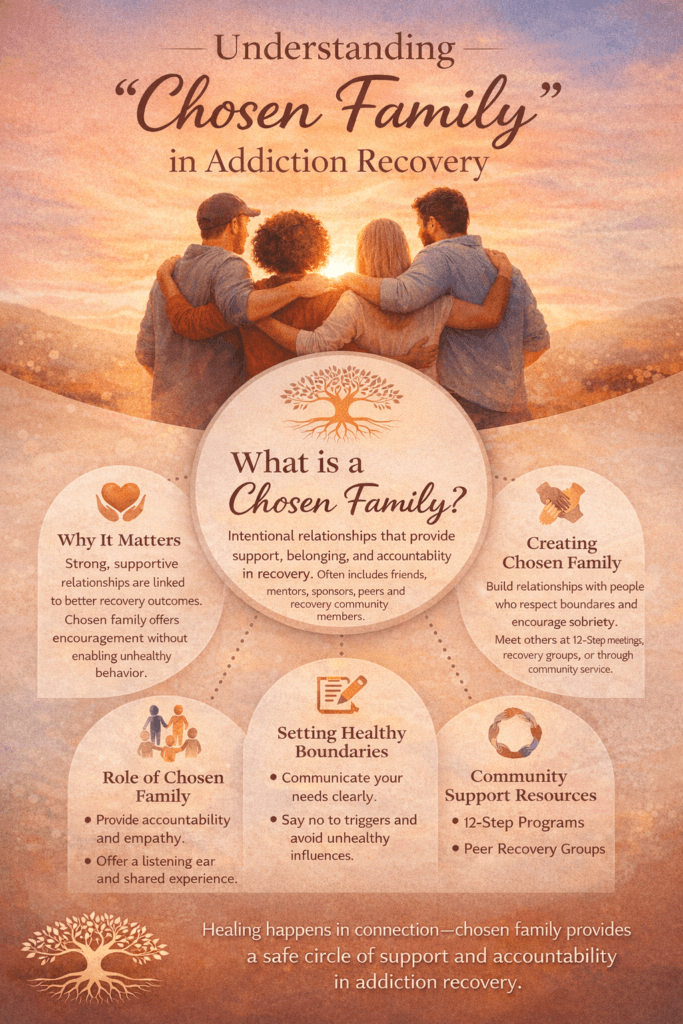
Understanding “chosen family” in addiction recovery is essential for recognizing how healing often occurs through connection rather than isolation. While biological relatives can be powerful sources of support, they may not always be available, safe, or aligned with recovery goals. Chosen family refers to intentionally built relationships—friends, sponsors, mentors, peers, and supportive community members—who provide encouragement, accountability, and acceptance. These relationships often emerge through recovery environments such as peer-support fellowships, therapy groups, and community programs. Because addiction frequently damages trust and social bonds, building a chosen family allows individuals to reconstruct a sense of belonging and identity grounded in growth rather than past behavior.
Understanding “Chosen Family” in Addiction Recovery
Addiction recovery is rarely sustained in isolation. While biological family relationships can be powerful sources of support, they may also be complicated by trauma, strained trust, or unhealthy dynamics. In this context, the concept of “chosen family” has become increasingly meaningful in recovery communities. A chosen family refers to supportive relationships that individuals intentionally build—friends, mentors, sponsors, peers, faith leaders, or recovery community members—who provide encouragement, accountability, and a sense of belonging.
Recovery research consistently highlights the importance of social connection in reducing the risk of relapse. Isolation fuels shame, and shame often drives substance use. Chosen family relationships counteract this cycle by offering acceptance without enabling destructive behavior. Unlike some traditional family systems that may struggle to adjust to new boundaries, chosen family members often meet individuals where they are in their recovery journey. These relationships are built on shared goals, mutual respect, and commitment to growth.
Programs such as Alcoholics Anonymous and Narcotics Anonymous emphasize fellowship as a cornerstone of healing. The sponsor–sponsee relationship is a classic example of chosen family in action—structured accountability paired with empathy from someone who understands lived experience. Similarly, recovery housing, peer support specialists, and faith-based communities often function as extended chosen families.
Chosen family does not replace biological relatives; rather, it supplements or stabilizes support when needed. In many cases, individuals rebuild healthier relationships with their families of origin once recovery strengthens. However, when certain relationships remain unsafe or destabilizing, chosen family provides a protective buffer.
From a clinical standpoint, incorporating chosen family into treatment planning can improve engagement and retention. Encouraging patients to identify safe supports, attend peer groups, and develop sober social networks enhances resilience. In long-term recovery, belonging becomes as critical as abstinence.
Ultimately, chosen family reflects a powerful truth: recovery thrives in connection. Healing is not only about eliminating substances—it is about rebuilding identity, trust, and community. When individuals intentionally surround themselves with people who reinforce growth, accountability, and hope, recovery becomes sustainable rather than fragile.
Self-Management Strategies in Understanding “Chosen Family” in Addiction Recovery
Recovery is both relational and personal. While “chosen family” provides belonging, accountability, and encouragement, long-term sobriety also requires strong self-management. Understanding how to intentionally build, maintain, and participate in a chosen family begins with internal work. Healthy external support systems grow from internal stability.
Self-management in recovery involves self-awareness, emotional regulation, boundary setting, and values-based decision-making. Individuals must first assess what kind of relationships support sobriety and which undermine it. This requires honest reflection: Who reinforces my recovery goals? Who normalizes substance use? Who respects my boundaries? By identifying personal triggers and relational risks, individuals can intentionally choose healthier connections.
Participation in communities such as Alcoholics Anonymous or Narcotics Anonymous often begins as an external support strategy, but sustained benefit depends on internal engagement. Attending meetings consistently, reaching out to sponsors, completing step work, and practicing daily reflection are acts of self-management. Chosen family is not accidental—it is cultivated through effort, reliability, and vulnerability.
Emotional regulation is another essential strategy. Chosen family relationships can sometimes trigger fear of rejection, comparison, or dependency. Learning coping skills such as journaling, mindfulness, exercise, structured routines, and cognitive restructuring helps individuals respond rather than react. These skills prevent relational conflict from becoming a relapse trigger.
Boundary setting is central to sustaining chosen family dynamics. Healthy chosen families are not enmeshed; they operate on mutual respect. Self-management includes clearly communicating needs, declining unsafe invitations, and recognizing when support becomes enabling. This strengthens both autonomy and connection.
Accountability also begins internally. While sponsors, peers, and mentors provide guidance, individuals must take ownership of attendance, medication adherence, therapy participation, and lifestyle changes. A chosen family can support recovery—but it cannot substitute for personal responsibility.
For clinicians and recovery leaders, integrating self-management education into treatment planning enhances social recovery capital. Teaching patients how to evaluate relationships, regulate emotions, and build consistent habits helps ensure that chosen family becomes a stabilizing force rather than a source of dependency.
Ultimately, understanding chosen family in addiction recovery requires balancing connection with autonomy. When individuals manage their thoughts, emotions, and behaviors effectively, they are better equipped to build supportive networks that reinforce sobriety, growth, and long-term healing.
Family Support Strategies in Understanding “Chosen Family” in Addiction Recovery
Addiction recovery often reshapes the meaning of family. While biological relatives may remain central, many individuals also develop a “chosen family”—trusted peers, mentors, sponsors, and recovery community members who provide consistent support. Understanding how biological family systems can engage positively with this concept is critical to sustainable recovery.
Family support strategies begin with education. When relatives understand substance use disorder as a chronic medical condition rather than a moral failure, they are more likely to support recovery efforts constructively. Learning about relapse triggers, brain changes, and behavioral patterns reduces blame and increases empathy. Families who attend open meetings in programs like Alcoholics Anonymous or support groups such as Al-Anon Family Groups often gain insight into healthy detachment, boundary setting, and supportive communication.
Another key strategy is respecting recovery boundaries. Chosen family members—such as sponsors or sober peers—may become primary accountability partners. Biological families can strengthen recovery by honoring those relationships rather than feeling replaced by them. Encouraging attendance at meetings, supporting time spent with sober peers, and avoiding pressure to prioritize old social patterns demonstrates alignment with recovery goals.
Healthy communication is essential. Families can practice active listening, avoid shaming language, and focus on solution-oriented discussions. Instead of monitoring or policing behavior, supportive relatives ask open-ended questions and affirm progress. This approach reduces defensiveness and promotes trust rebuilding.
Accountability with compassion is another cornerstone. Families should avoid enabling behaviors such as providing financial rescue without structure or ignoring warning signs. At the same time, responses to setbacks should emphasize concern and safety rather than punishment. Balancing firmness with empathy mirrors the supportive dynamics often found within chosen family systems.
Participation in family therapy or recovery education programs further strengthens outcomes. When biological and chosen families operate collaboratively—each respecting roles and boundaries—individuals in recovery experience a broader, more stable support network.
Ultimately, chosen family does not replace biological family; it expands the circle of recovery. When relatives embrace education, respect boundaries, communicate effectively, and support sober relationships, they reinforce a culture of healing. Recovery thrives where connection is safe, accountable, and aligned with long-term wellness.
Community Resource Strategies in Understanding “Chosen Family” in Addiction Recovery
Recovery is strengthened not only by individual effort and family involvement, but also by the broader community infrastructure surrounding a person. “Chosen family” in addiction recovery often emerges from community-based environments—peer groups, treatment programs, recovery housing, faith communities, and service organizations. Strategic use of community resources helps individuals build healthy relational networks that function as stabilizing, recovery-oriented chosen families.
Community resource strategies begin with access. Local treatment centers, outpatient programs, and peer recovery services provide structured environments where individuals meet others who share their goals. Organizations such as Alcoholics Anonymous and Narcotics Anonymous provide consistent meeting spaces that foster belonging and accountability. These settings normalize recovery challenges while reinforcing sober identity.
Recovery community centers and peer support specialists further expand chosen family networks. Peer-led groups promote mentorship, modeling of coping strategies, and real-life encouragement. Individuals who engage in volunteerism, sponsorship, or service work within recovery communities often deepen their sense of purpose and relational stability.
Faith-based organizations, vocational programs, and educational initiatives also contribute to the development of recovery-supportive social capital. When individuals connect with community services, job training, or spiritual support, they broaden their social circles beyond substance-centered environments. These diverse networks reduce isolation and provide multiple layers of accountability.
Community resource strategies should also address practical barriers. Transportation assistance, childcare services, telehealth options, and insurance navigation increase sustained engagement in recovery spaces. Without structural access, opportunities to build chosen family connections may be limited.
From a systems perspective, collaboration among healthcare providers, social services, courts, schools, and nonprofit organizations strengthens recovery ecosystems. Integrated care models allow individuals to experience continuity rather than fragmentation, increasing trust in supportive networks.
For clinicians and program leaders, intentionally linking patients to community-based recovery supports enhances long-term outcomes. Encouraging participation in sober social events, alumni groups, mentorship programs, and community outreach initiatives helps transform recovery from an isolated effort into a relational experience.
Ultimately, chosen family is often discovered within structured community spaces. When communities invest in accessible, stigma-free, recovery-oriented environments, they create conditions in which belonging, accountability, and resilience can flourish.
Frequently Asked Questions
Here are some common questions:
1. What is a “chosen family” in addiction recovery?
A chosen family refers to intentional, supportive relationships built outside one’s biological relatives. In recovery, this often includes sober peers, sponsors, mentors, therapists, faith leaders, or members of fellowships like Alcoholics Anonymous or Narcotics Anonymous. These individuals provide accountability, encouragement, and shared understanding.
2. Why is chosen family important in recovery?
Addiction thrives in isolation, while recovery thrives in connection. Chosen family reduces loneliness, counters shame, and reinforces sober identity. Research consistently shows that strong social support improves treatment retention and lowers relapse risk.
3. Does chosen family replace biological family?
No. Chosen family does not necessarily replace biological relatives—it supplements support. In some cases, biological relationships heal over time. In other situations, chosen family provides a safer or more recovery-aligned environment when certain relationships remain unstable.
4. How do I build a chosen family?
Building a chosen family requires intentional effort. Attend meetings, engage in peer groups, participate in recovery housing or community programs, volunteer, and be consistent. Healthy relationships develop through reliability, vulnerability, and shared growth.
5. What qualities should I look for in chosen family members?
Look for individuals who:
- Respect boundaries
- Support sobriety goals
- Practice accountability without shaming
- Demonstrate emotional stability
- Encourage personal growth
Avoid relationships that enable substance use or dismiss recovery efforts.
6. Can chosen family relationships become unhealthy?
Yes. Overdependence, blurred boundaries, or enabling behaviors can occur. Maintaining self-management skills—such as emotional regulation and clear communication—helps keep relationships balanced and healthy.
7. What role do sponsors or mentors play?
Sponsors and mentors serve as structured accountability partners. They provide guidance, share lived experience, and model coping strategies. These relationships are often foundational within chosen family systems.
8. How does chosen family support long-term recovery?
Long-term recovery requires more than abstinence; it requires belonging. Chosen family reinforces purpose, resilience, and identity transformation. Supportive networks help individuals navigate stress, celebrate milestones, and respond constructively to setbacks.
9. What if I struggle with trust?
Trust often takes time to rebuild after addiction. Start slowly. Engage in group settings before forming deeper one-on-one relationships. Practice honest communication and observe consistency in others before increasing vulnerability.
10. How can clinicians incorporate chosen family into treatment?
Healthcare providers can encourage patients to identify safe supports, attend peer programs, involve trusted individuals in care planning, and build sober social networks. Integrating relational recovery alongside medical and psychological treatment strengthens outcomes.
Conclusion
Chosen family represents one of the most powerful protective factors in long-term recovery. Sustainable healing rarely happens alone; it develops within supportive relationships that reinforce healthy choices, emotional stability, and personal accountability. Whether biological relatives are involved or not, chosen family expands the circle of support and strengthens resilience during stress, cravings, or life transitions. By intentionally cultivating connections that encourage growth and respect boundaries, individuals transform recovery from a solitary struggle into a shared journey. Ultimately, understanding and embracing chosen family highlights a core truth of recovery: lasting change is sustained not only by personal effort, but by meaningful, supportive relationships.
Video: The family that actually showed up #RecoveryJourney #ChosenFamily #Healing