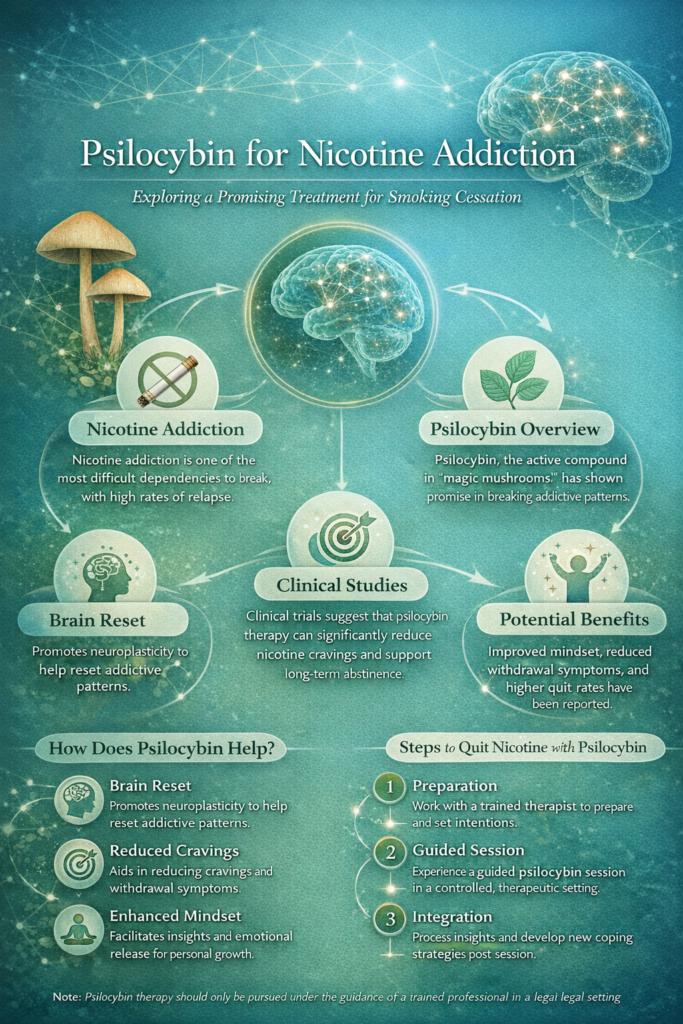
Nicotine addiction remains one of the leading causes of preventable disease and death, with many individuals struggling to quit despite available treatments. Traditional approaches—such as nicotine replacement therapy, medications, and behavioral counseling—often yield limited long-term success, highlighting the need for innovative interventions. In recent years, psilocybin, a naturally occurring psychedelic compound, has emerged as a promising area of research in addiction treatment. Early studies suggest that, when used in controlled therapeutic settings, psilocybin may help disrupt entrenched patterns of dependence, enhance psychological insight, and support lasting behavior change. Exploring its role in nicotine addiction offers a new perspective on how brain chemistry, cognition, and personal meaning intersect in the recovery process.
Psilocybin for Nicotine Addiction: A New Path to Quitting Smoking
Nicotine addiction remains one of the most persistent and difficult dependencies to overcome. Despite widespread awareness of the health risks, many smokers struggle with repeated relapse. In recent years, attention has turned toward an unconventional but increasingly researched approach: psilocybin-assisted therapy.
What Is Psilocybin?
Psilocybin is a naturally occurring psychedelic compound found in certain species of mushrooms. Once ingested, it is converted into psilocin, which interacts primarily with serotonin receptors in the brain. This interaction can temporarily alter perception, mood, and cognition—often producing deeply introspective experiences.
Why Traditional Methods Fall Short
Conventional smoking cessation tools—such as nicotine replacement therapy, medications, and behavioral counseling—can be effective, but success rates remain modest. One reason is that nicotine addiction is not purely physical; it is also deeply psychological, tied to habits, emotional regulation, and reward pathways in the brain.
The Role of Psilocybin in Addiction Treatment
Emerging research suggests that psilocybin may help disrupt entrenched patterns of thought and behavior. Rather than simply reducing cravings, psilocybin-assisted therapy appears to target the underlying mechanisms of addiction:
- Neuroplasticity: Psilocybin may enhance the brain’s ability to form new neural connections, making it easier to break habitual behaviors.
- Dopamine system reset: While psilocybin does not directly flood the brain with dopamine as nicotine does, it may indirectly influence reward processing and reduce dependence on external stimuli.
- Psychological insight: Many participants report gaining new perspectives on their addiction, including a stronger sense of motivation to quit.
What the Research Shows
Small clinical studies have reported promising results. In controlled therapeutic settings, a significant proportion of participants were able to quit smoking after just a few psilocybin sessions combined with psychotherapy. These outcomes are notably higher than those typically seen with standard treatments alone.
However, it is important to emphasize that this research is still in its early stages. Most studies involve small sample sizes and highly controlled environments with professional guidance.
Risks and Considerations
Psilocybin is not a casual or universally safe solution. Potential risks include:
- Intense psychological experiences can be distressing without proper support
- Possible exacerbation of underlying mental health conditions
- Legal restrictions in many regions
For these reasons, psilocybin should not be viewed as a do-it-yourself treatment. Its potential benefits appear closely tied to structured, therapeutic use.
A Shift in How We Understand Addiction
The growing interest in psilocybin reflects a broader shift in addiction science—from focusing solely on chemical dependence to addressing the deeper cognitive and emotional patterns that sustain it. Rather than suppressing symptoms, psychedelic-assisted therapy may help individuals reframe their relationship with substances altogether.
Conclusion
Psilocybin-assisted therapy represents a promising but still developing frontier in nicotine addiction treatment. While early findings are encouraging, more research is needed to fully understand its effectiveness, safety, and long-term outcomes. For now, it stands as a compelling example of how rethinking brain chemistry and human behavior could open new pathways to recovery.
Psilocybin and Smoking Cessation: Self-Management Strategies for Change
Interest in psilocybin-assisted therapy for nicotine addiction has grown in recent years, especially as traditional quitting methods continue to show mixed success. While most research emphasizes guided, clinical use, some individuals are exploring how principles from this research can inform self-management strategies for behavior change. The key idea is not simply the substance itself, but how intention, environment, and psychological integration shape outcomes.
Understanding the Foundation
Nicotine addiction is maintained by both neurochemical reinforcement and learned behavioral patterns. Smoking becomes tied to routines—morning coffee, stress relief, social cues—making it difficult to quit even when motivation is high. In therapeutic contexts, psilocybin appears to help disrupt these patterns by promoting cognitive flexibility and increasing awareness of automatic behaviors.
However, the effectiveness seen in studies is not due to psilocybin alone. It is the structured process around it that matters most.
1. Intention Setting
A central strategy is defining a clear, focused intention before any attempt at change. This mirrors protocols used in clinical settings.
- Identify why quitting matters (health, relationships, autonomy)
- Write a concrete goal (e.g., “I am becoming someone who no longer relies on nicotine”)
- Reflect on triggers and emotional drivers behind smoking
This process primes the brain to recognize and act on new insights.
2. Environmental Structuring (“Set and Setting”)
Research consistently highlights the importance of set (mindset) and setting (environment).
- Choose a calm, safe, and interruption-free space
- Minimize external stressors during the quitting process
- Remove cigarettes, lighters, and cues from the environment
Even outside of psychedelic use, these steps reduce relapse risk by weakening conditioned associations.
3. Psychological Preparation
Preparation involves building awareness of thought patterns before attempting change.
- Track when and why cravings occur
- Practice mindfulness or journaling
- Develop alternative coping strategies (e.g., breathing exercises, movement)
This creates a baseline understanding of the addiction cycle.
4. Integration: Turning Insight into Action
One of the most overlooked aspects is integration—what happens after a shift in perspective.
- Journal insights and revisit them regularly
- Translate realizations into specific behavior changes
- Reinforce new habits immediately (e.g., replacing smoking with a walk or hydration)
Without integration, even powerful insights can fade quickly.
5. Social and Professional Support
Even self-directed approaches benefit from external support.
- Share goals with a trusted person
- Consider counseling or support groups
- Seek professional guidance when possible
Support systems increase accountability and help process difficult emotions.
Important Considerations
It is essential to approach this topic responsibly:
- Psilocybin remains illegal in many areas
- Unsupervised use carries psychological risks, especially for individuals with certain mental health conditions
- Most evidence of effectiveness comes from controlled clinical settings, not independent use
Because of this, self-management strategies should focus primarily on behavioral change principles, not unsupervised substance use.
A Broader Perspective
The growing interest in psilocybin highlights a shift in addiction treatment—from suppressing cravings to restructuring how individuals relate to their habits, emotions, and identity. Whether or not psilocybin is involved, the most effective strategies emphasize awareness, intentionality, and long-term habit change.
Conclusion
Self-management strategies for quitting smoking—such as intention setting, environmental control, and integration—are powerful tools on their own. Research on psilocybin suggests that these strategies can be amplified in therapeutic contexts, but they remain essential regardless of the approach. Sustainable recovery ultimately depends on how insight is translated into daily action.
Family Support in Psilocybin-Assisted Smoking Cessation: Strategies for Lasting Change
Quitting nicotine is rarely just an individual challenge—it is deeply shaped by relationships, environment, and emotional support. As research explores psilocybin-assisted therapy as a potential aid for smoking cessation, one factor stands out across successful outcomes: strong, intentional support systems. Family members, when informed and engaged, can play a critical role in reinforcing motivation, reducing relapse, and helping translate insight into lasting behavioral change.
Why Family Support Matters
Nicotine addiction is both biological and behavioral. While psilocybin-assisted approaches may help disrupt rigid patterns and increase psychological insight, lasting change depends on what happens afterward. This is where family support becomes essential.
Supportive relationships can:
- Reinforce commitment during moments of doubt
- Help reduce environmental triggers
- Provide emotional grounding during stressful periods
- Encourage accountability and consistency
1. Creating a Nonjudgmental Environment
One of the most important roles family members can play is fostering a space of psychological safety.
- Avoid criticism, shame, or ultimatums
- Use open-ended, supportive language (“How can I help you through this?”)
- Recognize that relapse can be part of the process
A nonjudgmental approach increases honesty and reduces the likelihood of hidden struggles.
2. Understanding the Process
Family members should have a basic understanding of what psilocybin-assisted therapy involves—especially that it is not a quick fix.
- It often includes preparation, a guided experience, and integration
- Emotional experiences may be intense or introspective
- Insights gained need ongoing reinforcement
Even if not directly involved, informed support leads to more effective encouragement.
3. Supporting “Set and Setting” Principles
The concepts of mindset (set) and environment (setting) extend beyond the individual.
Family can help by:
- Maintaining a calm, low-stress home environment
- Respecting boundaries and quiet time during critical periods
- Reducing exposure to smoking cues (e.g., not smoking around the individual)
These changes strengthen the conditions needed for success.
4. Reinforcing New Habits
After a shift in perspective, behavior change must be sustained.
- Encourage replacement routines (walking, hydration, hobbies)
- Celebrate small milestones (1 day, 1 week, 1 month smoke-free)
- Participate in healthy activities together
Shared routines make new habits more stable and rewarding.
5. Emotional Support During Withdrawal
Nicotine withdrawal can involve irritability, anxiety, and mood fluctuations.
Family members can:
- Normalize these reactions rather than taking them personally
- Offer patience and reassurance
- Help the individual stay focused on long-term goals
Consistent emotional support reduces the risk of relapse during difficult periods.
6. Encouraging Integration
Insights—whether from therapy or personal reflection—need to be revisited and applied.
- Ask reflective questions (“What stood out to you most?”)
- Encourage journaling or discussion
- Help connect insights to daily decisions
This process helps transform temporary realizations into lasting change.
Important Considerations
It is essential to approach this topic responsibly:
- Psilocybin use is not legal in many regions
- Most evidence for its effectiveness comes from controlled, professional settings
- Unsupervised use can carry psychological risks
Family support should focus on safe, legal, and evidence-based approaches, while reinforcing the behavioral and emotional components of recovery.
A Family-Centered View of Recovery
Addiction recovery is most successful when it is not carried alone. Psilocybin-assisted approaches, where legally and clinically appropriate, may offer new tools—but they do not replace the importance of connection, support, and shared effort.
Conclusion
Family support can be a powerful stabilizing force in smoking cessation. By creating a supportive environment, reinforcing healthy habits, and helping integrate meaningful insights, families can significantly increase the chances of long-term success. Ultimately, recovery is not just about quitting nicotine—it is about building a sustainable, healthier way of living, together.
Community Resources and Psilocybin-Assisted Smoking Cessation: Building Support Beyond the Individual
Nicotine addiction is not just a personal struggle—it is shaped by social environments, access to care, and community support systems. As interest grows in psilocybin-assisted approaches to smoking cessation, it becomes clear that community-level resources play a crucial role in whether individuals can safely, legally, and effectively pursue recovery. While psilocybin research is still emerging, the broader framework of community support remains essential.
Why Community Support Matters
Addiction thrives in isolation but weakens in connection. Community resources provide structure, accountability, and access to guidance that individuals often cannot maintain on their own. In the context of psilocybin-assisted therapy, these supports are especially important because outcomes depend heavily on preparation, supervision, and integration.
1. Access to Licensed and Legal Programs
Where psilocybin services are legally available, community infrastructure is key.
- Seek state-regulated or research-based programs (where applicable)
- Look for licensed facilitators or clinical trials through universities or medical centers
- Avoid unregulated or underground services that may lack safety protocols
Legal access ensures safer conditions and professional oversight.
2. Integration Circles and Peer Support Groups
One of the most valuable community resources is integration support—spaces where individuals can process experiences and apply insights.
- Psychedelic integration circles (in-person or virtual)
- Smoking cessation support groups
- Peer-led recovery communities
These groups help normalize challenges and reinforce long-term behavior change.
3. Mental Health and Counseling Services
Professional support remains a cornerstone of addiction recovery.
- Therapists trained in addiction or behavioral change
- Counselors familiar with harm reduction approaches
- Clinics offering cognitive-behavioral therapy (CBT) or motivational interviewing
Even without direct involvement in psychedelic therapy, these services strengthen outcomes by addressing underlying psychological patterns.
4. Public Health and Smoking Cessation Programs
Existing community programs can complement emerging approaches.
- Local health departments offering quitlines or free resources
- Nonprofit organizations focused on tobacco cessation
- Educational workshops and prevention programs
Combining traditional and emerging strategies often yields better results than relying on a single approach.
5. Harm Reduction Education
Community-based harm reduction emphasizes safety and informed decision-making.
- Education on risks, contraindications, and mental health considerations
- Clear guidance on avoiding unsafe or illegal practices
- Emphasis on preparation, support, and aftercare
This approach meets individuals where they are while prioritizing well-being.
6. Building Supportive Environments
Communities can also reduce triggers and promote healthier norms.
- Smoke-free public spaces
- Wellness-focused community events
- Access to physical activity, nutrition programs, and stress management resources
These environmental shifts make it easier to maintain long-term change.
Important Considerations
It is essential to approach psilocybin responsibly:
- It remains illegal in many regions and is not widely available in clinical practice
- Most evidence for smoking cessation comes from small, controlled studies
- Unsupervised use carries psychological and safety risks
Community strategies should prioritize legal access, education, and evidence-based care.
A Broader Shift in Addiction Recovery
The exploration of psilocybin reflects a growing recognition that addiction is not only chemical but also behavioral, emotional, and social. Community resources address these broader dimensions by providing connection, structure, and continuity—elements that are critical regardless of the specific treatment approach.
Conclusion
Community resource strategies are a powerful complement to any smoking cessation effort. Whether or not psilocybin-assisted therapy is involved, access to supportive networks, professional care, and safe environments significantly increases the likelihood of success. Recovery is not just an individual journey—it is a collective one, shaped by the systems and communities that surround us.
Frequently Asked Questions
Here are some common questions:
1. What is psilocybin?
Psilocybin is a naturally occurring psychedelic compound found in certain mushrooms. In the body, it is converted to psilocin, which acts on serotonin receptors and can alter mood, perception, and cognition.
2. How could psilocybin help with nicotine addiction?
Research suggests psilocybin may help by:
- Disrupting habitual thought patterns
- Increasing self-awareness and motivation to quit
- Promoting neuroplasticity (the brain’s ability to form new connections)
This can make it easier to break the cycle of addiction rather than just manage cravings.
3. Is psilocybin more effective than traditional quitting methods?
Early studies show promising results, with some participants achieving higher quit rates than typical methods. However, research remains limited, and most success has occurred in structured, therapeutic settings rather than in casual use.
4. Is psilocybin safe?
Psilocybin can be safe in controlled environments with professional support, but risks include:
- Anxiety or distress during the experience
- Worsening of certain mental health conditions
- Impaired judgment during use
It is not recommended without proper screening and supervision.
5. Is psilocybin legal?
Psilocybin is illegal in many places, though some regions have decriminalized or legalized it for therapeutic use. Laws vary widely, so it’s important to check local regulations.
6. What does a psilocybin-assisted therapy session look like?
In clinical settings, it usually involves:
- Preparation (setting goals and expectations)
- Guided session (with trained professionals in a safe setting)
- Integration (processing insights and applying them to behavior change)
7. Can someone quit smoking using psilocybin alone?
Psilocybin is not a standalone cure. Its effectiveness depends heavily on therapy, support, and follow-up behavior changes. Without these, benefits may not last.
8. What are the psychological benefits reported?
Participants often report:
- Increased clarity about their addiction
- Reduced desire to smoke
- Greater emotional insight
- A stronger sense of purpose or motivation
9. Are there risks for people with mental health conditions?
Yes. Individuals with conditions like psychosis, bipolar disorder, or severe anxiety may be at higher risk for adverse effects. Screening by professionals is essential.
10. Why is “set and setting” important?
“Set” (mindset) and “setting” (environment) strongly influence the experience. A safe, supportive environment reduces risk and increases the likelihood of positive outcomes.
11. How long do the effects last?
The acute psychedelic experience lasts about 4–6 hours, but psychological insights and behavioral changes may persist much longer when properly integrated.
12. What is the biggest limitation of current research?
Most studies:
- Have small sample sizes
- Occur in controlled clinical environments
- Lack long-term, large-scale data
More research is needed before it becomes a mainstream treatment.
Conclusion
Psilocybin-assisted therapy represents a compelling but still developing approach to treating nicotine addiction. While preliminary findings indicate potential for higher cessation rates and deeper psychological transformation, its effectiveness appears closely tied to structured support, preparation, and integration. It is important to recognize that psilocybin is not a standalone solution and carries legal and clinical considerations that must be carefully addressed. As research continues to evolve, this approach highlights a broader shift in addiction science—one that prioritizes not only the reduction of cravings but also the reorganization of thought patterns and behaviors. Ultimately, psilocybin may contribute to a more holistic understanding of recovery, emphasizing lasting change through both biological and psychological pathways.
Video: