Personality disorder diagnosis is often surrounded by confusion, stigma, and misunderstanding. Many people view it as a fixed label or a judgment of character, rather than what it is intended to be: a clinical tool for identifying enduring patterns that affect how individuals think, feel, and relate to others. These patterns, often shaped by early experiences and coping mechanisms, can create significant challenges in daily functioning and relationships. Understanding diagnosis from a psychological perspective helps shift the focus from labeling the person to recognizing the patterns—opening the door to greater insight, effective treatment, and meaningful change.
Personality Disorder Diagnosis: Beyond Labels and Into Understanding
Why Diagnosis Matters
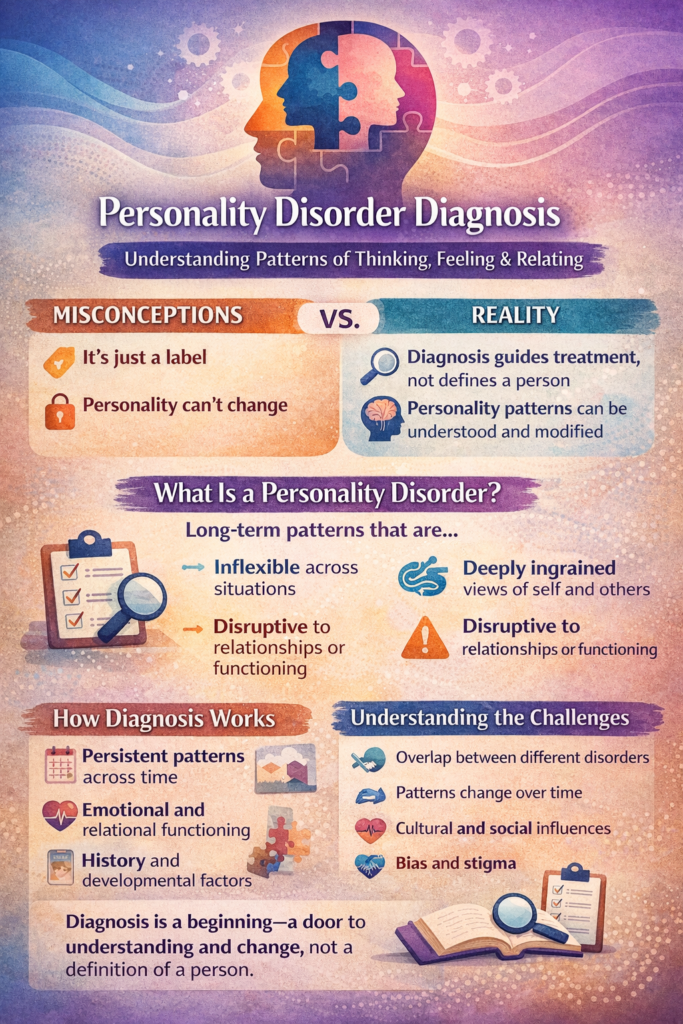
Personality disorder diagnosis is often misunderstood as simply “labeling” someone’s personality as problematic. In reality, it is a structured clinical process designed to identify enduring patterns of thinking, feeling, and behaving that significantly impact a person’s functioning, relationships, and well-being.
A diagnosis is not meant to define a person—it is meant to guide understanding, treatment, and support.
What Is a Personality Disorder?
Personality disorders involve long-term patterns that are:
- Inflexible across different situations
- Deeply ingrained in how a person sees themselves and others
- Disruptive to relationships, work, or daily life
These patterns are not temporary reactions—they are consistent ways of interacting with the world that often develop over time.
How Diagnosis Actually Works
Diagnosis is not based on one behavior or a single moment. Clinicians look for:
- Persistent patterns across time and contexts
- Emotional and interpersonal functioning
- The degree of distress or impairment
- History, including developmental and environmental factors
Standardized criteria (such as those in diagnostic manuals) are used, but clinical judgment and context are essential.
Common Misconceptions
1. “It’s Just a Label.”
While labels can feel limiting, they provide a shared language for:
- Understanding symptoms
- Accessing treatment
- Communicating between professionals
The problem isn’t the diagnosis itself—it’s how it’s sometimes used or misunderstood.
2. “Personality Can’t Change.”
Personality patterns are deeply rooted but not fixed. With therapy and support, individuals can:
- Develop healthier coping strategies
- Improve emotional regulation
- Change relational patterns
3. “Diagnosis Means Something Is ‘Wrong’ With the Person.”
A diagnosis reflects patterns of adaptation, often shaped by:
- Early life experiences
- Attachment dynamics
- Trauma or chronic stress
It’s less about being “broken” and more about understanding how those patterns developed.
Why Diagnosis Can Be Challenging
Personality disorders exist on a spectrum, which makes diagnosis complex:
- Traits overlap across different disorders
- Symptoms can change over time
- Cultural and social factors influence behavior
- Bias and stigma can affect interpretation
Because of this, diagnosis is often an ongoing, evolving process rather than a one-time decision.
The Role of Insight and Self-Awareness
A key part of diagnosis and treatment is helping individuals recognize:
- Their emotional patterns
- Their triggers and reactions
- How their behavior affects themselves and others
This awareness is the first step toward meaningful change.
Diagnosis as a Starting Point—Not an Endpoint
A personality disorder diagnosis should not be seen as a conclusion, but as a framework for growth.
It helps answer questions like:
- What patterns are causing difficulty?
- Where did they come from?
- What skills need to be developed?
From there, treatment can focus on:
- Emotional regulation
- Interpersonal effectiveness
- Cognitive flexibility
Reducing Stigma and Increasing Understanding
One of the biggest barriers is stigma. Personality disorders are often judged more harshly than other mental health conditions.
Shifting perspective means:
- Seeing behavior in context
- Recognizing the role of past experiences
- Balancing accountability with empathy
Final Thought
Personality disorder diagnosis is not about putting someone in a box—it’s about making sense of patterns that feel confusing, overwhelming, or stuck.
When used thoughtfully, diagnosis becomes a tool for clarity, direction, and change—helping individuals move from being defined by their patterns to understanding and reshaping them.
Taking Ownership of Change: Self-Management Strategies for Understanding Personality Disorder Diagnosis
Moving From Label to Self-Understanding
Receiving or exploring a personality disorder diagnosis can feel overwhelming. For some, it brings clarity; for others, it raises questions about identity, change, and control. But diagnosis is not a definition—it’s a tool for insight.
Self-management is about shifting from:
“What’s wrong with me?”
to
“What patterns do I have, and how can I work with them?”
Strategy 1: Learn Your Patterns Without Judgment
The first step is awareness—not criticism.
Start by identifying:
- Emotional triggers
- Repetitive thoughts
- Behavioral patterns in relationships
Ask:
- When do I react strongly?
- What situations feel hardest to manage?
Goal: Observe patterns as information, not flaws.
Strategy 2: Separate Identity From Behavior
A diagnosis describes patterns—it does not define who you are.
Instead of:
- “I am this disorder.”
Shift to:
- “I have learned patterns that I can understand and change.”
This creates psychological space for growth and reduces shame.
Strategy 3: Build Emotional Regulation Skills
Many personality-related challenges involve intense or difficult-to-manage emotions.
Helpful tools include:
- Pausing before reacting
- Naming emotions accurately
- Using grounding techniques during distress
Over time, this builds the ability to respond instead of react.
Strategy 4: Track Triggers and Responses
Keeping a simple log can increase insight:
- What happened?
- What did I feel?
- How did I respond?
- What was the outcome?
This helps identify patterns over time, making change more intentional.
Strategy 5: Practice Cognitive Flexibility
Personality patterns often involve rigid thinking.
Work on:
- Challenging all-or-nothing thoughts
- Considering alternative perspectives
- Asking: “Is there another way to interpret this?”
Flexibility reduces emotional intensity and improves decision-making.
Strategy 6: Start With Small Behavioral Changes
Big changes can feel overwhelming.
Instead:
- Choose one behavior to work on
- Practice it consistently
- Build gradually
For example:
- Delaying a reaction by a few minutes
- Communicating one’s feelings clearly instead of withdrawing
Small shifts create long-term change.
Strategy 7: Strengthen Interpersonal Skills
Relationships are often where personality patterns show up most.
Focus on:
- Clear communication
- Setting and respecting boundaries
- Listening without immediate defensiveness
These skills help break repetitive relational cycles.
Strategy 8: Manage Stress Proactively
Stress intensifies existing patterns.
Develop routines that reduce baseline stress:
- Regular sleep and structure
- Physical activity
- Time for recovery and reflection
Lower stress makes emotional regulation easier.
Strategy 9: Use Support Without Losing Autonomy
Self-management doesn’t mean doing everything alone.
Effective support includes:
- Therapy or counseling
- Skills-based programs
- Trusted relationships
The goal is to learn skills, not become dependent.
Strategy 10: Focus on Progress, Not Perfection
Change in personality patterns takes time.
Expect:
- Gradual improvement
- Occasional setbacks
- Ongoing learning
What matters is consistency, not perfection.
A More Empowering Perspective
A personality disorder diagnosis is not a life sentence—it’s a map.
It shows:
- Where patterns exist
- Where challenges arise
- Where growth is possible
Self-management turns that map into action.
Final Thought
Understanding your patterns is one of the most powerful steps you can take.
When you move from reacting automatically to responding intentionally,
you’re no longer controlled by those patterns—you’re actively reshaping them.
Supporting Without Stigma: Family Strategies for Understanding Personality Disorder Diagnosis
When a Diagnosis Affects the Whole Family
A personality disorder diagnosis doesn’t just impact the individual—it often affects the entire family system. Loved ones may feel confused, overwhelmed, or even hurt by patterns they don’t fully understand. Reactions like emotional intensity, withdrawal, conflict, or instability can be difficult to navigate without context.
Family support becomes most effective when it shifts from:
“Why are they like this?”
to
“What patterns are happening, and how can we respond in a healthier way?”
Understanding Before Reacting
Personality disorder diagnoses reflect long-standing patterns of thinking, feeling, and relating, often shaped by past experiences, attachment dynamics, and coping mechanisms.
What families may see as:
- Overreacting → may be difficulty regulating emotions
- Withdrawal → may be fear of rejection or overwhelm
- Conflict → may be struggles with communication or trust
Understanding these patterns doesn’t excuse harmful behavior—but it makes responses more effective.
Strategy 1: Separate the Person From the Diagnosis
Avoid defining your loved one by their diagnosis.
Instead of:
- “You’re being difficult.”
Try:
- “I’m noticing this pattern, and I want to understand what’s going on.”
Why it matters:
This reduces defensiveness and helps maintain connection.
Strategy 2: Educate Yourself About the Diagnosis
Knowledge reduces confusion and emotional reactivity.
Learn about:
- Common patterns and symptoms
- Emotional triggers
- Typical relationship dynamics
The more you understand, the less personal the behavior feels—and the more strategic your responses can be.
Strategy 3: Set Clear and Consistent Boundaries
Support does not mean tolerating harmful behavior.
Healthy boundaries might include:
- Defining what behavior is acceptable
- Following through on consequences calmly
- Avoiding reactive or inconsistent responses
Key principle: Boundaries create stability, not punishment.
Strategy 4: Avoid Power Struggles
Trying to “win” arguments often escalates situations.
Instead:
- Stay calm and grounded
- Focus on your response, not controlling theirs
- Step away when conversations become unproductive
This helps prevent cycles of escalation.
Strategy 5: Validate Emotions Without Reinforcing Harmful Behavior
Validation doesn’t mean agreement—it means acknowledging feelings.
For example:
- “I can see this is really upsetting for you.”
without:
- Agreeing with harmful actions or distorted thinking
Why it works:
People are more likely to regulate their emotions when they feel understood.
Strategy 6: Encourage Skill-Building and Treatment
Families can support growth by encouraging:
- Therapy (especially skills-based approaches)
- Emotional regulation techniques
- Communication and coping strategies
Focus on skill development, not just behavior correction.
Strategy 7: Manage Your Own Emotional Responses
Family members often experience:
- Frustration
- Guilt
- Burnout
Self-management is essential:
- Take breaks when needed
- Seek your own support (therapy, groups)
- Avoid taking behaviors personally
You can’t support effectively if you’re emotionally overwhelmed.
Strategy 8: Maintain Realistic Expectations
Change takes time—especially with long-standing patterns.
Expect:
- Gradual progress
- Occasional setbacks
- Ongoing effort
Avoid expecting immediate or perfect change.
Strategy 9: Reinforce Positive Changes
Small improvements matter.
Acknowledge:
- Efforts to communicate
- Attempts at emotional regulation
- Steps toward responsibility
Positive reinforcement encourages continued growth.
Strategy 10: Focus on the Relationship, Not Just the Problem
It’s easy for the diagnosis to dominate interactions.
Make space for:
- Neutral or positive conversations
- Shared activities
- Moments that are not centered on the disorder
This helps preserve connection and reduces tension.
A Healthier Family Dynamic
When families move from confusion and reactivity to understanding and structure:
- Communication improves
- Emotional intensity decreases
- Growth becomes more possible
The goal is not to “fix” the person—but to create an environment that supports accountability, stability, and change.
Final Thought
A personality disorder diagnosis can feel overwhelming—but it also provides a roadmap for understanding patterns that once felt chaotic.
With the right balance of education, boundaries, empathy, and self-care, families can shift from reacting to behaviors to responding with clarity and purpose—creating space for both support and growth.
Beyond Diagnosis: Community Resource Strategies for Understanding Personality Disorders
Why Community Support Matters
Personality disorder diagnoses are often misunderstood, not only by individuals and families but by society as a whole. Stigma, lack of access to care, and misinformation can make it difficult for individuals to receive the support they need.
A community-based approach shifts the focus from:
“What’s wrong with this person?”
to
“What systems and supports can help them function and grow?”
When communities are informed and equipped, diagnosis becomes less about labeling and more about connection, resources, and opportunity for change.
Moving From Stigma to Understanding
At the community level, personality disorders are often viewed through a lens of judgment rather than education. This can lead to:
- Social isolation
- Misinterpretation of behaviors
- Limited access to appropriate care
Community resources play a key role in reframing personality disorders as patterns that can be understood and managed, not fixed identities.
Strategy 1: Increase Access to Mental Health Services
Accessible, affordable care is foundational.
Communities can support:
- Outpatient therapy services
- Specialized treatment programs (e.g., skills-based therapies)
- Crisis support and intervention services
Impact: Early and consistent support helps individuals better understand and manage their patterns.
Strategy 2: Promote Public Education and Awareness
Many misconceptions about personality disorders stem from a lack of knowledge.
Community initiatives can include:
- Workshops and seminars
- Online educational campaigns
- School-based mental health education
Topics might cover:
- What personality disorders are (and aren’t)
- The role of environment and development
- The potential for change and growth
Strategy 3: Develop Peer Support Networks
Peer support reduces isolation and provides relatable insight.
These networks offer:
- Shared experiences
- Emotional validation
- Practical coping strategies
Seeing others manage similar challenges helps shift the narrative from “I’m alone” to “change is possible.”
Strategy 4: Provide Skills-Based Community Programs
Many individuals benefit from learning practical skills in accessible settings.
Community programs can focus on:
- Emotional regulation
- Communication and relationship skills
- Stress management
- Problem-solving
These programs bridge the gap between diagnosis and real-life application.
Strategy 5: Integrate Services Across Systems
Personality patterns often impact multiple areas of life.
Effective communities connect:
- Mental health services
- Educational institutions
- Employment and vocational programs
- Social services
Goal: Provide coordinated support rather than fragmented care.
Strategy 6: Support Families and Caregivers
Families are often part of the recovery environment.
Community resources can offer:
- Family education programs
- Support groups
- Guidance on boundaries and communication
When families are informed, they can support without enabling or escalating conflict.
Strategy 7: Create Safe and Inclusive Environments
Stigma can prevent individuals from seeking help.
Communities can promote:
- Nonjudgmental language
- Inclusive policies
- Safe spaces for discussion and support
This encourages openness and reduces fear of being labeled or misunderstood.
Strategy 8: Encourage Early Intervention
The earlier patterns are recognized, the easier they are to address.
Community systems (schools, healthcare providers, youth programs) can:
- Identify early signs of emotional and behavioral difficulties
- Provide timely referrals and support
- Normalize seeking help
Early support can prevent patterns from becoming more rigid over time.
A Systems-Based Perspective
Personality disorder diagnosis is not just an individual issue—it is influenced by:
- Access to care
- Social support
- Education and awareness
- Cultural attitudes toward mental health
When communities strengthen these areas, individuals are better equipped to understand and manage their experiences.
Final Thought
A diagnosis should never exist in isolation.
When communities provide education, access, structure, and support, personality disorders become less about limitation and more about understanding patterns and building skills.
In the right environment, diagnosis becomes not a label to carry—
but a starting point for growth, connection, and meaningful change.
Frequently Asked Questions
Here are some common questions:
1. What is a personality disorder diagnosis?
A personality disorder diagnosis is a clinical way of identifying long-term patterns of thinking, feeling, and behaving that significantly impact a person’s relationships, functioning, and emotional well-being. It helps guide understanding and treatment—not define a person’s identity.
2. How is a personality disorder diagnosed?
Diagnosis is based on:
- Persistent patterns over time
- Emotional and interpersonal functioning
- Level of distress or impairment
- Personal history and context
Clinicians use standardized criteria (like diagnostic manuals) along with professional judgment.
3. Is a personality disorder diagnosis permanent?
No. While personality patterns are deeply ingrained, they are not fixed. With therapy, self-awareness, and skill-building, individuals can change how they think, respond, and relate to others over time.
4. Why do personality disorders develop?
They often develop from a combination of:
- Early life experiences
- Attachment patterns
- Trauma or chronic stress
- Temperament and biological factors
They are typically adaptations to past environments, not random traits.
5. Is diagnosis just labeling someone?
No. While it involves a label, the purpose is to:
- Provide clarity
- Guide treatment
- Improve communication between professionals
The issue is not the diagnosis itself, but how it is understood and used.
6. Can someone have traits without having a disorder?
Yes. Everyone has personality traits. A diagnosis is only made when those traits are:
- Rigid
- Persistent
- Causing significant distress or impairment
7. Why is diagnosing personality disorders difficult?
Because:
- Traits can overlap across different disorders
- Symptoms can change over time
- Cultural and social factors influence behavior
- Personal bias can affect interpretation
Diagnosis is often an ongoing process, not a one-time conclusion.
8. Do people with personality disorders know they have one?
Not always. Some individuals may lack awareness of their patterns, especially if those patterns feel “normal” to them. Increasing self-awareness is often a key part of treatment.
9. What types of treatments are used?
Treatment often focuses on:
- Therapy (especially skills-based approaches)
- Emotional regulation
- Cognitive restructuring
- Interpersonal skill development
Medication may be used for related symptoms (like anxiety or depression), but therapy is usually central.
10. Can relationships improve after diagnosis?
Yes. With understanding and effort:
- Communication can improve
- Patterns can become more flexible
- Emotional responses can become more manageable
Both the individual and their support system often benefit from increased awareness.
11. Is it stigmatizing to have a personality disorder diagnosis?
Unfortunately, stigma still exists. However, increasing education and awareness are helping shift perspectives toward:
- Understanding patterns
- Reducing judgment
- Promoting growth and treatment
12. What’s the best way to think about a diagnosis?
Instead of:
“This defines me.”
Think:
“This explains patterns I can learn to manage and change.”
Conclusion
Ultimately, a personality disorder diagnosis is not a definition of who someone is, but a framework for understanding how certain patterns have developed and how they can be addressed. When viewed with clarity rather than stigma, diagnosis becomes a starting point rather than a limitation—guiding individuals, families, and professionals toward more informed and compassionate responses. By focusing on awareness, skill-building, and support, it is possible to move beyond the label and toward growth, stability, and improved quality of life.
Video: Personality Disorders Are Just Rigid Coping Mechanisms #psychology #awareness