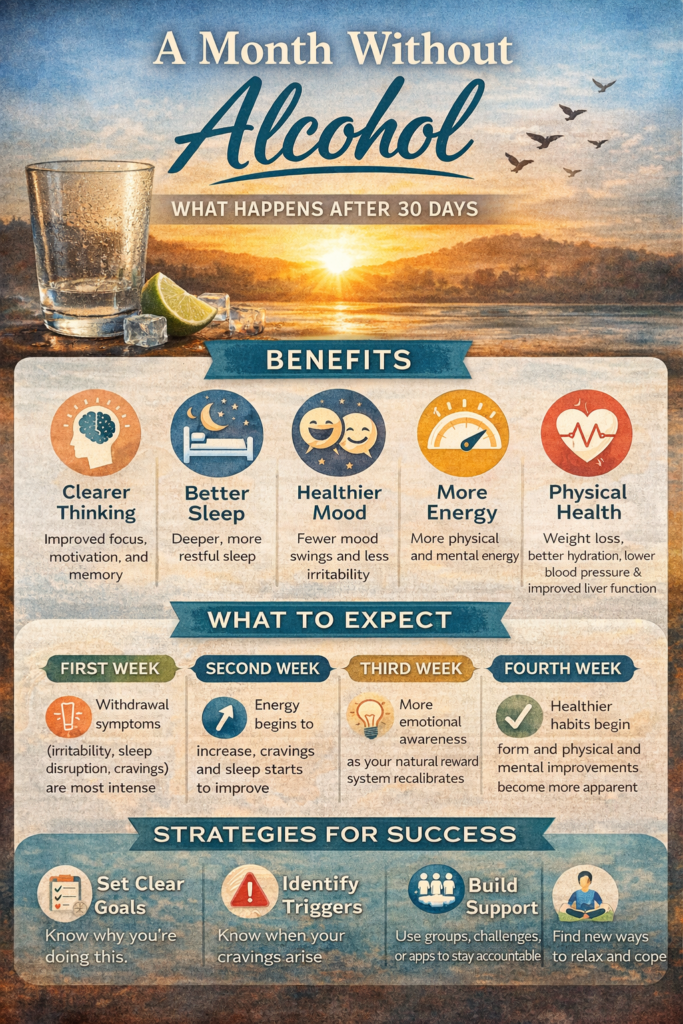
Choosing to spend a month without alcohol is more than just a short-term challenge—it is a purposeful decision to pause and reflect on how alcohol fits into daily life. For many people, drinking is closely tied to routines, social situations, and ways of coping with stress, making even a brief break feel meaningful. Stepping away creates space to notice patterns, triggers, and habits that often go unnoticed, and to reveal underlying emotional needs.
During this time, many individuals begin to experience benefits such as improved sleep, clearer thinking, increased energy, and greater emotional awareness. Rather than focusing on what is being given up, this period can be viewed as an opportunity for reflection, reset, and personal growth—helping to build healthier habits and a deeper understanding of oneself.
One Month Without Alcohol: What Really Changes
Taking a month off from alcohol sounds simple—but for many people, it’s anything but easy. Alcohol is woven into routines, social life, stress relief, and even identity. So what actually happens when you step away for 30 days?
This isn’t just a break. It’s an experiment in awareness, brain chemistry, and behavior.
Week 1: Disruption and Withdrawal
The first week is often the hardest. Sleep may get worse before it gets better. You might feel restless, irritable, or anxious. This happens because alcohol has been artificially enhancing calming neurotransmitters like GABA while suppressing excitatory systems like glutamate. When alcohol is removed, the brain has to rebalance.
Cravings can feel surprisingly strong—not just physical, but psychological. You may notice how often drinking is tied to habits: after work, with dinner, to unwind. This is your brain’s reward system signaling expectation.
Week 2: Stabilization Begins
By the second week, many people begin to feel more stable. Sleep starts to improve, though it may still be inconsistent. Energy levels often rise. You may notice clearer thinking and fewer mood swings.
This is the brain beginning to recalibrate dopamine pathways. Without alcohol flooding the system, natural rewards—like food, conversation, or exercise—start to feel more noticeable again.
Week 3: Clarity and Awareness
Around week three, something shifts. Many people report feeling more emotionally aware. Without alcohol dulling stress or discomfort, you begin to notice what actually needs attention.
This can be empowering—but also uncomfortable. Alcohol often masks underlying stress, anxiety, or habits. Removing it reveals what’s underneath.
At the same time, confidence grows. You’ve made it this far. The idea that you “need” alcohol may start to weaken.
Week 4: Reset and Reflection
By the fourth week, the benefits are more obvious:
- More consistent sleep
- Improved mood stability
- Better focus and memory
- Physical changes like reduced bloating or weight shifts
But the biggest change is psychological. You’ve proven something to yourself: that change is possible.
This is where reflection matters. What role did alcohol actually play in your life? What do you want going forward—moderation, continued abstinence, or something else?
What Science Tells Us
Research shows that even short breaks from alcohol can:
- Improve liver function
- Reduce blood pressure
- Enhance sleep quality over time
- Restore sensitivity in the brain’s reward system
In other words, the body and brain begin to repair faster than many people expect.
Final Thoughts
One month without alcohol isn’t just about “not drinking.” It’s about learning—about your habits, your brain, and your coping mechanisms.
Whether you return to drinking or choose to continue abstaining, you won’t see alcohol the same way again. And that awareness? That’s where real change begins.
One Month Without Alcohol: Self-Management Strategies That Work
Committing to a month without alcohol is more than just a decision—it’s a daily practice of self-management. Success doesn’t come from willpower alone. It comes from understanding your habits, preparing for challenges, and building systems that support change.
Here’s how to approach a 30-day alcohol-free commitment with strategies that actually work.
1. Start with Clear Intentions
Before day one, define your “why.” Are you improving your health? Testing your relationship with alcohol? Resetting your habits?
Write it down. Vague goals fade quickly, but clear intentions create direction—especially when motivation dips.
2. Identify Your Triggers
Most drinking isn’t random—it’s patterned. Common triggers include:
- Stress after work
- Social settings
- Boredom or loneliness
- Celebrations or routines
Track when and why you feel the urge to drink. Awareness is the first step in interrupting automatic behavior.
3. Replace, Don’t Just Remove
Simply removing alcohol leaves a gap. Fill it intentionally.
- Swap evening drinks with tea, sparkling water, or non-alcoholic options
- Replace “wind-down drinking” with a walk, shower, or music
- Build new rituals that signal relaxation without alcohol
Your brain still needs a reward—just in a different form.
4. Use “Delay and Decide.”
Cravings rise quickly but usually pass within 15–30 minutes.
When an urge hits:
- Delay acting on it
- Check in with yourself
- Decide consciously instead of reacting automatically
This builds cognitive control and weakens habitual responses over time.
5. Manage Your Environment
Self-control is easier when your environment supports your goal.
- Remove alcohol from your home
- Avoid high-risk situations early on
- Let close friends know what you’re doing
You’re not avoiding life—you’re setting yourself up for success.
6. Plan for Social Situations
Social pressure can derail even strong intentions.
- Decide in advance what you’ll say (“I’m taking a break this month”)
- Bring your own non-alcoholic drink if needed
- Have an exit plan if you feel uncomfortable
Confidence comes from preparation, not improvisation.
7. Track Your Progress
Keep it simple:
- Mark each alcohol-free day
- Note mood, sleep, and energy changes
- Celebrate small wins
Visible progress reinforces motivation and builds momentum.
8. Expect Discomfort—Not Failure
You may feel restless, irritable, or bored at times. That’s not failure—it’s adjustment.
Discomfort is often a sign that your brain is recalibrating. Learning to sit with it, rather than escape it, is part of the process.
9. Build Support and Accountability
You don’t have to do it alone.
- Tell a friend or join a challenge
- Check in with someone weekly
- Share progress or struggles
Accountability increases follow-through and reduces isolation.
10. Reflect, Don’t Just Finish
At the end of 30 days, take time to reflect:
- What changed physically and mentally?
- When was it hardest—and why?
- What do you want going forward?
The goal isn’t just to complete the month—it’s to learn from it.
Final Thoughts
A month without alcohol is not about perfection. It’s about awareness, strategy, and growth.
When you combine intention with practical self-management, you shift from relying on willpower to building real behavioral change. And that’s what makes the difference—not just for 30 days, but for what comes after.
One Month Without Alcohol: Family Support Strategies That Make It Possible
Taking a month off from alcohol is a personal commitment—but it rarely succeeds in isolation. The home environment, family dynamics, and daily interactions all shape whether that commitment holds or unravels.
Family support doesn’t have to be perfect to be powerful. Small, consistent actions can reduce stress, strengthen accountability, and make change feel sustainable rather than overwhelming.
1. Start with Open Communication
Before the month begins, have a clear and honest conversation.
Explain:
- Why are you choosing to stop drinking for 30 days
- What challenges do you expect
- What kind of support would help
This isn’t about asking for permission—it’s about creating understanding. When family members know the “why,” they’re more likely to support the “how.”
2. Set Shared Expectations
Misunderstandings can create unnecessary tension.
Discuss things like:
- Alcohol in the home
- Social events and gatherings
- How to handle difficult days
Clarity reduces conflict. It also helps family members feel included rather than excluded from the process.
3. Create a Supportive Home Environment
Environment matters more than willpower.
Supportive changes might include:
- Removing or limiting alcohol in shared spaces
- Keeping alternative drinks available
- Creating relaxing, alcohol-free routines at home
The goal is to make the healthier choice the easier choice.
4. Replace Drinking Rituals Together
Many families bond around routines that involve alcohol—dinners, weekends, celebrations.
Instead of eliminating the connection, reshape it:
- Have a movie night or game night
- Cook meals together
- Go for evening walks
This reinforces that connection—not alcohol—is what matters.
5. Practice Encouragement, Not Pressure
Support doesn’t mean constant monitoring or criticism.
Helpful support sounds like:
- “I’m proud of you for doing this.”
- “How can I support you today?”
Unhelpful support sounds like:
- “Are you sure you can stick with it?”
- “It’s just one drink, it won’t matter.r”
Tone matters. Encouragement builds motivation; pressure weakens it.
6. Plan for Stressful Moments
Withdrawal from routine drinking can bring irritability, fatigue, or mood swings—especially early on.
Families can help by:
- Giving space when needed
- Avoiding unnecessary conflict
- Recognizing that discomfort is temporary
Understanding reduces misinterpretation. What looks like frustration is often an adjustment.
7. Participate When Possible
Family members don’t have to give up alcohol—but participating, even partially, can be meaningful.
Examples:
- Joining in alcohol-free days
- Choosing not to drink at shared meals
- Trying non-alcoholic alternatives together
Shared effort strengthens connection and reduces feelings of isolation.
8. Build Accountability with Compassion
Checking in can be helpful—if it’s done with care.
Instead of policing behavior, focus on support:
- “How are you feeling about the process?”
- “What’s been hardest so far?”
Accountability works best when it feels safe, not judgmental.
9. Celebrate Milestones
Don’t wait until day 30 to acknowledge progress.
Celebrate:
- The first week
- Getting through a difficult day
- Reaching the halfway point
Recognition reinforces effort and builds momentum.
10. Reflect Together at the End
At the end of the month, take time as a family to reflect:
- What changes did you notice?
- What was easier or harder than expected?
- What should continue moving forward?
This turns a 30-day challenge into a shared learning experience—not just an individual effort.
Final Thoughts
A month without alcohol is not just about removing a substance—it’s about reshaping patterns, relationships, and support systems.
When families approach the process with openness, flexibility, and encouragement, they become part of the solution. And in many cases, that support is what transforms a temporary change into something lasting.
One Month Without Alcohol: Community Resource Strategies That Strengthen Success
Choosing to go one month without alcohol is a powerful step—but trying to do it entirely on your own can make it harder than it needs to be. Community resources provide structure, accountability, and connection—three things that significantly improve follow-through and long-term change.
If willpower is internal, community is external reinforcement. And both matter.
1. Join a Support Group
One of the most effective strategies is connecting with others who are doing the same thing.
Options include:
- Peer-led recovery groups (in-person or online)
- 30-day sobriety challenges
- Local wellness or recovery meetups
These spaces normalize your experience. You quickly realize you’re not the only one navigating cravings, habits, or social pressure.
2. Use Digital Tools and Apps
Technology can provide daily structure and reminders.
Look for apps that:
- Track alcohol-free days
- Offer daily motivation or reflections
- Provide coping strategies for cravings
These tools act as a “pocket support system,” especially during moments when immediate help isn’t available.
3. Access Educational Resources
Understanding what’s happening in your brain and body can increase motivation.
Explore:
- Podcasts on addiction and recovery
- Articles on sleep, cravings, and brain chemistry
- Short courses or workshops on behavior change
Knowledge reduces fear and builds confidence. When you understand the process, you’re less likely to misinterpret discomfort as failure.
4. Connect with Local Health Services
Many communities offer free or low-cost services that can support your goal.
These may include:
- Counseling or brief therapy
- Substance use education programs
- Community health clinics
Even a few sessions can provide tools for managing triggers, stress, and emotional regulation.
5. Build a Sober Social Network
Social environments often reinforce drinking habits. Changing your environment—even temporarily—can make a big difference.
Ways to do this:
- Attend alcohol-free events or meetups
- Spend time with people who support your goal
- Explore new social activities that don’t center around drinking
Connection doesn’t have to disappear—it just needs to shift.
6. Use Crisis or Support Hotlines if Needed
Some days will be harder than others. Having immediate support available can prevent setbacks.
Hotlines and text-based services offer:
- Real-time emotional support
- Guidance during intense cravings
- A non-judgmental space to talk
Reaching out in a difficult moment is a strategy—not a weakness.
7. Engage in Community-Based Activities
Filling your time with meaningful activities reduces boredom and reinforces new habits.
Consider:
- Fitness classes
- Volunteer opportunities
- Skill-based workshops
These not only occupy time but also rebuild your reward system around healthier experiences.
8. Create External Accountability
Accountability increases follow-through.
You can:
- Share your goal publicly (if comfortable)
- Check in with a group or mentor weekly
- Participate in structured challenges
Knowing someone else is aware of your goal adds an extra layer of commitment.
9. Leverage Faith or Spiritual Communities (If Applicable)
For some people, spiritual or faith-based communities provide strong support systems.
They can offer:
- A sense of purpose
- Structured gatherings
- Emotional and social support
This can be especially helpful during moments of uncertainty or stress.
10. Reflect and Stay Connected After 30 Days
Community support shouldn’t end when the month does.
At the end of your 30 days:
- Reflect on which resources helped most
- Stay connected to supportive groups
- Continue using tools that worked
Sustained change often depends on sustained support.
Final Thoughts
A month without alcohol is not just a test of discipline—it’s an opportunity to build a network of support that makes change easier and more sustainable.
Community resources remind you of something important: you don’t have to rely on willpower alone. When you combine personal commitment with external support, you create a system that works—not just for 30 days, but for whatever comes next.
Frequently Asked Questions
Here are some common questions:
1. What happens to your body when you stop drinking for a month?
Many people experience improvements in sleep, energy, mood, and focus. Physically, the liver begins to repair, hydration improves, and blood pressure may decrease. Mentally, the brain’s reward system starts to rebalance, which can improve motivation and emotional stability.
2. Is it normal to feel worse before feeling better?
Yes. In the first few days, you may experience irritability, sleep disruption, headaches, or cravings. This is your body and brain adjusting to the absence of alcohol. These symptoms are usually temporary and improve within the first 1–2 weeks.
3. How long do cravings last?
Cravings are often short-lived, typically lasting 15–30 minutes. However, they can come in waves, especially during times you normally drink (evenings, weekends, or stressful moments). Over time, they become less frequent and less intense.
4. Can I still go out socially without drinking?
Yes, but it may require planning. You can:
- Bring or order non-alcoholic drinks
- Let others know you’re taking a break
- Leave early if needed
Many people find that socializing without alcohol becomes easier after the first couple of weeks.
5. Will I sleep better without alcohol?
Eventually, yes. Alcohol disrupts sleep cycles, especially REM sleep. While sleep may feel worse at first, most people notice deeper, more restorative sleep after 1–2 weeks.
6. Will I lose weight if I stop drinking?
Possibly. Alcohol contains empty calories and can increase appetite. Some people lose weight during a month without alcohol, while others notice changes in bloating, digestion, or body composition rather than immediate weight loss.
7. What if I slip and have a drink?
A slip doesn’t mean failure. It’s an opportunity to learn:
- What triggered the situation?
- What could you do differently next time?
You can continue your 30-day goal without starting over unless you choose to.
8. How do I deal with stress without alcohol?
Replacing alcohol is key. Try:
- Exercise or walking
- Deep breathing or mindfulness
- Talking to someone
- Engaging in a relaxing activity (music, reading, etc.)
The goal is to build healthier coping strategies over time.
9. Should I tell people I’m doing this?
It can help. Sharing your goal with supportive people increases accountability and reduces social pressure. However, it’s your choice—some people prefer to keep it private.
10. Is one month enough to make a difference?
Yes. Even 30 days can lead to noticeable physical and mental changes. More importantly, it provides insight into your habits, triggers, and relationship with alcohol.
11. What should I do after the 30 days are over?
Reflect on your experience:
- What benefits did you notice?
- What was challenging?
- What do you want going forward (moderation, continued abstinence, etc.)?
Use what you learned to guide your next steps.
12. Is it safe for everyone to stop drinking suddenly?
Not always. If someone drinks heavily or regularly, stopping suddenly can lead to withdrawal symptoms that may require medical supervision. If there’s any concern, it’s important to consult a healthcare professional before stopping.
Conclusion
Completing a month without alcohol can be a meaningful reminder that change is possible and that healthier routines can be built one day at a time. Beyond the physical benefits, the experience often reveals important insights about stress, coping, social pressure, and personal habits. Whether the month leads to continued abstinence, reduced drinking, or simply a better understanding of one’s relationship with alcohol, it can serve as a valuable turning point. In the end, a month without alcohol is not just about avoiding drinks for thirty days; it is about gaining clarity, building confidence, and creating a stronger foundation for long-term well-being.
Video: My Sleep Changed After Quitting Alcohol for 30 Days #sobriety #sleep #challenge