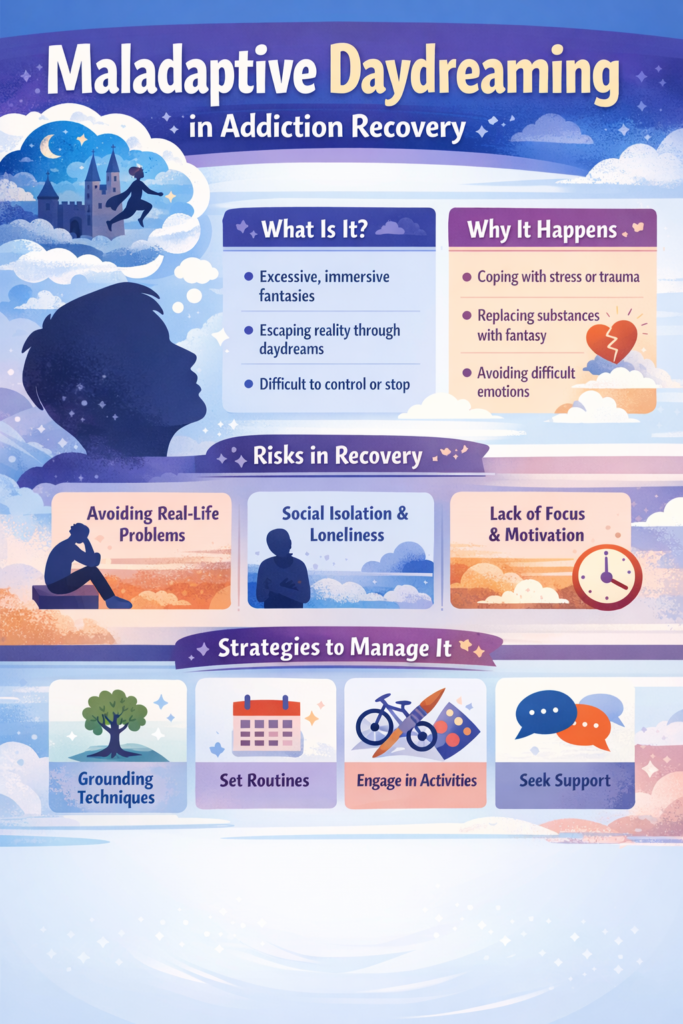
Maladaptive daydreaming in addiction recovery is a lesser-known but important challenge. While recovery focuses on stopping substance use, it also involves addressing the urge to escape emotional discomfort. For some, this need shifts inward, turning into maladaptive daydreaming—an internal form of avoidance that offers temporary relief but reduces engagement with reality. Recognizing this highlights that recovery is not just about behavior change, but about staying present and emotionally connected.
Maladaptive Daydreaming in Addiction Recovery: When the Mind Becomes the Escape
Recovery from addiction is often described as learning to live without substances—but what is less discussed is the challenge of learning to live without escape. For many individuals, substances once served as a way to cope with stress, trauma, or emotional discomfort. When that external escape is removed, the mind may seek alternatives. One such alternative is maladaptive daydreaming—a pattern of excessive, immersive fantasy that can interfere with daily functioning and emotional presence.
While daydreaming itself is a normal human experience, maladaptive daydreaming becomes problematic when it replaces real-life engagement. In the context of addiction recovery, it can function as a subtle, internal form of avoidance, making it an important but often overlooked factor in long-term healing.
What Is Maladaptive Daydreaming?
Maladaptive daydreaming involves intense, vivid fantasy that can consume significant amounts of time and attention. Unlike typical daydreaming, it is often:
- highly immersive and emotionally charged
- difficult to control or stop
- used as a way to escape reality
Individuals may create detailed scenarios, characters, or alternate versions of themselves, often returning to these mental worlds repeatedly.
The Connection to Addiction Recovery
Addiction and maladaptive daydreaming share a common function: escape. Both can serve as coping mechanisms to avoid difficult emotions, stress, or unmet needs.
In recovery, when substances are no longer available, the brain may turn to internal forms of escape. Maladaptive daydreaming can:
- provide temporary relief from discomfort
- mimic the “reward” feeling associated with substance use
- reduce engagement with real-life responsibilities
While it may seem harmless, it can interfere with the development of healthy coping skills.
Why It Can Be a Hidden Risk
Maladaptive daydreaming is often less visible than substance use, making it easier to overlook. However, its impact can still be significant.
Potential risks include:
- avoidance of real-life problems or responsibilities
- difficulty staying present in relationships
- reduced motivation or productivity
- reinforcement of unrealistic expectations or identity
Because it does not carry the same immediate consequences as substance use, it can quietly undermine recovery progress.
Emotional and Psychological Factors
Maladaptive daydreaming is often linked to:
- unresolved trauma
- loneliness or social disconnection
- anxiety or depression
- unmet emotional needs
In recovery, these underlying issues may become more noticeable without substances to numb them. Daydreaming can become a way to cope, but it does not address the root causes.
Recognizing the Pattern
Awareness is the first step in addressing maladaptive daydreaming. Signs may include:
- losing track of time due to daydreaming
- preferring fantasy over real-life interaction
- difficulty focusing on tasks
- feeling emotionally attached to imagined scenarios
Recognizing these patterns allows individuals to begin responding more intentionally.
Shifting from Escape to Engagement
Recovery involves learning to face reality rather than avoid it. This does not mean eliminating imagination, but using it in balanced, constructive ways.
Helpful strategies include:
- grounding techniques to stay present
- engaging in meaningful activities or hobbies
- building real-life connections and relationships
- developing emotional regulation skills
These approaches help replace avoidance with active participation in life.
Reframing the Role of Imagination
Imagination itself is not the problem—it can be a source of creativity, problem-solving, and emotional processing. The goal is not to eliminate daydreaming, but to shift it from maladaptive to adaptive use.
This might involve:
- using imagination for creative expression (writing, art)
- setting boundaries around when and how long to daydream
- bringing awareness to the purpose behind the behavior
When used intentionally, imagination can support rather than hinder recovery.
Conclusion: Returning to the Present
Maladaptive daydreaming highlights an important truth about addiction recovery: the need to address not just behaviors, but the underlying desire to escape. While the form of escape may change, the function often remains the same.
Recovery is not about removing all forms of relief—it is about finding healthier, more sustainable ways to cope and engage with life. By recognizing and managing maladaptive daydreaming, individuals can strengthen their ability to stay present, build meaningful connections, and continue growing beyond addiction.
The goal is not to escape reality.
It is to learn how to live fully within it.
Self-Management Strategies to Prevent Maladaptive Daydreaming in Addiction Recovery
Recovery from addiction often involves learning how to cope without escaping. While substances may no longer be present, the underlying urge to avoid discomfort can remain. For some individuals, this shift leads to maladaptive daydreaming—an internal form of escape that can quietly interfere with progress. Preventing this pattern requires intentional self-management strategies that promote awareness, presence, and engagement with real life.
Self-management is not about eliminating imagination, but about creating balance—so that the mind supports recovery rather than distracts from it.
Why Prevention Matters
Maladaptive daydreaming can reinforce the same avoidance patterns that fueled addiction. It may temporarily reduce stress or discomfort, but over time it can:
- delay emotional processing
- reduce motivation and productivity
- weaken real-life connections
- increase feelings of disconnection
Preventing this pattern early helps strengthen long-term recovery and supports a more grounded, stable sense of self.
1. Increasing Awareness of Triggers
The first step in prevention is recognizing when and why maladaptive daydreaming occurs. It is often triggered by:
- boredom or lack of structure
- stress or emotional discomfort
- loneliness or isolation
- specific environments or routines
Tracking when daydreaming happens helps identify patterns and creates opportunities for intervention.
2. Practicing Grounding Techniques
Grounding techniques help bring attention back to the present moment, reducing the pull of immersive fantasy.
Effective methods include:
- focusing on sensory input (what you can see, hear, feel)
- deep, paced breathing
- describing your surroundings out loud or mentally
These techniques interrupt the cycle of disengagement and reinforce presence.
3. Structuring Your Day
Unstructured time can increase the likelihood of drifting into excessive daydreaming. Creating a daily routine provides stability and reduces opportunities for avoidance.
Helpful structure includes:
- planned activities throughout the day
- scheduled breaks and downtime
- clear goals or tasks to focus on
Structure keeps the mind engaged in reality rather than escaping from it.
4. Engaging in Meaningful Activities
Replacing internal escape with external engagement is key. Activities that require focus and participation help anchor attention in the present.
Examples include:
- physical exercise
- creative outlets (writing, art, music)
- social interaction
- skill-building or educational pursuits
Meaningful engagement reduces the need to retreat into fantasy.
5. Developing Emotional Regulation Skills
Maladaptive daydreaming often serves to avoid difficult emotions. Learning to manage those emotions directly reduces reliance on escape.
Strategies include:
- identifying and labeling emotions
- using coping techniques like journaling or relaxation exercises
- allowing discomfort without immediately reacting to it
Emotional regulation builds resilience and reduces avoidance behaviors.
6. Setting Boundaries with Imagination
Imagination is not inherently harmful—it becomes problematic when it is excessive or uncontrolled. Setting intentional limits can help maintain balance.
This might involve:
- designating specific times for creative thinking
- gently redirecting attention when daydreaming becomes excessive
- recognizing when imagination is serving avoidance rather than creativity
Boundaries allow imagination to remain a healthy tool rather than a coping mechanism.
7. Strengthening Real-Life Connections
Isolation can increase the appeal of internal fantasy. Building and maintaining relationships helps ground individuals in real-life experiences.
This includes:
- spending time with supportive people
- participating in group activities or recovery communities
- engaging in honest, present conversations
Connection reduces the need to escape and reinforces a sense of belonging.
8. Practicing Self-Monitoring and Reflection
Regular reflection helps maintain awareness and track progress.
This may involve:
- journaling about triggers and responses
- noting improvements in focus and engagement
- reflecting on moments of success in staying present
Self-monitoring turns prevention into an ongoing, intentional practice.
Conclusion: Choosing Presence Over Escape
Preventing maladaptive daydreaming in addiction recovery is not about suppressing thoughts—it is about choosing engagement over avoidance. Through self-management strategies, individuals can build the skills needed to stay present, process emotions, and participate fully in their lives.
Recovery is not just about what you stop doing.
It is about what you start building.
By strengthening awareness, structure, and connection, you create a life that no longer requires escape—because it becomes something you can actively live in, rather than withdraw from.
Family Support Strategies to Prevent Maladaptive Daydreaming in Addiction Recovery
Recovery from addiction involves more than abstaining from substances—it requires learning how to stay present in reality rather than escaping from it. While much attention is given to external behaviors, internal patterns such as maladaptive daydreaming can also serve as a form of avoidance. For individuals in recovery, family support plays a crucial role in recognizing and preventing this subtle but impactful behavior.
Families can help create an environment that encourages presence, emotional engagement, and healthy coping—reducing the need for internal escape.
Why Family Support Matters
Maladaptive daydreaming often develops as a response to stress, loneliness, or emotional discomfort. Without awareness, families may overlook it or misinterpret it as a distraction or a lack of motivation.
Supportive family involvement can:
- increase awareness of avoidance patterns
- encourage real-life engagement
- provide emotional safety
- reinforce healthier coping strategies
When families understand the behavior, they can respond with support rather than frustration.
1. Encourage Open and Nonjudgmental Communication
Creating a safe space for conversation allows individuals to talk about their experiences without fear of criticism.
Families can:
- ask about how the person is feeling rather than assuming
- listen without interrupting or correcting
- validate emotions, even if they don’t fully understand them
For example:
“I’ve noticed you seem distant sometimes—do you want to talk about what’s going on?”
This approach promotes awareness and reduces the need to withdraw into fantasy.
2. Help Identify Triggers Together
Maladaptive daydreaming is often triggered by specific emotional or situational factors.
Families can support by:
- gently noticing patterns (e.g., during stress or boredom)
- discussing possible triggers collaboratively
- helping the individual recognize early signs
This shared awareness makes it easier to intervene before the behavior becomes habitual.
3. Promote Structure and Routine
Unstructured time can increase the likelihood of excessive daydreaming. Families can help create a balanced daily routine that supports engagement.
This might include:
- encouraging consistent sleep and meal schedules
- planning activities throughout the day
- supporting participation in recovery-related routines
Structure reduces idle time and keeps attention grounded in reality.
4. Encourage Real-Life Engagement
Active participation in daily life helps counteract the pull of internal escape.
Families can:
- invite involvement in shared activities (meals, outings, hobbies)
- encourage social interaction
- support involvement in meaningful responsibilities
Engagement strengthens connection and reduces reliance on fantasy.
5. Support Healthy Coping Strategies
Instead of trying to eliminate daydreaming directly, families can help individuals develop alternative ways to cope with stress and emotions.
Examples include:
- encouraging physical activity
- supporting creative outlets in a structured way
- promoting relaxation techniques
Providing alternatives makes it easier to shift away from avoidance behaviors.
6. Model Presence and Emotional Awareness
Family members influence behavior through their own actions. Demonstrating presence and healthy emotional expression can set a powerful example.
This includes:
- being attentive during conversations
- expressing emotions openly and constructively
- showing how to manage stress without avoidance
Modeling reinforces the behaviors that support recovery.
7. Set Gentle and Supportive Boundaries
If maladaptive daydreaming begins to interfere with responsibilities or relationships, boundaries may be necessary.
Effective boundaries:
- are communicated calmly and respectfully
- focus on behavior, not personal criticism
- encourage accountability while maintaining support
For example:
“Let’s make sure we’re staying present during family time—it’s important for us to connect.”
8. Encourage Professional Support When Needed
If maladaptive daydreaming becomes persistent or disruptive, professional guidance can provide additional tools and strategies.
Families can:
- support therapy or counseling
- participate in family sessions if appropriate
- remain open to learning alongside the individual
Professional support helps address underlying emotional needs that may be driving the behavior.
Conclusion: Supporting Presence, Not Perfection
Preventing maladaptive daydreaming in addiction recovery is not about controlling thoughts—it is about fostering connection, awareness, and healthy engagement with life. Families play a vital role in this process by creating environments that support presence rather than escape.
Through communication, structure, and understanding, families can help individuals stay grounded in reality and continue building a meaningful life in recovery.
Recovery is not just about avoiding substances.
It is about learning to stay—and live—fully present.
Community Resource Strategies to Prevent Maladaptive Daydreaming in Addiction Recovery
Addiction recovery is not only about overcoming substance use—it is about learning how to stay engaged with reality rather than escaping from it. While external behaviors often receive the most attention, internal patterns like maladaptive daydreaming can quietly interfere with progress. Because this form of escape is less visible, it often goes unrecognized without broader support systems.
Community resources play a critical role in prevention by creating environments that promote connection, structure, and healthy coping. When communities provide accessible, supportive spaces, they help individuals remain grounded in real-life experiences rather than retreating into internal worlds.
Why Community Resources Matter
Maladaptive daydreaming often develops in response to unmet needs—such as isolation, lack of purpose, or emotional distress. Community resources address these underlying factors by offering opportunities for engagement, support, and growth.
Effective community support helps:
- reduce isolation and loneliness
- provide structure and routine
- encourage meaningful participation
- reinforce real-world connections
Prevention becomes stronger when individuals feel connected to something larger than themselves.
1. Expanding Access to Structured Programs
Structured programs provide consistency, which reduces unoccupied time that may lead to excessive daydreaming.
Examples include:
- recovery meetings and support groups
- skill-building workshops
- wellness or recreational programs
These environments keep individuals actively engaged and focused on real-life goals.
2. Promoting Peer Support Networks
Peer support offers a connection with others who understand the challenges of recovery. These relationships can help individuals stay present and accountable.
Benefits of peer networks:
- shared experiences that normalize struggles
- encouragement to stay engaged in reality
- accountability in maintaining healthy habits
When individuals feel understood, the need to escape internally often decreases.
3. Providing Mental Health and Counseling Services
Maladaptive daydreaming is often linked to emotional distress, trauma, or unmet psychological needs. Community-based mental health services help address these root causes.
Key services include:
- individual therapy
- group counseling
- trauma-informed care
By addressing underlying issues, individuals are less likely to rely on avoidance behaviors.
4. Creating Opportunities for Meaningful Engagement
Communities can reduce the appeal of internal escape by offering opportunities for real-world involvement.
This may include:
- volunteer programs
- community events
- creative or recreational activities
Participation fosters a sense of purpose, which anchors individuals in reality.
5. Encouraging Social Connection and Inclusion
Isolation is a major factor in maladaptive daydreaming. Communities that promote inclusion help individuals feel seen, valued, and connected.
Strategies include:
- creating welcoming, nonjudgmental spaces
- encouraging group interaction and collaboration
- supporting diverse pathways to connection
Belonging reduces the need to withdraw into fantasy.
6. Offering Educational Resources on Healthy Coping
Education helps individuals recognize maladaptive patterns and replace them with healthier strategies.
Community programs can teach:
- grounding techniques
- emotional regulation skills
- time management and focus strategies
Knowledge empowers individuals to make intentional choices about how they cope.
7. Integrating Technology and Digital Support
In today’s environment, digital resources can complement in-person support. Online communities, virtual meetings, and educational platforms can provide additional structure and connection.
These tools:
- increase accessibility
- offer support outside of scheduled activities
- provide continuous engagement opportunities
When used effectively, technology can reinforce real-world coping rather than replace it.
8. Coordinating Resources Across Systems
Prevention is most effective when community services are connected. Collaboration between healthcare providers, recovery programs, and social services ensures comprehensive support.
This coordination:
- reduces gaps in care
- provides consistent messaging and strategies
- supports individuals across multiple areas of life
A unified system strengthens the overall recovery environment.
Conclusion: Building Communities That Support Presence
Preventing maladaptive daydreaming in addiction recovery is not about eliminating imagination—it is about strengthening connection to reality. Community resources provide the structure, support, and opportunities needed to make that connection sustainable.
When individuals are engaged, supported, and connected, the need to escape diminishes.
Recovery becomes less about avoiding something—and more about building something meaningful.
Communities that invest in connection, education, and opportunity don’t just support recovery—they help individuals fully participate in life again.
Frequently Asked Questions
Here are some common questions:
1. What is maladaptive daydreaming?
Maladaptive daydreaming is a pattern of excessive, immersive fantasy that interferes with daily functioning. Unlike normal daydreaming, it is often difficult to control and can take up significant time, pulling attention away from real-life responsibilities and relationships.
2. How is maladaptive daydreaming related to addiction recovery?
Both maladaptive daydreaming and substance use can serve a similar purpose: escape. In recovery, when substances are no longer used, individuals may turn to internal forms of escape like daydreaming to cope with stress, emotions, or discomfort.
3. Is maladaptive daydreaming considered an addiction?
Maladaptive daydreaming is not officially classified as an addiction, but it can share similar characteristics, such as:
- compulsive engagement
- difficulty stopping
- using it to cope with emotional distress
Because of these similarities, it can function as a behavioral substitute for substance use.
4. Why does maladaptive daydreaming develop during recovery?
It often develops as a response to:
- unresolved emotional pain or trauma
- increased awareness of stress or anxiety
- boredom or lack of structure
- the absence of previous coping mechanisms (like substances)
The mind seeks alternative ways to manage discomfort.
5. What are the signs of maladaptive daydreaming in recovery?
Common signs include:
- spending long periods lost in fantasy
- difficulty focusing on tasks
- preferring imagined scenarios over real interactions
- feeling emotionally attached to daydreams
- losing track of time
These patterns may interfere with recovery progress.
6. Is daydreaming always harmful in recovery?
No. Daydreaming is a normal and often healthy cognitive process. It becomes problematic only when it is excessive, uncontrollable, and used as a primary means of avoiding reality or emotional experiences.
7. Can maladaptive daydreaming increase the risk of relapse?
Indirectly, yes. Because it reinforces avoidance and reduces engagement with real-life coping strategies, it can weaken emotional regulation and increase vulnerability to relapse over time.
8. How can someone tell the difference between healthy and maladaptive daydreaming?
Healthy daydreaming:
- is brief and controllable
- does not interfere with responsibilities
- enhances creativity or problem-solving
Maladaptive daydreaming:
- is excessive and difficult to stop
- disrupts daily functioning
- is used primarily to escape reality
9. What triggers maladaptive daydreaming?
Triggers can include:
- stress or anxiety
- loneliness or isolation
- boredom or unstructured time
- exposure to certain music, media, or environments
Identifying triggers is key to managing the behavior.
10. How can maladaptive daydreaming be managed in recovery?
Effective strategies include:
- grounding techniques to stay present
- maintaining a structured routine
- engaging in meaningful activities
- developing emotional regulation skills
- seeking support from therapy or peer groups
These approaches help reduce reliance on internal escape.
11. Should maladaptive daydreaming be discussed in therapy?
Yes. Discussing it in therapy can help identify underlying causes, develop coping strategies, and integrate it into a broader recovery plan. It is often linked to emotional or psychological factors that benefit from professional support.
12. Can maladaptive daydreaming replace one addiction with another?
It can function as a substitute coping mechanism, sometimes referred to as “cross-addiction” or “replacement behavior.” While it may seem less harmful, it can still interfere with recovery if it becomes excessive.
13. How can families or supporters help?
They can:
- encourage open conversations without judgment
- help identify patterns or triggers
- promote engagement in real-life activities
- support professional help if needed
Support should focus on understanding rather than control.
14. Does maladaptive daydreaming go away over time?
It can decrease with awareness, structure, and the development of healthier coping strategies. Addressing underlying emotional needs is key to long-term improvement.
15. Why is it important to address maladaptive daydreaming in recovery?
Because recovery is not just about stopping substance use—it’s about learning to live fully in reality. Addressing maladaptive daydreaming helps strengthen presence, emotional resilience, and long-term stability.
Conclusion
Addressing maladaptive daydreaming in addiction recovery requires awareness, intention, and supportive strategies that encourage presence over escape. While imagination itself is not harmful, excessive use of it as a coping mechanism can interfere with growth and connection. By recognizing this pattern and developing healthier ways to manage emotions and stress, individuals can strengthen their recovery and build a more grounded sense of self. Ultimately, recovery is not just about avoiding substances or behaviors—it is about learning to fully engage with life as it is, with all its challenges and opportunities for growth.
Video: