Infidelity and addiction are two deeply complex and often interconnected challenges that can significantly impact individuals and relationships. Both involve patterns of secrecy, emotional disconnection, and impaired decision-making, which can lead to profound breaches of trust. When they occur together, the effects are often intensified, leaving partners feeling hurt, confused, and uncertain about the future. Understanding how these issues interact is essential, as it allows individuals and couples to move beyond blame and toward a more informed and intentional path of healing.
Infidelity and Addiction: Understanding the Link and Rebuilding Trust
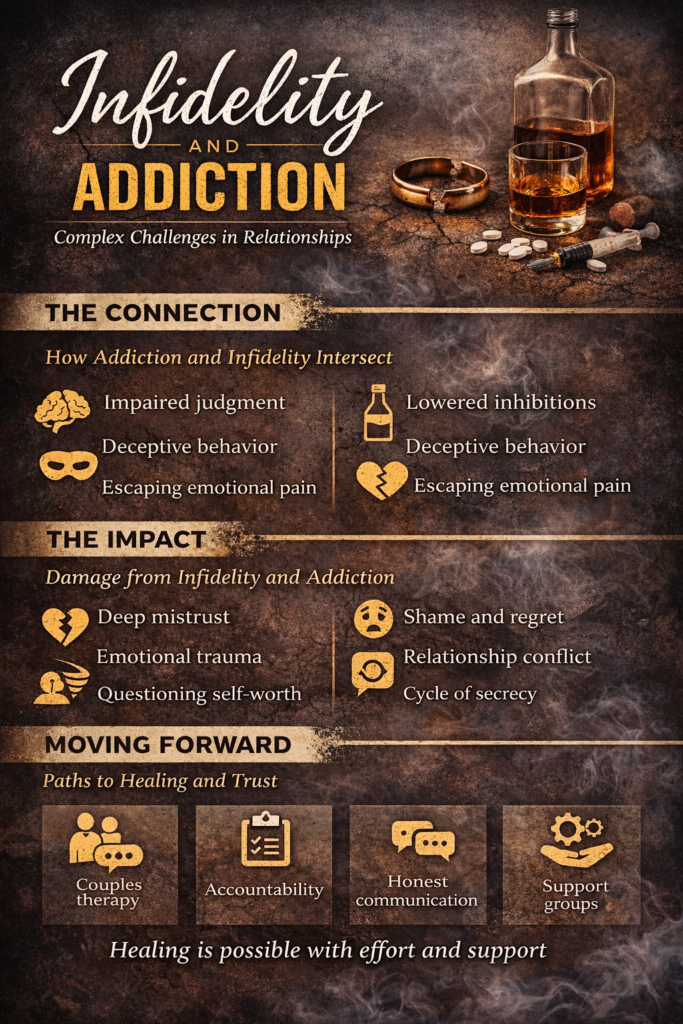
Infidelity and addiction often intersect in complex and painful ways, creating deep emotional wounds within relationships. When substance use or addictive behaviors are present, judgment can become impaired, boundaries may weaken, and secrecy often increases—factors that can contribute to betrayal. For many couples, the discovery of both addiction and infidelity can feel like a “double rupture” of trust. Yet, while the damage can be significant, understanding the connection between these issues is the first step toward healing and rebuilding.
The Connection Between Infidelity and Addiction
Addiction alters brain functioning, particularly in areas related to impulse control, decision-making, and reward. This can lead individuals to engage in behaviors they might not otherwise consider, including infidelity.
Common contributing factors include:
- Disinhibition: Substances lower inhibitions, increasing risky behavior
- Escapism: Infidelity may serve as another way to avoid emotional pain
- Secrecy patterns: Addiction often involves lying or hiding behaviors, which can extend into relationships
- Emotional disconnection: Individuals may feel detached from their partner and seek external validation
While addiction can influence behavior, it does not excuse infidelity—it helps explain the context in which it may occur.
The Impact on the Relationship
When addiction and infidelity coexist, the emotional impact on both partners is intensified.
The betrayed partner may experience:
- Deep mistrust and hypervigilance
- Emotional trauma, anger, or confusion
- Questioning of self-worth and reality
The partner struggling with addiction may experience:
- Shame and guilt
- Fear of losing the relationship
- Difficulty facing the consequences of their actions
The relationship itself often becomes unstable, marked by conflict, distance, and emotional pain.
Breaking the Cycle of Secrecy
Both addiction and infidelity thrive in secrecy. Recovery requires bringing these patterns into the open.
This involves:
- Honest disclosure of behaviors
- Willingness to answer difficult questions
- Ending hidden or deceptive patterns
Transparency is uncomfortable, but it is essential for rebuilding trust.
Accountability and Responsibility
Healing cannot begin without accountability. The partner who engaged in infidelity and/or substance use must take full responsibility for their actions.
This includes:
- Acknowledging the impact of their behavior
- Avoiding defensiveness or blame
- Demonstrating consistent change over time
Accountability creates the foundation for repair.
Rebuilding Trust: A Gradual Process
Trust is not restored through words—it is rebuilt through consistent actions.
Key components include:
- Consistency: Aligning actions with promises
- Transparency: Open communication about thoughts, behaviors, and struggles
- Reliability: Showing up in predictable, trustworthy ways
Trust takes time, but it can be rebuilt with sustained effort.
The Role of Therapy and Support
Professional support is often essential when addressing both addiction and infidelity.
Helpful resources include:
- Individual therapy for each partner
- Couples therapy focused on trust and communication
- Addiction treatment programs or support groups
Therapy provides structure, guidance, and a safe space to process difficult emotions.
Healing for Both Partners
Both individuals need healing—not just the relationship.
- The person in recovery must address underlying issues related to addiction and behavior
- The betrayed partner may need support to process trauma, rebuild safety, and establish boundaries
Healing is not one-sided; it requires effort from both partners.
Moving Forward
Recovery from addiction and infidelity is challenging, but it is possible. Some couples choose to rebuild, while others may decide to separate. Either path can involve growth and healing.
For those who stay together, the process can lead to:
- Deeper honesty and communication
- Stronger boundaries
- A more intentional and connected relationship
Final Thoughts
Infidelity and addiction can deeply damage trust, but they do not have to define the future. With accountability, transparency, and support, individuals and couples can begin to heal.
Recovery is not about returning to the past—it is about creating something new. And while the journey may be difficult, it also holds the potential for profound transformation, both individually and within the relationship.
Taking Responsibility and Rebuilding Integrity: Self-Management Strategies for Infidelity and Addiction
When infidelity and addiction intersect, the damage can feel overwhelming—for both the individual and the relationship. These behaviors are often rooted in patterns of avoidance, impulsivity, and emotional disconnection. While understanding the “why” behind these patterns is important, real change comes from what happens next. Self-management becomes a critical part of recovery, helping individuals take responsibility, rebuild integrity, and develop healthier ways of coping and relating.
Why Self-Management Is Essential
Both addiction and infidelity involve a loss of control and a breakdown in personal boundaries. Self-management is the process of regaining control internally.
Without it, individuals may:
- Repeat cycles of secrecy and impulsivity
- Struggle to manage urges or emotional discomfort
- Avoid accountability
With self-management, individuals begin to act with intention rather than reaction.
1. Developing Radical Self-Awareness
Change begins with honest self-reflection. Individuals must be willing to examine their thoughts, emotions, and behaviors without minimizing or justifying them.
This includes:
- Identifying triggers for both substance use and infidelity (stress, loneliness, validation needs)
- Recognizing patterns of avoidance or escape
- Acknowledging underlying emotional needs
Self-awareness creates the foundation for meaningful change.
2. Managing Impulses and Urges
Both addiction and infidelity often involve acting on impulse. Learning to pause is a critical skill.
Strategies include:
- Delaying action when urges arise
- Practicing mindfulness or grounding techniques
- Asking, “What are the consequences of this choice?”
The ability to sit with discomfort rather than react to it is a major step forward.
3. Replacing Secrecy with Transparency
Secrecy fuels both addiction and infidelity. Self-management requires a shift toward openness.
This may involve:
- Being honest about thoughts, urges, and behaviors
- Sharing struggles with a trusted person, therapist, or sponsor
- Avoiding situations that require hiding or deception
Transparency builds accountability and breaks old patterns.
4. Strengthening Personal Boundaries
Healthy boundaries protect both the individual and the relationship. Without them, it is easy to slip back into harmful behaviors.
Examples include:
- Limiting contact with people or environments linked to past behaviors
- Setting clear guidelines for communication and behavior
- Avoiding high-risk situations
Boundaries create structure and reduce vulnerability to relapse or betrayal.
5. Addressing Emotional Needs Directly
Infidelity and addiction often serve as attempts to meet unmet emotional needs—such as validation, connection, or escape from pain.
Self-management involves:
- Identifying those needs
- Finding healthier ways to meet them (communication, therapy, self-care)
- Learning to tolerate discomfort without avoidance
Meeting needs directly reduces the reliance on harmful coping strategies.
6. Practicing Accountability
Taking responsibility is essential for rebuilding trust and personal integrity.
This includes:
- Owning past behaviors without defensiveness
- Following through on commitments
- Accepting feedback and making adjustments
Accountability is not about punishment—it is about growth and consistency.
7. Building a Recovery-Oriented Lifestyle
Long-term change requires more than avoiding negative behaviors—it requires building a positive, structured life.
This can include:
- Engaging in therapy or support groups
- Establishing daily routines
- Prioritizing physical and mental health
- Developing meaningful goals
A structured lifestyle reduces chaos and supports stability.
Moving Toward Integrity
Self-management is not about perfection—it is about alignment. It means making choices that reflect one’s values, even when it is difficult. Over time, these choices rebuild a sense of integrity and self-trust.
The process is gradual, and setbacks may occur. What matters is the commitment to continue showing up, learning, and making different choices.
Final Thoughts
Infidelity and addiction can deeply disrupt both personal identity and relationships. However, with strong self-management strategies, individuals can break cycles of impulsivity and secrecy and begin to rebuild their lives with honesty and intention.
Recovery is not just about stopping harmful behaviors—it is about becoming someone who no longer needs them. And that transformation begins with the daily practice of self-awareness, accountability, and intentional living.
Rebuilding Trust Together: Family Support Strategies for Infidelity and Addiction
When infidelity and addiction occur within a relationship or family system, the impact can be profound and far-reaching. Trust is broken, emotions run high, and families often find themselves caught between anger, fear, and a desire to help. The combination of these two issues can create a cycle of secrecy, hurt, and instability. However, with the right support strategies, families can play a critical role in the healing process—helping to restore stability, rebuild trust, and support long-term recovery.
Understanding the Family Impact
Infidelity and addiction rarely affect just one person. Families often experience:
- Emotional distress, confusion, and betrayal
- Hypervigilance or mistrust
- Conflict and communication breakdown
- Role shifts, such as over-functioning or withdrawal
Recognizing that the entire family system is affected is the first step toward meaningful healing.
1. Educating the Family on Both Addiction and Infidelity
Understanding the dynamics behind addiction and infidelity helps families respond with clarity rather than reactivity.
Families benefit from learning:
- How addiction affects behavior, impulse control, and decision-making
- Why secrecy and avoidance are common in both issues
- The difference between explanation and excuse
Education reduces blame while still maintaining accountability.
2. Creating a Safe and Structured Environment
Healing requires a sense of emotional and physical safety. Families can support this by creating a stable, predictable environment.
This includes:
- Reducing high-conflict interactions
- Establishing clear expectations for behavior
- Encouraging consistency in recovery efforts
A stable environment helps both partners focus on healing rather than crisis management.
3. Encouraging Accountability Without Shame
Accountability is essential for rebuilding trust, but it must be balanced with a non-shaming approach.
Healthy accountability involves:
- Acknowledging the impact of behaviors
- Encouraging responsibility for actions
- Avoiding excessive criticism or humiliation
Shame can lead to withdrawal and defensiveness, while accountability promotes growth.
4. Setting and Maintaining Boundaries
Boundaries protect both the family and the recovery process. Without them, patterns like enabling or control can re-emerge.
Examples include:
- Not covering up or minimizing harmful behaviors
- Setting limits around acceptable communication and actions
- Protecting personal emotional well-being
Boundaries create clarity and reduce confusion within the family system.
5. Supporting Open and Honest Communication
Both infidelity and addiction thrive in secrecy. Families can help break this cycle by encouraging open communication.
Effective communication includes:
- Expressing feelings without blame
- Listening without interrupting or fixing
- Allowing space for difficult conversations
Honesty, even when uncomfortable, is essential for rebuilding trust.
6. Avoiding Enabling Behaviors
Families often try to protect their loved ones, but certain behaviors can unintentionally support the problem.
Enabling may include:
- Making excuses for actions
- Shielding the individual from consequences
- Taking responsibility for their recovery
Support, in contrast, encourages responsibility and change.
7. Seeking Professional and External Support
Given the complexity of infidelity and addiction, professional guidance is often necessary.
Helpful resources include:
- Couples therapy focused on trust and communication
- Individual therapy for each person
- Family therapy to address systemic dynamics
- Support groups for both partners and family members
External support provides structure and guidance that families alone may not be able to offer.
8. Practicing Patience and Realistic Expectations
Healing from both addiction and infidelity takes time. Families may expect quick change, but recovery is often gradual and nonlinear.
Patience involves:
- Recognizing that trust is rebuilt over time
- Accepting that setbacks may occur
- Staying consistent in support without becoming overwhelmed
Realistic expectations reduce frustration and support long-term progress.
Moving Forward as a Family
Recovery from infidelity and addiction is not just about repairing damage—it’s about creating a new way of relating. Families who engage in this process have the opportunity to build stronger communication, healthier boundaries, and deeper understanding.
Final Thoughts
Infidelity and addiction can deeply disrupt a family system, but they do not have to define its future. With education, boundaries, accountability, and support, families can become a powerful part of the healing process.
Recovery is not just an individual effort—it is a collective transformation. And with the right strategies, families can move from pain and instability toward trust, connection, and lasting change.
Expanding the Support System: Community Resource Strategies for Infidelity and Addiction Recovery
When infidelity and addiction intersect, the complexity of healing often extends beyond what individuals or families can manage alone. These issues involve deep emotional wounds, patterns of secrecy, and behavioral challenges that require structured support. Community resources play a vital role in this process, offering guidance, accountability, and connection. By engaging with the right supports, individuals and couples can move from crisis and instability toward healing and long-term recovery.
Why Community Resources Are Essential
Infidelity and addiction both thrive in isolation and secrecy. Without outside support, individuals may struggle to break patterns or maintain change. Community resources provide:
- Objective guidance and professional expertise
- Accountability beyond the relationship
- A sense of connection and shared experience
- Tools for managing both addiction and relational repair
These supports help create a more balanced and sustainable recovery process.
1. Engaging in Specialized Therapy Services
Given the dual impact of infidelity and addiction, professional therapy is often essential.
Key options include:
- Individual therapy to address underlying emotional and behavioral patterns
- Couples therapy focused on trust, communication, and relational repair
- Family therapy to address broader system dynamics
Working with trained professionals helps guide difficult conversations and provides structured healing.
2. Participating in Support Groups
Peer support groups offer a unique form of connection and understanding. Individuals benefit from hearing others’ experiences and sharing their own in a safe environment.
Helpful groups may include:
- Addiction recovery groups (e.g., substance use recovery communities)
- Support groups for partners affected by infidelity
- Family-focused groups that address both addiction and relational impact
These groups reduce isolation and reinforce accountability.
3. Accessing Recovery and Relationship Education Programs
Education is a powerful tool in breaking cycles of behavior. Many communities offer programs that focus on both addiction recovery and relationship skills.
These programs may cover:
- Communication and conflict resolution
- Understanding trauma and trust repair
- Relapse prevention strategies
- Healthy relationship dynamics
Learning new skills helps individuals and couples move forward with intention.
4. Utilizing Crisis and Immediate Support Resources
Periods of intense emotional distress or relapse risk can occur during recovery. Having access to immediate support is critical.
Important resources include:
- Crisis hotlines or emergency mental health services
- Rapid-access counseling or walk-in clinics
- Detox or stabilization centers
Planning ahead for these situations increases safety and reduces impulsive decisions.
5. Building a Recovery-Focused Social Network
Community involvement helps individuals replace isolation with connection. Building a network of supportive people reinforces both sobriety and relational healing.
This can include:
- Sponsors or mentors
- Friends in recovery
- Couples or peer groups focused on healthy relationships
A strong support network provides encouragement and accountability.
6. Engaging in Meaningful and Sober Activities
Recovery is not just about addressing problems—it’s about building a fulfilling life. Community resources often provide opportunities for engagement and growth.
Examples include:
- Volunteer work or service opportunities
- Wellness programs (fitness, mindfulness, creative activities)
- Faith-based or spiritual communities
These activities help individuals reconnect with purpose and identity.
7. Maintaining Consistent Involvement
The effectiveness of community resources depends on consistency. Occasional use may provide temporary support, but regular engagement creates lasting change.
Strategies include:
- Scheduling regular therapy or group sessions
- Staying connected even during stable periods
- Continuing participation as part of a long-term lifestyle
Consistency transforms support into a stable foundation.
Moving Toward Healing and Stability
Community resources expand the recovery process beyond the individual or couple, creating a network of support that addresses both addiction and relational repair. This broader system helps reduce pressure on the relationship while strengthening long-term outcomes.
Final Thoughts
Infidelity and addiction can deeply disrupt lives and relationships, but healing is possible with the right support. Community resources provide the structure, connection, and expertise needed to navigate this complex process.
Recovery is not meant to happen in isolation. By reaching outward and engaging with supportive communities, individuals and couples can move from secrecy and instability toward honesty, connection, and lasting change.
Frequently Asked Questions
Here are some common questions:
1. How are infidelity and addiction connected?
Infidelity and addiction are often linked through patterns of:
- Impulsivity
- Emotional avoidance
- Secrecy and deception
Addiction can lower inhibitions and impair judgment, increasing the likelihood of risky behaviors like infidelity.
2. Does addiction cause infidelity?
Addiction does not cause infidelity, but it can contribute to it. It creates conditions—such as poor decision-making and emotional disconnection—that increase vulnerability to betrayal.
3. Why do both addiction and infidelity involve secrecy?
Both behaviors often rely on hiding actions, thoughts, or feelings to avoid consequences. Over time, secrecy becomes a pattern that reinforces both the addiction and the betrayal.
4. Can a relationship survive both infidelity and addiction?
Yes, but it requires:
- Full honesty and accountability
- Commitment to recovery
- Willingness to rebuild trust over time
- Often professional support
Some relationships grow stronger, while others may not continue.
5. What is the emotional impact on the betrayed partner? The betrayed partner may experience:
- Shock and confusion
- Loss of trust and safety
- Anxiety or hypervigilance
- Anger, grief, or self-doubt
This can be experienced as a form of relational trauma.
6. What does accountability look like in this situation?
Accountability includes:
- Taking full responsibility without blaming others
- Acknowledging the harm caused
- Being open and transparent
- Demonstrating consistent behavioral change
It’s about actions—not just words.
7. How can trust be rebuilt after both addiction and infidelity?
Trust is rebuilt through:
- Consistency over time
- Honest communication
- Transparency in behavior and decisions
- Patience from both partners
It is a gradual and ongoing process.
8. Should both partners go to therapy?
Yes, in most cases:
- Individual therapy helps each person process their own experience
- Couples therapy helps rebuild communication and trust
Both are often necessary for full recovery.
9. What are common patterns that need to change?
Key patterns include:
- Secrecy and dishonesty
- Avoidance of emotions
- Impulsive decision-making
- Poor boundaries
Changing these patterns is essential for long-term healing.
10. How do boundaries help in recovery?
Boundaries:
- Protect both partners emotionally
- Prevent enabling behaviors
- Create clarity and expectations
- Support accountability
They are a key part of rebuilding safety.
11. Can someone stop the addiction but still struggle with infidelity patterns?
Yes. If underlying issues (like validation needs, emotional avoidance, or poor boundaries) are not addressed, infidelity patterns may continue even after sobriety.
12. What role does shame play in this process?
Shame can:
- Lead to defensiveness or withdrawal
- Prevent honest communication
- Increase the risk of repeating behaviors
Healthy recovery focuses on accountability without being stuck in shame.
13. How long does it take to heal from both issues?
There is no set timeline. Healing often takes:
- Months to begin stabilizing
- Years to fully rebuild trust and connection
Consistency and effort matter more than speed.
14. What are the signs that real change is happening?
Signs include:
- Increased honesty and openness
- Consistent follow-through on commitments
- Improved emotional regulation
- Healthier communication patterns
Behavior changes over time.
15. What is the most important takeaway?
Infidelity and addiction are deeply damaging—but also treatable. Recovery requires:
- Honesty
- Accountability
- Support
- Willingness to change
Healing is possible, but it requires intentional, consistent effort from everyone involved.
Conclusion
While the combination of infidelity and addiction can feel overwhelming, it does not have to define the outcome of a relationship or an individual’s life. With accountability, transparency, and the right support, healing is possible. Recovery involves not only addressing substance use and behavior but also rebuilding trust, improving communication, and creating healthier patterns moving forward. Though the process may be challenging and take time, it offers opportunities for growth, deeper understanding, and a more honest and resilient connection.
Video: