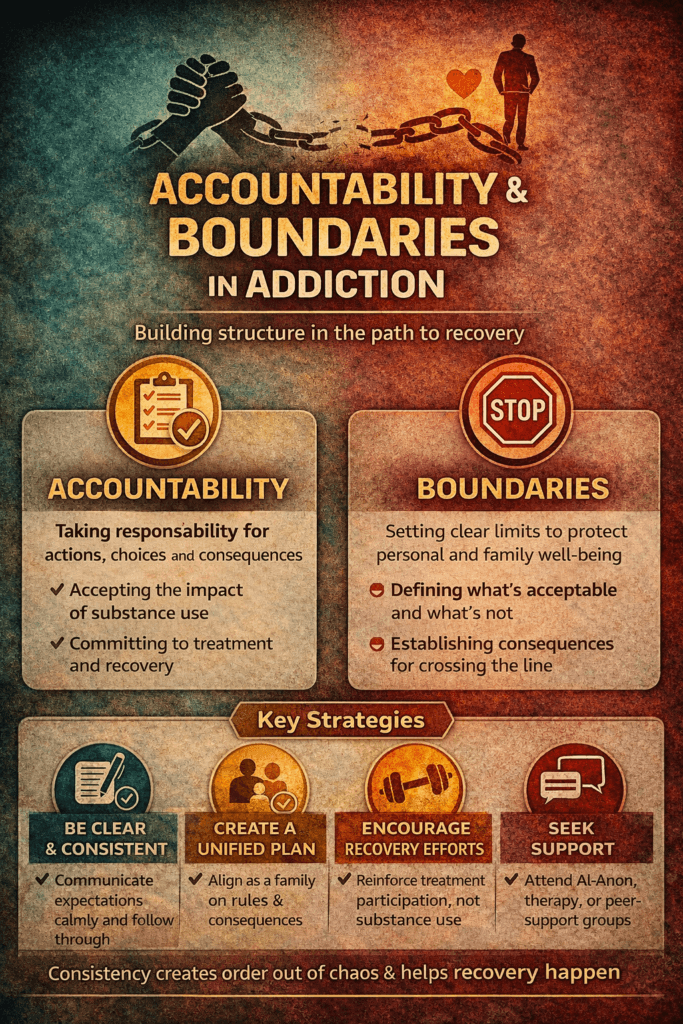
Accountability and boundaries are foundational principles in addiction recovery, yet they are often misunderstood as punitive or unsupportive. In reality, they provide structure in environments frequently characterized by chaos, denial, and emotional volatility. Addiction can impair judgment, distort priorities, and strain relationships, leading families and systems to either over-control or over-accommodate. Accountability restores personal responsibility by requiring individuals to acknowledge the impact of their behaviors and commit to change. Boundaries, meanwhile, define clear limits that protect emotional, financial, and physical well-being. When applied consistently and compassionately, these principles create stability and reinforce recovery-oriented behavior rather than enabling dysfunction.
Accountability & Boundaries in Addiction
Addiction disrupts personal responsibility, distorts priorities, and destabilizes relationships. In this environment, accountability and boundaries become essential—not punitive tools, but stabilizing structures. Without accountability, recovery lacks ownership. Without boundaries, families and support systems become overwhelmed, resentful, or enabling. Together, accountability and boundaries create a framework where recovery can move from crisis management to sustained change.
Understanding Accountability in Addiction
Accountability means accepting responsibility for one’s behaviors, choices, and consequences. Substance use disorders alter brain reward and decision-making pathways, but they do not eliminate responsibility. Recovery begins when individuals acknowledge the impact of their actions—missed obligations, broken trust, financial strain, or legal consequences—and commit to corrective steps.
In treatment settings, accountability may include attending therapy consistently, participating in medication-assisted treatment when appropriate, submitting to drug screening, rebuilding damaged relationships, and developing relapse prevention plans. Ownership strengthens intrinsic motivation, which research consistently associates with better long-term outcomes.
The Role of Boundaries
Boundaries define what behaviors are acceptable and what actions will occur if those limits are crossed. They protect emotional safety, financial stability, and physical well-being. In families affected by addiction, boundaries might include refusing to provide money, declining to engage during intoxication, or requiring treatment participation as a condition for living at home.
Healthy boundaries are clear, calm, and consistent. Inconsistent enforcement weakens credibility and can reinforce manipulation or denial. Boundaries are not threats—they are predictable responses to behavior.
Why Accountability and Boundaries Must Work Together
Accountability without boundaries becomes empty language. Boundaries without accountability become rigid rules without growth. When aligned, they create structure:
- The individual owns behavior.
- The family or system defines limits.
- Consequences are predictable and consistent.
- Support remains available for recovery efforts.
This balance prevents enabling while maintaining compassion.
Clinical Perspective
From a behavioral health standpoint, addiction often thrives in environments where consequences are inconsistent or unclear. Structured accountability enhances executive functioning and self-regulation over time. Family systems that adopt firm but respectful boundaries reduce chaos and emotional reactivity. This structured approach is particularly critical in opioid use disorder, stimulant use disorder, and alcohol use disorder, where relapse risk is high without environmental stability.
Practical Strategies
- Communicate expectations in writing when appropriate.
- Avoid negotiating boundaries during emotional escalation.
- Reinforce treatment engagement, not substance use.
- Seek family therapy or peer-support programs for guidance.
- Review and adjust boundaries as recovery progresses.
Conclusion
Accountability and boundaries are not oppositional—they are complementary forces in addiction recovery. Accountability restores personal responsibility. Boundaries protect individuals and families from chaos and burnout. When practiced consistently and compassionately, they create an environment where recovery becomes possible, dignity is preserved, and long-term change is supported.
Self-Management Strategies for Accountability & Boundaries in Addiction
Addiction disrupts judgment, impulse control, and relational stability. In recovery—and in families affected by substance use—accountability and boundaries must first be practiced internally before they can be sustained externally. Self-management is the disciplined process of regulating behavior, honoring commitments, and maintaining consistent limits. Without personal structure, accountability becomes inconsistent, and boundaries collapse under emotional pressure.
1. Conduct a Personal Responsibility Audit
Accountability begins with honest self-assessment. Identify how substance use—or enabling patterns—have affected finances, relationships, work performance, or emotional health. Writing these impacts down increases clarity and reduces denial. For individuals in recovery, this may include missed appointments, broken agreements, or high-risk behaviors. For family members, it may involve recognizing enabling tendencies.
2. Define Non-Negotiable Boundaries
Self-management requires clear internal limits before communicating them outwardly. Examples include:
- I will not use substances to cope with stress.
- I will not provide money that could support substance use.
- I will not engage in arguments during intoxication.
Boundaries should be specific, realistic, and measurable. Vague intentions weaken follow-through.
3. Strengthen Emotional Regulation
Accountability often triggers shame, defensiveness, or avoidance. Techniques such as cognitive reframing, mindfulness, journaling, and structured breathing reduce impulsive reactions. Emotional stability supports consistent boundary enforcement and prevents relapse driven by stress.
4. Create Structured Accountability Systems
Self-monitoring tools improve follow-through. These may include:
- Daily recovery check-ins
- Scheduled therapy or peer-support attendance
- Medication adherence tracking
- Financial budgeting plans
- Relapse prevention worksheets
External structure supports internal discipline until habits are solidified.
5. Anticipate Boundary Testing
In addiction dynamics, boundaries are often challenged. Prepare responses in advance. Rehearsed statements such as “I am not willing to do that” reduce hesitation during emotionally charged moments. Consistency builds credibility over time.
6. Separate Shame from Responsibility
Healthy accountability is not self-condemnation. Shame fuels relapse and avoidance. Responsibility focuses on behavior change and repair. Self-compassion combined with corrective action promotes sustainable growth.
7. Seek Feedback and Support
Therapists, sponsors, mentors, and peer groups provide corrective insight. Self-management improves when individuals allow trusted accountability partners to review goals and progress.
Clinical Insight
From a behavioral health perspective, executive functioning and impulse control improve with structured routines and consistent consequences. Self-management strengthens neural pathways associated with decision-making and delayed gratification—critical components of long-term recovery.
Conclusion
Self-management strategies for accountability and boundaries in addiction shift recovery from reactive to intentional. By clarifying responsibility, defining non-negotiable limits, regulating emotions, and building structured accountability systems, individuals create stability within themselves. When internal boundaries are strong, external boundaries become easier to maintain. Accountability then transforms from punishment into empowerment—supporting dignity, responsibility, and lasting recovery.
Family Support Strategies for Accountability & Boundaries in Addiction
Addiction alters family dynamics in powerful ways. Roles shift, communication becomes reactive, and crisis management often replaces stability. In these environments, accountability and boundaries are essential not only for the individual struggling with substance use but for the health of the entire family system. Family support does not mean shielding someone from consequences. It means creating structured, consistent expectations that promote responsibility while maintaining compassion.
Establish a Unified Family Approach
One of the most important strategies is consistency. When family members disagree about limits—one rescues while another enforces consequences—the addicted individual may exploit those differences, a dynamic known as triangulation. Regular family meetings to clarify expectations, consequences, and treatment goals create a unified plan. A shared message strengthens accountability.
Define Clear and Specific Boundaries
Boundaries must be concrete and measurable. Examples may include:
- No financial support that could enable substance use.
- Treatment participation is a condition for living at home.
- No verbal aggression or intoxicated conversations in shared spaces.
Boundaries should be communicated calmly and, when appropriate, written down. Written agreements reduce emotional reinterpretation during high-conflict moments.
Allow Natural Consequences
Rescuing behaviors—repeatedly paying legal fees, covering missed work, or minimizing harmful behavior—can unintentionally delay recovery. Allowing natural consequences to occur reinforces accountability. This does not eliminate support; rather, it redirects support toward treatment engagement and behavioral change.
Reinforce Recovery-Oriented Behavior
Families can actively encourage positive steps, such as attending counseling, participating in medication-assisted treatment, attending peer-support meetings, or pursuing vocational rehabilitation. Affirming progress strengthens intrinsic motivation while maintaining clear expectations.
Practice Calm, Structured Communication
Emotional escalation weakens boundaries. Using “I” statements, setting time limits on difficult conversations, and refusing to argue during intoxication protect emotional stability. Structured communication reduces defensiveness and promotes clarity.
Seek Professional Guidance
Family therapy, recovery education programs, and peer-support groups such as Al-Anon provide tools for balancing compassion with firmness. Professional mediation is especially helpful when boundaries repeatedly collapse under emotional strain.
Protect Vulnerable Family Members
Children and emotionally sensitive individuals require additional safeguards. Ensuring safety and stability takes priority over maintaining appearances or avoiding conflict.
Clinical Perspective
From a family systems standpoint, addiction thrives in inconsistent environments. When families adopt clear, predictable boundaries and reinforce accountability, they reduce chaos and emotional volatility. This structured environment increases the likelihood that individuals recognize the need for treatment and sustained recovery efforts.
Conclusion
Family support strategies for accountability and boundaries in addiction center on clarity, consistency, and compassion. By unifying communication, allowing natural consequences, reinforcing recovery behaviors, and accessing professional guidance, families create an environment where responsibility is expected and growth is possible. Boundaries are not punishments—they are protective structures that restore dignity, safety, and long-term stability for everyone involved.
Community Resource Strategies for Accountability & Boundaries in Addiction
Addiction is not solely an individual or family issue—it is a public health concern that requires a structured community response. Accountability and boundaries in addiction are most effective when reinforced not only at the personal level but also through community systems. When treatment pathways, workplace policies, legal structures, and public health resources align around clear expectations and consistent consequences, recovery becomes more sustainable, and environments become safer.
Expand Access to Structured Treatment
Accessible outpatient programs, inpatient services, medication-assisted treatment (MAT), and behavioral counseling create formal accountability frameworks. Scheduled appointments, toxicology monitoring, therapy participation, and relapse prevention planning provide measurable benchmarks for progress. When communities invest in evidence-based treatment infrastructure, families are less pressured to manage addiction alone.
Strengthen Drug Courts and Diversion Programs
Problem-solving courts and diversion initiatives integrate accountability with treatment rather than relying solely on incarceration. Participants are required to attend therapy, comply with testing, and meet court standards while receiving clinical support. This balanced approach reinforces both consequences and rehabilitation.
Implement Workplace and Institutional Policies
Employers, schools, and healthcare systems can promote accountability by establishing clear substance use policies, employee assistance programs (EAPs), and structured re-entry agreements. Written expectations protect safety while offering treatment referrals. Transparent reporting processes reduce stigma and improve early intervention.
Promote Community Education
Public education campaigns that explain addiction as a chronic but treatable condition help communities understand the difference between enabling and structured support. Workshops on boundary-setting, trauma-informed care, and recovery principles empower organizations and families to maintain consistent standards.
Develop Crisis Response Systems
Mobile crisis units, crisis hotlines, and coordinated referral networks allow families to redirect emergencies to trained professionals. This prevents impulsive rescue behaviors and reinforces appropriate boundaries during high-risk situations.
Support Recovery Community Organizations
Peer-support networks, recovery community centers, and sober living environments provide accountability through mentorship, routine, and shared expectations. Structured peer engagement strengthens intrinsic motivation and reduces isolation.
Encourage Data-Driven Oversight
Community coalitions and public health departments can monitor overdose trends, treatment access gaps, and relapse rates. Data-informed strategies ensure accountability at a systems level and improve resource allocation.
Public Health Perspective
Addiction thrives where expectations are inconsistent and consequences unpredictable. Communities that combine accessible treatment with clear behavioral standards promote both compassion and responsibility. Accountability does not mean punishment—it means creating predictable systems that support recovery and protect public safety.
Conclusion
Community resource strategies for accountability and boundaries in addiction transform individual struggles into coordinated public health action. Through expanded access to treatment, structured legal alternatives, workplace policies, crisis services, and peer recovery networks, communities reinforce clear expectations while preserving dignity and opportunity for change. When accountability and boundaries are embedded in community systems, recovery becomes more attainable, sustainable, and supported at every level.
Frequently Asked Questions
Here are some common questions:
1. What does accountability mean in addiction recovery?
Accountability means taking responsibility for one’s actions, choices, and consequences related to substance use. It includes acknowledging harm caused, engaging in treatment, repairing relationships when possible, and actively participating in recovery efforts.
2. What are boundaries in the context of addiction?
Boundaries are clearly defined limits that protect emotional, physical, and financial well-being. They outline what behaviors are acceptable and what consequences will follow if limits are crossed. Boundaries create structure and predictability.
3. Are boundaries the same as punishment?
No. Boundaries are protective, not punitive. Punishment focuses on control or retaliation, while boundaries focus on safety, stability, and consistent expectations. They are communicated calmly and enforced predictably.
4. Why are accountability and boundaries important together?
Accountability without boundaries lacks structure. Boundaries without accountability lack ownership. Together, they create a balanced system in which individuals take responsibility, and families or communities maintain protective limits.
5. How can families practice accountability without enabling?
Families can support treatment engagement, encourage recovery behaviors, and offer emotional support while refusing to cover up consequences or provide resources that support substance use. Allowing natural consequences reinforces responsibility.
6. What happens if boundaries are inconsistent?
Inconsistent boundaries weaken credibility and may reinforce manipulation or denial. Addiction often thrives in unpredictable environments. Consistency builds trust and stability over time.
7. How do I communicate boundaries effectively?
Use clear, calm language such as: “I will not provide money,” or “I’m willing to help you access treatment, but I won’t engage during intoxication.” Avoid arguing during emotional escalation and repeat boundaries as needed without hostility.
8. Can accountability improve recovery outcomes?
Yes. Research shows that intrinsic motivation and personal responsibility are strongly associated with sustained recovery. When individuals take ownership of their behavior and follow structured plans, the risk of relapse may decrease.
9. What role do community systems play?
Community systems—such as drug courts, treatment programs, workplace policies, and peer-support networks—reinforce accountability through structured expectations while maintaining access to rehabilitation services.
10. When should professional guidance be sought?
Professional support is recommended when boundaries repeatedly collapse, emotional conflict escalates, relapse is frequent, legal issues arise, or family members experience burnout or psychological distress.
Conclusion
Accountability and boundaries are not opposites of compassion—they are expressions of it. By clearly defining expectations and allowing predictable consequences, individuals and families shift from reactive crisis management to intentional recovery support. Accountability strengthens ownership and motivation, while boundaries protect against burnout and repeated harm. Together, they establish a balanced framework where dignity, responsibility, and healing can coexist. In addiction care, sustainable change is rarely achieved through control alone; it emerges through consistent structure, mutual respect, and the courage to uphold healthy limits.
Video: The Boundary That Saved My Recovery #AddictionRecovery #HealthyBoundaries