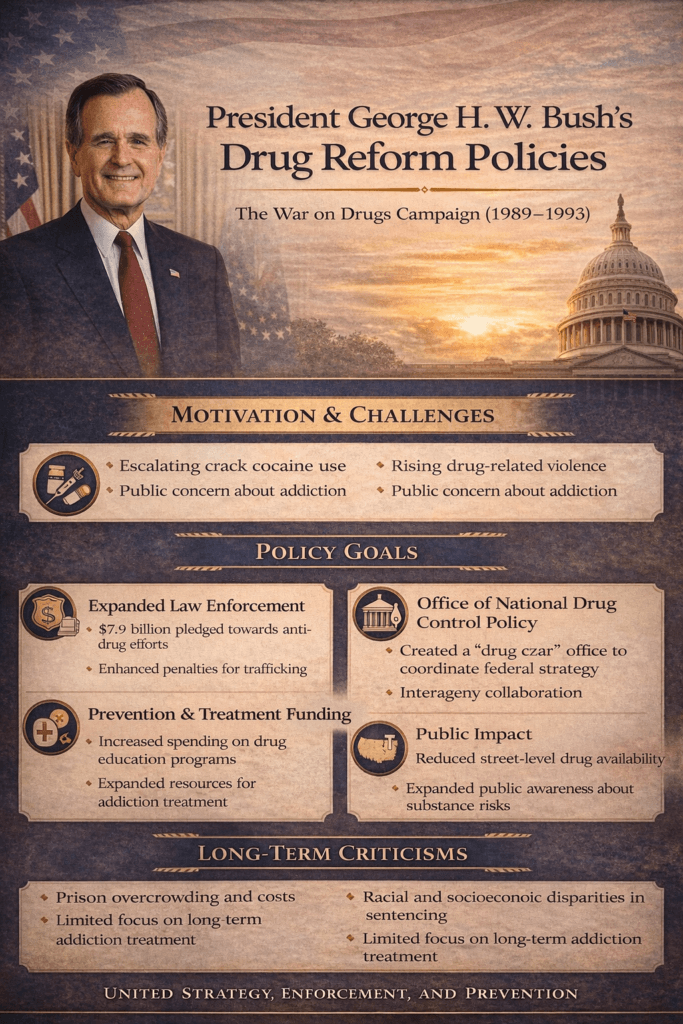
When George H. W. Bush took office in 1989, the United States was confronting escalating crack cocaine use, rising drug-related violence, and widespread public concern about substance misuse. Building upon earlier federal anti-drug initiatives, his administration intensified the national response through a comprehensive strategy that combined increased law enforcement funding, stronger penalties for trafficking, expanded international interdiction efforts, and greater coordination under the Office of National Drug Control Policy. While the approach aimed to reduce supply and deter use, it also included prevention campaigns and expanded treatment resources. His policies reflected the urgency of the era and shaped the trajectory of federal drug reform for decades to follow.
President George H. W. Bush’s Drug Reform in the War on Drugs Campaign
During the late 1980s and early 1990s, the United States faced rising concerns about crack cocaine, urban violence, and substance misuse. When George H. W. Bush assumed office in 1989, he intensified the federal government’s anti-drug efforts within the broader framework of the “War on Drugs,” a campaign initially expanded during the Reagan administration. His strategy combined strong law enforcement measures with expanded treatment and prevention initiatives.
In September 1989, President Bush delivered a nationally televised address outlining a comprehensive National Drug Control Strategy. The plan increased funding for federal law enforcement agencies, strengthened border interdiction efforts, and enhanced penalties for trafficking offenses. It emphasized coordination among federal, state, and local authorities to combat drug distribution networks. The administration sought to disrupt supply chains while also addressing domestic production and international drug cartels.
At the same time, Bush’s approach acknowledged the importance of treatment and prevention. The strategy allocated resources for drug education programs, community coalitions, and expanded access to treatment services. Schools became central venues for prevention messaging, and public awareness campaigns aimed to discourage youth experimentation. The administration also supported the creation of the Office of National Drug Control Policy (ONDCP), commonly known as the “drug czar” office, to coordinate federal efforts.
Supporters argued that the strategy demonstrated federal resolve against drug trafficking and sent a strong deterrent message. Critics, however, contended that the emphasis on incarceration contributed to prison overcrowding and disproportionately impacted marginalized communities. The debate over enforcement versus treatment became a defining feature of drug policy discussions in the decades that followed.
President George H. W. Bush’s drug reform efforts reflected the era’s priorities—balancing public health messaging with intensified law enforcement. His administration shaped the trajectory of U.S. drug policy, influencing future reforms and ongoing national conversations about prevention, criminal justice, and addiction treatment.
Advantages of President George H. W. Bush’s Drug Reform Policies in the War on Drugs Campaign
When George H. W. Bush assumed office in 1989, the United States was confronting escalating crack cocaine use, rising overdose rates, and drug-related violence. His administration intensified the national response through a coordinated strategy that combined enforcement, prevention, and treatment initiatives. While the broader War on Drugs remains debated, several advantages emerged from the structural reforms introduced during his presidency.
One major advantage was the formalization of centralized coordination. The expansion and empowerment of the Office of National Drug Control Policy (ONDCP) created a unified federal strategy rather than fragmented agency responses. This centralized oversight improved interagency collaboration among law enforcement, public health officials, and international partners.
Another strength was heightened national awareness. President Bush’s nationally televised addresses and public campaigns elevated addiction to a top-tier public policy priority. Increased visibility helped mobilize state and local governments, community coalitions, and schools to implement prevention programs.
The administration also increased funding for drug treatment and prevention services. Although enforcement remained prominent, federal resources were directed toward expanding education programs and community-based prevention initiatives. These efforts acknowledged addiction as a health issue requiring intervention beyond policing alone.
Enhanced international cooperation was another benefit. The administration strengthened partnerships with foreign governments to disrupt trafficking routes and reduce supply at the source. This global coordination marked a more strategic approach to addressing cross-border drug markets.
Additionally, the policies signaled federal commitment to addressing community safety. Law enforcement investments targeted organized trafficking networks, aiming to reduce drug-related violence in high-impact urban areas.
Historically, President Bush’s reforms reinforced the idea that addiction policy required both public health and public safety frameworks. While later decades would reassess and refine elements of the strategy, his administration advanced federal coordination, increased national attention, and expanded prevention infrastructure during a period of significant public concern.
Disadvantages of President George H. W. Bush’s Drug Reform Policies in the War on Drugs Campaign
When George H. W. Bush intensified federal anti-drug efforts in 1989, his administration expanded enforcement mechanisms within the broader War on Drugs framework. Although intended to reduce drug supply and improve public safety, several disadvantages became evident over time.
One major criticism was the heavy emphasis on incarceration. Enhanced penalties and aggressive enforcement strategies contributed to rising prison populations throughout the 1990s. Mandatory sentencing policies disproportionately affected low-level offenders, including individuals struggling with addiction, rather than high-level traffickers. Critics argue that incarceration without adequate treatment does little to address the underlying drivers of substance use.
Another disadvantage was the disproportionate impact on marginalized communities. Enforcement strategies often concentrate in urban areas heavily affected by crack cocaine, leading to racial and socioeconomic disparities in arrests and sentencing. These disparities fueled long-term social and economic consequences, including family disruption and reduced employment opportunities.
Additionally, the supply-focused strategy faced limitations. Despite intensified interdiction and international cooperation, illicit drug markets adapted quickly. Demand reduction efforts did not always keep pace with enforcement, and new substances emerged in subsequent decades.
Some public health advocates also argued that prevention messaging relied heavily on fear-based campaigns rather than evidence-based behavioral strategies. Limited integration of harm reduction approaches meant that overdose prevention and treatment accessibility lagged behind enforcement initiatives.
Finally, financial costs were substantial. Expanding law enforcement, border control, and incarceration systems required significant federal spending, fueling ongoing debates over resource allocation between public safety and healthcare.
In retrospect, President Bush’s policies reflected the urgency of the era’s drug crisis but also highlighted the complexities of addressing addiction through primarily punitive frameworks. The experience informed later reforms that increasingly emphasized access to treatment, diversion programs, and public health–centered strategies.
Ethical Dilemmas of President George H. W. Bush’s Drug Reform Policies in the War on Drugs Campaign
When George H. W. Bush expanded federal anti-drug initiatives in 1989, his administration sought to respond decisively to rising crack cocaine use, overdose deaths, and drug-related violence. While the strategy aimed to protect public safety and restore order, it generated enduring ethical dilemmas that continue to shape debates about addiction policy.
One central ethical tension was between punishment and treatment. The administration increased funding for enforcement and incarceration while also supporting prevention and treatment programs. However, critics argued that prioritizing criminal penalties for individuals with substance use disorders risked treating a health condition as a moral or legal failure. The question emerged: should addiction be addressed primarily through the justice system or through healthcare?
Another dilemma concerned proportionality and fairness. Sentencing disparities—particularly those related to crack versus powder cocaine—raised concerns about unequal impact across racial and socioeconomic groups. Ethical critiques focused on whether policies inadvertently amplified structural inequalities rather than alleviating them.
A third issue was the balance between deterrence and harm reduction. The War on Drugs framework emphasized strong deterrent messaging and strict penalties. Yet some public health experts questioned whether fear-based approaches adequately addressed underlying trauma, mental illness, and social determinants of substance use. The absence of broader harm-reduction measures raised questions about whether policy responses minimized total harm or merely shifted it.
Civil liberties also entered the discussion. Expanded surveillance, asset forfeiture policies, and intensified policing strategies prompted debate over privacy rights and due process. Policymakers faced the ethical challenge of protecting community safety without eroding constitutional safeguards.
Finally, resource allocation posed a moral question. Significant federal funds were directed toward enforcement infrastructure. Critics asked whether a greater investment in prevention, mental health care, and community development might have produced more equitable and sustainable outcomes.
President George H. W. Bush’s drug reform efforts reflected the urgency of a national crisis, yet they illuminated complex ethical trade-offs between justice and health, equality and enforcement, security and liberty. These dilemmas continue to inform modern addiction policy discussions as the nation reevaluates how best to balance public safety with compassion and evidence-based care.
Frequently Asked Questions
Here are some common questions:
1. What was the main goal of President George H. W. Bush’s drug reform policies?
The primary goal was to reduce drug use, drug trafficking, and drug-related violence through a coordinated national strategy combining law enforcement, prevention, and treatment initiatives.
2. When did these policies take place?
They were implemented during his presidency from 1989 to 1993.
3. What major structural reform occurred during his administration?
The expansion and strengthening of the Office of National Drug Control Policy (ONDCP), often referred to as the “drug czar” office, is to coordinate federal anti-drug efforts.
4. Did his policies focus only on enforcement?
No. While enforcement funding increased significantly, the administration also allocated resources toward prevention programs and treatment services.
5. What role did public messaging play?
Nationally televised addresses and public awareness campaigns elevated drug addiction as a major public policy issue and emphasized deterrence.
6. What were the advantages of his approach?
Improved federal coordination, increased public awareness, enhanced international cooperation against trafficking, and expanded prevention infrastructure.
7. What were the main criticisms?
Critics argue that the policies contributed to rising incarceration rates, prison overcrowding, and sentencing disparities, particularly affecting marginalized communities.
8. How did the policies impact incarceration rates?
Stronger penalties and enforcement efforts contributed to increased prison populations during the 1990s.
9. Did the policies reduce drug use?
The results were mixed. While certain enforcement actions disrupted trafficking networks, overall substance use trends evolved and shifted over time.
10. How did these reforms influence future drug policy?
They shaped long-term federal drug control strategy and influenced later debates about balancing enforcement with public health–focused approaches.
11. Were treatment services expanded under his administration?
Yes, funding for prevention and treatment increased, although enforcement remained a dominant feature of the strategy.
12. Why is his drug policy legacy still debated today?
Because it highlights enduring tensions among public safety and public health, enforcement and rehabilitation, and justice-system responses versus healthcare-based solutions.
Conclusion
President George H. W. Bush’s drug reform policies remain a defining chapter in the broader War on Drugs campaign. His administration strengthened federal coordination and emphasized national commitment to combating drug trafficking and community violence. At the same time, the enforcement-heavy framework sparked long-term debates about incarceration rates, sentencing disparities, public health integration, and civil liberties. The legacy of these policies continues to influence modern discussions about addiction treatment, harm reduction, and criminal justice reform. Understanding this period provides important context for evaluating how the United States has evolved—and continues to evolve—in balancing public safety with evidence-based approaches to substance use disorders.
Video: George H W Bush’s Drug Reform