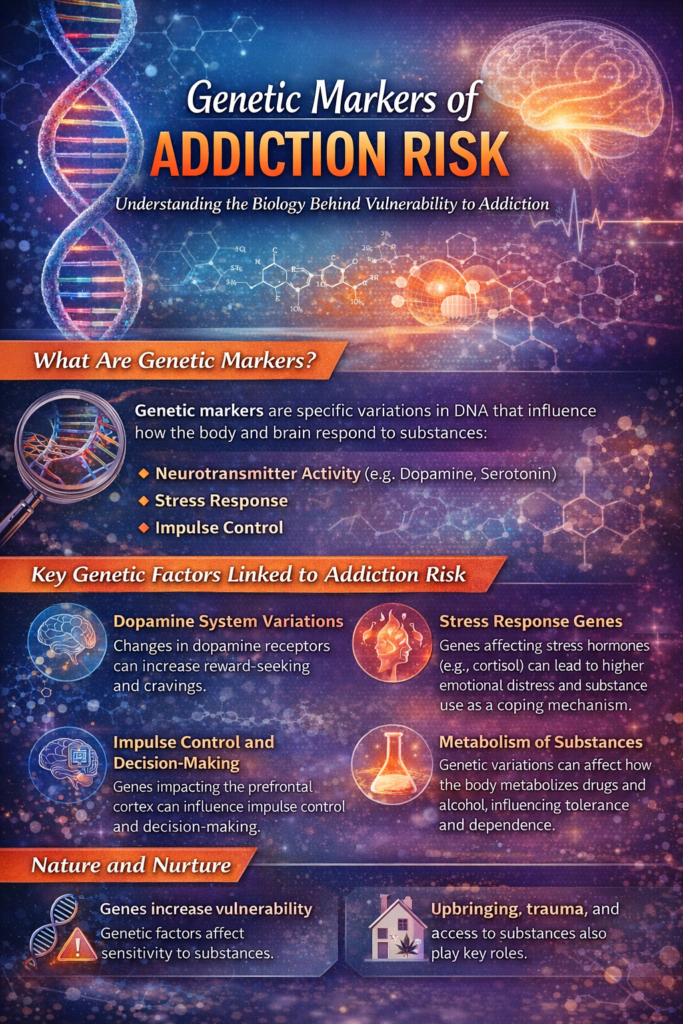
Genetic markers of addiction risk provide important insight into the biological factors that can influence an individual’s vulnerability to substance use disorders. These markers, which are variations in DNA, can affect how the brain responds to reward, stress, and impulse control. While addiction is often viewed through a behavioral or environmental lens, research shows that genetics play a significant role in shaping susceptibility. Understanding these biological influences helps shift the perspective from blame to awareness, allowing for more informed approaches to prevention, treatment, and recovery.
Genetic Markers of Addiction Risk: Understanding the Biology Behind Vulnerability
Introduction: Looking Beyond Behavior
Addiction is often misunderstood as a matter of choice or willpower, but modern research shows it is deeply influenced by biology—particularly genetics. Genetic markers, or specific variations in DNA, can affect how individuals respond to substances, stress, and reward. These biological differences help explain why some people are more vulnerable to developing substance use disorders than others. Understanding genetic markers of addiction risk shifts the conversation from blame to science, opening the door for more personalized and effective approaches to prevention and recovery.
What Are Genetic Markers?
Genetic markers are identifiable variations in DNA that can influence how the body and brain function. In the context of addiction, these markers may affect:
- Neurotransmitter systems (e.g., dopamine and serotonin)
- Stress response pathways
- Impulse control and decision-making processes
Rather than a single “addiction gene,” multiple genetic factors interact to shape an individual’s level of risk.
Key Genetic Factors Linked to Addiction Risk
1. Dopamine System Variations
Dopamine plays a central role in the brain’s reward system. Genetic differences in dopamine receptors or transporters can:
- Alter how strongly someone experiences pleasure
- Increase the reinforcing effects of substances
- Contribute to stronger cravings
Individuals with lower baseline dopamine activity may be more likely to seek substances to compensate.
2. Stress Response Genes
Genes that regulate the body’s stress system (such as those affecting cortisol) can influence how someone reacts to pressure or trauma. Heightened stress sensitivity can:
- Increase emotional distress
- Make substances more appealing as a coping mechanism
- Elevate relapse risk
3. Impulse Control and Executive Function
Certain genetic markers affect the prefrontal cortex, the part of the brain responsible for decision-making and self-control. Variations in these genes may lead to:
- Increased impulsivity
- Difficulty delaying gratification
- Greater susceptibility to risky behaviors
4. Metabolism and Tolerance Differences
Genetic variations can also affect how the body processes substances. For example:
- Faster metabolism may lead to higher consumption
- Slower metabolism can increase sensitivity to effects
These differences influence patterns of use and potential dependence.
Nature and Nurture: More Than Just Genetics
While genetic markers increase vulnerability, they do not determine outcomes. Environmental factors—such as upbringing, trauma, social influences, and access to substances—interact with genetic predispositions. This interaction is often referred to as gene-environment interplay, meaning:
- High genetic risk + supportive environment = lower likelihood of addiction
- Lower genetic risk + high stress environment = increased risk
Understanding both factors provides a more complete picture.
How This Knowledge Supports Recovery
1. Reduces Stigma
Recognizing the biological component of addiction helps shift away from blame and toward compassion.
2. Supports Personalized Treatment
Genetic insights can guide treatment approaches, including therapy types and medication options.
3. Improves Prevention Strategies
Individuals with known risk factors can take proactive steps to reduce exposure to triggers.
4. Enhances Self-Awareness
Understanding one’s vulnerabilities can lead to better coping strategies and decision-making.
Limitations of Genetic Testing
Although genetic research is advancing, current testing has limitations:
- It cannot predict addiction with certainty
- Results must be interpreted within a broader context
- Environmental and behavioral factors remain critical
Genetics provides insight—not a definitive outcome.
Conclusion: Knowledge as Empowerment
Genetic markers of addiction risk offer valuable insight into why some individuals may be more vulnerable than others. However, they do not define a person’s future. By understanding the biological factors at play, individuals can take a more informed and proactive approach to their health and recovery. Addiction is shaped by both genes and environment, but with awareness, support, and effective strategies, long-term recovery is achievable. Knowledge of genetic risk is not a limitation—it is a tool for empowerment and change.
Taking Control of Your Risk: Self-Management Strategies to Understand Genetic Markers of Addiction
Introduction: Awareness as a Starting Point
Understanding genetic markers of addiction risk can feel overwhelming at first. Learning that biology may influence vulnerability to substance use often raises concerns about control and long-term outcomes. However, genetic risk is not a fixed destiny—it is information. Self-management strategies enable individuals to use that information proactively. By developing awareness, building coping skills, and making intentional choices, individuals can better understand their personal risk and reduce the likelihood of addiction or relapse.
Understanding Genetic Risk in Everyday Life
Genetic markers influence how the brain responds to reward, stress, and impulse control. This may show up as:
- Stronger reactions to stress or anxiety
- Increased sensitivity to cravings or pleasure
- Difficulty with impulse control or emotional regulation
Self-management focuses on recognizing these patterns early and responding in healthier ways.
Self-Management Strategies to Navigate Genetic Risk
1. Build Self-Awareness of Patterns
Understanding your personal tendencies is key:
- Notice how you respond to stress or emotional discomfort
- Track situations where cravings or urges increase
- Reflect on family history and behavioral patterns
Awareness helps you anticipate challenges rather than react to them.
2. Identify High-Risk Triggers
Genetic vulnerability often interacts with environmental triggers:
- Stressful life events
- Social environments involving substance use
- Emotional states like boredom, anxiety, or frustration
Recognizing these triggers allows you to plan ahead and reduce exposure.
3. Strengthen Emotional Regulation Skills
If genetic factors increase emotional sensitivity, managing emotions becomes essential:
- Practice mindfulness to observe emotions without reacting
- Use breathing techniques to calm the nervous system
- Label emotions clearly to reduce overwhelm
These skills reduce the likelihood of using substances to cope.
4. Apply Cognitive Restructuring
Thought patterns can amplify genetic vulnerability. Challenge unhelpful thoughts by asking:
- Is this thought realistic or exaggerated?
- What evidence supports or contradicts it?
- What is a healthier way to view this situation?
This helps prevent negative thinking from leading to harmful behaviors.
5. Create a Structured Lifestyle
Consistency helps stabilize mood and reduce impulsivity:
- Maintain regular sleep and meal schedules
- Establish daily routines
- Include time for self-care and recovery-focused activities
Structure reduces unpredictability, which can trigger stress responses.
6. Develop Healthy Coping Alternatives
Replace risky behaviors with constructive ones:
- Exercise or physical activity
- Journaling or creative outlets
- Social connection with supportive individuals
Healthy coping reduces reliance on substances for relief.
7. Monitor and Manage Stress Levels
Since genetic risk often involves heightened stress sensitivity:
- Identify early signs of stress
- Use relaxation techniques regularly
- Avoid chronic stress when possible
Managing stress directly reduces relapse vulnerability.
8. Stay Connected to Support Systems
Self-management does not mean isolation. Support strengthens your ability to manage risk:
- Engage in therapy or counseling
- Participate in support groups
- Maintain relationships with trusted individuals
Connection provides accountability and perspective.
From Genetic Risk to Personal Strength
Understanding genetic markers can shift your perspective from “What’s wrong with me?” to “What do I need to manage?” This reframing promotes self-compassion and empowers proactive decision-making. Viewing risk as a limitation becomes a guide for building stronger coping strategies.
Conclusion: Empowerment Through Self-Management
Genetic markers of addiction risk provide valuable insight, but they do not determine your future. Through self-management strategies—such as awareness, emotional regulation, structured routines, and healthy coping strategies—you can take control of how these risks affect your life. Recovery and prevention are not about changing your biology, but about learning how to work with it effectively. With consistent effort and the right tools, genetic vulnerability can be transformed into a foundation for resilience, growth, and long-term well-being.
Stronger Together: Family Support Strategies to Understand Genetic Markers of Addiction Risk
Introduction: Understanding Risk as a Family
When addiction appears in a family, questions about genetics often arise—“Is this inherited?” or “Could others be at risk?” Understanding genetic markers of addiction risk can feel overwhelming, but it also provides valuable insight. Rather than placing blame, this knowledge allows families to approach addiction with greater awareness and compassion. By recognizing that biology can influence vulnerability, families can shift from judgment to support, creating an environment that promotes prevention, early intervention, and long-term recovery.
What Genetic Risk Means for Families
Genetic markers do not guarantee addiction, but they can increase susceptibility by affecting:
- How individuals respond to stress
- How rewarding substances feel
- Impulse control and decision-making
For families, this means that patterns of addiction may not be random—but they are also not inevitable. Understanding this balance is key to providing effective support.
Family Support Strategies That Make a Difference
1. Educate the Family System
Knowledge reduces fear and stigma. Families can:
- Learn about how genetics influences addiction risk
- Understand that addiction is not simply a choice
- Recognize the role of both biology and environment
Education helps families respond with empathy rather than frustration.
2. Open Conversations About Family History
Honest discussions about substance use patterns can:
- Increase awareness of potential risks
- Encourage early prevention strategies
- Reduce secrecy and shame
Approach these conversations with sensitivity and without blame.
3. Reduce Stigma and Blame
Statements like “This runs in the family, so it’s hopeless” can be harmful. Instead:
- Emphasize that risk is not destiny
- Reinforce that change and recovery are possible
- Support a growth-focused mindset
A supportive tone encourages openness and help-seeking.
4. Promote Healthy Coping Skills Early
Families can help build resilience by encouraging:
- Emotional expression and communication
- Stress management techniques
- Problem-solving skills
Developing these habits early can reduce the impact of genetic vulnerability.
5. Create a Low-Stress, Supportive Environment
Since genetic risk often includes heightened stress sensitivity:
- Maintain consistent routines
- Reduce unnecessary conflict
- Encourage calm and constructive communication
A stable environment helps regulate emotional responses.
6. Set Clear and Healthy Boundaries
Support should be balanced with accountability:
- Avoid enabling substance use behaviors
- Be clear about expectations
- Maintain consistency in rules and consequences
Boundaries protect both the individual and the family system.
7. Encourage Preventive and Professional Support
Families can normalize seeking help by:
- Supporting therapy or counseling
- Encouraging substance use education
- Considering family therapy when appropriate
Early intervention is especially important when genetic risk is present.
8. Support Individual Differences Within the Family
Not everyone in a family will have the same level of risk. Avoid:
- Comparing individuals
- Assuming identical outcomes
- Labeling family members
Each person’s experience is unique and should be treated as such.
Balancing Awareness With Empowerment
Understanding genetic markers can initially feel limiting, but it can also be empowering. Families can use this knowledge to:
- Be proactive rather than reactive
- Recognize early warning signs
- Strengthen protective factors like communication and support
This shifts the focus from fear to preparedness.
Conclusion: A Family Approach to Prevention and Support
Genetic markers of addiction risk provide insight—but they do not define outcomes. Families play a crucial role in shaping how that risk is managed. Through education, open communication, supportive environments, and healthy boundaries, families can help reduce vulnerability and promote resilience. Addiction may have biological roots, but recovery and prevention are strengthened through connection, understanding, and shared effort. When families work together with awareness and intention, they create a foundation where growth and long-term well-being are possible.
Community Resource Strategies for Understanding Genetic Markers of Addiction Risk
Introduction: From Individual Risk to Community Support
Understanding genetic markers of addiction risk can feel complex and even overwhelming. While genetics may influence vulnerability to substance use, individuals are not meant to navigate this knowledge alone. Community resources play a critical role in translating scientific understanding into practical support. Through education, shared experiences, and accessible services, communities help individuals and families better understand genetic risk and apply that knowledge in meaningful ways. This collective approach transforms uncertainty into awareness and action.
Why Community Resources Matter
Genetic risk is only one piece of the addiction puzzle. Community resources help bridge the gap between biology and behavior by:
- Providing education about how genetics influences addiction
- Offering support systems that reduce isolation and stigma
- Teaching practical coping and prevention strategies
- Encouraging early intervention and ongoing care
These resources make complex information more understandable and actionable.
Community Strategies to Understand Genetic Risk
1. Public Education and Awareness Programs
Community workshops, seminars, and outreach initiatives can:
- Explain the role of genetics in addiction
- Clarify that genetic risk is not destiny
- Promote informed decision-making
Education empowers individuals to understand their risk without fear or stigma.
2. Access to Mental Health and Counseling Services
Community clinics and counseling centers provide:
- Professional guidance on how genetic risk interacts with behavior
- Support for managing stress, anxiety, and emotional triggers
- Personalized prevention and recovery strategies
These services help individuals apply knowledge in a practical, supportive setting.
3. Peer Support and Recovery Groups
Community-based groups offer:
- Shared experiences that normalize genetic vulnerability
- Insight into how others manage similar risks
- Emotional support and accountability
Learning from others reduces isolation and builds confidence.
4. Family Education Programs
Community resources often include family-focused support:
- Workshops on understanding hereditary risk
- Guidance on communication and support strategies
- Tools for creating a healthier home environment
Informed families can better support prevention and recovery efforts.
5. Preventive Programs for At-Risk Populations
Communities can offer targeted programs for individuals with higher risk, including:
- Youth education initiatives
- Early intervention programs
- Skill-building workshops focused on coping and decision-making
Prevention reduces the likelihood of addiction developing.
6. Digital and Online Resources
Online platforms expand access to information and support:
- Educational content about genetics and addiction
- Virtual counseling and support groups
- Tools for tracking behaviors and triggers
These resources make support more accessible and flexible.
7. Collaboration Between Healthcare and Community Organizations
Partnerships between medical providers and community programs can:
- Integrate genetic education into treatment plans
- Provide referrals to local support services
- Ensure continuity of care
This collaboration creates a more comprehensive support system.
Overcoming Barriers to Access
Some individuals may hesitate to use community resources due to:
- Stigma surrounding addiction or genetics
- Lack of awareness about available services
- Accessibility challenges (transportation, cost)
Communities can address these barriers by promoting inclusivity, affordability, and education.
From Genetic Awareness to Community Empowerment
Understanding genetic markers of addiction risk is not just an individual responsibility—it is a shared opportunity. Communities that prioritize education and support create environments where individuals feel informed, supported, and empowered to make healthier choices.
Conclusion: Turning Knowledge Into Collective Strength
Genetic markers may influence addiction risk, but they do not determine outcomes. Community resources play a vital role in helping individuals and families understand this risk and respond effectively. Through education, connection, and accessible support, communities transform complex scientific concepts into practical tools for prevention and recovery. When individuals are supported by informed and engaged communities, genetic vulnerability is not a limitation but a starting point for resilience, growth, and long-term well-being.
Frequently Asked Questions
Here are some common questions:
1. What are genetic markers of addiction risk?
Genetic markers are specific variations in DNA that can influence how a person’s brain and body respond to substances. These markers can affect reward sensitivity, stress response, and impulse control, all of which play a role in addiction vulnerability.
2. Is there a single “addiction gene”?
No. Addiction is not caused by one single gene. Instead, it involves many genes interacting with one another, along with environmental and psychological factors. This is why addiction risk varies widely between individuals.
3. How much of the addiction risk is genetic?
Research suggests that genetics can account for about 40–60% of a person’s risk for developing a substance use disorder. The remaining risk is influenced by environment, behavior, and life experiences.
4. What brain systems are affected by genetic markers?
Genetic variations can impact several key systems, including:
- Dopamine pathways (reward and pleasure)
- Stress response systems (e.g., cortisol regulation)
- Executive functioning (decision-making and impulse control)
These systems influence how individuals respond to substances and stress.
5. If addiction runs in my family, am I guaranteed to develop it?
No. A family history increases risk but does not determine outcomes. Many people with genetic vulnerability never develop addiction, especially when protective factors—like strong coping skills and supportive environments—are present.
6. Can genetic testing determine my addiction risk?
Some genetic tests claim to assess addiction risk, but they are not definitive. Addiction is complex, and current tests cannot fully predict whether someone will develop a substance use disorder. Family history remains one of the most useful indicators.
7. How do genetics and environment work together?
This is known as gene-environment interaction. For example:
- A person with high genetic risk in a supportive environment may never develop addiction
- A person with lower genetic risk in a high-stress environment may still develop it
Both biology and life experiences shape outcomes.
8. Why do some people become addicted faster than others?
Genetic differences can affect:
- How strongly substances are experienced as rewarding
- How quickly tolerance develops
- How the body processes substances
These factors can make some individuals more vulnerable to rapid dependence.
9. Can lifestyle choices reduce genetic risk?
Yes. While genes cannot be changed, their expression can be influenced by behavior (epigenetics). Healthy habits like stress management, exercise, strong social support, and avoiding high-risk environments can significantly reduce the impact of genetic vulnerability.
10. How can understanding genetic risk help in recovery?
It can:
- Reduce shame by highlighting the biological component
- Encourage personalized treatment approaches
- Help individuals anticipate triggers and risks
- Promote proactive coping strategies
Knowledge allows for more effective planning and support.
11. Do genetic markers affect relapse risk as well?
Yes. Genetic factors that influence stress sensitivity, cravings, and emotional regulation can also increase the likelihood of relapse. This is why long-term coping strategies and support are essential.
12. What is the most important takeaway about genetic risk?
Genetic risk is a predisposition, not a destiny. It provides insight into vulnerability, but outcomes are shaped by choices, environment, and support systems. With the right strategies, individuals can successfully prevent or overcome addiction.
Conclusion
Although genetic markers can increase the risk of addiction, they do not determine an individual’s future. Instead, they offer valuable information that can guide proactive decision-making and personalized support strategies. By combining this knowledge with healthy coping skills, supportive environments, and appropriate interventions, individuals can effectively manage their risk. Ultimately, understanding genetic markers empowers individuals and families to move beyond fear and toward informed, resilient approaches to long-term well-being and recovery.
Video: