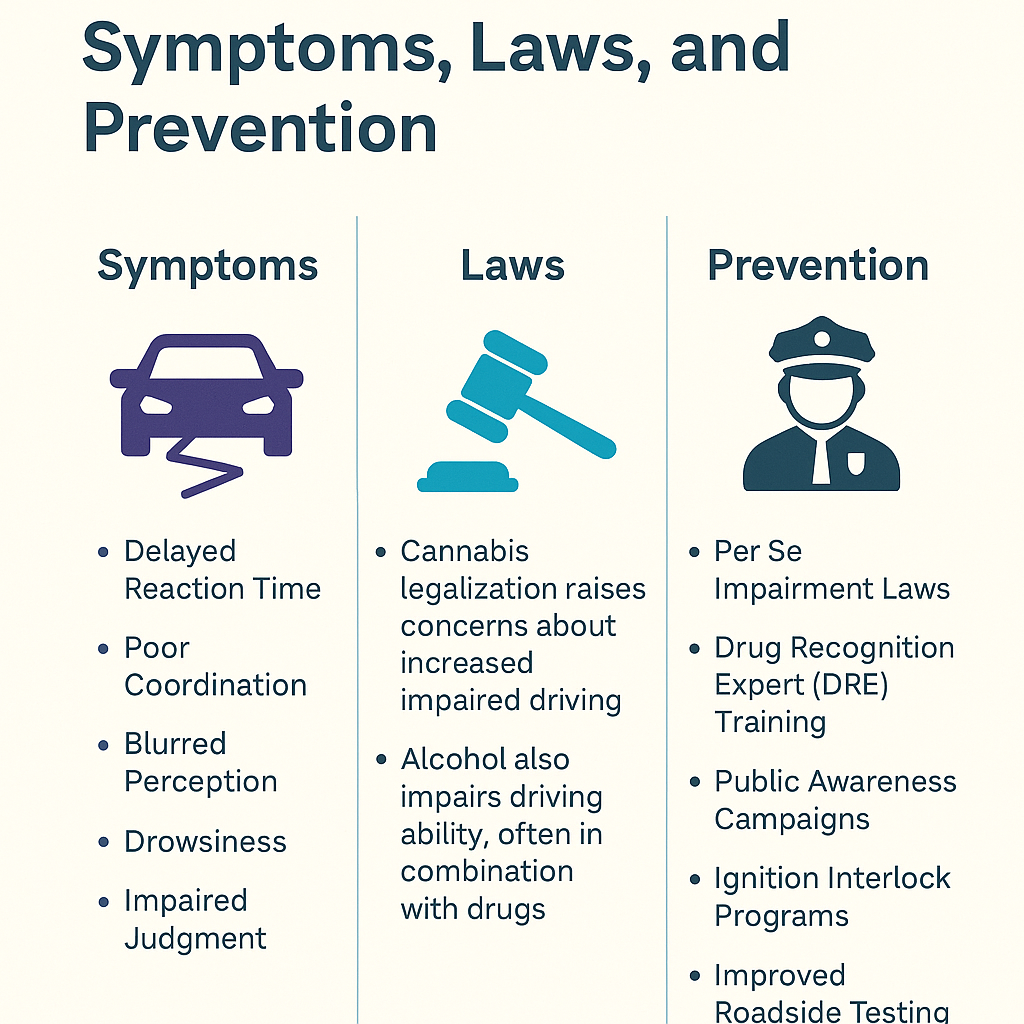
Drugged driving occurs when a driver operates a vehicle while impaired by drugs—whether illicit substances, prescription medications, or cannabis. Symptoms often include delayed reaction time, poor coordination, blurred perception, drowsiness, and impaired judgment, all of which drastically increase crash risk. With the legalization of cannabis in several U.S. states, law enforcement and health officials have observed growing concern about increased rates of impaired driving, especially when cannabis is mixed with alcohol or other substances. Both alcohol and drugs affect the central nervous system, altering perception and decision-making behind the wheel. In response, state governments have implemented measures such as stricter per-se impairment laws, Drug Recognition Expert (DRE) training, public awareness campaigns, ignition interlock programs, and improved roadside testing to detect impairment and prevent accidents.
Drugged Driving: How Substance Use Puts Every Road User at Risk
Drugged driving refers to operating a motor vehicle while impaired by legal or illegal substances that affect the brain, coordination, judgment, and reaction time. These substances may include illegal drugs such as marijuana, cocaine, or methamphetamine, prescription medications like opioids or benzodiazepines, or even over-the-counter medicines that cause drowsiness or dizziness. Regardless of legality, any substance that alters mental or physical functioning can make driving dangerous.
🚗 How Drugs Affect Driving
Drugs interfere with the brain’s ability to process information, make decisions, and respond to sudden changes on the road. Depending on the substance, impairment may include:
Slowed reaction time and poor motor control
Distorted perception of speed and distance
Impaired judgment and increased risk-taking
Drowsiness, confusion, or hallucinations
Difficulty focusing or staying awake
A dangerous misconception is believing that feeling “normal” means it is safe to drive. Many substances remain active in the nervous system long after their effects fade, meaning that driving can remain unsafe for hours or even days later.
⚖️ Legal Consequences of Drugged Driving
Most states treat drugged driving the same as drunk driving. Laws prohibit driving under the influence of any impairing substance, not alcohol alone. Consequences may include:
License suspension or revocation
Fines and court fees
Mandatory treatment or education programs
Criminal charges or jail time
Law enforcement may use field sobriety tests, toxicology screenings, or Drug Recognition Experts (DREs) to identify impairment.
🧠 Prevention Strategies
Preventing drugged driving relies on informed and responsible decision-making:
Plan ahead by arranging a sober driver, rideshare, or public transportation.
Ask healthcare providers if prescribed medications affect driving ability.
Avoid mixing substances — combining drugs and alcohol multiplies crash risk.
Educate young drivers about the dangers of driving under any impairment.
✅ Summary
Drugged driving is a serious public safety issue that endangers drivers, passengers, and everyone on the road. Whether a substance is legal or illegal, if it alters the mind or slows reflexes, driving becomes unsafe. Prevention depends on awareness, personal responsibility, and community education — because one impaired decision behind the wheel can lead to irreversible consequences.
Cannabis Legalization and Motor Vehicle Crashes: What the Evidence Really Shows
As more states legalize recreational cannabis, researchers have begun examining how legalization affects public safety — especially motor vehicle crash rates. Evidence suggests that after legalization, crash and injury rates have increased modestly in some states. However, the relationship is complex, and conclusions require careful interpretation.
✅ What Studies Show
Several large-scale studies have identified measurable changes in traffic outcomes following recreational cannabis legalization.
Research examining multiple legalized states found:
• Approximately a 6.5% increase in injury-related crash rates
• Around a 2.3% increase in fatal crash rates
Another multi-state review reported:
• An average 10% increase in motor-vehicle accident deaths in legalized markets
Additional hospital data show:
• Increases in emergency department visits for traffic injuries involving cannabis exposure after legalization
These findings suggest that legalization is associated with higher crash risk, though the increases are generally smaller than those linked to alcohol-impaired driving.
⚠️ Why the Picture Is Not Straightforward
Interpreting cannabis-related crash data involves important scientific and policy challenges.
Key caveats include:
• State-to-state variation — outcomes differ based on local laws, enforcement intensity, and public education efforts
• Correlation vs. causation — studies cannot always prove legalization directly caused crashes because traffic volume, alcohol use, and policing also change over time
• Measurement limitations — THC can remain in the bloodstream long after impairment ends, meaning a “THC-positive” test does not always equal real-time driving impairment
These factors make it difficult to measure cannabis impairment as precisely as alcohol impairment.
🔍 What This Means for Policy and Individuals
Overall, legalization appears to be associated with modest but meaningful increases in crash and injury risk. However, states that implemented:
• Strong public education campaigns
• Clear impaired-driving laws
• Active traffic enforcement
Have observed smaller increases—and, in some cases, improved safety outcomes.
For individuals, the message remains clear:
• Driving while high is unsafe
• Combining cannabis with alcohol greatly increases crash risk
• Feeling “fine” does not guarantee unimpaired reaction time
✅ Summary
Recreational cannabis legalization has been associated with small but significant increases in motor-vehicle crashes and injuries. While the science continues to evolve, the risk of cannabis-impaired driving is real. Effective policy, enforcement, and education can reduce harm — but personal responsibility remains the most important factor. When it comes to driving, impairment is impairment, regardless of legality.
State Strategies to Reduce Alcohol- and Drug-Impaired Driving
State governments, often supported by federal transportation and public health agencies, have implemented a wide range of strategies to reduce alcohol- and drug-impaired driving. These policies combine enforcement, technology, treatment, and education to prevent crashes, save lives, and promote long-term behavioral change.
✅ Major Strategies
1. Lowering Blood Alcohol Concentration (BAC) Limits & Enforcement
Several states have strengthened alcohol-impairment laws to reduce crash risk.
• Some states, such as Utah, lowered the legal BAC limit from 0.08 g/dL to 0.05 g/dL, resulting in measurable reductions in alcohol-related crash deaths.
• Sobriety checkpoints, saturation patrols, and high-visibility enforcement campaigns deter impaired driving by increasing the perceived risk of arrest.
Impact: Strong enforcement and lower BAC thresholds reduce alcohol-related crashes and fatalities.
2. Ignition Interlocks and Vehicle Safety Technology
Technology now plays a major role in preventing repeat impaired driving.
• Many states require ignition interlock devices for drivers convicted of alcohol-impaired driving — in some states, even for first-time offenders.
• Federal vehicle-safety mandates are advancing passive impairment-detection systems, designed to prevent a vehicle from operating when impairment is detected.
Impact: Interlocks significantly reduce repeat offenses while allowing offenders to maintain employment and mobility safely.
3. Drug-Impaired Driving Laws and Enforcement
As drug-impaired driving increases, states are expanding detection and training.
• Law enforcement agencies are training more Drug Recognition Experts (DREs) to identify drug-related impairment.
• Pilot programs for roadside oral-fluid testing and improved toxicology reporting help strengthen drug-impairment enforcement.
• Standardized testing in fatal crashes improves data accuracy and policy planning.
Impact: Enhanced detection tools improve accountability and data collection for emerging drug-driving risks.
4. Screening, Treatment, and Rehabilitation Programs
Modern policy increasingly treats impaired driving as both a legal and a health issue.
• Many states require substance-use screening and treatment referrals following impaired-driving convictions.
• Community-based programs provide responsible alcohol service training, safe-ride services, and recovery-linked driving programs.
Impact: Integrating treatment reduces repeat offenses and addresses underlying substance-use disorders.
5. Community Education and Coalition Approaches
Public awareness remains one of the most effective prevention tools.
• States fund media campaigns warning against impaired driving.
• Community coalitions deliver local outreach, school education programs, and youth prevention initiatives.
• Statewide data systems track outcomes and guide evidence-based improvements.
Impact: Education builds long-term cultural norms that discourage impaired driving.
6. Policy Integrity and Repeat-Offender Monitoring
Strong policy design ensures deterrence remains effective.
• States monitor diversion programs, plea agreements, and record-sealing practices to prevent weakened accountability.
• Repeat-offender tracking systems improve supervision and intervention.
Impact: Consistent policy enforcement prevents loopholes in the system that allow high-risk drivers to reoffend.
🔍 Considerations and Ongoing Challenges
Despite progress, several challenges remain:
• Drug-impaired driving evidence is still evolving, especially for cannabis and prescription medications.
• Testing standards for real-time drug impairment remain less precise than alcohol testing.
• State implementation varies based on funding, training, and technology access.
• Emerging vehicle-based detection systems are promising but still in early rollout stages.
✅ Summary
States are actively combining enforcement, technology, treatment, and education to reduce alcohol- and drug-impaired driving. Lower BAC limits, ignition interlocks, drug-impairment detection, treatment referrals, and public awareness campaigns have all contributed to declining alcohol-related fatalities. As drug-impaired driving becomes a growing concern, continued innovation, research, and policy refinement will be essential. Ultimately, the most effective strategy remains clear: prevent impairment before the keys ever reach the ignition.
Consequences of Driving Under the Influence of Alcohol or Drugs
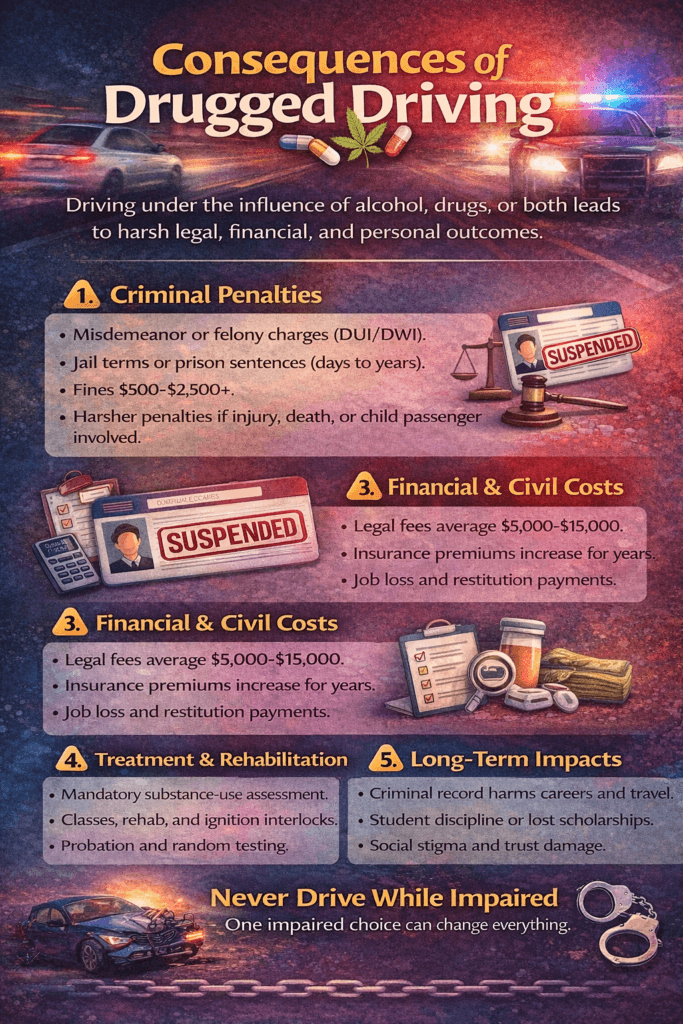
Driving under the influence of alcohol, drugs, or a combination of both carries serious legal, financial, and personal consequences. While penalties vary by state, substance type, and prior history, impaired-driving laws across the United States share one goal: protecting public safety by holding impaired drivers accountable. Understanding these consequences can help individuals make informed, life-saving decisions before getting behind the wheel.
⚖️ 1. Criminal Penalties
Driving while impaired — often charged as DUI (Driving Under the Influence) or DWI (Driving While Intoxicated) — is a criminal offense in every state.
Common outcomes include:
• First offense: Misdemeanor charges, fines ranging from $500–$2,500, license suspension, and possible jail time of 1–6 months.
• Repeat offenses: Felony charges, long-term license revocation, ignition interlock requirements, and potential prison sentences lasting several years.
• Aggravated offenses: Harsher penalties if impairment results in injury, death, or involves a child passenger.
Legal threshold examples:
Most states arrest drivers at a BAC ≥ 0.08%.
Some states (such as Utah) enforce 0.05% BAC limits.
Several states maintain zero-tolerance drug laws, where any detectable amount of an illicit substance can result in a DUI charge.
Impact: Criminal penalties can permanently alter a person’s legal record and future opportunities.
🚗 2. License and Administrative Consequences
In addition to court penalties, motor vehicle departments impose immediate administrative sanctions.
Possible consequences include:
• Immediate license suspension or revocation (90 days to 2+ years).
• Mandatory alcohol or drug education programs.
• Requirement to carry SR-22 high-risk insurance for reinstatement.
• Automatic suspension for refusing breath, blood, or urine testing under implied consent laws.
Impact: Loss of driving privileges often affects employment, family responsibilities, and daily independence.
💰 3. Financial and Civil Costs
A DUI or drug-impaired driving case is extremely expensive.
Typical costs include:
• Legal defense and court fees averaging $5,000–$15,000.
• Increased insurance premiums for 3–5 years.
• Possible job loss, especially for commercial drivers or licensed professionals.
• Restitution payments if property damage or injuries occurred.
Impact: Financial strain can persist long after legal penalties are completed.
🧠 4. Treatment and Rehabilitation Requirements
Many courts now combine punishment with health-based intervention.
Common requirements include:
• Mandatory substance-use assessments.
• Completion of DUI education or treatment programs.
• Ignition interlock device installation for repeat offenses.
• Probation monitoring with random drug or alcohol testing.
Impact: These programs aim to reduce relapse and prevent repeat offenses.
🚨 5. Long-Term and Collateral Consequences
Even after fines are paid and jail terms completed, consequences remain.
Long-term effects may include:
• A permanent criminal record.
• Difficulty obtaining employment or housing.
• Loss of scholarships or school disciplinary action for students.
• Child custody complications if endangerment occurred.
• Social stigma and damaged personal trust.
Impact: A single impaired-driving conviction can shape life opportunities for years.
🧩 6. Special Considerations for Drugged Driving
Drug-impaired driving laws apply even when substances are legally obtained.
Key points:
• Marijuana or prescription medications — legal use does not make impaired driving legal.
• THC blood limits exist in some states (commonly 5 ng/mL), while others rely on observed impairment.
• Polydrug use (mixing alcohol with drugs) greatly increases impairment and often results in aggravated charges.
Impact: Drugged driving enforcement is growing rapidly as substance use patterns change nationwide.
✅ Summary
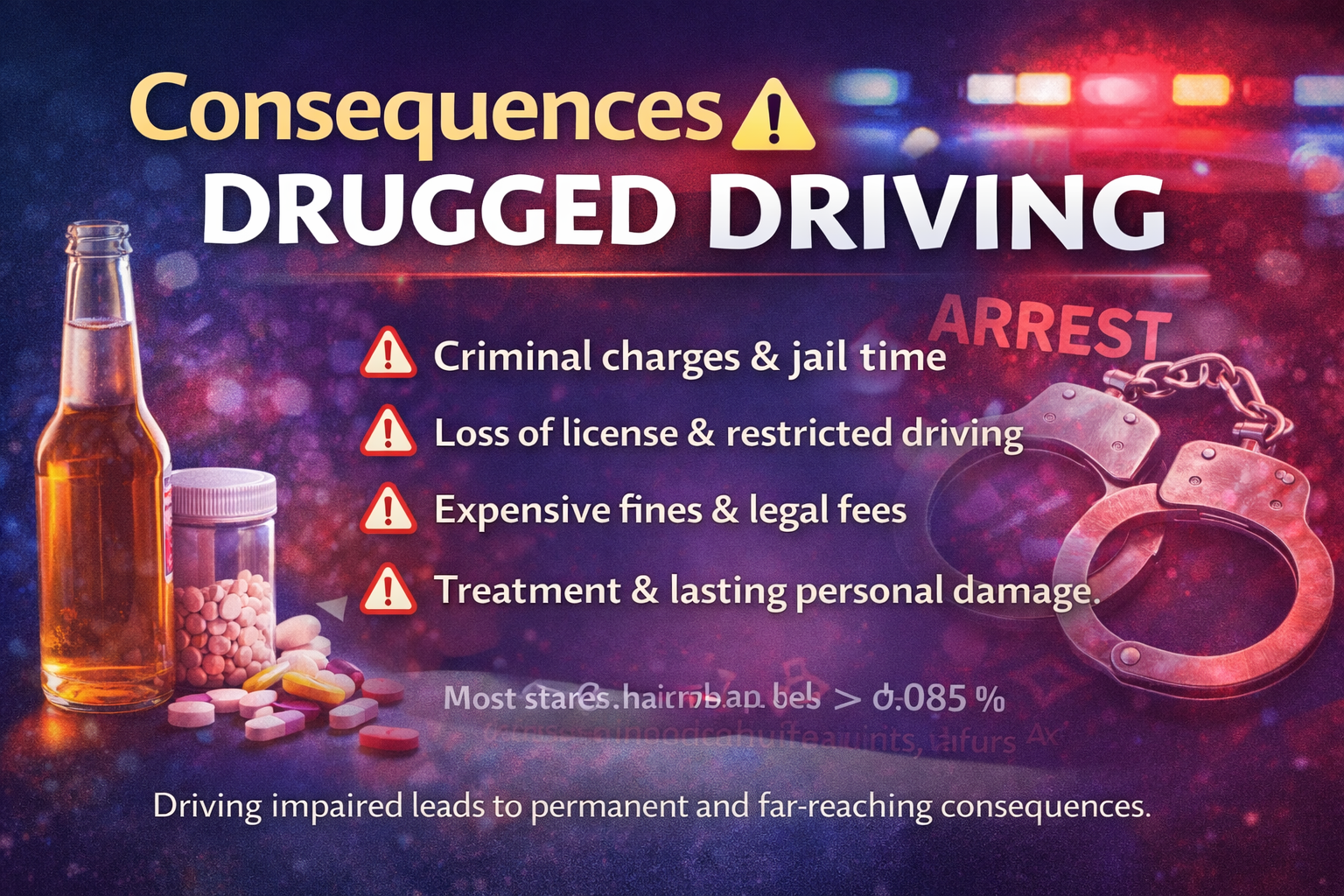
Driving under the influence of alcohol or drugs carries consequences that extend far beyond the moment of arrest. Criminal charges, license loss, financial hardship, mandatory treatment, and lasting personal damage can follow a single impaired decision. The most effective prevention strategy is simple: never drive while impaired. Planning ahead, understanding medication warnings, and using alternative transportation save lives — including your own.
Frequently Asked Questions
Here are some common questions:
1. What is considered drugged driving?
Drugged driving occurs when a person operates a vehicle while impaired by illegal drugs, prescription medications, over-the-counter medicines, or any substance that affects judgment, reaction time, or coordination.
2. Is driving under the influence of prescription medication illegal?
Yes. Even legally prescribed medications can lead to DUI charges if they impair driving ability. Drivers are responsible for knowing whether their medication affects alertness or motor function.
3. How is drugged driving detected by police?
Law enforcement may use field sobriety tests, Drug Recognition Experts (DREs), blood or urine tests, and behavioral observations to determine impairment.
4. Can you be charged if the drug is legal in your state?
Yes. Legal status does not matter. If cannabis, medication, or any substance impairs driving, a DUI or DUID charge can apply.
5. What are typical legal penalties for drugged driving?
Common penalties include fines, license suspension, mandatory treatment programs, probation, ignition interlock devices, and possible jail time. Repeat offenses carry harsher consequences.
6. Does refusing a drug test have consequences?
Yes. Under implied consent laws, refusing chemical testing usually results in automatic license suspension and may be used against the driver in court.
7. How much does a drugged driving conviction cost?
Total costs often range from $5,000 to $15,000 or more, including fines, legal fees, treatment programs, and increased insurance rates.
8. Can drugged driving affect employment?
Yes. A DUI or DUID conviction can impact professional licenses, background checks, commercial driving eligibility, and job opportunities.
9. Are young drivers penalized differently?
Many states have zero-tolerance laws for drivers under 21, meaning any detectable amount of alcohol or drugs can result in immediate penalties.
10. How does mixing drugs and alcohol affect penalties?
Polydrug impairment is treated as an aggravated offense in many states, often resulting in harsher criminal charges and longer license revocation.
11. Can drugged driving lead to mandatory treatment?
Yes. Courts frequently require substance abuse assessments, DUI education courses, or rehabilitation as part of sentencing.
12. What happens if drugged driving causes an accident?
If injuries or fatalities occur, charges can escalate to felony DUI, vehicular assault, or vehicular manslaughter, with long-term imprisonment possible.
13. Does a DUI or DUID stay on your record permanently?
In many states, impaired-driving convictions remain on driving and criminal records for years and may never be fully removed.
14. How can drugged driving be prevented?
Planning ahead for transportation, understanding medication side effects, avoiding substance use before driving, and using ride services are the most effective prevention strategies.
15. Why is drugged driving considered a serious public safety issue?
Impaired reaction time and judgment significantly increase crash risk, endangering drivers, passengers, and pedestrians alike.
Conclusion
Drugged driving represents a growing public safety issue at the intersection of evolving drug laws, social behaviors, and transportation risk. While cannabis legalization has reshaped social norms, it has also required policymakers to strengthen enforcement, education, and prevention systems to protect public safety. The consequences of drug- and alcohol-impaired driving are severe, ranging from fines and license suspension to loss of life. Combating this issue requires collaboration across personal responsibility, community education, and government policy. Through consistent enforcement, data-driven prevention strategies, and public awareness efforts, society can reduce impaired driving incidents and promote a culture of safety that values mindfulness, accountability, and sober decision-making while driving.
Video: He Thought One Pill Was Safe to Drive On #wrong #consequences #arrest