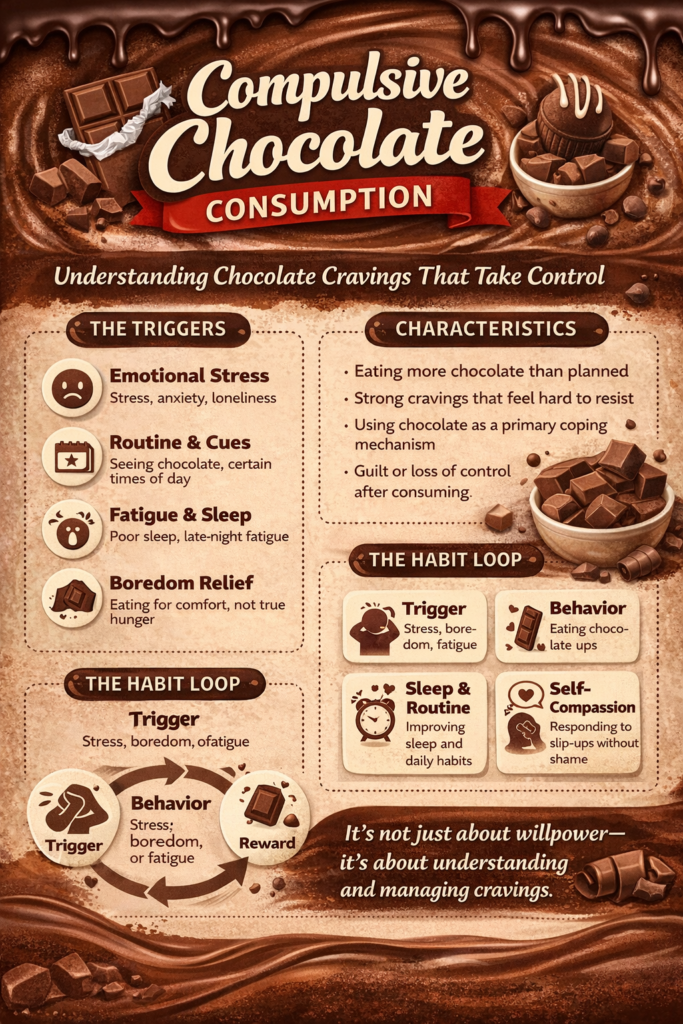
Compulsive chocolate consumption is often dismissed as a harmless indulgence or a simple “sweet tooth,” but for some individuals, it reflects a deeper behavioral and psychological pattern. Chocolate’s unique combination of sugar, fat, and mood-altering compounds can strongly activate the brain’s reward system, reinforcing repeated use—especially during times of stress, fatigue, or emotional discomfort. Over time, this can develop into a cycle of cravings and consumption that feels difficult to control. Understanding compulsive chocolate consumption requires looking beyond the surface to examine the interplay among brain chemistry, emotional regulation, and learned habits.
Compulsive Chocolate Consumption: When Cravings Turn Into Control
Chocolate is one of the most widely loved foods in the world—rich, comforting, and often tied to pleasure and reward. But for some individuals, chocolate consumption can move beyond enjoyment and into a pattern that feels difficult to control. This phenomenon, often referred to as compulsive chocolate consumption, reflects a deeper interaction between brain chemistry, behavior, and emotional regulation.
The Science Behind the Craving
Chocolate is not just a treat—it’s a biochemical experience. It contains sugar, fat, caffeine, and compounds like theobromine and phenylethylamine, all of which can influence mood and energy. When consumed, chocolate stimulates the brain’s reward system, particularly the release of dopamine, a neurotransmitter associated with pleasure and reinforcement.
Over time, repeated exposure to these rewarding effects can condition the brain to seek chocolate more frequently. This is especially true when chocolate becomes associated with relief from stress, boredom, or negative emotions. The brain begins to “learn” that chocolate equals comfort, reinforcing the habit.
When Enjoyment Becomes Compulsion
Compulsive chocolate consumption is not simply about liking chocolate—it involves patterns such as:
- Eating chocolate in larger amounts than intended
- Experiencing strong cravings that feel hard to resist
- Using chocolate as a primary coping mechanism
- Feeling guilt or loss of control after consumption
- Repeated attempts to cut back that are unsuccessful
These behaviors mirror patterns seen in other forms of compulsive eating, where the behavior continues despite negative consequences.
The Role of Emotions and Stress
Emotional triggers play a major role. Stress, anxiety, and fatigue can weaken self-regulation and increase the brain’s demand for quick rewards. Chocolate, being easily accessible and socially acceptable, becomes a go-to solution.
In this way, the behavior is less about hunger and more about emotional regulation. The chocolate acts as a temporary buffer against discomfort—but does not address the underlying issue, which can lead to a cycle of dependence.
Habit Loops and Conditioning
Compulsive consumption often follows a habit loop:
- Trigger (stress, boredom, late-night fatigue)
- Behavior (eating chocolate)
- Reward (temporary relief or pleasure)
Over time, this loop becomes automatic. The brain begins to anticipate the reward as soon as the trigger appears, making the urge feel almost involuntary.
Breaking the Cycle
Addressing compulsive chocolate consumption is not about eliminating chocolate entirely—it’s about restoring balance and control. Some effective strategies include:
- Awareness: Identifying triggers and patterns of use
- Substitution: Finding alternative coping mechanisms (e.g., exercise, journaling, social support)
- Mindful eating: Slowing down and paying attention to the experience of eating
- Sleep and routine: Reducing vulnerability to cravings by maintaining consistent habits
- Self-compassion: Avoiding shame, which can reinforce the cycle
A Balanced Perspective
Chocolate itself is not the problem. The issue arises when it becomes a primary coping tool or when consumption feels compulsive rather than intentional. Understanding the psychological and neurological factors at play allows for a more compassionate and effective approach to change.
Recovery—whether from substance use or behavioral patterns—often involves rebuilding the brain’s relationship with reward, control, and self-awareness. In that process, even something as simple as chocolate can become an important lens into how habits are formed—and how they can be reshaped.
In summary, compulsive chocolate consumption is not a lack of willpower; it is a learned pattern shaped by biology, behavior, and environment. And like any learned pattern, it can be unlearned with the right strategies and support.
Mastering Cravings: Self-Management Strategies for Compulsive Chocolate Consumption
Compulsive chocolate consumption is more than just a strong sweet tooth—it often reflects deeper patterns involving habit, emotion, and brain-based reward systems. While chocolate itself is not inherently harmful, relying on it as a primary coping mechanism can lead to cycles of craving, overconsumption, and loss of control. The good news is that with the right self-management strategies, individuals can better understand their behaviors and regain balance.
Understanding the “Why” Behind the Craving
Before change can happen, awareness is key. Compulsive eating is rarely about hunger alone. It is often triggered by:
- Emotional states such as stress, anxiety, or loneliness
- Environmental cues, like seeing chocolate or associating it with certain routines
- Fatigue or poor sleep, which lowers impulse control
- Habitual patterns formed over time
Recognizing these triggers helps shift the focus from “What’s wrong with me?” to “What’s driving this behavior?”
Tracking Patterns and Triggers
One of the most effective tools is simple self-monitoring. Keeping a journal of when cravings occur, what you were feeling, and how you responded can reveal patterns you might not otherwise notice.
Ask yourself:
- What time of day do cravings hit hardest?
- What emotions am I experiencing beforehand?
- Am I physically hungry, or seeking comfort?
This process builds self-awareness, which is the foundation of behavior change.
Interrupting the Habit Loop
Compulsive chocolate consumption often follows a predictable loop: trigger → behavior → reward. To break this cycle, you don’t need to eliminate the trigger—you need to interrupt the response.
Try:
- Waiting 10–15 minutes before acting on a craving
- Drinking water or engaging in a brief activity (walk, stretch)
- Changing your environment (leave the room, remove access)
These small pauses help retrain the brain to tolerate urges without immediately acting on them.
Developing Healthier Coping Strategies
Since many cravings are emotionally driven, replacing chocolate with other forms of relief is essential. Effective alternatives include:
- Physical activity to reduce stress and boost mood
- Journaling or reflection to process emotions
- Talking to someone for support and connection
- Relaxation techniques like deep breathing or mindfulness
The goal is not to remove comfort, but to expand your coping toolbox.
Practicing Mindful Consumption
Instead of labeling chocolate as “bad,” practice intentional eating:
- Slow down and savor each bite
- Pay attention to taste, texture, and satisfaction
- Set a clear portion before starting
Mindfulness reduces automatic behavior and increases a sense of control, making it less likely to overconsume.
Strengthening Daily Foundations
Self-management is easier when your baseline is stable. Key lifestyle factors include:
- Consistent sleep, which improves impulse control
- Balanced nutrition, preventing extreme hunger
- Routine and structure, reducing decision fatigue
When the body and mind are supported, cravings tend to feel less intense and more manageable.
Building Self-Compassion
Perhaps the most overlooked strategy is how you respond to setbacks. Shame and self-criticism often reinforce the cycle of compulsive behavior. Instead:
- Acknowledge the slip without judgment
- Reflect on what triggered it
- Use it as information, not failure
Change is a process, not a single decision.
A Path Toward Control and Understanding
Compulsive chocolate consumption is not simply about willpower—it’s about learned behaviors shaped by the brain, emotions, and environment. Through self-management strategies like awareness, pattern tracking, habit interruption, and mindful coping, it is possible to shift from feeling controlled by cravings to understanding and managing them.
In the end, the goal isn’t perfection—it’s progress, balance, and a healthier relationship with both food and yourself.
Stronger Together: Family Support Strategies for Understanding Compulsive Chocolate Consumption
Compulsive chocolate consumption can be confusing—not just for the individual experiencing it, but also for the people around them. What may look like a simple habit or lack of willpower is often a complex interaction of emotional triggers, learned behaviors, and brain-based reward systems. This is where family support becomes a powerful part of understanding and change.
Moving Beyond Misunderstanding
Family members may unintentionally minimize or misinterpret compulsive eating behaviors, viewing them as indulgence or poor self-control. However, approaching the situation with curiosity rather than judgment fosters a more supportive environment.
Understanding that compulsive chocolate consumption is often tied to:
- Stress and emotional regulation
- Habit loops and conditioning
- Temporary relief from discomfort
…helps shift the mindset from blame to support.
Creating a Safe Space for Open Communication
One of the most important strategies is fostering honest, pressure-free conversations. Individuals are more likely to reflect on their behavior when they feel safe, not criticized.
Families can:
- Ask open-ended questions like, “What do you notice before a craving starts?”
- Listen without interrupting or offering immediate solutions
- Validate feelings, even if they don’t fully understand the behavior
This builds trust and encourages self-awareness.
Identifying Triggers Together
Family members can play a helpful role in recognizing patterns that the individual might miss. Gently observing and discussing routines can reveal shared insights.
For example:
- Do cravings happen during stressful times at home?
- Are there specific times of day when chocolate is always present?
- Is chocolate used during certain emotional states (e.g., after conflict, boredom)?
Approaching this as a team effort reduces isolation and increases understanding.
Supporting Healthy Alternatives
Rather than focusing on restriction, families can help introduce and reinforce alternative coping strategies:
- Encouraging physical activities or shared walks
- Creating opportunities for connection (talking, playing games, spending time together)
- Supporting relaxation habits like mindfulness or quiet time
When healthier options are normalized within the family, they become easier to adopt.
Shaping the Environment
The home environment can strongly influence behavior. Small adjustments can reduce automatic habits without feeling controlled.
Examples include:
- Keeping chocolate less visible or not in bulk quantities
- Stocking a variety of balanced snacks
- Establishing consistent meal and sleep routines
These changes support better decision-making without singling anyone out.
Avoiding Shame and Pressure
Criticism, guilt, or overly close monitoring can backfire, increasing stress and reinforcing the cycle of compulsive consumption. Instead, families should focus on:
- Encouragement over correction
- Progress over perfection
- Understanding over control
Support should feel empowering, not restrictive.
Celebrating Small Wins
Change doesn’t happen overnight. Recognizing small improvements—like pausing before a craving or choosing an alternative coping strategy—can build confidence and motivation.
Positive reinforcement strengthens new patterns and reminds the individual that progress is possible.
A Shared Journey Toward Understanding
Compulsive chocolate consumption is not just an individual issue—it exists within a broader social and emotional context. When families approach it with empathy, patience, and teamwork, they become an essential part of the solution.
By creating a supportive environment, encouraging open dialogue, and focusing on understanding rather than judgment, families can help transform confusion into clarity—and isolation into connection.
In summary, healing and behavior change are rarely achieved alone. With the right support system, even deeply ingrained habits can begin to shift toward healthier, more balanced patterns.
Beyond Willpower: Community Resource Strategies for Understanding Compulsive Chocolate Consumption
Compulsive chocolate consumption is often misunderstood as a simple lack of discipline, but in reality, it reflects a complex interaction between brain chemistry, emotional regulation, and learned behavior. While individual and family efforts are important, community resources play a critical role in helping individuals better understand and manage these patterns. Accessing the right support systems can turn confusion into clarity and isolation into connection.
Why Community Support Matters
Behavior change is difficult to sustain in isolation. Community resources provide:
- Education about how cravings and habits develop
- Accountability through shared goals and support
- Connection with others experiencing similar challenges
- Access to professional guidance
These elements help normalize the experience and reduce stigma, making it easier to seek help and stay engaged in the change process.
Educational Programs and Workshops
Local health organizations, wellness centers, and community groups often offer programs focused on nutrition, stress management, and behavioral health. These workshops can help individuals:
- Understand the science of cravings and reward systems
- Learn practical coping strategies
- Develop healthier relationships with food
Education empowers individuals to move from reactive behavior to informed decision-making.
Support Groups and Peer Networks
Peer support groups—whether in-person or online—offer a unique benefit: shared experience. Hearing others describe similar struggles with compulsive eating can be both validating and motivating.
In these settings, individuals can:
- Share personal challenges and successes
- Learn strategies that have worked for others
- Build a sense of accountability and belonging
Knowing “you’re not alone” can significantly reduce the emotional burden tied to compulsive behaviors.
Access to Professional Support
Community resources often include access to trained professionals, such as:
- Counselors or therapists
- Nutritionists or dietitians
- Behavioral health specialists
These professionals can help individuals explore underlying emotional triggers, restructure habits, and develop personalized strategies for managing cravings.
Digital and Online Resources
In today’s connected world, community support extends beyond physical spaces. Apps, forums, and virtual programs provide flexible access to tools and guidance.
Benefits include:
- On-demand tracking of habits and triggers
- Guided mindfulness and stress-reduction exercises
- Virtual communities for support and encouragement
These resources are especially helpful for those who may not have local options available.
Creating a Supportive Community Environment
Communities themselves can contribute to healthier behaviors by:
- Promoting awareness about compulsive eating patterns
- Reducing stigma around seeking help
- Offering inclusive, accessible wellness initiatives
When communities prioritize mental and behavioral health, individuals are more likely to engage with available resources.
Taking the First Step
Reaching out to community resources can feel intimidating, but it often begins with a small step:
- Attending a workshop
- Joining a support group
- Exploring an online forum or app
Each step builds knowledge, confidence, and connection.
A Collective Approach to Change
Compulsive chocolate consumption is not just an individual challenge—it is shaped by broader social, emotional, and environmental influences. Community resource strategies provide a bridge between understanding and action, offering the tools and support needed to create lasting change.
In summary, true progress often happens when individuals feel supported not only by themselves or their families, but by a wider network of resources and understanding. In that shared space, healthier habits become more achievable—and more sustainable.
Frequently Asked Questions
Here are some common questions:
1. What is compulsive chocolate consumption?
Answer:
Compulsive chocolate consumption refers to a pattern of eating chocolate that feels difficult to control, often driven by cravings rather than hunger. It typically involves repeated overconsumption despite intentions to limit intake and may be linked to emotional or psychological triggers.
2. Is compulsive chocolate consumption considered an addiction?
Answer:
While it is not officially classified as a substance addiction, it can resemble behavioral addiction patterns. Chocolate activates the brain’s reward system, releasing dopamine, which reinforces repeated behavior—similar to other compulsive habits.
3. Why do people crave chocolate so strongly?
Answer:
Chocolate contains sugar, fat, caffeine, and mood-enhancing compounds that stimulate pleasure centers in the brain. Cravings can also be influenced by stress, hormonal changes, fatigue, and learned associations between chocolate and comfort.
4. What are common signs of compulsive chocolate consumption?
Answer:
Common signs include:
- Eating more chocolate than intended
- Strong, frequent cravings
- Using chocolate to cope with emotions
- Feeling guilt or loss of control after eating
- Difficulty cutting back despite efforts
5. Is it about lack of willpower?
Answer:
No. Compulsive chocolate consumption is not simply a willpower issue. It is influenced by brain chemistry, habit formation, emotional regulation, and environmental cues. Understanding these factors is key to managing the behavior.
6. How does stress affect chocolate consumption?
Answer:
Stress increases the body’s demand for quick energy and comfort. It also weakens impulse control, making high-reward foods like chocolate more appealing. As a result, people often turn to chocolate as a coping mechanism.
7. Can lack of sleep increase chocolate cravings?
Answer:
Yes. Sleep deprivation disrupts hormones that regulate hunger and appetite, increasing cravings for sugary and high-fat foods. It also reduces decision-making ability, making it harder to resist impulses.
8. What is the “habit loop” in compulsive eating?
Answer:
The habit loop consists of three parts:
- Trigger: Stress, boredom, or fatigue
- Behavior: Eating chocolate
- Reward: Temporary pleasure or relief
Over time, this loop becomes automatic and reinforces the behavior.
9. How can someone manage compulsive chocolate consumption?
Answer:
Effective strategies include:
- Identifying triggers and patterns
- Practicing mindful eating
- Developing alternative coping methods (exercise, journaling, relaxation)
- Improving sleep and daily routines
- Seeking support from family, peers, or professionals
10. Should chocolate be completely avoided?
Answer:
Not necessarily. The goal is balance, not elimination. For many people, learning to consume chocolate mindfully and in moderation is more sustainable than strict restriction, which can sometimes increase cravings.
11. When should someone seek professional help?
Answer:
If chocolate consumption feels out of control, causes distress, or interferes with daily life, it may be helpful to seek support from a therapist, counselor, or nutrition professional.
12. Can this behavior be changed?
Answer:
Yes. Because compulsive chocolate consumption is a learned behavior, it can be unlearned. With awareness, consistent strategies, and support, individuals can regain control and develop a healthier relationship with food.
Conclusion
Compulsive chocolate consumption is not merely a matter of willpower, but a learned behavior shaped by biological, psychological, and environmental factors. By recognizing the underlying triggers, habit loops, and emotional drivers, individuals can begin to shift their relationship with chocolate from automatic to intentional. Whether through self-awareness, supportive relationships, or community resources, meaningful change is possible. Ultimately, the goal is not to eliminate enjoyment, but to restore balance—allowing chocolate to remain a pleasure rather than a source of control.
Video: