Addiction is a complex and deeply personal struggle that often extends beyond the individual to impact family members and loved ones. In an effort to help, many people take on supportive roles—but not all forms of support are beneficial. Two commonly misunderstood approaches, caretaking and caregiving, differ significantly in their impact on recovery. Caretaking often involves overprotective or enabling behaviors that shield individuals from consequences, while caregiving emphasizes healthy boundaries, accountability, and emotional support. Understanding this distinction is essential for fostering recovery and preventing unintentional harm.
Helping or Hurting? Caretaking vs. Caregiving in Addiction
In the context of addiction, support from loved ones can play a critical role in recovery—but not all forms of help are equally beneficial. Two commonly confused concepts, caretaking and caregiving, represent very different approaches to supporting someone struggling with substance use. While both are rooted in concern and compassion, caretaking can unintentionally enable harmful behaviors, whereas caregiving promotes accountability and long-term healing. Understanding the distinction between these roles is essential for families, friends, and professionals who want to provide meaningful and effective support.
Understanding Caretaking in Addiction
Caretaking often involves over-involvement and control, in which one person takes responsibility for another’s actions or their consequences. This may include:
- Covering up mistakes or minimizing consequences
- Providing money or resources that support substance use
- Avoiding conflict to “keep the peace.”
- Feeling responsible for the other person’s choices
Although these behaviors come from a place of love, they can enable addiction by removing natural consequences and reinforcing dependency.
Understanding Caregiving in Addiction
Caregiving, in contrast, is supportive but boundaried. It focuses on helping the individual take responsibility for their recovery while still offering emotional and practical support. Caregiving may include:
- Encouraging treatment and professional help
- Setting and maintaining healthy boundaries
- Offering emotional support without enabling harmful behavior
- Promoting independence and accountability
Caregiving empowers the individual rather than controlling or rescuing them.
Key Differences Between Caretaking and Caregiving
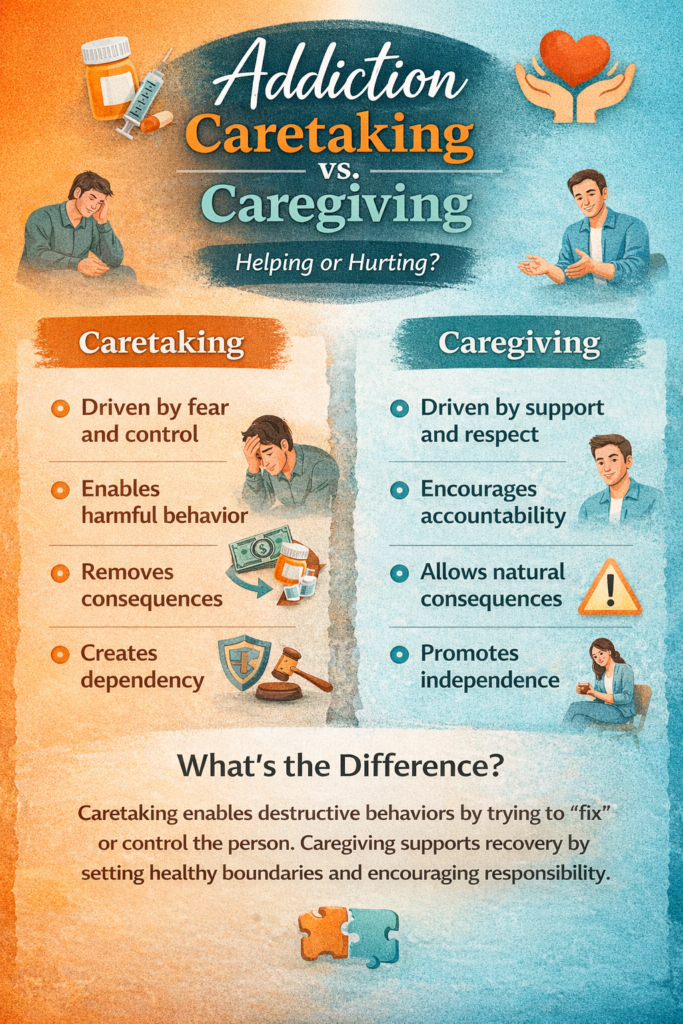
| Caretaking | Caregiving |
|---|---|
| Driven by fear and control | Driven by support and respect |
| Enables harmful behavior | Encourages accountability |
| Removes consequences | Allows natural consequences |
| Creates dependency | Promotes independence |
| Often leads to burnout | Supports sustainable relationships |
Why the Distinction Matters
Confusing caretaking with caregiving can have serious consequences. When caretaking behaviors dominate, they may prolong addiction, increase emotional strain, and create unhealthy relationship dynamics. On the other hand, caregiving supports recovery by fostering responsibility and resilience.
For many families, shifting from caretaking to caregiving is challenging. It requires letting go of control, tolerating discomfort, and trusting the recovery process. However, this shift is often necessary for both the individual struggling with addiction and the well-being of their support system.
The Emotional Challenge for Loved Ones
It’s important to recognize that caretaking behaviors are often rooted in:
- Fear of losing a loved one
- Guilt or self-blame
- Desire to fix or control the situation
- Emotional exhaustion
These feelings are valid—but acting on them in a caretaking way can unintentionally do more harm than good. Learning healthier support strategies is part of the recovery journey for families as well.
Moving Toward Healthy Support
Transitioning to caregiving involves:
- Setting clear and consistent boundaries
- Seeking support through counseling or support groups
- Educating oneself about addiction and recovery
- Practicing self-care and emotional regulation
This approach not only supports the individual in recovery but also protects the mental and emotional health of loved ones.
Conclusion
In addiction, the difference between helping and harming often lies in how support is given. Caretaking, though well-intentioned, can enable destructive patterns and delay recovery. Caregiving, on the other hand, fosters accountability, independence, and healing.
By understanding and applying caregiving principles, families and support systems can become a powerful force for positive change. True support is not about controlling outcomes—it’s about creating the conditions for recovery to take place.
Taking Control: Self-Management Strategies for Understanding Caretaking vs. Caregiving in Addiction
Supporting someone with addiction can be emotionally complex, often blurring the line between helping and unintentionally enabling. Many individuals struggle to recognize whether their actions fall under caretaking or caregiving. This is where self-management strategies become essential. By developing awareness, emotional regulation, and clear boundaries, individuals can better understand their role and shift from harmful caretaking behaviors to healthier, more effective caregiving approaches.
Why Self-Management Matters
Self-management is the ability to regulate one’s thoughts, emotions, and behaviors in challenging situations. In addiction contexts, it helps individuals:
- Avoid reacting impulsively מתוך fear or guilt
- Recognize unhealthy patterns like enabling
- Make intentional, informed decisions about support
- Maintain their own emotional well-being
Without self-management, even well-intentioned support can become overwhelming or counterproductive.
Key Self-Management Strategies
1. Increase Self-Awareness
Understanding your motivations is the first step. Ask yourself:
- Am I helping out of love or fear?
- Am I trying to control the situation?
- Am I taking responsibility for someone else’s choices?
Self-awareness helps identify when caretaking behaviors are present.
2. Learn the Difference Between Caretaking and Caregiving
Educate yourself on the key distinctions:
- Caretaking = rescuing, controlling, enabling
- Caregiving = supporting, setting boundaries, and encouraging accountability
This knowledge allows you to pause and choose healthier responses.
3. Set and Maintain Boundaries
Boundaries are essential for shifting into caregiving. This may include:
- Saying no to behaviors that enable substance use
- Refusing to cover up consequences
- Defining what support you are willing (and not willing) to give
Consistency is key—boundaries lose effectiveness when they are not maintained.
4. Practice Emotional Regulation
Addiction situations often trigger strong emotions like fear, anger, or guilt. Self-management involves learning to:
- Pause before reacting
- Use coping strategies (deep breathing, journaling, mindfulness)
- Respond thoughtfully rather than impulsively
This prevents emotional decision-making that leads to caretaking.
5. Focus on Personal Responsibility
A critical mindset shift is recognizing that you are not responsible for another person’s addiction or recovery. Self-management means:
- Letting go of the need to “fix” the situation
- Allowing natural consequences to occur
- Supporting without taking control
This promotes healthier dynamics for both individuals.
6. Seek Support and Education
Self-management does not mean handling everything alone. Consider:
- Therapy or counseling
- Support groups for families (e.g., Al-Anon)
- Educational resources on addiction and recovery
These tools provide guidance and reinforce healthy caregiving behaviors.
The Challenge of Letting Go
One of the hardest parts of self-management is letting go of control. Caretaking often feels like helping, even when it is not. Transitioning to caregiving requires tolerating discomfort and uncertainty while trusting the recovery process.
This shift is not about withdrawing care—it’s about providing the right kind of care.
Benefits of Self-Management
When individuals practice self-management, they often experience:
- Reduced stress and emotional burnout
- Healthier relationships
- Greater clarity in decision-making
- More effective support for their loved one’s recovery
It becomes a process of growth not just for the person with addiction, but for everyone involved.
Conclusion
Understanding the difference between caretaking and caregiving in addiction begins with self-management. By developing awareness, setting boundaries, and regulating emotional responses, individuals can move away from enabling behaviors and toward supportive, empowering actions.
Ultimately, self-management is about reclaiming control over your own role in the situation. You cannot control addiction—but you can control how you respond to it. And that response can make all the difference in fostering true recovery.
Stronger Together: Family Support Strategies for Understanding Caretaking vs. Caregiving in Addiction
Addiction does not only affect the individual—it impacts the entire family system. Loved ones often struggle to find the right way to help, frequently confusing caretaking with caregiving. While both stem from concern and love, they lead to very different outcomes. Caretaking can unintentionally enable harmful behaviors, while caregiving supports recovery through healthy boundaries and accountability. By developing strong family support strategies, families can better understand these roles and create an environment that encourages healing rather than prolonging addiction.
Why Family Support Is Critical
Family dynamics play a powerful role in addiction and recovery. Without a clear understanding, families may fall into patterns of:
- Overprotecting or rescuing their loved one
- Avoiding difficult conversations
- Taking responsibility for the addiction
When families shift toward informed caregiving, they can:
- Encourage treatment and recovery
- Promote accountability
- Reduce enabling behaviors
- Strengthen healthier relationships
Key Family Support Strategies
1. Educate the Whole Family
Understanding the difference between caretaking and caregiving is the foundation. Families should learn:
- Caretaking = controlling, rescuing, enabling
- Caregiving = supporting, setting limits, encouraging responsibility
Shared knowledge helps everyone stay consistent in their approach.
2. Establish Clear and Consistent Boundaries
Healthy boundaries are essential for caregiving. Families can:
- Set limits on financial support or housing if it enables substance use
- Refuse to cover up consequences (legal, financial, or social)
- Communicate expectations clearly and calmly
Consistency among family members prevents mixed messages.
3. Encourage Open and Honest Communication
Avoiding difficult conversations often leads to caretaking. Instead, families should:
- Speak honestly about concerns without blame
- Use “I” statements (e.g., “I’m worried about your health”)
- Listen actively and empathetically
Open dialogue builds trust and reduces defensiveness.
4. Avoid Enabling Behaviors
Families may unintentionally enable addiction by:
- Giving money that supports substance use
- Making excuses for harmful behavior
- Taking over responsibilities, the individual should manage
Recognizing and stopping these patterns is key to shifting into caregiving.
5. Support Professional Treatment
Caregiving involves guiding loved ones toward appropriate help, such as:
- Detox and rehabilitation programs
- Therapy or counseling
- Support groups
Families should understand that recovery requires professional support—not just family effort alone.
6. Practice Family Self-Care
Supporting someone with addiction can be emotionally exhausting. Families must also:
- Prioritize their own mental and emotional health
- Seek support groups (e.g., Al-Anon)
- Set limits to prevent burnout
Healthy families are better equipped to provide healthy support.
Challenges Families May Face
Transitioning from caretaking to caregiving is not easy. Common challenges include:
- Fear of losing a loved one
- Guilt about setting boundaries
- Disagreements among family members
- Emotional fatigue and stress
Recognizing these challenges helps families approach change with patience and compassion.
The Impact of Healthy Family Support
When families adopt caregiving strategies, the impact can be powerful:
- Individuals are more likely to take responsibility for recovery
- Relationships become healthier and more balanced
- Families experience less stress and conflict
- Long-term recovery outcomes improve
This shift creates a supportive environment where recovery is possible.
Conclusion
Understanding the difference between caretaking and caregiving is essential for families navigating addiction. While caretaking may feel like helping, it often prolongs harmful patterns. Caregiving, on the other hand, fosters accountability, independence, and healing.
Through education, boundaries, communication, and self-care, families can transform their role from enabling to empowering. In the journey of recovery, the most effective support is not about controlling the outcome—it’s about creating the conditions for real change.
Building Better Support: Community Resource Strategies for Understanding Caretaking vs. Caregiving in Addiction
Addiction is a complex condition that affects not only individuals but also families and entire communities. One of the most challenging aspects of supporting someone with addiction is understanding the difference between caretaking and caregiving. While caretaking often involves enabling behaviors, caregiving promotes accountability and recovery. Community resources play a vital role in helping individuals and families recognize this distinction and develop healthier support strategies. By providing education, guidance, and shared experiences, communities can empower people to move from harmful patterns to effective, recovery-oriented support.
Why Community Resources Matter
Many individuals and families struggle to navigate addiction on their own, often falling into caretaking behaviors due to a lack of knowledge or support. Community resources help bridge this gap by offering:
- Access to evidence-based information about addiction
- Support networks that normalize shared experiences
- Professional guidance on healthy support strategies
- Tools to shift from enabling to empowering behaviors
These resources create a foundation for informed and compassionate caregiving.
Key Community Resource Strategies
1. Support Groups and Peer Networks
Groups such as family support meetings provide a safe space to:
- Share experiences and challenges
- Learn from others who have faced similar situations
- Understand the impact of caretaking vs. caregiving
Hearing real-life stories often helps individuals recognize their own patterns and make meaningful changes.
2. Community Education Programs
Workshops and seminars offered by community centers, clinics, or recovery organizations can:
- Explain the differences between enabling and supportive behaviors
- Teach practical strategies for setting boundaries
- Provide insight into the recovery process
Education reduces confusion and builds confidence in decision-making.
3. Access to Counseling and Professional Guidance
Community-based counselors, therapists, and social workers can help individuals:
- Identify unhealthy caretaking patterns
- Develop personalized caregiving strategies
- Process emotions like guilt, fear, and frustration
Professional support ensures that families are not navigating addiction alone.
4. Public Health Campaigns and Awareness Efforts
Community initiatives can raise awareness by:
- Addressing common misconceptions about addiction
- Promoting healthy support roles
- Reducing stigma סביב seeking help
These campaigns encourage more people to access available resources.
5. Resource Centers and Hotlines
Local organizations and helplines provide immediate access to:
- Information about treatment options
- Crisis support
- Referrals to recovery programs
These services are especially important for individuals unsure where to begin.
6. Collaboration with Recovery Programs
Community partnerships with treatment centers and recovery programs help families:
- Understand the role of medical and therapeutic support
- Distinguish between professional care and family roles
- Reinforce caregiving behaviors that support long-term recovery
This collaboration strengthens the overall support system.
Overcoming Barriers to Community Support
Despite their value, community resources are sometimes underused due to:
- Lack of awareness about available services
- Stigma surrounding addiction
- Fear of judgment or exposure
- Limited access in certain areas
Addressing these barriers requires outreach, education, and the creation of welcoming, inclusive environments.
The Impact of Community-Based Support
When individuals and families engage with community resources, they are more likely to:
- Shift from caretaking to caregiving behaviors
- Establish healthy boundaries
- Feel less isolated and overwhelmed
- Support recovery in a more effective and sustainable way
Communities become a source of strength rather than silence.
Conclusion
Understanding the difference between caretaking and caregiving in addiction is not always intuitive—but it is essential for meaningful support. Community resources provide the education, guidance, and connection needed to make this distinction clear and actionable.
By engaging with support groups, educational programs, and professional services, individuals and families can move away from enabling patterns and toward empowering, recovery-focused care. In the journey of addiction recovery, community is not just helpful—it is transformative.
Frequently Asked Questions
Here are some common questions:
1. What is the difference between caretaking and caregiving in addiction?
Caretaking involves controlling, rescuing, or enabling behaviors that protect the individual from consequences. Caregiving, on the other hand, focuses on supportive actions that encourage responsibility, boundaries, and recovery.
2. Why is caretaking considered harmful in addiction?
Caretaking can unintentionally enable addiction by removing consequences and reinforcing dependency. For example, covering up mistakes or providing money may allow the addiction to continue without accountability.
3. What does healthy caregiving look like?
Healthy caregiving includes:
- Setting clear boundaries
- Encouraging treatment and recovery
- Offering emotional support without enabling harmful behavior
- Allowing natural consequences to occur
It supports the person without taking control of their choices.
4. Why do people fall into caretaking roles?
Caretaking is often driven by:
- Fear of losing a loved one
- Guilt or self-blame
- Desire to fix or control the situation
- Emotional stress and urgency
These motivations are understandable but can lead to unhealthy patterns.
5. Can caretaking feel like helping?
Yes. Caretaking often feels like helping because it provides immediate relief from conflict or crisis. However, in the long term, it can prolong addiction and prevent real change.
6. How can someone shift from caretaking to caregiving?
Key steps include:
- Educating yourself about addiction
- Setting and maintaining boundaries
- Letting go of control over outcomes
- Seeking support (therapy or support groups)
This shift takes time and practice.
7. What are examples of enabling behaviors?
Examples include:
- Giving money that may be used for substances
- Making excuses for the person’s behavior
- Taking over responsibilities they should handle
- Avoiding consequences to “protect” them
These behaviors are common in caretaking.
8. What role do boundaries play in caregiving?
Boundaries are essential in caregiving because they:
- Protect your emotional and mental health
- Encourage accountability in the person with addiction
- Prevent enabling behaviors
Without boundaries, caregiving can turn into caretaking.
9. Is it wrong to want to help someone with addiction?
No. Wanting to help is natural and compassionate. The key is how you help. Effective support means helping in ways that promote recovery, not dependency.
10. Can caregiving improve recovery outcomes?
Yes. Supportive, boundaried caregiving can:
- Encourage individuals to seek treatment
- Promote personal responsibility
- Strengthen healthier relationships
- Increase the likelihood of long-term recovery
11. How does caregiving affect the supporter?
Caregiving, when done in a healthy way, can reduce burnout and emotional stress. It allows supporters to care for others while also maintaining their own well-being.
12. When should someone seek outside help?
If the situation feels overwhelming, involves safety concerns, or includes repeated enabling patterns, it’s important to seek:
- Professional counseling
- Family therapy
- Support groups (like Al-Anon)
External support can provide guidance and relief.
Conclusion
Recognizing the difference between caretaking and caregiving is a critical step in supporting someone with addiction. While caretaking may feel like helping, it can reinforce dependency and prolong harmful behaviors. In contrast, caregiving promotes responsibility, independence, and long-term healing. By shifting toward caregiving strategies, individuals can provide support that empowers rather than enables. Ultimately, effective support in addiction is not about controlling outcomes, but about creating a balanced environment where recovery has the opportunity to take root and grow.
Video: