In relationships affected by addiction, emotions can feel intense, urgent, and deeply meaningful—often leading individuals to believe they are experiencing profound love. However, what is frequently at play is a powerful form of attachment shaped by cycles of inconsistency, emotional highs and lows, and fear of loss. Addiction can amplify dependence, blur boundaries, and create patterns in which connection is driven more by need than by mutual stability. Understanding the difference between attachment and love is essential because it helps individuals and those around them recognize when a relationship is rooted in emotional survival rather than a genuine, healthy connection.
Attachment vs. Love in Addiction: Understanding the Difference in Relationships
When Love Feels Intense—but Unstable
Relationships affected by addiction are often described as intense, consuming, and difficult to leave. Many people in these dynamics believe they are experiencing deep love—but what’s often happening is something more complex: a blend of attachment, dependency, and emotional survival.
Understanding the difference between attachment and love is essential, especially in addiction-affected relationships, where emotions can feel amplified and confusing.
What Is Love?
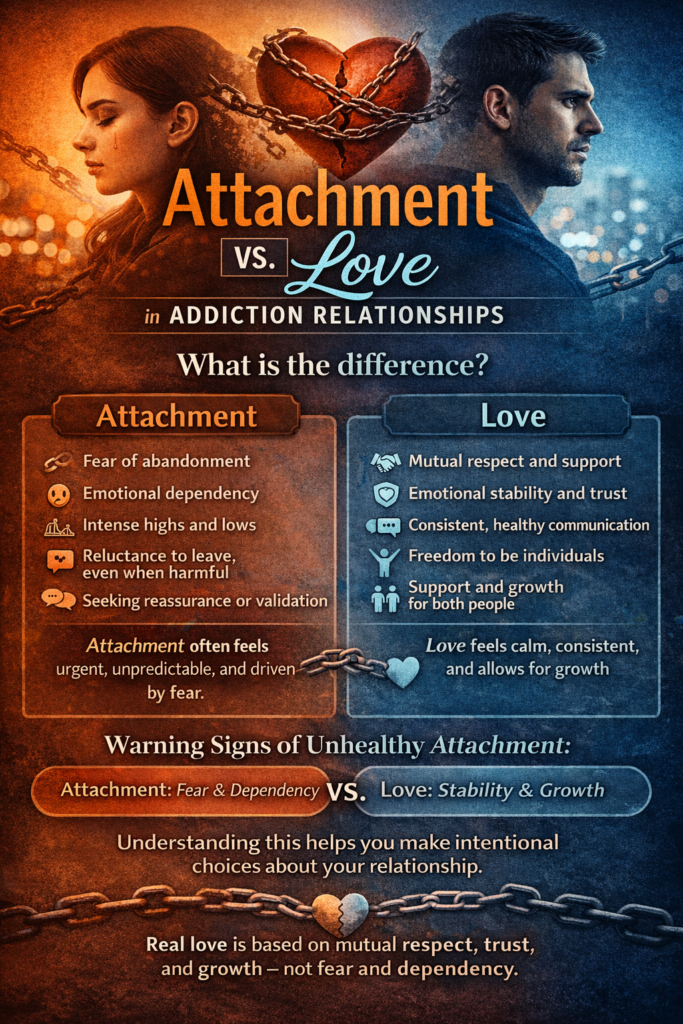
Healthy love is typically characterized by:
- Mutual respect and support
- Emotional safety
- Consistency and trust
- Individual autonomy
- Growth for both people
Love allows space. It does not rely on instability to feel meaningful.
What Is Attachment?
Attachment, especially in the context of addiction, often looks different:
- Fear of abandonment
- Emotional dependency
- Difficulty leaving, even when the relationship is harmful
- Intense highs and lows
- Seeking reassurance or validation
Attachment is not inherently unhealthy—but when combined with addiction, it can become fear-based rather than connection-based.
Why Addiction Intensifies Attachment
Addiction changes relationship dynamics in powerful ways:
1. Intermittent Reinforcement
Periods of:
- Affection, connection, or sobriety
are followed by:
- Withdrawal, conflict, or relapse
This creates a cycle where the brain becomes conditioned to chase the “good moments,” making the bond feel stronger than it is.
2. Emotional Highs and Lows
The unpredictability of addiction can mimic emotional intensity:
- Reconnection after conflict feels euphoric
- Crises create urgency and closeness
- Instability is mistaken for passion
But intensity is not the same as stability—and not the same as love.
3. Caretaking and Dependency Roles
Partners may fall into roles such as:
- Caregiver or rescuer
- Emotional stabilizer
- Problem-solver
This can create a sense of purpose, but it also leads to imbalanced relationships where one person carries more responsibility.
4. Fear-Based Bonding
When addiction is involved, relationships may be held together by:
- Fear of being alone
- Fear of the other person’s decline
- Fear of losing the relationship entirely
This type of attachment is driven more by anxiety than genuine connection.
Signs It May Be Attachment, Not Love
- You feel responsible for the other person’s well-being
- You stay despite repeated harm or instability
- The relationship feels like a cycle of crisis and relief
- You fear leaving more than you feel fulfilled staying
- Your needs are consistently secondary
These patterns suggest the bond may be rooted in dependency or attachment rather than mutual love.
The Role of Trauma and Past Patterns
Attachment in addiction relationships is often influenced by:
- Early attachment experiences
- Past trauma
- Learned relationship dynamics
For example:
- If love was inconsistent growing up, instability may feel familiar
- If care were tied to responsibility, caretaking may feel like love
Understanding these patterns helps explain why these relationships can feel so hard to leave.
Moving Toward Healthier Connection
Shifting from attachment-based dynamics to healthier relationships involves:
- Recognizing patterns without self-blame
- Rebuilding a sense of individual identity
- Setting boundaries
- Learning emotional regulation outside the relationship
- Seeking support (therapy, groups, community)
The goal is not just to leave or stay, but to understand what is driving the bond.
A More Accurate Question
Instead of asking:
“Do I love them?”
Ask:
“Is this connection based on stability and mutual growth—or fear and dependency?”
Final Thought
In addiction-affected relationships, what feels like love is often a powerful form of attachment shaped by cycles of intensity, relief, and fear.
Real love is not built on instability or survival—it is built on consistency, safety, and mutual respect.
Understanding the difference doesn’t just change how you see the relationship—
It changes what you believe you deserve.
Choosing Clarity Over Intensity: Self-Management Strategies to Understand Attachment vs. Love in Addiction Relationships
Why This Distinction Matters
In addiction-affected relationships, emotions can feel overwhelming, urgent, and deeply meaningful. But intensity is not always love—it is often attachment shaped by fear, inconsistency, and unmet needs.
Self-management is about stepping back from the emotional pull and asking:
“What am I actually experiencing—and why?”
Strategy 1: Identify the Emotional Pattern
Start by observing your experience without judgment.
Ask yourself:
- Do I feel secure or anxious in this relationship?
- Are my emotions mostly stable or reactive to their behavior?
- Do I feel grounded—or constantly on edge?
Insight: Love tends to feel stable. Attachment in addiction often feels unpredictable.
Strategy 2: Track the Cycle, Not Just the Feelings
Addiction relationships often follow a loop:
- Conflict or distance
- Emotional distress
- Reconnection or relief
- Temporary closeness
- Repeat
Write this out if needed.
Why it matters:
This helps you see that what feels like “love” may actually be a cycle of relief after distress, not a consistent connection.
Strategy 3: Separate Caretaking From Connection
Ask yourself:
- Am I supporting them—or managing their life?
- Do I feel responsible for their choices or recovery?
- Is my role based on partnership or caregiving?
Key distinction:
Love supports. Attachment often overfunctions to maintain the relationship.
Strategy 4: Check for Fear-Based Motivation
Many attachment-driven relationships are maintained by fear.
Reflect on:
- Fear of them relapsing
- Fear of being alone
- Fear of losing the relationship
Ask:
“If fear were removed, would I still choose this relationship?”
Strategy 5: Reconnect With Your Own Needs
Attachment often involves losing sight of your own needs.
Take time to identify:
- What do I need emotionally?
- What does a healthy relationship look like to me?
- Are those needs being met consistently?
Self-management means putting your needs back into the equation.
Strategy 6: Build Emotional Independence
If your emotional state depends heavily on the other person, attachment may be driving the connection.
Practice:
- Regulating your emotions without relying on them
- Creating space for your own routines and identity
- Developing support systems outside the relationship
This reduces dependency and increases clarity.
Strategy 7: Set and Observe Boundaries
Boundaries are one of the clearest ways to distinguish love from attachment.
Try:
- Setting a small boundary
- Observing both your reaction and theirs
Ask:
- Do I feel guilty or anxious for setting it?
- Do they respect it or push against it?
Healthy love respects boundaries. Attachment often struggles with them.
Strategy 8: Tolerate Discomfort Without Reacting
Attachment urges immediate action—texting, fixing, checking, staying.
Instead:
- Pause before reacting
- Sit with discomfort
- Notice what the urge is trying to do
This creates space between feeling and behavior, which is essential for breaking patterns.
Strategy 9: Challenge the “Intensity = Love” Belief
Ask yourself:
- Is this relationship peaceful or chaotic?
- Do I feel safe—or constantly activated?
- Is the connection consistent—or dependent on crisis?
Reminder:
Calm and stable do not mean boring—they often mean healthy.
Strategy 10: Seek Clarity, Not Just Connection
Instead of focusing only on staying connected, focus on understanding:
- What keeps me attached?
- What patterns am I repeating?
- What am I avoiding by staying?
Clarity leads to better decisions than emotional intensity alone.
A More Grounded Perspective
What feels like love in addiction relationships is often:
- A response to inconsistency
- A cycle of relief and distress
- A pattern shaped by past experiences
Self-management helps you step out of the emotional pull and into awareness and choice.
Final Thought
The goal isn’t to force yourself to leave or stay—it’s to understand what’s driving your connection.
When you can clearly see the difference between attachment rooted in fear and love rooted in stability,
you gain the ability to choose relationships that support—not destabilize—you.
Supporting Without Confusion: Family Strategies for Understanding Attachment vs. Love in Addiction Relationships
When Families See “Love” That Looks Painful
Families often struggle when watching a loved one stay in a relationship affected by addiction—especially when that relationship appears unstable, one-sided, or harmful. It’s common to hear:
- “Why don’t they just leave?”
- “This isn’t love.”
But what looks like love from the outside may actually be attachment shaped by fear, dependency, and emotional cycles. Understanding this distinction helps families respond with more clarity and less frustration.
Why the Confusion Happens
Addiction relationships often involve:
- Intense emotional highs and lows
- Cycles of conflict and reconciliation
- Caretaking and dependency roles
To the person in the relationship, this intensity can feel like love. To family members, it may look chaotic or unhealthy. Both perspectives are reacting to the same dynamic—but interpreting it differently.
Strategy 1: Shift From Judgment to Curiosity
Instead of:
“Why are they choosing this?”
Ask:
“What is keeping them emotionally attached?”
This shift helps families:
- Reduce frustration
- Better understand the emotional pull
- Respond more effectively
Strategy 2: Understand Attachment as a Strong Emotional Bond
Attachment in addiction relationships is often reinforced by:
- Intermittent positive moments
- Fear of abandonment
- A sense of responsibility for the other person
Recognizing that this bond is psychologically powerful helps families avoid oversimplifying the situation.
Strategy 3: Avoid Invalidating Their Feelings
Telling someone:
- “That’s not love.”
- “You’re making a mistake.”
can lead to:
- Defensiveness
- Withdrawal
- Increased attachment to the relationship
Instead, try:
- “I can see how much you care about them.”
- “I’m here to support you, no matter what.”
Validation keeps communication open.
Strategy 4: Gently Introduce the Difference Between Love and Attachment
Families can help by asking reflective questions:
- “Do you feel safe and supported in this relationship?”
- “Do you feel like yourself—or are you constantly stressed?”
- “Is this relationship helping you grow or exhausting you?”
This encourages insight without forcing conclusions.
Strategy 5: Don’t Compete With the Relationship
Trying to “pull” someone away from the relationship often backfires.
Avoid:
- Ultimatums (unless necessary for safety)
- Forcing decisions
- Constant criticism of the partner
These can strengthen the attachment rather than weaken it.
Strategy 6: Set Boundaries Around Your Role
Families can become pulled into the dynamic by:
- Trying to fix the relationship
- Managing crises
- Taking on emotional responsibility
Instead:
- Define what you will and won’t take on
- Avoid enabling unhealthy patterns
- Support without over-involvement
Strategy 7: Recognize the Caretaking Trap
Your loved one may feel needed in the relationship, which can reinforce attachment.
Families can gently highlight:
- The difference between helping and over-responsibility
- The importance of mutual effort in relationships
This helps shift perspective from “I have to stay” to “What is actually healthy?”
Strategy 8: Support Emotional Independence
Encourage your loved one to:
- Maintain friendships and interests outside the relationship
- Develop coping skills independent of their partner
- Reconnect with their own identity
The stronger their independence, the clearer their perspective becomes.
Strategy 9: Be Patient With the Process
Understanding attachment vs. love is not immediate.
Expect:
- Mixed feelings
- Repeated cycles
- Gradual realization
Change often happens through experience and reflection, not pressure.
Strategy 10: Take Care of Yourself as a Family Member
Watching someone you love struggle in these dynamics can be exhausting.
Prioritize:
- Your own emotional boundaries
- Support systems (therapy, groups)
- Time away from the situation
You can support more effectively when you’re not overwhelmed.
A More Helpful Perspective
What families often see as “bad choices” are frequently:
- Emotional bonds shaped by inconsistency
- Fear of loss or abandonment
- Learned patterns of connection
Understanding this transforms the approach from reacting to behavior to supporting awareness.
Final Thought
You cannot force someone to see the difference between attachment and love—but you can create an environment where they feel safe enough to discover it themselves.
With patience, boundaries, and understanding, families can move from frustration to meaningful support—helping their loved one find clarity, not through pressure, but through insight.
It Takes a Village: Community Resource Strategies for Understanding Attachment vs. Love in Addiction Relationships
Why Community Perspective Matters
Attachment in addiction relationships can be incredibly strong—often driven by cycles of intensity, fear, and emotional dependency. From the outside, these relationships may seem confusing or unhealthy, but for the individuals involved, the bond feels real and difficult to break.
This is where community resources become essential. They help shift the perspective from:
“Why don’t they just leave?”
to
“What support and education can help them understand their attachment?”
Moving Beyond Isolation and Misunderstanding
Without community support, individuals may:
- Normalize unhealthy relationship patterns
- Feel isolated or misunderstood
- Confuse emotional intensity with love
- Lack of tools to recognize attachment dynamics
Community resources provide education, connection, and alternative perspectives, making it easier to distinguish between attachment and healthy love.
Strategy 1: Increase Access to Relationship and Addiction Education
Education is the foundation of awareness.
Community programs can offer:
- Workshops on attachment styles and relationship dynamics
- Education on how addiction affects relationships
- Resources explaining trauma bonding and emotional cycles
Impact: When people understand the why behind their feelings, they gain clarity and choice.
Strategy 2: Promote Peer Support Groups
Peer support is powerful because it provides:
- Shared experiences
- Validation without judgment
- Real-life examples of breaking unhealthy patterns
Hearing others describe similar dynamics helps individuals recognize:
“This isn’t just love—this is a pattern.”
Strategy 3: Integrate Mental Health and Addiction Services
Attachment patterns are often tied to:
- Trauma
- Emotional regulation difficulties
- Past relationship experiences
Community access to:
- Therapy
- Group counseling
- Dual-diagnosis programs
helps address both addiction and relational patterns simultaneously.
Strategy 4: Create Safe Spaces for Open Discussion
Many people stay stuck because they feel:
- Ashamed
- Judged
- Misunderstood
Communities can provide:
- Nonjudgmental discussion groups
- Supportive environments for sharing experiences
- Spaces where emotional struggles are normalized
Goal: Reduce stigma so people can explore their relationships honestly.
Strategy 5: Offer Life Skills and Emotional Skills Programs
Understanding attachment vs. love requires skills such as:
- Emotional regulation
- Boundary-setting
- Communication
- Decision-making
Community-based programs that teach these skills help individuals move from reactive attachment to intentional connection.
Strategy 6: Support Family and Social Network Education
Communities can educate families and friends on:
- The difference between attachment and love
- How to support without enabling
- How to communicate without pushing the person away
When the broader support system understands the dynamics, it reduces pressure and improves outcomes.
Strategy 7: Provide Access to Healthy Relationship Models
Many individuals in addiction relationships have limited exposure to healthy dynamics.
Communities can promote:
- Mentorship programs
- Healthy relationship education
- Positive social environments
Seeing stable, respectful relationships in action helps redefine what love actually looks like.
Strategy 8: Address Stigma Around Both Addiction and Relationships
Stigma can keep people trapped in unhealthy dynamics.
Community efforts can:
- Challenge harmful stereotypes
- Promote compassionate understanding
- Encourage seeking help without shame
Reducing stigma makes it easier for individuals to step back and reassess their relationships.
Strategy 9: Encourage Holistic Recovery Environments
Recovery is not just about stopping substance use—it’s about rebuilding life patterns.
Community support can include:
- Sober living environments
- Structured recovery communities
- Social activities that reinforce stability
These environments reduce reliance on unhealthy attachments by providing alternative sources of connection and support.
A Systems-Based Perspective
Attachment in addiction relationships is not just an individual issue—it is shaped by:
- Lack of education
- Limited support systems
- Social and emotional isolation
- Unaddressed trauma and coping patterns
Community resources fill these gaps, making understanding and change more accessible.
Final Thought
No one untangles attachment from love alone.
When communities provide education, support, safe spaces, and skill-building opportunities, individuals gain the clarity to see their relationships more accurately.
And with that clarity, what once felt like an unbreakable attachment can begin to shift—
into healthier choices, stronger boundaries, and relationships built on stability rather than survival.
Frequently Asked Questions
Here are some common questions:
1. What is the difference between attachment and love?
- Attachment is often driven by fear, dependency, and emotional need
- Love is based on stability, trust, and mutual respect
Attachment says: “I need you.”
Love says: “I choose you.”
2. Why do addiction relationships feel so intense?
Addiction creates cycles of:
- Conflict → distance → reconnection → relief
This pattern triggers strong emotional highs and lows, which can feel like passion—but are often reinforced attachment cycles rather than stable love.
3. Can attachment feel like love?
Yes. Attachment can feel just as strong—sometimes stronger—than love because it is fueled by:
- Fear of loss
- Emotional dependency
- Intermittent reinforcement
This intensity can be mistaken for a deep connection.
4. What is trauma bonding in addiction relationships?
Trauma bonding occurs when a relationship is strengthened by repeated cycles of:
- Harm or distress
- Followed by comfort or reconciliation
This creates a powerful emotional bond that is difficult to break, even when the relationship is unhealthy.
5. Why is it so hard to leave these relationships?
Several factors make it difficult:
- Fear of being alone
- Hope for change during “good” periods
- Emotional dependency
- Feeling responsible for the other person
These are attachment-driven forces, not necessarily signs of healthy love.
6. Does caring for someone mean it’s love?
Not always. You can care deeply about someone while still being in an unhealthy attachment dynamic.
Love involves:
- Mutual effort
- Consistency
- Emotional safety
Care alone does not guarantee those qualities.
7. What are the signs it’s attachment, not love?
- You feel anxious or unstable in the relationship
- Your mood depends heavily on the other person
- You stay despite repeated harm
- You feel responsible for their behavior or recovery
These patterns suggest dependency rather than a balanced connection.
8. What are the signs of healthy love?
- Emotional stability and consistency
- Mutual respect and support
- Clear boundaries
- Independence alongside connection
- Growth for both individuals
Love feels secure, not chaotic.
9. How does addiction affect relationship dynamics?
Addiction can:
- Increase unpredictability
- Disrupt trust and communication
- Create caretaker–dependent roles
- Reinforce cycles of crisis and relief
This environment makes attachment stronger and love harder to sustain.
10. Can a relationship with addiction become healthy?
It can—but only if:
- The person with addiction is actively in recovery
- Both individuals develop healthier patterns
- Boundaries and accountability are established
Without change, the cycle of attachment usually continues.
11. How can someone start recognizing the difference?
Ask yourself:
- Do I feel safe and stable, or anxious and reactive?
- Is this relationship consistent or unpredictable?
- Am I staying out of love—or fear?
These questions help shift awareness from emotion to pattern recognition.
12. What helps break unhealthy attachment patterns?
- Building emotional independence
- Setting and maintaining boundaries
- Seeking therapy or support groups
- Reconnecting with personal identity and needs
Change starts with awareness and small, consistent steps.
Conclusion
Distinguishing between attachment and love in addiction relationships is not about dismissing feelings, but about understanding their source and impact. While attachment may feel intense and difficult to break, it is often maintained by fear, instability, and unmet needs rather than mutual growth and security. By gaining clarity on these patterns, individuals can begin to make more intentional choices—whether that means setting boundaries, seeking support, or redefining what a healthy relationship looks like. Ultimately, moving beyond confusion creates space for relationships grounded in consistency, respect, and genuine emotional connection, rather than cycles of dependency.
Video: