Addiction has a profound impact on intimate relationships, often disrupting trust, communication, and emotional safety. For couples, the effects can be especially complex, as both partners are influenced by patterns of substance use, whether directly or indirectly. Recovery, therefore, is not just an individual process—it becomes a shared journey that requires intentional effort, mutual accountability, and relational healing. Couples in recovery must navigate not only sobriety but also the rebuilding of connection, the establishment of healthy boundaries, and the development of new ways of relating. When approached with structure and support, addiction recovery can become an opportunity to transform the relationship into one that is more honest, stable, and resilient.
Healing Together: A Guide to Addiction Recovery for Couples
Addiction doesn’t just affect the individual—it reshapes the entire relationship. Trust erodes, communication breaks down, and both partners often find themselves stuck in cycles of pain, blame, or emotional distance. But recovery, when approached together, can become more than just sobriety—it can be a powerful opportunity to rebuild, reconnect, and create a healthier relationship than before.
The Impact of Addiction on Relationships
In couples where addiction is present, both partners are affected—whether one is using or both are struggling. Over time, patterns often emerge:
- Broken trust from secrecy, dishonesty, or infidelity
- Emotional instability, including anger, anxiety, or withdrawal
- Codependency or enabling behaviors
- Communication breakdown, where conversations become reactive or avoidant
Even after sobriety begins, these patterns don’t automatically disappear. Recovery must address both the addiction and the relationship dynamics.
Recovery Is Not Just Individual—It’s Relational
Traditional recovery often focuses on the individual, but couples recovery recognizes that healing must happen on both sides. The partner who is not using may carry resentment, trauma, or hypervigilance. The partner in recovery may struggle with shame, guilt, and rebuilding credibility.
True healing requires:
- Accountability without shame
- Boundaries without punishment
- Support without enabling
This balance is what makes couples’ recovery both challenging and deeply transformative.
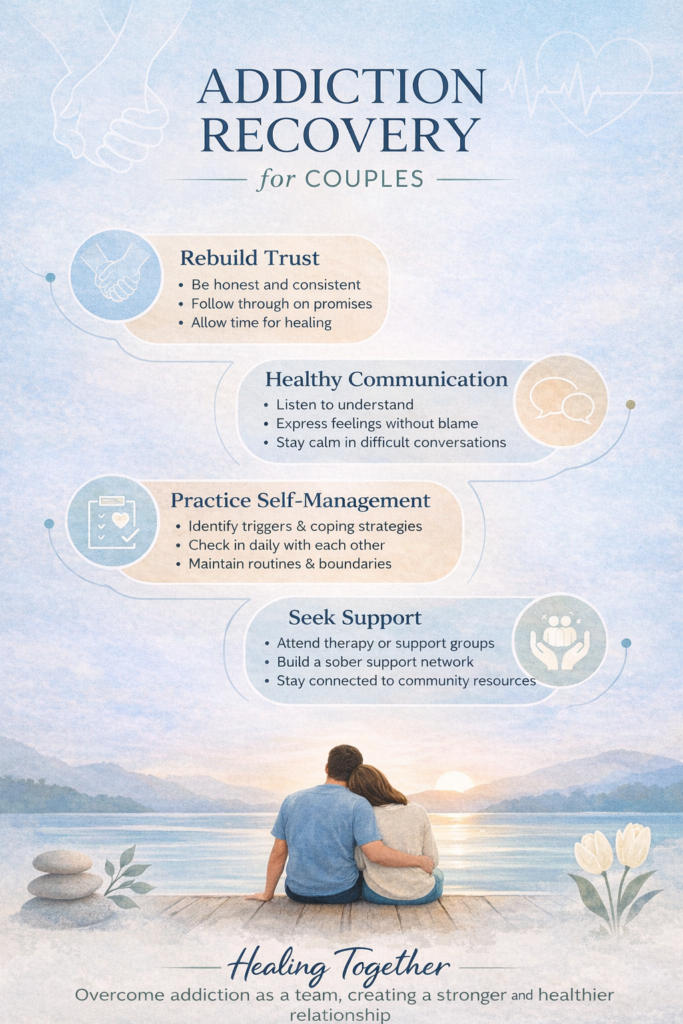
Rebuilding Trust: A Gradual Process
Trust is not restored through promises—it’s rebuilt through consistent, observable change over time.
Key elements include:
- Transparency (honesty about actions, feelings, and struggles)
- Consistency (matching words with behavior)
- Emotional safety (creating space for both partners to express without fear)
Trust grows slowly, but it can grow stronger than before when both partners are committed.
Communication: From Reaction to Connection
Addiction often creates reactive communication—defensiveness, blame, or shutdown. Recovery invites couples to relearn how to communicate with intention.
This includes:
- Listening to understand, not to respond
- Expressing feelings without attacking
- Learning to tolerate discomfort without escalation
Healthy communication becomes the foundation for everything else in recovery.
Individual Healing Still Matters
While working as a couple is powerful, each person must also do their own work. This might include therapy, support groups, or personal reflection.
- The person in recovery focuses on sobriety, triggers, and emotional regulation
- The partner focuses on boundaries, self-care, and healing from relational trauma
When both individuals grow, the relationship is more likely to thrive.
Moving from Survival to Connection
Many couples impacted by addiction live in “survival mode”—focused on getting through the day, avoiding conflict, or managing crises. Recovery offers a path out of that space.
With time and effort, couples can move toward:
- Emotional intimacy
- Mutual respect
- Shared goals and meaning
Recovery is not just about stopping substance use—it’s about learning how to truly live and connect again.
Final Thoughts
Addiction can deeply damage a relationship—but it doesn’t have to define its future. With commitment, honesty, and the right support, couples can rebuild not just what was lost, but something stronger and more intentional.
Healing together is not easy. But it is possible—and for many couples, it becomes one of the most meaningful journeys they ever take.
Staying on Track Together: Self-Management Strategies for Couples in Addiction Recovery
Recovery doesn’t end when substance use stops—it begins there. For couples, the real work lies in how both partners manage daily life, emotions, triggers, and relationship patterns moving forward. Without intentional self-management, it’s easy to fall back into old cycles. But with the right strategies, couples can actively build a stable, supportive, and lasting recovery together.
Why Self-Management Matters in Couples Recovery
In addiction recovery, structure and awareness are everything. When two people are involved, those needs double. Each partner brings their own triggers, habits, and emotional responses into the relationship.
Self-management helps couples:
- Stay accountable without controlling each other
- Prevent relapse by recognizing early warning signs
- Replace chaos with structure and predictability
- Build confidence in their ability to handle challenges together
It shifts recovery from something reactive to something intentional.
1. Daily Check-Ins: Creating Consistent Connection
A simple but powerful habit is a daily check-in. This is not a time for problem-solving or conflict—it’s a space to stay emotionally connected and aware.
Each partner can share:
- How they’re feeling emotionally
- Any triggers or stressors that came up
- What they need (support, space, reassurance, etc.)
This builds transparency and prevents issues from building under the surface.
2. Trigger Awareness and Planning
Triggers don’t disappear in recovery—they become more visible. Couples who succeed learn to identify and plan for them together.
Strategies include:
- Naming personal and shared triggers (stress, conflict, certain environments)
- Creating a plan for high-risk situations
- Agreeing on how to support each other without taking over
The goal is not to eliminate triggers, but to respond to them differently.
3. Boundaries That Support Recovery
Healthy boundaries are essential in couples’ recovery. Without them, patterns such as enabling or controlling can re-emerge.
Examples of effective boundaries:
- Not covering up or minimizing substance use
- Allowing space when emotions escalate
- Respecting each other’s individual recovery practices
Boundaries are not about distance—they are about creating safety and clarity.
4. Routine and Structure
Unstructured time can be a major risk factor in early recovery. Couples benefit from building routines that support stability.
This might include:
- Regular sleep schedules
- Shared meals or activities
- Scheduled recovery meetings or therapy
- Planned downtime that doesn’t involve substances
Structure reduces uncertainty and helps both partners feel grounded.
5. Emotional Regulation Skills
Addiction often develops alongside difficulty managing emotions. In recovery, learning how to regulate those emotions is critical.
Couples can practice:
- Pausing before reacting
- Using grounding techniques during stress
- Taking time-outs during conflict
- Returning to conversations when both partners are calm
Managing emotions individually strengthens the relationship as a whole.
6. Accountability Without Control
One of the biggest challenges in couples’ recovery is balancing support with autonomy.
Healthy accountability looks like:
- Honest communication about struggles
- Willingness to accept feedback
- Following through on commitments
Unhealthy control looks like monitoring, checking, or trying to “manage” the other person’s recovery. Each partner is responsible for their own sobriety.
7. Celebrating Progress
Recovery can feel heavy if the focus is only on what’s going wrong. Couples need to intentionally recognize growth.
Celebrate:
- Milestones in sobriety
- Improved communication
- Moments of honesty or vulnerability
- Small wins in handling triggers differently
These moments reinforce motivation and remind both partners why the work matters.
Moving Forward Together
Self-management in couples’ recovery is not about perfection—it’s about consistency. There will be setbacks, difficult conversations, and moments of doubt. What matters is the commitment to keep showing up, individually and together.
Over time, these strategies become habits. And those habits become a new way of living—one built on trust, stability, and genuine connection.
Recovery is not just something you go through as a couple. It’s something you actively create, every single day.
Stronger Together: Family Support Strategies for Couples in Addiction Recovery
Addiction rarely exists in isolation—it impacts the entire family system. When a couple enters recovery, their healing doesn’t just involve the two of them; it often requires shifts in family roles, communication patterns, and levels of support. When families are engaged in a healthy way, they can become one of the most powerful protective factors in long-term recovery.
Why Family Support Matters
Family members often carry their own experiences of stress, confusion, and even trauma related to a loved one’s addiction. Without guidance, their attempts to help can unintentionally reinforce unhealthy patterns like enabling, avoidance, or conflict.
Effective family support:
- Reinforces recovery-oriented behaviors
- Reduces isolation for the couple
- Provides accountability in a healthy, non-controlling way
- Creates a more stable and predictable environment
Recovery becomes more sustainable when the couple is supported by a system that understands the process.
1. Educating the Family on Addiction and Recovery
One of the most important steps is helping family members understand that addiction is not simply a matter of willpower. Education reduces blame and increases empathy.
Families benefit from learning:
- The nature of addiction and relapse
- The emotional and behavioral changes in recovery
- The difference between support and enabling
When families understand the process, they are more likely to respond in helpful, rather than reactive, ways.
2. Establishing Healthy Boundaries
Boundaries are essential not just for the couple, but for the family as well. Without them, family dynamics can become overwhelming or counterproductive.
Examples include:
- Not providing money or resources that could support substance use
- Respecting the couple’s recovery plans and decisions
- Avoiding intrusive or controlling behaviors
Clear boundaries protect both the couple and the family from falling back into unhealthy roles.
3. Encouraging Open, Respectful Communication
Families often struggle with either saying too much (criticism, blame) or not enough (avoidance, silence). Recovery requires a middle ground—honest, respectful communication.
Healthy communication includes:
- Expressing concern without accusation
- Listening without interrupting or fixing
- Validating feelings, even when there is disagreement
This creates an environment where the couple feels supported rather than judged.
4. Supporting Without Enabling
This is one of the most challenging dynamics for families. Support involves encouragement and accountability, while enabling removes consequences and protects the addiction.
Support looks like:
- Encouraging treatment and recovery efforts
- Acknowledging progress
- Being present without taking control
Enabling looks like:
- Making excuses for behavior
- Covering up consequences
- Taking responsibility for the individual’s recovery
Understanding this difference is key to long-term success.
5. Participating in the Recovery Process
Family involvement can go beyond emotional support. When appropriate, families can actively participate in recovery efforts.
This might include:
- Attending family therapy sessions
- Joining support groups (such as Al-Anon or similar programs)
- Learning communication and coping skills alongside the couple
Active participation strengthens the overall recovery environment.
6. Creating a Recovery-Supportive Environment
The physical and emotional environment matters. Families can help by creating spaces that support sobriety and stability.
Examples include:
- Avoiding substances during family gatherings
- Reducing high-conflict interactions
- Encouraging routines and healthy activities
A supportive environment reduces triggers and reinforces positive change.
7. Practicing Patience and Realistic Expectations
Recovery is not linear. There may be setbacks, emotional ups and downs, and periods of slow progress. Families who expect immediate change often become frustrated or discouraged.
Patience involves:
- Recognizing that trust is rebuilt over time
- Allowing space for growth without pressure
- Staying consistent in support, even when it’s difficult
Long-term recovery is built through persistence, not perfection.
Moving Forward as a System
When families shift from reacting to addiction to supporting recovery, everything changes. The couple no longer feels alone, and the family no longer feels helpless.
Healthy family support is not about fixing or controlling—it’s about creating a foundation where recovery can grow. With education, boundaries, and consistent support, families can become a powerful force for healing, helping couples not only maintain sobriety but rebuild stronger, more connected lives.
Beyond the Relationship: Leveraging Community Resources in Couples’ Addiction Recovery
Recovery for couples doesn’t happen in isolation. While the relationship plays a central role, long-term success often depends on what exists outside the couple—support systems, structured programs, and community resources that reinforce stability and growth. When couples actively engage with their community, recovery becomes more sustainable, supported, and less vulnerable to relapse.
Why Community Resources Matter
Addiction thrives in isolation, but recovery grows in connection. Community resources provide couples with:
- Accountability beyond the relationship
- Access to professional guidance and peer support
- Structured environments that reinforce sobriety
- Opportunities to build a new, recovery-focused lifestyle
Relying solely on each other can create pressure and imbalance. Community support helps distribute that weight.
1. Engaging in Support Groups
Peer support groups are one of the most accessible and effective recovery tools. They provide shared experience, understanding, and accountability.
Options for couples include:
- Individual groups (AA, NA, SMART Recovery)
- Family-focused groups (Al-Anon, Nar-Anon)
- Couples or relationship-focused recovery groups (where available)
Attending separately and/or together can help each partner grow while staying aligned in recovery.
2. Utilizing Professional Services
Community-based professional support adds structure and expertise that couples often cannot provide for themselves.
Key services include:
- Outpatient or intensive outpatient programs (IOP)
- Individual therapy for each partner
- Couples counseling focused on addiction recovery
- Case management or recovery coaching
These services help address both substance use and relationship dynamics in a guided, evidence-based way.
3. Accessing Recovery-Friendly Activities
Recovery isn’t just about avoiding substances—it’s about building a meaningful life without them. Communities often offer sober-friendly activities that help couples reconnect in healthier ways.
Examples include:
- Sober social events or meetups
- Fitness classes, yoga, or wellness programs
- Volunteer opportunities
- Faith-based or spiritual groups
These activities reduce isolation and replace old habits with positive experiences.
4. Building a Sober Support Network
Couples benefit from developing relationships with people who support their recovery goals.
This might include:
- Sponsors or mentors
- Friends in recovery
- Peer accountability partners
A strong network provides encouragement, perspective, and support during difficult moments—without over-relying on the partner.
5. Using Crisis and Relapse Prevention Resources
Even with a strong recovery, high-risk situations can arise. Having access to immediate support is critical.
Important resources include:
- 24/7 crisis hotlines
- Local emergency mental health services
- Detox or stabilization centers
- Rapid-access counseling services
Planning ahead for these situations reduces panic and increases the likelihood of a safe, effective response.
6. Addressing Practical Needs Through Community Services
Stress from unmet basic needs—housing, employment, finances—can increase relapse risk. Community resources can help stabilize these areas.
Support may include:
- Job placement or vocational training programs
- Housing assistance or sober living environments
- Financial counseling
- Legal aid services
When these foundational needs are addressed, couples can focus more fully on recovery.
7. Staying Consistently Connected
The key to benefiting from community resources is consistency. Occasional use is helpful—but regular engagement is what creates lasting change.
Couples can:
- Schedule weekly meetings or sessions
- Build routines around recovery activities
- Stay connected even when things are going well
Recovery is not just something to turn to in crisis—it’s something to maintain over time.
Moving Forward with Support
Couples who successfully navigate recovery understand one important truth: they cannot do it alone. Community resources provide the structure, connection, and support needed to sustain long-term change.
By stepping outside the relationship and into a broader network of support, couples strengthen not only their sobriety but also their connection to each other. Recovery becomes more than survival—it becomes a shared, supported way of living.
Healing doesn’t happen in isolation. It happens in the community.
Frequently Asked Questions
Here are some common questions:
1. Can couples recover from addiction together?
Yes, couples can recover together—but it requires structure, commitment, and often professional support. Both partners must be willing to engage in the recovery process, take accountability, and work on both individual and relational healing.
2. Should both partners be sober for the couple’s recovery to work?
Ideally, yes. Recovery is most effective when both partners are committed to sobriety or at least actively supporting a sober lifestyle. If one partner continues using, it can create instability and increase relapse risk.
3. What if only one partner has an addiction?
Even if only one partner struggles with substance use, both partners are affected. The non-using partner may develop patterns like enabling, resentment, or hypervigilance. Recovery should address both individuals and the relationship dynamics.
4. How do couples rebuild trust after addiction?
Trust is rebuilt through:
- Consistency over time
- Transparency and honesty
- Following through on commitments
- Open communication
It’s a gradual process—not something that happens quickly.
5. Is couples therapy necessary in addiction recovery?
While not always required, couples therapy is highly beneficial. It provides a safe space to:
- Address conflict
- Improve communication
- Work through betrayal or past harm
- Learn healthier relationship patterns
6. What are common challenges couples face in recovery?
Some of the most common challenges include:
- Trust issues
- Communication breakdown
- Codependency or control dynamics
- Emotional instability
- Relapse fears
Recognizing these challenges early helps couples manage them more effectively.
7. How can couples avoid relapse triggers together?
Couples can:
- Identify shared and individual triggers
- Create a plan for high-risk situations
- Support each other without taking control
- Maintain structured routines
Planning ahead is key to prevention.
8. What does healthy support look like in recovery?
Healthy support includes:
- Encouragement without pressure
- Accountability without control
- Listening without judgment
- Respecting boundaries
Support should empower—not enable.
9. How important are boundaries in couples’ recovery?
Boundaries are essential. They help:
- Prevent enabling behaviors
- Reduce conflict
- Create emotional safety
- Support individual responsibility
Without boundaries, unhealthy patterns often return.
10. Can a relationship survive both addiction and infidelity?
Yes, but it requires significant work. Healing involves:
- Full honesty and accountability
- Processing betrayal and emotional pain
- Rebuilding trust slowly
- Often engaging in therapy
Not all relationships survive, but many can rebuild stronger foundations.
11. What role does communication play in recovery?
Communication is foundational. Couples must learn to:
- Express feelings without blame
- Listen to understand
- Manage conflict without escalation
Healthy communication supports long-term recovery and connection.
12. How can couples stay motivated in recovery?
Couples can stay motivated by:
- Celebrating small wins
- Setting shared goals
- Staying connected to support systems
- Reminding themselves of progress
Recovery is sustained through consistent effort, not perfection.
13. Is it normal to feel disconnected during early recovery?
Yes. Early recovery often involves emotional adjustment, withdrawal, and rebuilding trust. Disconnection is common, but with time and effort, couples can rebuild intimacy and connection.
14. What are the most important habits for couples in recovery?
Key habits include:
- Daily or regular check-ins
- Maintaining routines
- Attending therapy or support groups
- Practicing emotional regulation
- Prioritizing honesty
These habits create stability and predictability.
15. When should a couple seek professional help?
Couples should seek help if they experience:
- Ongoing conflict or communication breakdown
- Relapse or high-risk behavior
- Unresolved trust issues or trauma
- Difficulty maintaining boundaries
Early intervention leads to better outcomes.
Conclusion
Addiction recovery for couples is challenging, but it also holds the potential for big and lasting change. By addressing both individual healing and relational dynamics, couples can move beyond cycles of conflict, mistrust, and survival-based functioning. Through consistent effort, open communication, and supportive strategies and resources, partners can rebuild trust and create a stronger foundation for the future. Recovery is not about returning to how things were—it is about creating something healthier and more intentional. With commitment and support, couples can not only maintain sobriety but also rediscover connection, purpose, and a renewed sense of partnership.
Video: