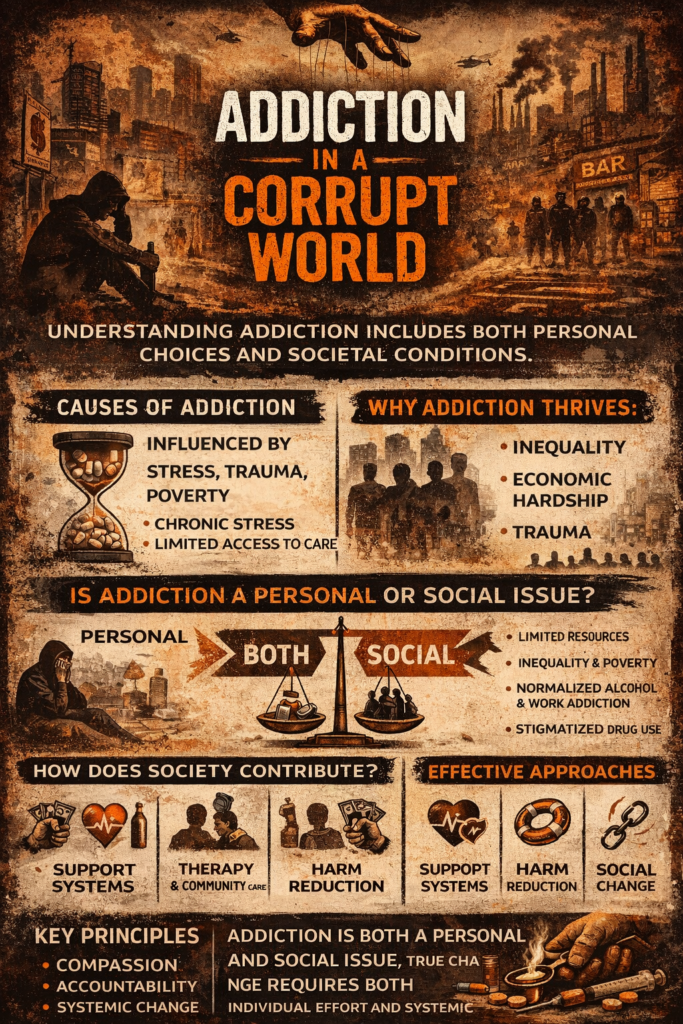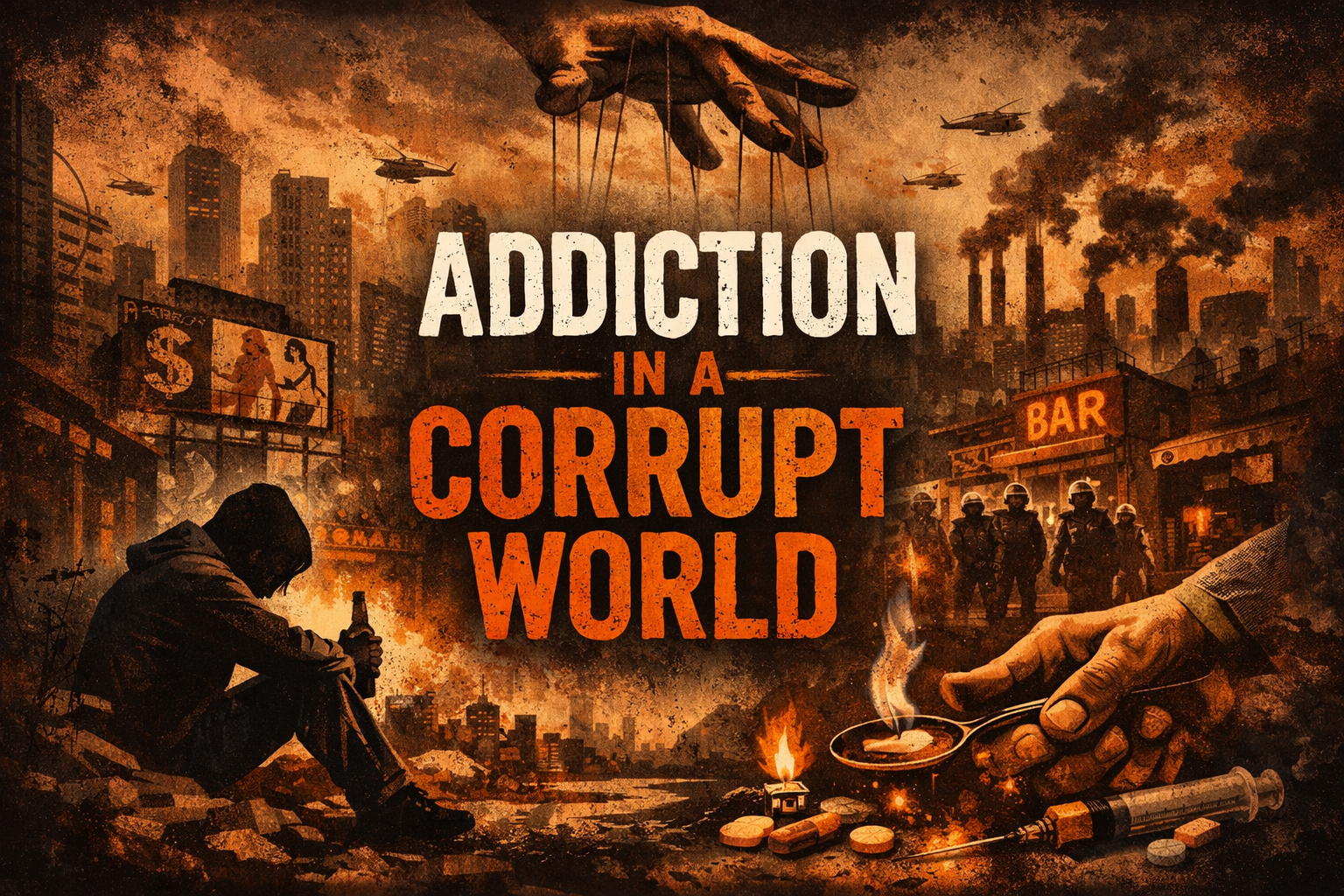
Addiction is frequently viewed as a personal failing—something rooted in poor decision-making, lack of willpower, or moral weakness. However, this limited perspective ignores the larger social environment in which addiction takes shape. In a world marked by inequality, ongoing stress, and unstable systems, addiction can develop as a way of coping with difficult and overwhelming conditions. Rather than occurring in isolation, addictive behaviors are closely tied to factors such as financial hardship, trauma, and social disconnection. To fully understand addiction in a “corrupt” world, it is necessary to move beyond individual blame and adopt a broader perspective that acknowledges both personal responsibility and the impact of structural forces.
The Ethics of Escape: Addiction in a Corrupt World
Addiction is commonly framed as a personal failure—a lack of discipline or moral weakness. However, this perspective overlooks the broader context in which addiction develops. In many cases, addiction is not just an individual issue, but a response to living in a flawed or “corrupt” environment.
- Addiction reflects both personal behavior and social conditions
- Recovery must address individual responsibility and systemic influences
The Paradox of Modern Society
Modern society promotes ideals such as success, happiness, and productivity, yet simultaneously creates conditions that undermine them. Economic instability, social inequality, and emotional disconnection are widespread, creating a contradiction between what people are told to achieve and what they actually experience.
- Society encourages:
- Achievement
- Fulfillment
- But produces:
- Stress
- Inequality
- Isolation
- This tension increases vulnerability to addiction
Addiction as a Form of Escape
In this context, addiction can function as a coping mechanism rather than simply reckless behavior. For many, substances or compulsive habits provide temporary relief from emotional pain, trauma, or overwhelming stress.
- Addiction may serve as:
- Emotional relief
- Psychological escape
- Often driven by:
- Trauma
- Anxiety
- Chronic stress
- It is less about pleasure and more about avoiding distress
Consequences and Reality
While addiction may begin as a form of coping, its consequences are serious and often destructive. It can lead to long-term harm that affects both the individual and those around them.
- Negative outcomes include:
- Physical and mental health decline
- Damaged relationships
- Loss of control
- Understanding addiction does not excuse its impact
Responsibility: Individual vs. Society
The question of responsibility becomes complex when addiction is viewed through a broader lens. While individuals make choices, those choices are shaped by environment, opportunity, and lived experiences.
- Traditional view:
- Addiction = personal failure
- Expanded view:
- Addiction influenced by:
- Environment
- Trauma
- Social inequality
- Addiction influenced by:
- Raises ethical questions about shared responsibility
Society’s Contradictory Attitudes
Society does not treat all addictions equally. Some forms are normalized or even encouraged, while others are heavily stigmatized and criminalized.
- Normalized addictions:
- Alcohol use
- Workaholism
- Stigmatized addictions:
- Illicit drug use
- These differences reflect:
- Cultural norms
- Economic interests
- Power dynamics
The Role of Stigma
Stigma plays a significant role in sustaining addiction. It discourages individuals from seeking help and reinforces cycles of shame and isolation.
- Effects of stigma:
- Increased shame
- Social withdrawal
- Barriers to treatment
- Ultimately, stigma worsens rather than solves the problem
Rethinking Recovery
Recovery should not be viewed as solely an individual burden. A more effective approach considers both personal effort and systemic change.
- Key components of recovery:
- Mental health care
- Social support
- Community connection
- Broader needs:
- Reducing inequality
- Addressing trauma
- Expanding access to resources
Broader Implications
Addiction serves as a reflection of deeper societal issues. It highlights how environments can shape behavior and coping mechanisms.
- Addiction reveals:
- Disconnection
- Lack of support systems
- Structural inequality
- It is both a personal struggle and a social symptom
Conclusion
Addiction in a corrupt world challenges the belief that individuals alone are responsible for their suffering. While personal accountability remains important, it must be understood within a broader social and structural context. The reality is that addiction is shaped not only by individual choices but also by environments marked by inequality, stress, and disconnection. Addressing addiction, therefore, requires transforming the harmful conditions that contribute to it. The issue lies in both the individual seeking escape and the world that makes that escape appealing. True recovery depends on supporting individuals through compassion, resources, and treatment, while also working toward systemic change that creates healthier, more supportive environments for all.
Managing the Self in a Broken System: Strategies for Understanding Addiction in a Corrupt World
Understanding addiction requires more than focusing on treatment—it demands attention to how individuals manage themselves daily within environments that often contribute to stress, instability, and disconnection. Self-management is not simply about discipline; it is about navigating a system that can actively challenge recovery.
- Addiction is shaped by both internal struggles and external conditions
- Self-management is a continuous process, not a one-time solution
- Recovery involves adapting to environments that may not support well-being
What Is Self-Management in Addiction?
Self-management refers to the ability to regulate thoughts, emotions, and behaviors in response to triggers. In a corrupt or unstable world, this becomes more complex because stressors are constant rather than occasional.
- Includes managing:
- Emotional responses
- Behavioral impulses
- Thought patterns
- Functions as a form of resilience under pressure
- Requires awareness of both personal patterns and environmental influences
Strategy 1: Recognizing Triggers
A key part of self-management is identifying what drives the urge to use substances or engage in harmful behaviors. These triggers can be external or internal and are often intensified by social conditions.
- External triggers:
- People, places, environments
- Internal triggers:
- Stress, shame, anxiety, boredom
- Social factors (e.g., inequality, trauma) can amplify these triggers
- Awareness allows for anticipation instead of reaction
Strategy 2: Developing Alternative Coping Mechanisms
Since addiction often functions as a form of escape, recovery requires replacing harmful coping strategies with healthier ones that still address underlying stress.
- Examples include:
- Exercise and physical activity
- Creative expression
- Mindfulness or relaxation techniques
- Structured daily routines
- These tools help:
- Restore control and agency
- Reduce reliance on substances
- Limitation:
- Access to these resources is not equal for everyone
Strategy 3: Building Support Systems
Recovery is difficult in isolation. Social connection plays a critical role in maintaining progress and reducing the risk of relapse.
- Benefits of support:
- Accountability
- Emotional stability
- Encouragement during setbacks
- Sources of support:
- Peer groups
- Community networks
- Trusted individuals
- Challenge:
- Disconnection in modern society can make support harder to find
Strategy 4: Reframing Relapse
Relapse is often misunderstood as a failure, but it can be viewed more productively as part of the recovery process.
- Relapse can indicate:
- Unmet needs
- Ineffective coping strategies
- Reframing helps:
- Reduce shame
- Encourage learning and adjustment
- Supports a long-term, adaptive approach to recovery
Limits of Self-Management
While self-management is essential, it cannot fully address addiction without considering broader systemic issues. Placing all responsibility on the individual ignores the conditions that contribute to addiction.
- Self-management alone is insufficient
- Structural issues include:
- Poverty
- Trauma
- Lack of access to care
- Recovery requires both:
- Personal effort
- Social and systemic change
Broader Understanding
Self-management in addiction highlights the tension between individual responsibility and environmental influence. It reflects the need to balance personal strategies with awareness of larger societal forces.
- Addiction is both:
- A personal challenge
- A socially influenced condition
- Effective understanding requires:
- Compassion
- Contextual awareness
Conclusion
Managing addiction in a corrupt world is an act of persistence and adaptation. Individuals are often required to develop coping strategies in environments that may not fully support recovery, while also recognizing that self-reliance has its limits. Addiction is shaped not only by personal behavior but by broader systems that influence stress, access to resources, and overall well-being. In this context, self-management becomes both a form of survival and a form of resistance against conditions that make recovery more difficult. However, true recovery goes beyond individual effort—it requires strengthening personal coping strategies while also addressing the larger systems that contribute to addiction.
Holding the Line: Family Support Strategies in Understanding Addiction in a Corrupt World
Addiction does not occur in isolation—it affects and is affected by family systems. In a world marked by instability, inequality, and disconnection, families often become the first line of support. However, supporting a loved one through addiction requires more than care; it demands understanding, boundaries, and adaptability within challenging social conditions.
- Addiction impacts both the individual and the family unit
- Families play a critical role in support and recovery
- Effective support must balance compassion with structure
Understanding Addiction in Context
To support effectively, families must first understand addiction beyond the idea of moral failure. In a “corrupt” or stressful environment, addiction can develop as a coping response to deeper issues.
- Addiction may be influenced by:
- Trauma
- Stress
- Social and economic instability
- Shifting perspective from blame → understanding improves support
- Recognizing context helps reduce conflict and misunderstanding
Strategy 1: Educating the Family
Knowledge is one of the most important tools families can have. Understanding how addiction works allows for more informed and effective responses.
- Learn about:
- The nature of addiction (psychological and physical aspects)
- Triggers and relapse patterns
- Benefits:
- Reduces stigma and judgment
- Encourages empathy
- Improves communication
Strategy 2: Practicing Support Without Enabling
Families often struggle to balance helping their loved one while not reinforcing harmful behaviors. Support should empower recovery, not sustain addiction.
- Support includes:
- Emotional encouragement
- Being present and consistent
- Avoid enabling behaviors such as:
- Covering up consequences
- Providing financial support that fuels addiction
- Goal:
- Promote accountability alongside care
Strategy 3: Establishing Healthy Boundaries
Boundaries are essential for both the individual in recovery and the family’s well-being. Without them, families risk burnout and emotional harm.
- Boundaries may include:
- Clear expectations for behavior
- Limits on financial or emotional support
- Benefits:
- Protects family members
- Reinforces responsibility in the individual
- Boundaries are not punishment—they are protection and structure
Strategy 4: Encouraging Professional and Community Support
Families cannot manage addiction alone. External support systems are critical for long-term recovery.
- Encourage:
- Therapy or counseling
- Support groups (for both the individual and family)
- Community resources provide:
- Guidance
- Shared experiences
- Reduced isolation
- Recognizing limits of family support prevents over-reliance
Strategy 5: Improving Communication
Open, honest, and non-judgmental communication strengthens trust and reduces conflict.
- Effective communication includes:
- Active listening
- Expressing concern without blame
- Avoiding shame-based language
- Creates:
- Safer emotional environment
- Greater willingness to seek help
Strategy 6: Supporting Without Losing Self
Families often prioritize the individual struggling with addiction at the expense of their own well-being. Sustainable support requires self-care.
- Family members should:
- Maintain their own mental health
- Seek support for themselves
- Prevents:
- Burnout
- Resentment
- Reinforces that recovery is a shared but not singular burden
Challenges in a “Corrupt” World
Supporting someone with addiction is more difficult in environments with limited resources and high stress.
- Barriers may include:
- Lack of access to treatment
- Financial strain
- Social stigma
- These conditions can:
- Intensify family stress
- Limit available options for help
Broader Understanding
Family support highlights the intersection between personal relationships and larger societal forces. It shows that addiction is not just an individual issue but one shaped by context.
- Addiction reflects:
- Personal struggle
- Social and environmental pressures
- Families act as:
- Support systems
- Stabilizing forces within unstable conditions
Conclusion
In a corrupt or challenging world, family support becomes both essential and complex, requiring a careful balance between empathy and accountability as you navigate systems that may not provide adequate resources. Effective family support involves education, clear boundaries, open communication, and the use of external resources to ensure that care is both compassionate and structured. At the same time, recovery is not solely the responsibility of the individual or the family—it is a collective effort that involves both family and society working together to create supportive environments. Ultimately, recovery is a deeply personal journey, but it is strengthened when individuals are supported by informed, connected, and resilient systems of care.
Beyond the Individual: Community Resource Strategies for Addiction in a Corrupt World
Addiction cannot be fully understood or addressed at the individual level alone. In a world shaped by inequality, limited access to care, and social fragmentation, community resources become essential to both prevention and recovery. These resources act as a bridge between personal struggle and systemic support.
- Addiction is influenced by social and environmental conditions
- Community resources provide structure, access, and connection
- Recovery is strengthened through collective support systems
Understanding Community Resources
Community resources include services, organizations, and informal networks that support individuals struggling with addiction. In unstable or “corrupt” systems, these resources often compensate for gaps in healthcare and social support.
- Examples of resources:
- Treatment centers and clinics
- Peer support groups
- Nonprofit organizations
- Outreach and harm reduction programs
- They provide:
- Access to care
- Education
- Social connection
Strategy 1: Expanding Access to Care
One of the most critical roles of community resources is making treatment available to those who might otherwise be excluded.
- Focus areas:
- Affordable or free treatment services
- Mobile clinics and outreach programs
- Transportation and accessibility support
- Importance:
- Reduces barriers related to cost, location, and availability
- Especially vital in underserved or marginalized communities
Strategy 2: Harm Reduction Approaches
Not all individuals are ready or able to stop using substances immediately. Harm reduction focuses on minimizing the negative consequences of addiction while supporting long-term recovery.
- Examples include:
- Safe use education
- Needle exchange programs
- Overdose prevention resources
- Benefits:
- Reduces immediate health risks
- Builds trust between individuals and support systems
- Recognizes recovery as a gradual process
Strategy 3: Building Peer Support Networks
Peer support connects individuals with others who have lived experience with addiction, creating a sense of understanding and belonging.
- Forms of peer support:
- Group meetings
- Mentorship or sponsorship programs
- Benefits:
- Reduces isolation
- Provides shared insight and encouragement
- Strengthens community-based accountability
Strategy 4: Community Education and Awareness
Education helps reshape how addiction is understood within a community, reducing stigma and encouraging earlier intervention.
- Focus areas:
- Understanding addiction as a health issue
- Recognizing warning signs
- Promoting available resources
- Outcomes:
- Increased empathy
- Greater willingness to seek help
- Stronger community engagement
Strategy 5: Integrating Social Services
Addiction is often linked to broader social challenges such as housing instability, unemployment, and mental health issues. Community strategies must address these interconnected needs.
- Integrated support may include:
- Housing assistance
- Job training programs
- Mental health services
- Holistic approach:
- Treats the root causes, not just symptoms
- Improves long-term recovery outcomes
Challenges in a “Corrupt” World
Community resources often operate within systems that are underfunded, inconsistent, or inequitable. These limitations can reduce their effectiveness.
- Common challenges:
- Limited funding and staffing
- Unequal distribution of services
- Bureaucratic barriers
- Result:
- Gaps in care and support
- Increased strain on communities
Broader Understanding
Community resource strategies highlight the importance of collective responsibility in addressing addiction. They show that recovery is not just a personal effort but a shared social process.
- Addiction reflects:
- Individual struggle
- Structural inequality
- Community resources act as:
- Support networks
- Stabilizing systems within unstable environments
Conclusion
In a corrupt or imperfect world, community resources play a vital role in supporting individuals affected by addiction, offering access, connection, and hope where larger systems may fall short. These resources not only provide essential services such as treatment, education, and support networks, but also help reduce isolation and stigma within communities. However, their impact depends on accessibility, inclusivity, and sustained support. True progress requires strengthening these community systems while addressing the broader conditions that contribute to addiction. Ultimately, recovery is most effective when individuals are supported not just by personal effort but by communities committed to care, equity, and collective well-being.
Frequently Asked Questions
Here are some common questions:
1. What does “Addiction in a Corrupt World” mean?
It refers to understanding addiction not just as an individual issue, but as something influenced by social, economic, and cultural systems. A “corrupt world” includes environments shaped by inequality, stress, and limited access to resources, which can increase vulnerability to addiction.
2. Is addiction a personal choice or a social issue?
Addiction involves both personal choice and social influence. While individuals make decisions, those decisions are shaped by:
- Environment
- Trauma
- Economic conditions
- Social support systems
A balanced view recognizes shared responsibility between the individual and society.
3. Why do people turn to addiction in stressful environments?
People often use substances or behaviors to:
- Cope with emotional pain
- Escape stress or instability
- Manage trauma or mental health struggles
In high-stress or unequal environments, addiction can feel like a temporary form of relief or survival.
4. Does understanding addiction mean excusing it?
No. Understanding addiction provides context, not justification.
- It helps explain why addiction happens
- But it does not remove responsibility for harmful consequences
The goal is compassion + accountability, not blame alone.
5. How does society contribute to addiction?
Society contributes through:
- Economic inequality
- Lack of mental health resources
- Cultural normalization of certain addictions (e.g., alcohol)
- Stigma toward others (e.g., drug use)
These factors can both encourage and worsen addiction cycles.
6. Why are some addictions accepted while others are stigmatized?
This is often due to:
- Cultural norms
- Economic interests
- Legal status
For example:
- Alcohol and work addiction are often normalized
- Drug addiction is more heavily stigmatized
This reflects bias, not consistent moral standards.
7. What role does stigma play in addiction?
Stigma can:
- Prevent people from seeking help
- Increase feelings of shame and isolation
- Reinforce addictive behavior
Reducing stigma is essential for effective recovery and support.
8. Can people recover in a “corrupt” or unstable environment?
Yes, but it is more challenging. Recovery in such environments requires:
- Strong self-management strategies
- Support systems (family, peers, community)
- Access to resources
It often involves resilience and adaptation, not just treatment.
9. What are the most effective ways to address addiction?
A comprehensive approach includes:
- Therapy and/or medication
- Social and community support
- Harm reduction strategies
- Addressing systemic issues (poverty, trauma, access to care)
No single solution works for everyone.
10. What is the role of the community in recovery?
Communities provide:
- Support networks
- Access to resources
- Reduced isolation
They help shift recovery from an individual burden to a shared responsibility.
11. How can families support someone with addiction?
Families can:
- Offer emotional support
- Set healthy boundaries
- Avoid enabling harmful behaviors
- Encourage professional help
Support must balance care with accountability.
12. Why is self-management important in recovery?
Self-management helps individuals:
- Recognize triggers
- Control impulses
- Develop healthier coping strategies
It is essential for long-term stability, especially when external support is limited.
13. What are harm reduction strategies?
Harm reduction focuses on reducing risks, not just eliminating substance use immediately.
Examples include:
- Safe-use education
- Overdose prevention
- Needle exchange programs
It recognizes recovery as a gradual process.
14. What ethical questions does addiction raise?
Addiction raises questions such as:
- Who is responsible—the individual or society?
- Is addiction a moral failure or a response to suffering?
- What obligations does society have to support recovery?
These questions challenge simple, blame-based views.
15. What is the main takeaway about addiction in a corrupt world?
Addiction is both:
- A personal struggle
- A socially influenced condition
Effective understanding and recovery require:
- Compassion
- Context
- Systemic awareness
Conclusion
Ultimately, addiction in a corrupt world challenges the idea that individuals alone are responsible for their struggles. While personal accountability remains an important part of recovery, it cannot be separated from the conditions that shape behavior and limit opportunity. Addressing addiction effectively requires not only supporting individuals through treatment and self-management but also confronting the societal factors that contribute to despair and disconnection. By recognizing addiction as both a personal and social issue, we can move toward more compassionate, comprehensive approaches to recovery—ones that seek not only to change individuals, but to improve the world in which they live.
Video: