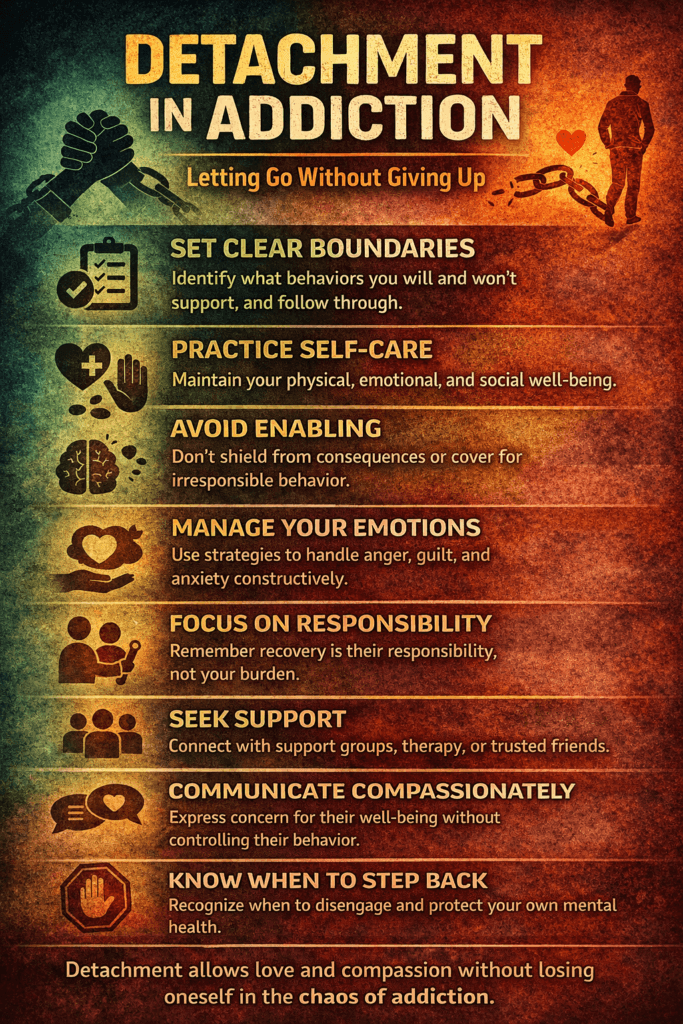
Detachment in addiction is a structured and intentional shift away from controlling another person’s substance use and toward managing one’s own responses, boundaries, and well-being. In families and recovery environments, addiction often creates cycles of crisis, rescue, guilt, and relapse. Loved ones may feel compelled to monitor behavior, prevent consequences, or fix situations to reduce immediate harm. While rooted in care, this overinvolvement can unintentionally reinforce dependence and delay accountability. Healthy detachment is not emotional withdrawal or abandonment; rather, it is the practice of maintaining compassion while allowing individuals to experience the natural outcomes of their choices. By separating love from control, detachment restores balance and clarity in relationships affected by substance use disorders.
Detachment in Addiction: Letting Go Without Giving Up
Detachment in addiction is often misunderstood as emotional withdrawal or abandonment. In reality, healthy detachment is a structured coping strategy that allows individuals and families to stop being consumed by another person’s substance use while still maintaining compassion. In addiction medicine, detachment protects emotional stability, prevents enabling, and restores personal responsibility. It is not about indifference—it is about separating love from control.
What Detachment Means
Detachment involves recognizing that you cannot control another person’s substance use, decisions, or recovery timeline. Attempts to monitor, rescue, argue, or shame often intensify conflict and reinforce dysfunctional cycles. Detachment shifts the focus from managing the addicted individual to managing one’s own responses, boundaries, and well-being.
For families, this may mean refusing to provide money, declining to lie to employers, or allowing natural consequences to occur. For individuals in recovery, detachment can involve distancing from triggering environments, high-risk peers, or emotionally volatile relationships that threaten sobriety.
The Difference Between Detachment and Abandonment
Abandonment implies rejection or emotional coldness. Healthy detachment, by contrast, maintains care while reducing overinvolvement. Statements such as, “I love you, but I won’t support behavior that harms you or our family,” communicate both compassion and boundaries. This balance is central in family systems therapy and peer-support models such as Al-Anon.
Why Detachment Is Necessary
Addiction often creates cycles of crisis, guilt, rescue, and relapse. Family members may become hyper-focused on preventing harm, inadvertently enabling substance use. Chronic stress from these cycles can lead to anxiety, depression, and burnout. Detachment interrupts this pattern by restoring clarity and reducing emotional reactivity.
From a clinical perspective, detachment supports accountability. Recovery requires ownership. When consequences are consistently shielded, motivation for change diminishes.
Practical Strategies for Healthy Detachment
- Establish clear, written boundaries and follow through consistently.
- Avoid arguing when intoxicated or during emotional escalation.
- Focus conversations on behavior and choices rather than character.
- Seek support through counseling, peer groups, or faith communities.
- Practice self-care routines that restore emotional balance.
Detachment also includes recognizing when professional intervention—such as structured treatment programs, medication-assisted treatment, or family therapy—is necessary.
Emotional Challenges of Detachment
Letting go of control can produce guilt, fear, or sadness. Families may worry that stepping back will worsen outcomes. However, long-term recovery often requires individuals to experience the results of their choices. Support remains available—but it is structured and conditional on safety and accountability.
Conclusion
Detachment in addiction is not about giving up hope; it is about giving up control. By shifting attention toward personal boundaries, emotional regulation, and structured support, families and individuals reduce chaos and promote accountability. Healthy detachment creates space for recovery to emerge—not through force, but through responsibility and clarity.
Self-Management Strategies for Practicing Detachment in Addiction
Detachment in addiction is not emotional coldness—it is disciplined self-management. Whether you are a family member supporting someone with substance use disorder or an individual in recovery distancing yourself from triggers, detachment protects emotional stability and prevents enabling cycles. In clinical practice, especially within opioid and stimulant use disorders, overinvolvement and emotional reactivity often intensify relapse patterns. Self-management strategies create structure, preserve mental health, and reinforce accountability without abandoning compassion.
1. Clarify What You Can and Cannot Control
A core principle of detachment is recognizing personal limits. You cannot control another person’s cravings, choices, or recovery timeline. You can control your responses, boundaries, and environment. Writing a simple “control inventory” can help: list what is within your responsibility (communication style, financial decisions, emotional regulation) and what is not (someone else’s sobriety).
2. Strengthen Emotional Regulation
Addiction-related conflict often triggers anxiety, anger, or fear. Techniques such as diaphragmatic breathing, grounding exercises, journaling, and cognitive reframing reduce impulsive reactions. Pausing before responding to manipulation or crisis prevents escalation. Emotional steadiness supports clearer boundary enforcement.
3. Establish and Maintain Boundaries
Healthy detachment requires defined limits. This may include refusing to provide money, declining to engage during intoxication, or setting structured visitation rules. Boundaries should be specific, calmly communicated, and consistently enforced. Inconsistent boundaries undermine detachment and reinforce dysfunctional cycles.
4. Avoid Rescue Behaviors
Rescuing—covering consequences, making excuses, or absorbing responsibilities—temporarily reduces discomfort but prolongs addiction patterns. Self-management involves tolerating the discomfort of allowing natural consequences while maintaining compassion.
5. Develop Personal Support Systems
Peer groups, such as family recovery programs, therapy, pastoral counseling, or trusted mentors, provide emotional support. Detachment is difficult without validation and guidance. Professional support also helps differentiate between supportive involvement and enabling.
6. Prioritize Self-Care and Identity
Chronic focus on someone else’s addiction can erode personal identity. Structured routines, exercise, hobbies, spiritual practices, and professional goals restore balance. Protecting your well-being strengthens resilience and reduces burnout.
7. Practice Compassion Without Overidentification
Detachment does not mean indifference. It means caring without absorbing responsibility. Statements like, “I care about you and hope you seek treatment, but I cannot manage your recovery for you,” reflect balanced compassion.
Clinical Perspective
From a behavioral health standpoint, detachment supports motivational processes. Individuals are more likely to pursue treatment when external control decreases and personal accountability increases. Self-managed detachment creates a stable environment in which recovery decisions are internally driven rather than externally imposed.
Conclusion
Self-management strategies for detachment in addiction shift the focus from controlling others to stabilizing oneself. By clarifying control, regulating emotions, setting boundaries, resisting rescue behaviors, and strengthening support systems, individuals protect their mental health while promoting accountability. Detachment is not surrender—it is structured strength.
Family Support Strategies for Practicing Detachment in Addiction
Detachment in addiction is one of the most difficult but necessary skills for families to learn. When a loved one struggles with substance use, family members often feel responsible for preventing relapse, fixing crises, or shielding them from consequences. While these responses are rooted in love, they can unintentionally reinforce addiction cycles. Healthy family detachment does not mean withdrawal or abandonment. It means creating structure, fostering accountability, and maintaining emotional stability while remaining compassionate.
In clinical addiction care—particularly in opioid and stimulant use disorders—family systems often become organized around crisis management. Detachment shifts the family from a reactive survival mode to a structured support mode.
1. Develop a Unified Family Plan
Families benefit from meeting together to clarify expectations and limits. Mixed messages undermine detachment. A unified plan may include agreements such as not providing financial support for substance use, not lying to employers or the legal system, and treatment engagement as a condition for certain privileges. Consistency is critical; inconsistency reinforces manipulation and denial.
2. Establish Clear, Written Boundaries
Boundaries should be specific and calmly communicated. For example:
“We will not provide money.”
“We will not engage in conversation during intoxication.”
“We will help schedule treatment appointments if you request help.”
Written agreements reduce emotional escalation and confusion during high-stress moments.
3. Avoid Enabling Behaviors
Enabling includes covering up consequences, paying debts repeatedly, or absorbing responsibilities that belong to the individual with addiction. Families practicing detachment allow natural consequences to occur while remaining emotionally supportive. Accountability is not punishment—it is a prerequisite for recovery.
4. Maintain Compassionate Communication
Detachment is not hostility. Families can express concern without controlling behavior. Using statements such as, “We love you and want you safe, but we cannot manage your recovery,” reinforces both care and limits. Avoiding lectures, shaming, or heated arguments during crises improves long-term engagement.
5. Protect Vulnerable Family Members
Children and emotionally sensitive relatives require protection from chaotic or volatile interactions. Structured supervision, therapy, and clear safety plans ensure that detachment does not expose others to harm.
6. Utilize External Support Systems
Family therapy, peer support groups such as Al-Anon, faith-based counseling, and community behavioral health services provide education and emotional support. Families often need guidance to differentiate healthy detachment from emotional withdrawal.
7. Prioritize Family Self-Care
Chronic stress from addiction can lead to anxiety, depression, and burnout among family members. Scheduling personal time, engaging in hobbies, maintaining focus at work, and strengthening social networks rebuild resilience and prevent codependency.
Clinical Perspective
Addiction disrupts family homeostasis. Without detachment, families may inadvertently stabilize the addiction rather than the recovery. When families shift toward structured support and consistent boundaries, individuals are more likely to recognize personal responsibility and pursue treatment.
Conclusion
Family detachment in addiction is not about giving up on a loved one—it is about giving up control. Through unified planning, clear boundaries, avoidance of enabling, compassionate communication, and external support, families create a stable environment where accountability and recovery can emerge. Healthy detachment strengthens the family system while preserving dignity, safety, and hope.
Community Resource Strategies for Supporting Detachment in Addiction
Detachment in addiction is not solely an individual or family skill—it is strengthened by community systems that reinforce accountability, safety, and structured support. When communities provide clear pathways to treatment, peer education, and protective policies, they reduce the pressure on families to manage addiction alone. Community resource strategies create an environment where compassion coexists with responsibility, allowing detachment to function as a healthy boundary rather than abandonment.
In addiction care settings—particularly in opioid use disorder (OUD), stimulant use disorder, and alcohol use disorder—community infrastructure plays a central role in breaking cycles of crisis and overinvolvement.
1. Expand Access to Evidence-Based Treatment
Accessible outpatient programs, medication-assisted treatment (MAT), counseling services, and crisis stabilization centers provide structured alternatives to family rescue behaviors. When treatment is readily available, families can redirect loved ones toward professional care instead of attempting to manage withdrawal, relapse, or psychiatric instability at home.
2. Promote Peer-Support Networks
Community-based peer programs, such as family recovery groups and recovery community organizations, educate families about principles of detachment. These groups normalize boundary-setting, reduce guilt, and offer practical strategies to avoid enabling patterns. Peer validation strengthens consistency in applying detachment.
3. Implement Workplace and School Policies
Clear policies regarding substance use, safety, and performance standards reinforce accountability. When institutions maintain structured expectations, families are less likely to feel pressured to cover up behaviors or absorb consequences. Transparent reporting systems protect both individuals and organizations.
4. Offer Family Education Programs
Community health centers and faith-based organizations can provide workshops on addiction neuroscience, trauma-informed care, and boundary-setting. Education reduces stigma and equips families with tools to practice structured detachment rather than emotional withdrawal.
5. Develop Crisis Response and Referral Pathways
Crisis hotlines, mobile response teams, and coordinated referral systems help families step back during emergencies while ensuring safety. Instead of reacting impulsively, families can contact professionals trained to manage intoxication, overdose risk, or psychiatric crises.
6. Encourage Restorative and Accountability-Based Approaches
Drug courts, diversion programs, and recovery-oriented probation models combine accountability with treatment access. These systems reinforce the principle that consequences and support can coexist—mirroring healthy detachment at a societal level.
7. Reduce Stigma Through Public Education
Communities that understand addiction as a chronic but treatable condition are more likely to support structured boundaries. Public health campaigns emphasizing recovery, accountability, and access to care reduce shame and promote treatment engagement.
Behavioral Health Perspective
Detachment is most effective when supported by systems that promote autonomy and responsibility. When communities provide accessible treatment, consistent standards, and professional crisis intervention, families can disengage from control-based responses without abandoning hope.
Conclusion
Community resource strategies transform detachment from an isolated family decision into a reinforced public health approach. By expanding treatment access, strengthening peer support, implementing clear policies, and coordinating crisis services, communities create conditions in which accountability and compassion work together. In this environment, detachment becomes a structured pathway toward recovery—not a withdrawal of care, but a redirection toward responsibility and healing.
Frequently Asked Questions
Here are some common questions:
1. What does detachment in addiction mean?
Detachment is the practice of separating love and concern from control and overinvolvement. It means recognizing that you cannot manage another person’s substance use, but you can manage your own boundaries, responses, and well-being.
2. Is detachment the same as giving up on someone?
No. Detachment is not abandonment or emotional coldness. It allows you to care about someone without enabling harmful behaviors. It is structured compassion with boundaries.
3. Why is detachment important in addiction recovery?
Addiction often creates cycles of crisis, rescue, guilt, and relapse. When families repeatedly shield individuals from consequences, motivation for change may decrease. Detachment restores accountability and reduces emotional chaos within the family system.
4. What is the difference between detachment and enabling?
Enabling involves protecting someone from the natural consequences of their substance use, such as paying debts, covering up behavior, or repeatedly rescuing them from crises. Detachment allows consequences to occur while maintaining emotional support and encouragement toward treatment.
5. How do I practice detachment without feeling guilty?
Guilt is common because stepping back can feel counterintuitive. Education about addiction as a chronic condition, participation in peer-support groups, and counseling can reinforce that boundaries promote responsibility rather than harm.
6. Can detachment improve recovery outcomes?
Detachment does not guarantee sobriety, but it can improve conditions that support recovery. When individuals face consistent boundaries and clear consequences, intrinsic motivation for treatment engagement often increases.
7. How do I communicate detachment to a loved one?
Use calm, clear statements such as: “I care about you, but I cannot manage your recovery for you,” or “I will support treatment efforts, but I won’t support substance use.” Avoid arguing when intoxicated or during emotional escalation.
8. When is professional help necessary?
Professional support is recommended when there are safety concerns, co-occurring mental health conditions, repeated relapse crises, legal involvement, or significant emotional distress among family members.
9. Can someone in recovery practice detachment?
Yes. Individuals in recovery may need to detach from high-risk peers, toxic environments, or emotionally triggering relationships to protect sobriety. Detachment can strengthen relapse prevention planning.
10. What role do community resources play in detachment?
Community resources such as outpatient treatment programs, medication-assisted treatment, family therapy, and peer-support groups reinforce structured accountability. They provide families with alternatives to crisis-based management.
Conclusion
Detachment in addiction represents strength, not surrender. It requires emotional discipline, consistent boundaries, and the willingness to tolerate discomfort in the service of long-term health. When individuals and families step back from control-based responses and focus on personal responsibility, addiction dynamics shift. Accountability becomes clearer, enabling patterns diminish, and recovery motivation has space to develop. While detachment does not guarantee sobriety, it protects mental health, reduces chaos, and creates a stable environment where healing is more likely to occur. In this way, detachment is not giving up on someone—it is redefining support to promote dignity, responsibility, and sustainable recovery.
Video: How Detachment Heals Your Whole Family #FamilyRecovery #HealthyBoundaries