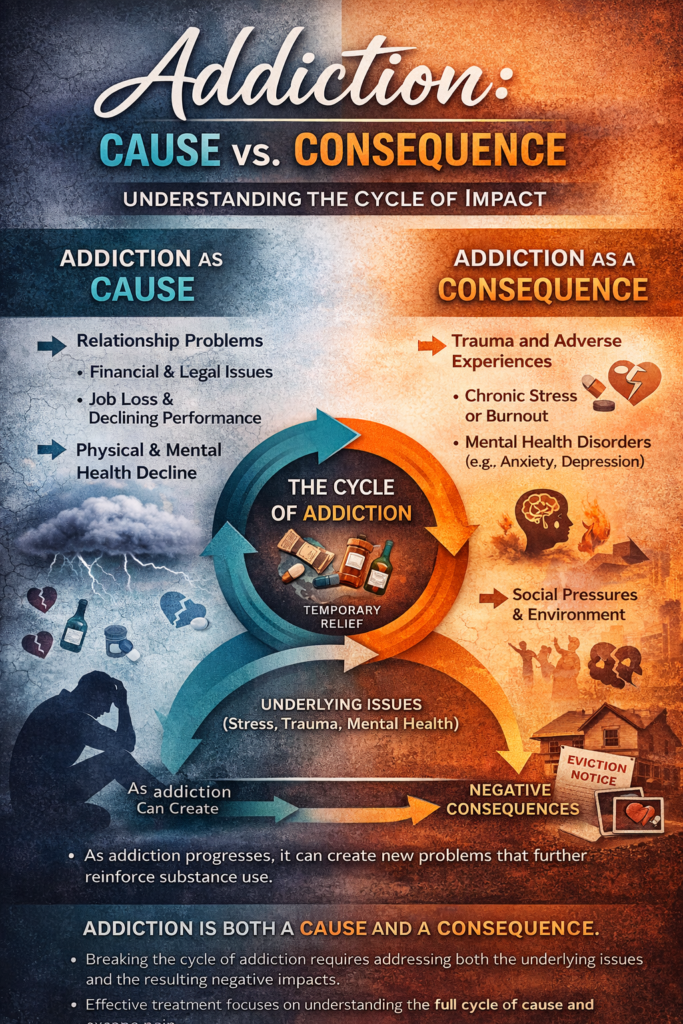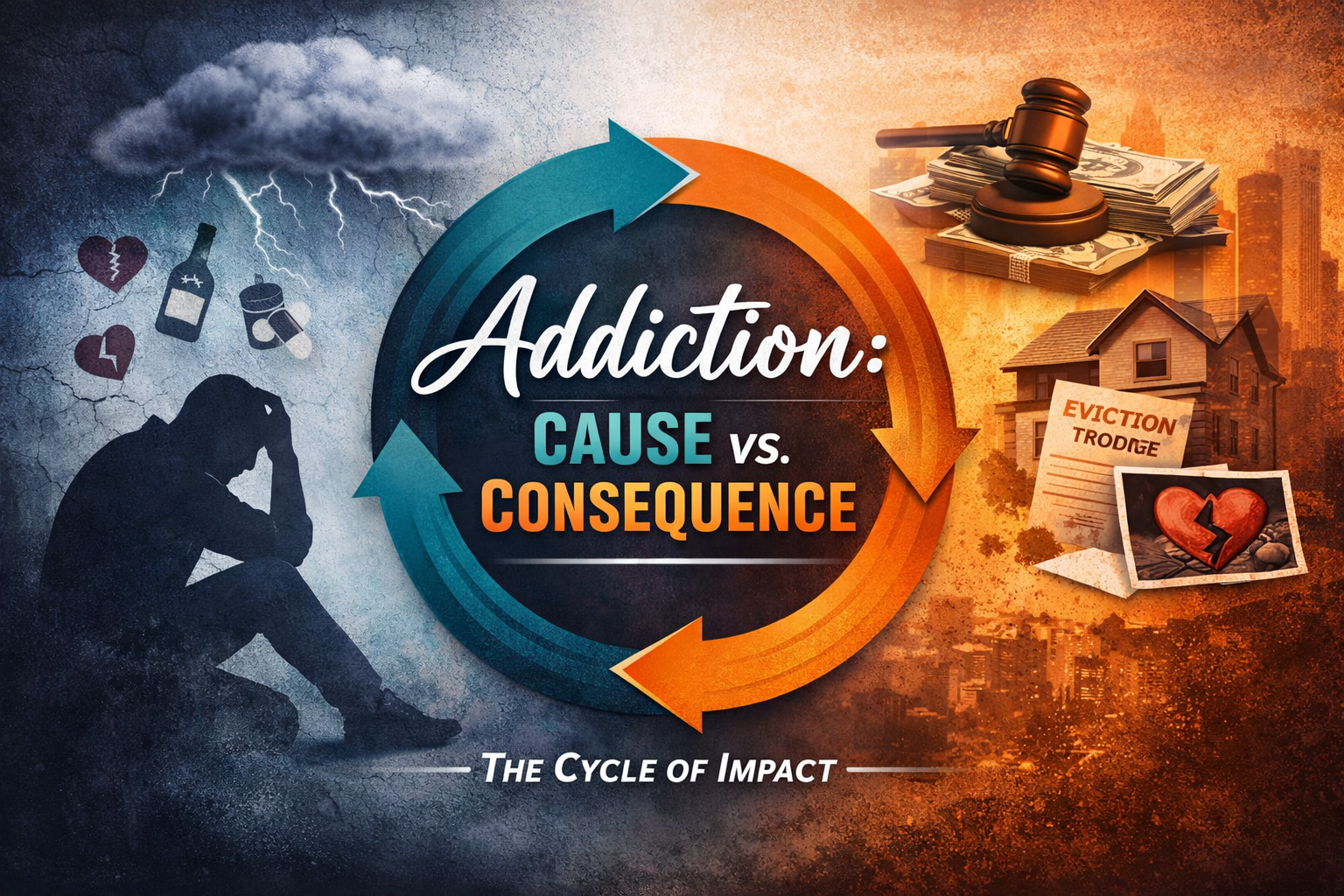
Addiction is frequently discussed in terms of whether it is the root cause of personal and societal issues or a result of them. This debate highlights the complexity of addiction, which seldom has a clear starting point or outcome. For many people, substance use begins as a way to cope with underlying problems like trauma, mental health issues, or external stressors. However, over time, addiction itself can lead to additional difficulties, such as damaged relationships, financial strain, and deteriorating health. Viewing addiction as both a cause and a consequence offers a more holistic understanding, enabling more effective treatment, support, and long-term recovery strategies.
Cause or Consequence? Understanding the Cycle of Addiction
One of the most debated questions in addiction is whether it is the cause of life problems or the consequence of them. Often described as a “chicken or the egg” dilemma, addiction exists within a complex web of biological, psychological, and social factors. Some individuals turn to substances as a way to cope with trauma, stress, or mental health issues, while others experience significant life disruptions as a result of their substance use. Understanding addiction as both a cause and a consequence is essential for developing effective treatment approaches and breaking the cycle.
Addiction as a Consequence
For many individuals, addiction begins as a response to underlying challenges. These may include:
- Mental health conditions such as anxiety, depression, or PTSD
- Trauma or adverse life experiences
- Chronic stress or environmental pressures
- Social influences, including peer pressure or family dynamics
In these cases, substance use can initially serve as a coping mechanism—a way to numb pain or escape difficult emotions. However, what begins as temporary relief can evolve into dependency over time.
Addiction as a Cause
Once addiction develops, it often becomes a driving force behind further problems, such as:
- Relationship breakdowns
- Financial instability
- Legal issues
- Declining physical and mental health
At this stage, addiction is no longer just a response—it actively contributes to worsening life circumstances. This creates a cycle where problems lead to substance use, and substance use leads to more problems.
The Cycle of Addiction
Addiction is best understood as a feedback loop:
- Underlying issues (stress, trauma, mental health)
- Substance use as a coping mechanism
- Temporary relief
- Negative consequences
- Increased stress or emotional pain
- Continued or increased substance use
This cycle reinforces itself, making it difficult to determine a clear starting point.
Why This Distinction Matters
Recognizing addiction as both a cause and a consequence shifts how we approach treatment and support. It highlights the need to:
- Address underlying issues, not just substance use
- Provide holistic care, including mental health support
- Avoid blame and stigma
- Focus on long-term recovery rather than short-term fixes
This perspective encourages compassion and more effective intervention strategies.
Breaking the Cycle
Recovery involves interrupting the cycle at multiple points. This may include:
- Therapy to address root causes (trauma, mental health)
- Medical and psychological treatment for addiction
- Building healthy coping strategies
- Strengthening social support systems
By targeting both the causes and consequences, individuals have a greater chance of sustainable recovery.
Conclusion
The question of whether addiction is a cause or a consequence does not have a simple answer—it is both. Addiction often begins as a response to pain or hardship, but over time, it becomes a source of additional problems, creating a self-perpetuating cycle.
Understanding this dual role is key to effective treatment and compassionate support. Rather than focusing on where addiction starts, the goal should be to understand how it functions and how the cycle can be broken. In doing so, individuals can move from a pattern of cause and consequence to a path of healing and recovery.
Taking Control of the Cycle: Self-Management Strategies for Understanding Addiction as Cause vs. Consequence
Understanding addiction as both a cause and a consequence can be challenging, especially for individuals directly affected by it or supporting someone who is. The cycle of addiction often involves underlying issues such as stress or trauma, followed by substance use, which then creates additional problems that reinforce the behavior. Self-management strategies are essential for recognizing this cycle and responding to it in a healthier, more intentional way. By developing awareness, emotional regulation, and critical thinking, individuals can better understand how addiction functions and take steps toward breaking the cycle.
Why Self-Management Matters
Self-management helps individuals move from reactive behavior to intentional decision-making. In the context of addiction, it allows people to:
- Recognize patterns between causes and consequences
- Avoid impulsive reactions driven by stress or emotion
- Take responsibility for personal choices
- Build healthier coping mechanisms
Without self-management, individuals may remain stuck in a cycle, failing to fully understand how their actions and experiences are connected.
Key Self-Management Strategies
1. Develop Self-Awareness
Self-awareness is the foundation for understanding addiction. This involves reflecting on questions such as:
- What triggers substance use or unhealthy behaviors?
- Are these behaviors a response to stress, emotions, or past experiences?
- What consequences follow these actions?
Recognizing these patterns helps clarify whether addiction is acting as a cause, a consequence, or both.
2. Identify Triggers and Underlying Factors
Addiction often stems from deeper issues. Identifying these can help break the cycle:
- Emotional triggers (anxiety, loneliness, anger)
- Environmental triggers (people, places, situations)
- Psychological factors (trauma, depression)
Understanding triggers allows individuals to address root causes instead of only reacting to consequences.
3. Practice Emotional Regulation
Strong emotions often drive the cycle of addiction. Learning to manage these emotions can reduce reliance on substances or harmful behaviors. Strategies include:
- Mindfulness and deep breathing
- Journaling thoughts and feelings
- Pausing before reacting
Emotional regulation creates space for healthier decision-making.
4. Reframe Thinking Patterns
Self-management involves changing how you interpret situations. Instead of viewing addiction as purely a failure or weakness, individuals can see it as part of a cycle that can be understood and changed. This shift reduces shame and encourages problem-solving.
5. Set Realistic Goals for Change
Breaking the cycle of addiction takes time. Setting small, achievable goals—such as reducing harmful behaviors or improving coping strategies—can build momentum and confidence.
6. Take Responsibility Without Self-Blame
A key aspect of self-management is balancing accountability with self-compassion. Recognizing personal responsibility helps create change, but excessive self-blame can lead to shame and relapse. The goal is to learn from consequences, not be defined by them.
7. Seek Support When Needed
Self-management does not mean handling everything alone. Support from therapists, support groups, or trusted individuals can provide guidance, perspective, and accountability.
Breaking the Cause-and-Consequence Cycle
By applying self-management strategies, individuals can begin to interrupt the cycle:
- Address underlying causes instead of escaping them
- Reduce negative consequences through healthier choices
- Build resilience against triggers
- Create new, positive patterns of behavior
Over time, this weakens the connection between cause and consequence, allowing for meaningful change.
Conclusion
Understanding addiction as both a cause and a consequence is essential for breaking its cycle—but awareness alone is not enough. Self-management strategies provide the tools needed to recognize patterns, regulate emotions, and make intentional choices.
By developing these skills, individuals can shift from being caught in the cycle to actively reshaping it. Addiction may involve both causes and consequences, but with self-management, it is possible to move toward clarity, control, and lasting recovery.
Understanding Together: Family Support Strategies for Navigating Addiction as Cause vs. Consequence
Addiction is often misunderstood as either the cause of life’s problems or the result of them, when in reality, it is usually both. This complexity can make it difficult for families to know how to respond effectively. Loved ones may struggle to determine whether they should focus on addressing the addiction itself or the underlying issues that contribute to it. Family support strategies play a critical role in helping individuals navigate this cause-and-consequence cycle. By developing awareness, communication, and informed approaches, families can better support recovery while avoiding patterns that unintentionally reinforce the cycle.
Why Family Understanding Matters
Families are often deeply affected by addiction, and their responses can either help break the cycle or contribute to it. Without understanding the dual nature of addiction, families may:
- Focus only on stopping substance use without addressing root causes
- Blame the individual without recognizing underlying struggles
- Respond reactively instead of strategically
When families understand addiction as both a cause and a consequence, they are better equipped to provide balanced, effective support.
Key Family Support Strategies
1. Educate the Family on Addiction Dynamics
Understanding that addiction can both stem from and create problems is essential. Families should learn about:
- The role of mental health, trauma, and stress as contributing factors
- How substance use can worsen these issues over time
- The cyclical nature of addiction
Education reduces blame and promotes empathy.
2. Encourage Open and Nonjudgmental Communication
Honest communication helps uncover both causes and consequences. Families can:
- Ask open-ended questions about feelings and experiences
- Listen without interrupting or judging
- Validate emotions while still addressing harmful behaviors
This creates a safe space for meaningful dialogue.
3. Address Underlying Issues Alongside Addiction
Focusing only on substance use is not enough. Families should support efforts to address:
- Mental health conditions (e.g., anxiety, depression)
- Past trauma or unresolved stress
- Environmental or social pressures
This dual focus helps break the cycle more effectively.
4. Set Healthy Boundaries
While supporting recovery, families must avoid enabling behaviors. This includes:
- Allowing natural consequences to occur
- Refusing to support harmful actions
- Clearly defining acceptable and unacceptable behaviors
Boundaries help shift responsibility back to the individual.
5. Support Professional Treatment
Addiction and its underlying causes often require professional help. Families can:
- Encourage therapy, counseling, or rehabilitation programs
- Participate in family therapy when appropriate
- Learn from professionals about effective support strategies
Professional guidance strengthens the recovery process.
6. Practice Patience and Realistic Expectations
Breaking the cycle of addiction takes time. Families should:
- Understand that setbacks may occur
- Focus on progress rather than perfection
- Avoid expecting immediate change
Patience helps maintain long-term support.
Challenges Families May Face
Families often encounter emotional and practical challenges, such as:
- Frustration when progress is slow
- Confusion about when to help and when to step back
- Emotional fatigue and stress
- Differing opinions among family members
Recognizing these challenges allows families to approach them with empathy and resilience.
The Impact of Family Support
When families adopt informed strategies, they can:
- Help individuals recognize both the causes and consequences of their addiction
- Reduce stigma and blame within the family
- Create a supportive environment for recovery
- Strengthen relationships and communication
Family involvement becomes a powerful tool for change.
Conclusion
Understanding addiction as both a cause and a consequence is essential for effective family support. By combining education, communication, boundaries, and professional guidance, families can help break the cycle rather than unintentionally reinforce it.
Ultimately, recovery is not just an individual journey—it is a shared process. When families approach addiction with knowledge and compassion, they create a foundation where healing, accountability, and long-term change can truly take place.
Community Matters: Resource Strategies for Understanding Addiction as Cause vs. Consequence
Addiction is often misunderstood as either the root of life’s problems or the result of them, when in reality it functions as both. This cause-and-consequence cycle can be difficult for individuals and families to fully understand without guidance. Community resources play a vital role in bridging this gap by providing education, support, and access to professional care. Through community-based strategies, individuals can gain a clearer understanding of how addiction develops, how it reinforces itself, and how it can be effectively addressed.
Why Community Resources Are Essential
Community resources offer a broader perspective that goes beyond personal experience. They help individuals:
- Understand the complex relationship between causes (e.g., trauma, mental health) and consequences (e.g., social, legal, health issues)
- Access evidence-based information rather than relying on myths or stigma
- Build support networks that encourage recovery
- Connect with professionals who can address both sides of addiction
These resources shift the understanding of addiction from a simple problem to a multifaceted process.
Key Community Resource Strategies
1. Community Education Programs
Workshops, seminars, and public health initiatives help explain:
- The cycle of addiction (cause → use → consequence → continued use)
- The role of mental health and environmental factors
- Strategies for prevention and recovery
Education empowers individuals to see the full picture rather than focusing on one aspect.
2. Support Groups and Peer Networks
Community-based support groups provide real-life insight into addiction’s dual nature. Participants can:
- Share personal experiences of how addiction began and evolved
- Recognize patterns of cause and consequence
- Learn coping strategies from others in recovery
Peer support reduces isolation and increases understanding.
3. Access to Professional Services
Community resources often include access to:
- Counselors and therapists
- Addiction specialists
- Social workers
These professionals help individuals address both the underlying causes (such as trauma or mental health conditions) and the consequences (such as relationship or legal issues).
4. Public Awareness Campaigns
Community campaigns can challenge common misconceptions by:
- Highlighting that addiction is not simply a choice
- Educating the public about its cyclical nature
- Reducing stigma סביב seeking help
Awareness encourages more people to engage with available resources.
5. Integrated Recovery Programs
Many community programs take a holistic approach, combining:
- Substance use treatment
- Mental health services
- Life skills and social support
This integrated model directly addresses both cause and consequence, increasing the chances of long-term recovery.
6. Crisis Support and Resource Centers
Hotlines, outreach centers, and emergency services provide immediate help for individuals experiencing acute consequences of addiction. These services:
- Offer guidance during critical moments
- Connect individuals to long-term support
- Help prevent further harm
They are often the first step toward breaking the cycle.
Challenges in Using Community Resources
Despite their importance, community resources may be underutilized due to:
- Lack of awareness about available services
- Social stigma or fear of judgment
- Limited access in certain areas
- Misunderstanding of addiction as a simple issue
Addressing these barriers is essential for improving community engagement.
The Impact of Community-Based Understanding
When individuals engage with community resources, they are more likely to:
- Recognize addiction as both a cause and a consequence
- Seek appropriate, comprehensive treatment
- Develop healthier coping strategies
- Build supportive networks that sustain recovery
Communities become environments of education, support, and transformation.
Conclusion
Understanding addiction as both a cause and a consequence requires more than individual insight—it requires collective knowledge and support. Community resources provide the tools, education, and connections needed to fully grasp this complex cycle and respond effectively.
By engaging with community programs, support networks, and professional services, individuals can move beyond confusion and toward clarity. In doing so, they not only improve their own understanding but also contribute to a more informed and compassionate community—one that supports recovery at every stage of the journey.
Frequently Asked Questions
Here are some common questions:
1. What does “addiction as a cause vs. consequence” mean?
It refers to the idea that addiction can both result from existing problems (like trauma or mental health issues) and also create new problems (such as financial, legal, or relationship difficulties). It is not one or the other—it is often both.
2. Is addiction more of a cause or a consequence?
Addiction is typically both. It may begin as a consequence of underlying issues, but over time, it becomes a cause of additional problems, creating a cycle that reinforces itself.
3. What are common causes that can lead to addiction?
Some common contributing factors include:
- Trauma or adverse life experiences
- Mental health disorders (e.g., anxiety, depression)
- Chronic stress
- Environmental influences and peer pressure
These factors can lead individuals to use substances as a coping mechanism.
4. What are common consequences of addiction?
Addiction can lead to a wide range of negative outcomes, such as:
- Relationship conflicts
- Financial instability
- Legal issues
- Declining physical and mental health
These consequences often increase stress, which can worsen the addiction.
5. Why is addiction considered a cycle?
Addiction is cyclical because:
- Underlying problems lead to substance use
- Substance use provides temporary relief
- Negative consequences occur
- These consequences create more stress
- The individual continues using substances to cope
This loop makes it difficult to break without intervention.
6. How does understanding this cycle help with recovery?
Recognizing addiction as both a cause and consequence helps individuals and professionals:
- Address root causes, not just symptoms
- Develop more effective treatment plans
- Reduce blame and stigma
- Focus on long-term solutions
It leads to a more holistic approach to recovery.
7. Can addiction start without an obvious cause?
In some cases, addiction may not have a single clear cause. It can develop gradually due to a combination of biological, psychological, and social factors, even if no single trigger is obvious.
8. How do mental health and addiction relate to this concept?
Mental health conditions can be both a cause (leading to substance use for coping) and a consequence (worsened by substance use). This is often referred to as co-occurring disorders.
9. Can breaking the cycle of addiction be difficult?
Yes. Because addiction reinforces itself, breaking the cycle requires addressing both the underlying causes and the resulting consequences. This often involves professional treatment, support systems, and lifestyle changes.
10. What role does personal responsibility play?
Personal responsibility is important, but it should be balanced with understanding. Recognizing addiction as a complex cycle helps avoid oversimplifying it as just a choice, while still encouraging accountability in recovery.
11. How can families better understand this concept?
Families can:
- Educate themselves about addiction’s complexity
- Avoid blaming or oversimplifying the situation
- Support both emotional healing and behavioral change
- Encourage professional help
This leads to more effective and compassionate support.
12. What is the key takeaway about addiction as cause vs. consequence?
The key takeaway is that addiction is not a one-directional problem. It is a dynamic cycle where causes and consequences continuously interact. Effective recovery requires addressing both sides of this cycle.
Conclusion
The distinction between addiction as a cause or a consequence is not a matter of choosing one over the other—it is about recognizing the interconnected cycle between the two. Addiction often starts as a coping mechanism but evolves into a condition that generates further problems, reinforcing the cycle. By acknowledging this dual role, individuals, families, and professionals can move beyond blame and toward a more compassionate, holistic understanding. Effective recovery depends on addressing both the underlying causes and the resulting consequences, ultimately breaking the cycle and creating a pathway toward sustained healing and stability.
Video: