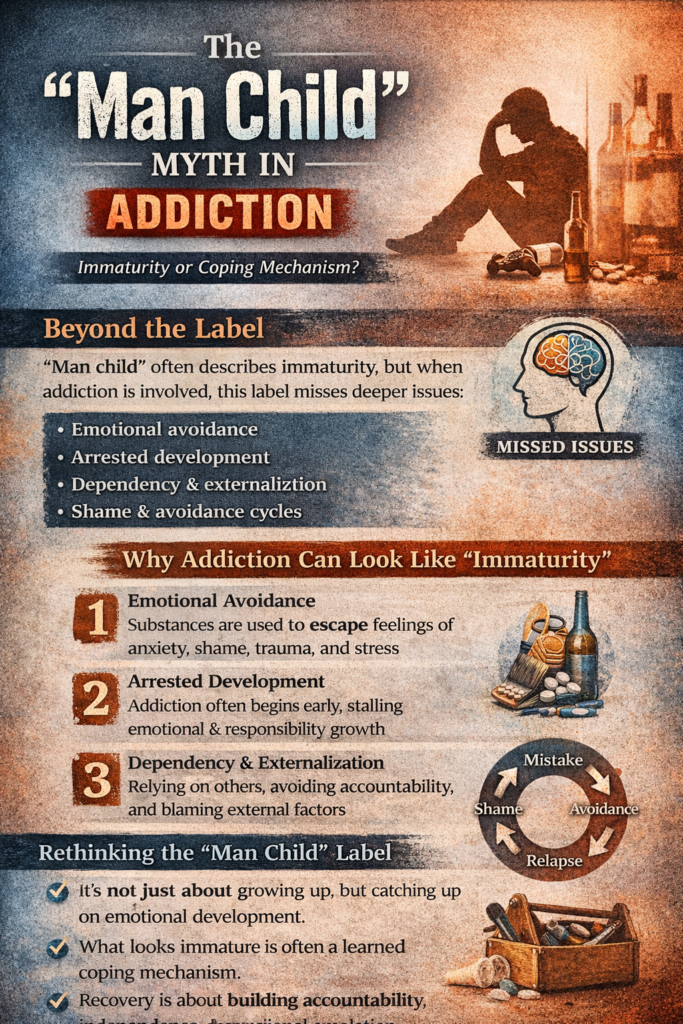
The idea of the “man-child” is often used to describe someone who appears emotionally immature, irresponsible, or unwilling to take on adult roles. In the context of addiction, this label can feel especially fitting to those observing repeated patterns of avoidance, dependency, and poor decision-making. However, reducing these behaviors to immaturity alone overlooks the deeper psychological and neurological factors at play. Addiction reshapes how individuals cope with stress, regulate emotions, and respond to responsibility, often creating patterns that resemble underdevelopment rather than simple unwillingness. To truly understand these behaviors, it is necessary to move beyond labels and examine the underlying mechanisms driving them.
The “Man Child” Myth in Addiction: Immaturity or a Coping Mechanism?
Rethinking the Label
In conversations about addiction, the term “man child” often shows up to describe someone who seems irresponsible, emotionally reactive, or unwilling to “grow up.”
But when addiction is involved, that label misses something critical:
What looks like immaturity is often the visible surface of a much deeper struggle.
Addiction Changes Behavior—Not Just Choices
Addiction isn’t simply about poor decisions or lack of discipline. It affects:
- Impulse control
- Emotional regulation
- Motivation and reward systems
- Stress tolerance
Over time, the brain becomes wired to prioritize immediate relief over long-term responsibility. What gets labeled as “childish” behavior—avoidance, denial, emotional outbursts—often reflects this internal imbalance.
Why Addiction Can Look Like “Immaturity”
1. Emotional Avoidance
Substances and addictive behaviors are often used to escape:
- Anxiety
- Shame
- Stress
- Unresolved trauma
Instead of processing emotions, the person learns to numb or distract. This can resemble emotional immaturity—but it’s actually a learned survival strategy.
2. Arrested Development
Many people struggling with addiction began using during adolescence or early adulthood.
That timing matters.
When substances become a primary coping tool, emotional growth can stall. Skills like:
- Handling conflict
- Regulating emotions
- Taking responsibility
may not fully develop—not because the person can’t, but because they haven’t had to practice them sober.
3. Dependency and Externalization
Addiction often creates dependency—not just on substances, but on others:
- Relying on family or partners for stability
- Avoiding accountability
- Blaming circumstances or other people
This can look like a refusal to “grow up,” but it’s often tied to cycles of shame, relapse, and survival.
4. Shame → Avoidance Cycle
A key dynamic in addiction is the loop:
Mistake → Shame → Avoidance → More Use → More Shame
What appears as laziness or irresponsibility is often someone trying to avoid overwhelming self-criticism. The more they feel like a failure, the harder it becomes to face responsibilities directly.
The Impact on Relationships
Loved ones may feel like they’re dealing with a “child” instead of a partner:
- Taking on caretaker roles
- Managing finances, responsibilities, or crises
- Feeling resentment and emotional exhaustion
This dynamic is real—and painful—but labeling it as “man child” can sometimes deepen the divide rather than address the underlying issue.
Why the Myth Is Harmful
The “man-child” label in addiction:
- Oversimplifies a complex condition
- Reinforces shame, which can worsen addictive behavior
- Distracts from root causes like trauma, coping deficits, and brain changes
- Frames the person as the problem, instead of the pattern
Understanding doesn’t excuse harmful behavior—but it creates a path to change.
What Growth Actually Looks Like in Recovery
Recovery isn’t just about stopping substance use—it’s about catching up on emotional development.
This often includes:
- Learning to tolerate discomfort without escaping
- Building accountability step by step
- Developing emotional regulation skills
- Relearning independence and responsibility
In many ways, recovery involves doing the emotional work that was delayed.
A Better Question to Ask
Instead of:
“Why won’t he grow up?”
Try:
“What is he using to cope—and what skills are missing underneath that?”
This shift doesn’t remove boundaries or consequences. It just replaces judgment with clarity.
Final Thought
What gets called a “man-child” in addiction is often a person stuck in survival mode—using the only tools they’ve learned to manage overwhelming internal states.
And while those patterns can be harmful, they are not fixed.
With the right support, accountability, and skill-building, growth is not only possible—it’s expected.
Beyond the Label: Self-Management Strategies for Understanding the “Man Child” Myth in Addiction
Why This Matters
When addiction is involved, behaviors often get labeled as “immature,” “irresponsible,” or “childlike.” While those reactions are understandable—especially for people affected by the behavior—they don’t explain why it’s happening or how to change it.
Self-management shifts the focus from judging the behavior to understanding and changing the pattern.
Step 1: Identify the Pattern—Not the Label
Instead of thinking in terms of “acting like a man-child,” break behaviors down into observable patterns:
- Avoiding responsibilities
- Escaping through substances or distractions
- Reacting emotionally instead of responding intentionally
- Relying on others to manage consequences
Why it helps:
Clarity reduces shame and makes change more actionable. You can’t fix a label—but you can work on a pattern.
Step 2: Map the Trigger → Behavior → Outcome Cycle
Most addictive and avoidant behaviors follow a predictable loop:
- Trigger: stress, boredom, conflict, shame
- Behavior: substance use, withdrawal, procrastination
- Outcome: temporary relief → long-term consequences
Write this out for yourself. Seeing the cycle makes it easier to interrupt.
Step 3: Build Emotional Awareness (Without Escaping)
A major driver behind both addiction and perceived immaturity is emotional avoidance.
Practice:
- Naming what you feel (e.g., “I’m overwhelmed,” not just “I’m stressed”)
- Pausing before reacting
- Sitting with discomfort for short periods
Goal: Increase tolerance for feelings without needing immediate escape.
Step 4: Start With Micro-Responsibility
One of the biggest barriers is feeling overwhelmed by “adult expectations.”
Instead of trying to fix everything:
- Pick one small responsibility daily
- Follow through, even if imperfectly
- Gradually increase complexity
Why it works:
Consistency builds self-trust, which addiction often erodes.
Step 5: Replace Avoidance With Structured Action
Avoidance feeds both addiction and the “man-child” perception.
Try:
- Time-blocking tasks (even 10–20 minutes)
- Using external structure (lists, reminders, routines)
- Breaking tasks into the smallest possible steps
Action reduces anxiety more effectively than avoidance.
Step 6: Address the Shame Loop
Shame often fuels the cycle:
Mistake → Shame → Avoidance → More Mistakes
To interrupt it:
- Separate behavior from identity (“I messed up” vs. “I am a failure”)
- Focus on correction, not punishment
- Practice self-accountability without self-attack
Growth requires honesty—but also self-compassion.
Step 7: Relearn Independence Gradually
Dependency patterns don’t disappear overnight.
Work toward:
- Making your own decisions (even small ones)
- Handling consequences directly
- Reducing reliance on others for emotional regulation
This is how autonomy is rebuilt over time.
Step 8: Set Boundaries (For Yourself and Others)
If you’re the one struggling:
- Define what you’re responsible for
- Avoid expecting others to “rescue” you
If you’re supporting someone:
- Avoid over-functioning for them
- Support growth without enabling avoidance
Boundaries create space for responsibility to develop.
Step 9: Focus on Skill-Building, Not Just Abstinence
Stopping substance use is only part of the process.
Long-term change comes from:
- Emotional regulation skills
- Communication skills
- Stress management strategies
- Problem-solving ability
Without these, old patterns tend to resurface.
A More Accurate Perspective
What gets labeled as a “man-child” in addiction is often:
- A person using avoidance to cope
- Someone with underdeveloped emotional skills
- An individual stuck in a cycle of shame and relief
Self-management is about learning what wasn’t learned, not just “trying harder.”
Final Thought
The goal isn’t to prove you’re not a “man child.”
The goal is to build the skills that make the label irrelevant.
Because when patterns change—
The narrative changes with them.
Supporting Without Enabling: Family Strategies to Understand the “Man Child” Myth in Addiction
Why Families Get Stuck in This Pattern
When a loved one struggles with addiction, their behavior can feel confusing, frustrating, and even childlike—missed responsibilities, emotional outbursts, avoidance, or dependency.
It’s common for families to default to labels like “man child” as a way to make sense of the chaos. But over time, that label can actually trap everyone in a cycle:
- The individual feels shamed and misunderstood
- The family becomes overwhelmed and over-responsible
- The dynamic reinforces dependency and avoidance
Understanding the pattern—not the label—is what allows change.
Reframing the Behavior
Before changing how you respond, it helps to shift how you interpret what you’re seeing.
What looks like:
- Laziness → may be avoidance tied to anxiety or shame
- Irresponsibility → may reflect underdeveloped coping skills
- Emotional outbursts → may signal poor emotional regulation
This doesn’t excuse harmful behavior—but it explains why it persists.
Strategy 1: Separate the Person From the Behavior
Avoid defining your loved one by their actions.
Instead of:
- “You’re acting like a child.”
Try:
- “This behavior isn’t working, and we need to address it.”
Why it matters:
Reducing shame makes it more likely they’ll engage instead of withdraw.
Strategy 2: Stop Over-Functioning
Families often compensate in ways that unintentionally reinforce the problem:
- Covering financial consequences
- Taking over responsibilities
- Cleaning up after mistakes
While it may feel helpful, this can delay growth and accountability.
Shift toward:
- Letting natural consequences happen (when safe)
- Encouraging responsibility without rescuing
Strategy 3: Set Clear, Consistent Boundaries
Boundaries are not punishments—they’re structure.
Examples:
- “We won’t provide money if it supports substance use.”
- “You’re responsible for your own appointments and commitments.”
- “We’re here to support recovery, not avoidance.”
Key: Consistency matters more than intensity.
Strategy 4: Encourage Skill-Building, Not Just Sobriety
Recovery is more than stopping substance use—it’s about developing skills that may be missing.
Families can be supported by encouraging:
- Therapy or counseling
- Emotional regulation strategies
- Problem-solving and decision-making
- Routine and structure
Think: growth, not just compliance.
Strategy 5: Don’t Engage in Power Struggles
Arguments often reinforce the dynamic:
- You push → they resist
- You lecture → they shut down
- You demand → they avoid
Instead:
- Stay calm and direct
- Focus on your boundaries, not controlling their behavior
- Disengage when conversations become unproductive
Strategy 6: Recognize the Shame Cycle
Addiction often operates on:
Mistake → Shame → Avoidance → More Mistakes
Harsh criticism can unintentionally fuel this loop.
Support looks like:
- Holding them accountable without attacking their identity
- Acknowledging effort, not just outcomes
- Leaving space for honesty without immediate judgment
Strategy 7: Take Care of Yourself
Supporting someone with addiction can be emotionally exhausting.
Families need:
- Their own support systems (therapy, support groups)
- Emotional boundaries
- Time and space away from the situation
You cannot pour from an empty cup—and burnout helps no one.
Strategy 8: Shift the Core Question
Instead of asking:
“Why won’t they grow up?”
Ask:
“What skills are missing, and how can responsibility be encouraged without enabling?”
This shift changes your role from rescuer or critic to supporter with boundaries.
A Healthier Dynamic
When families move away from the “man child” label and toward understanding patterns:
- Accountability becomes clearer
- Roles become more balanced
- Growth becomes more possible
Change doesn’t happen overnight—but the environment around the person can either support growth or reinforce stagnation.
Final Thought
Your loved one is not a label—and neither are you.
The goal isn’t to “fix” them or carry them.
It’s to create a dynamic where responsibility, support, and growth can coexist.
Beyond the Label: Community Resource Strategies for Understanding the “Man Child” Myth in Addiction
Why Community Matters
Addiction doesn’t develop—or resolve—in isolation. Yet when someone is labeled a “man child,” the focus narrows to personal failure rather than the broader system around them.
In reality, what looks like immaturity is often shaped and reinforced by:
- Lack of access to mental health care
- Limited life-skills education
- Social environments that normalize avoidance or substance use
- Absence of supportive, structured communities
Community resources help shift the narrative from “what’s wrong with them?” to “what support systems are missing?”
Reframing the Issue
Instead of viewing the individual as incapable or unwilling to grow, community-based approaches recognize:
- Many people in addiction lack skill-building opportunities
- Emotional regulation and responsibility are learned behaviors
- Recovery requires consistent external structure, not just willpower
The “man-child” label often disappears when the right supports are in place.
Strategy 1: Connect to Structured Recovery Programs
Programs provide routine, accountability, and peer support.
Examples:
- Outpatient or inpatient treatment programs
- Intensive outpatient programs (IOPs)
- Peer recovery groups
Why it works:
Structure replaces chaos, and shared experience reduces isolation and shame.
Strategy 2: Utilize Peer Support Networks
Peer-based communities can be powerful because they offer:
- Relatability (“someone who gets it”)
- Accountability without authority-based pressure
- Real-life models of growth and responsibility
These spaces often challenge the idea that someone is “just immature” by showing change in action.
Strategy 3: Access Life Skills and Vocational Programs
Many individuals in addiction haven’t had the opportunity to fully develop:
- Financial management
- Time management
- Job readiness
- Communication skills
Community programs that teach these skills help bridge the gap between dependency and independence.
Strategy 4: Integrate Mental Health Services
Addiction is frequently linked with:
- Anxiety
- Depression
- Trauma
Without addressing these, behavior may continue to look like avoidance or immaturity.
Community access to:
- Therapy
- Counseling
- Case management
helps target the underlying causes—not just the symptoms.
Strategy 5: Create Accountability Through External Systems
Community systems can reinforce responsibility in ways that families often struggle to:
- Sober living environments
- Court-mandated programs (when applicable)
- Employment requirements within programs
These structures provide clear expectations and consequences without emotional entanglement.
Strategy 6: Encourage Pro-Social Environments
Environment shapes behavior.
Helpful community spaces include:
- Volunteer organizations
- Recreational groups
- Faith-based or service communities
These provide:
- A sense of purpose
- Positive social reinforcement
- Opportunities to practice responsibility and commitment
Strategy 7: Support Family Education Programs
Communities often offer resources for families as well:
- Educational workshops on addiction
- Support groups for loved ones
- Guidance on boundaries and communication
When families understand the difference between enabling and supporting, the entire system becomes more effective.
Strategy 8: Reduce Stigma Through Education
The “man-child” myth is partly sustained by misunderstanding.
Community-level education can:
- Reframe addiction as a health and behavioral issue
- Reduce shame-based narratives
- Promote empathy alongside accountability
The more informed the community, the more supportive—and less judgmental—the environment becomes.
A Systems-Based Perspective
What gets labeled as a “man-child” in addiction is often:
- A person without a consistent structure
- Someone lacking access to skill-building resources
- An individual caught between dependency and unmet developmental needs
Community resources fill in these gaps, making growth possible.
Final Thought
No one develops responsibility, emotional regulation, or independence in a vacuum.
When communities provide the right combination of structure, support, and opportunity, the behaviors associated with the “man child” myth begin to shift—
not because the person was forced to change,
but because they were finally given the tools to.
Frequently Asked Questions
Here are some common questions:
1. What does “man child” mean in the context of addiction?
The term “man-child” is often used to describe an adult who appears emotionally immature, avoids responsibility, or depends on others. In addiction, these behaviors are usually not about refusal to grow up, but about coping deficits, emotional avoidance, and the impact of substance use on brain function.
2. Is addiction a form of immaturity?
No—addiction is not simply immaturity. It is a complex psychological and neurological condition. While it can lead to behaviors that resemble immaturity (like impulsivity or avoidance), these are typically the result of altered reward systems, poor emotional regulation, and learned coping patterns.
3. Why do people with addiction seem irresponsible?
Addiction shifts priorities toward immediate relief rather than long-term responsibility. This can lead to:
- Missed obligations
- Poor decision-making
- Avoidance of consequences
What looks like irresponsibility is often short-term survival thinking driven by the addiction cycle.
4. Does addiction cause emotional immaturity?
It can contribute to it. Many individuals begin using substances during adolescence or early adulthood, which can interrupt emotional development. Over time, they may rely on substances instead of learning:
- Emotional regulation
- Problem-solving
- Accountability
This is often referred to as arrested development.
5. Why do people in addiction avoid responsibility?
Avoidance is often tied to:
- Fear of failure
- Shame about past behavior
- Feeling overwhelmed
Substances become a means of escaping these feelings. Avoidance isn’t just laziness—it’s often a protective coping mechanism.
6. Is calling someone a “man-child” harmful?
Yes, it can be. The label:
- Increases shame, which can worsen addiction
- Oversimplifies complex behavior
- Shifts focus away from solutions
Understanding patterns is more effective than labeling people.
7. Can someone grow out of these behaviors?
Yes—with the right support. Growth involves:
- Developing emotional regulation skills
- Learning accountability
- Building healthier coping strategies
Recovery is not just about stopping substance use—it’s about emotional and behavioral development.
8. How is dependency in addiction different from immaturity?
Dependency in addiction is often:
- Reinforced by brain chemistry
- Connected to emotional coping needs
- Maintained by cycles of relief and withdrawal
It may look like immaturity, but it’s rooted in biological and psychological dependence, not simply unwillingness to be independent.
9. Why do relationships often feel unbalanced?
Partners or family members may take on caretaker roles, leading to:
- Unequal responsibility
- Emotional burnout
- Resentment
This dynamic can unintentionally reinforce dependency, making the person appear more “childlike” over time.
10. What helps break the “man-child” pattern in addiction?
Effective change usually includes:
- Accountability (clear expectations and consequences)
- Skill-building (emotional regulation, decision-making)
- Support systems (therapy, recovery programs, community)
- Reduced shame (understanding without excusing behavior)
11. Is it possible to be both responsible and struggling with addiction?
Yes. Many individuals function in certain areas (work, social life) while struggling in others. Addiction is not an all-or-nothing condition—it can selectively impair functioning, which can make the behavior confusing to others.
12. What’s a better way to understand these behaviors?
Instead of asking:
“Why are they acting like a child?”
Ask:
“What are they avoiding, and what skills are missing?”
This shift leads to more effective support and realistic expectations.
Conclusion
Reframing the “man child” myth in addiction is not about excusing harmful behavior, but about understanding it in a way that makes change possible. What appears as immaturity is often the result of coping deficits, delayed emotional development, and cycles of avoidance reinforced over time. When we shift from judgment to insight, we open the door to more effective responses—ones grounded in accountability, skill-building, and support. Ultimately, moving beyond the label allows both individuals and those around them to focus less on blame and more on growth, creating a path toward responsibility, recovery, and lasting change.
Video: