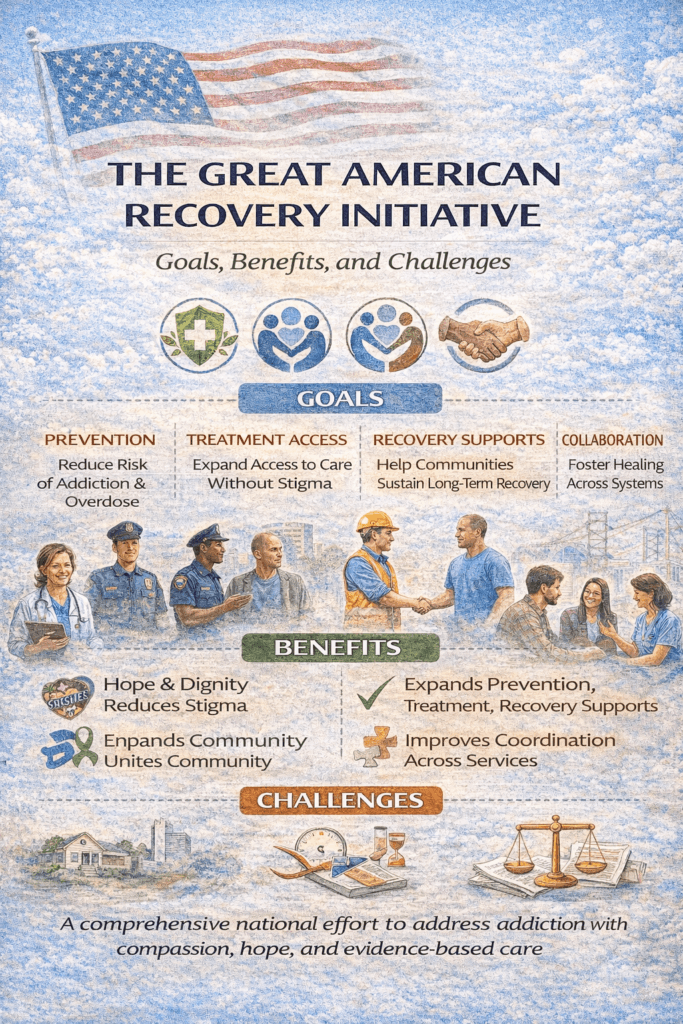
The Great American Recovery Initiative represents a broad, recovery-oriented effort to address addiction as a public health and community issue rather than solely a criminal or individual failing. Its strengths include promoting hope, expanding access to treatment and recovery supports, encouraging cross-system collaboration, and reducing stigma through a long-term recovery framework. At the same time, the initiative faces notable disadvantages, including uneven access across regions, funding and sustainability challenges, fragmented implementation, and difficulties measuring outcomes. Ethical dilemmas also arise regarding autonomy versus mandated participation, equity in resource allocation, clinical responsibility, data privacy, and the influence of political priorities. Examining the initiative’s advantages, limitations, and ethical concerns is essential to understanding its real-world impact and improving its effectiveness.
The Great American Recovery Initiative: Rebuilding Lives Through Hope, Health, and Community
The Great American Recovery Initiative represents a comprehensive, values-driven approach to addressing addiction, mental health challenges, and the social conditions that place individuals and families at risk. Rooted in the belief that recovery is possible for everyone, this initiative emphasizes prevention, access to treatment, long-term recovery support, and community engagement as essential pillars of national healing.
At its core, the Great American Recovery Initiative emphasizes recovery as a lifelong process rather than a single event. Addiction is recognized as a chronic, treatable condition influenced by biology, trauma, environment, and opportunity. By shifting the narrative from punishment and stigma to compassion and evidence-based care, the initiative aims to create pathways that support sustained recovery and reintegration into society.
A key component of the initiative is the expansion of access to treatment and recovery services. This includes promoting early screening, mental health care, medication-assisted treatment, peer recovery support, and continuity of care across healthcare, justice, and social service systems. Ensuring that individuals receive timely and appropriate treatment reduces overdose risk, relapse, and long-term societal costs.
The Great American Recovery Initiative also prioritizes family and community involvement. Families are recognized as critical partners in recovery, providing emotional support, accountability, and stability. Community-based programs—such as recovery community centers, faith-based and secular organizations, housing support, workforce development, and education—help individuals rebuild purpose, independence, and connection.
Another essential focus is prevention and resilience-building. The initiative supports education, life skills development, trauma-informed care, and youth engagement to reduce the risk factors associated with substance use. By strengthening coping skills, mental wellness, and social supports early in life, communities can reduce future addiction rates and interrupt generational cycles of substance misuse.
Economic stability and opportunity are also central to the initiative’s mission. Access to safe housing, employment, job training, and financial literacy reduces vulnerability to addiction and supports long-term recovery. Recovery thrives when individuals have meaningful roles, stable income, and hope for the future.
Finally, the Great American Recovery Initiative emphasizes collaboration across systems. Healthcare providers, public health agencies, schools, law enforcement, nonprofits, and community leaders are encouraged to collaborate rather than operate in isolation. Integrated responses improve outcomes, reduce service duplication, and create safer, healthier communities.
The Great American Recovery Initiative reflects a national commitment to healing—one that recognizes addiction recovery as both a personal journey and a shared responsibility. By investing in people, families, and communities, the initiative seeks to transform recovery from a fragmented effort into a united movement that restores dignity, saves lives, and strengthens the nation as a whole.
Advantages of the Great American Recovery Initiative
The Great American Recovery Initiative offers several important advantages by approaching addiction and recovery as a national public health, social, and community issue rather than a problem limited to individuals or the criminal justice system. Its strengths lie in scope, philosophy, and integration.
Promotes a Recovery-Oriented Framework
The initiative emphasizes recovery as a long-term, achievable process rather than a one-time intervention. This shift reduces stigma, encourages hope, and validates that people can and do rebuild meaningful lives after addiction.
Expands Access to Treatment and Recovery Supports
By prioritizing prevention, early intervention, treatment, and long-term recovery services, the initiative helps close gaps in care. Increased attention to mental health services, medication-assisted treatment, peer support, and continuity of care improves outcomes and reduces overdose risk.
Encourages Cross-System Collaboration
The initiative supports coordination among healthcare, behavioral health, housing, education, employment, and justice systems. Integrated care reduces service duplication, improves transitions, and helps individuals avoid falling through the cracks in the system.
Strengthens Families and Communities
Recognizing families and communities as essential partners in recovery, the initiative supports education, family involvement, and community-based programs. This strengthens protective factors and builds environments that support sustained recovery.
Focuses on Prevention and Resilience
Investment in prevention, life skills, trauma-informed care, and youth development addresses root causes of substance use before addiction develops. Prevention reduces long-term social and economic costs while improving population health.
Supports Economic Stability and Reintegration
By emphasizing housing, workforce development, and education, the initiative addresses key social determinants of recovery. Stable housing and employment significantly improve long-term recovery success and reduce recidivism.
Reduces Stigma and Promotes Compassionate Care
The initiative reframes addiction as a treatable health condition rather than a moral failure. This encourages help-seeking, increases treatment engagement, and improves public attitudes toward people in recovery.
Encourages Data-Driven and Evidence-Based Practices
When implemented well, the initiative supports evidence-based prevention, treatment, and recovery models, improving accountability and effectiveness across programs.
Creates a National Vision and Shared Responsibility
By elevating recovery to a national priority, the initiative unites policymakers, providers, communities, and individuals around shared goals. This broad visibility helps sustain momentum and public support.
In summary, the Great American Recovery Initiative’s advantages include reduced stigma, expanded access to care, stronger community involvement, improved coordination, and a long-term focus on recovery and prevention. When paired with ethical safeguards, equitable funding, and evidence-based standards, it has the potential to significantly improve outcomes for individuals, families, and communities affected by addiction.
Disadvantages and Challenges of the Great American Recovery Initiative
While the Great American Recovery Initiative promotes an ambitious, compassionate vision for addressing addiction and recovery nationwide, large-scale recovery initiatives also face significant limitations and challenges that can affect their effectiveness, equity, and sustainability. Understanding these disadvantages is essential for realistic implementation and continuous improvement.
One major challenge is a lack of clarity and standardization. Broad initiatives often use aspirational language—such as “recovery,” “community support,” or “holistic care”—without clearly defining operational standards. This can lead to inconsistent implementation across states, regions, and organizations, making outcomes difficult to measure and compare.
Another disadvantage is uneven access and geographic disparities. Rural and underserved communities frequently lack treatment providers, recovery housing, mental health professionals, and transportation. Even when an initiative is national in scope, local infrastructure limitations can prevent individuals from accessing promised services, widening existing inequities.
Funding limitations and sustainability concerns also pose significant obstacles. Large-scale recovery initiatives often rely on a combination of grants, public funding, and partnerships, which may fluctuate with political priorities or economic conditions. Short-term funding cycles can undermine long-term recovery goals, especially since addiction recovery often requires years of sustained support.
The initiative may also face fragmentation across systems. Coordinating healthcare, behavioral health, criminal justice, housing, education, and employment services is complex. Without strong oversight and accountability, programs can operate in silos, leading to duplicated efforts, service gaps, or individuals falling through the cracks during transitions of care.
Another concern is overemphasis on recovery rhetoric without sufficient clinical integration. While recovery-oriented language reduces stigma, it can unintentionally minimize the importance of evidence-based medical treatment, including medication-assisted treatment, psychiatric care, and trauma-informed therapy. If recovery messaging is not paired with strong clinical standards, outcomes may suffer.
There is also the risk of political influence and shifting priorities. National initiatives are vulnerable to changes in leadership, policy agendas, and public opinion. This instability can disrupt programs, alter funding streams, or shift focus away from evidence-based practices toward ideologically driven approaches.
Accountability and outcome measurement present additional challenges. Recovery is a complex, non-linear process, making it difficult to define success using simple metrics. Without robust data systems and transparent evaluation methods, initiatives may struggle to demonstrate effectiveness or justify continued investment.
Finally, the initiative may not adequately address structural root causes, including poverty, housing shortages, systemic inequality, and limited access to healthcare. While recovery services are critical, without broader social and economic reforms, individuals may continue to face environments that undermine long-term recovery.
In summary, the Great American Recovery Initiative offers an important framework for national healing, but its success depends on clear standards, sustained funding, clinical integration, equitable access, strong coordination, and accountability. Recognizing these disadvantages does not reject the initiative’s goals—it is a necessary step toward building a more effective, realistic, and durable recovery system.
Ethical Dilemmas of the Great American Recovery Initiative
The Great American Recovery Initiative aims to expand prevention, treatment, and long-term recovery supports nationwide. While its goals are broadly positive, large recovery initiatives raise ethical dilemmas that must be addressed to ensure fairness, autonomy, and effective care for vulnerable populations.
Autonomy vs. Mandated Participation
Efforts to expand recovery through courts, schools, workplaces, or social services can blur the line between voluntary help and coercion. When access to housing, employment, or reduced legal penalties is tied to participation, ethical questions arise about whether individuals truly consent to treatment or recovery programs.
Equity and Fair Access
National initiatives risk benefiting communities with stronger infrastructure while leaving rural, tribal, or underserved populations behind. Ethically, a recovery initiative must avoid widening disparities by ensuring that resources reach those with the greatest need, not just those who are easiest to serve.
Recovery Language vs. Clinical Responsibility
A strong focus on “recovery” and resilience can unintentionally minimize the need for evidence-based medical care. Ethical tension arises if recovery rhetoric overshadows access to medication-assisted treatment, psychiatric care, or trauma-informed services—especially for individuals with severe or co-occurring conditions.
Stigma Reduction vs. Accountability
While reducing stigma is ethically important, initiatives must balance compassion with honest risk communication and accountability. Over-simplifying addiction as solely a social issue may obscure the serious medical and behavioral risks involved, affecting informed decision-making.
Data Collection and Privacy
Large initiatives often require data sharing across healthcare, justice, housing, and employment systems. Ethical concerns include confidentiality, informed consent, and potential misuse of sensitive information—particularly for people with histories of substance use or incarceration.
Political Influence and Ideological Bias
National recovery initiatives may be shaped by shifting political agendas or ideological beliefs about addiction, abstinence, or morality. Ethical dilemmas arise when policy priorities override scientific evidence or when certain recovery pathways are favored over others without clear justification.
Resource Allocation and Opportunity Cost
Decisions about where funding is directed—prevention versus treatment, enforcement versus recovery, short-term programs versus long-term supports—carry ethical weight. Investing heavily in one area may unintentionally deprive others of essential services.
Defining “Successful Recovery”
Recovery is non-linear and deeply personal. Ethical challenges arise when initiatives define success too narrowly (e.g., abstinence-only, employment outcomes, or program completion), potentially excluding or penalizing individuals whose recovery may look different.
In summary, the ethical dilemmas of the Great American Recovery Initiative center on autonomy, equity, clinical integrity, privacy, and fairness. Addressing these concerns openly—through transparency, evidence-based standards, inclusive policies, and community input—is essential to ensuring the initiative supports recovery in an ethical, effective, and respectful way.
Frequently Asked Questions
Here are some common questions:
What is the Great American Recovery Initiative?
The Great American Recovery Initiative is a broad recovery-oriented framework focused on addressing addiction through prevention, treatment access, long-term recovery support, and community collaboration. It views addiction as a public health issue and emphasizes compassion, evidence-based care, and sustained recovery.
What problem does the initiative aim to address?
It aims to reduce substance use disorders, overdoses, and the social harms associated with addiction by strengthening prevention, expanding access to treatment, and supporting long-term recovery and reintegration into society.
How is the initiative different from past drug policies?
Unlike enforcement-centered approaches, this initiative prioritizes public health, recovery, and stigma reduction. It emphasizes treatment, prevention, and community support alongside accountability and coordination across systems.
Who benefits from the initiative?
Individuals with substance use disorders, families, communities, healthcare systems, employers, and public safety agencies all benefit through reduced harm, improved access to care, and stronger recovery outcomes.
What role does prevention play?
Prevention is a core pillar. The initiative supports education, life skills development, mental health services, trauma-informed care, and youth engagement to reduce risk factors before addiction develops.
Does the initiative support evidence-based treatment?
Yes. When implemented effectively, it promotes access to evidence-based practices, including behavioral therapies, medication-assisted treatment, mental health care, and recovery support services.
How does the initiative support long-term recovery?
It emphasizes recovery as an ongoing process and supports peer recovery services, housing stability, employment opportunities, family involvement, and community-based recovery programs.
What role do families and communities play?
Families and communities are central partners. The initiative encourages family education and engagement, community coalitions, and local organizations to create supportive environments for sustained recovery.
Is participation in programs voluntary?
The initiative promotes voluntary, person-centered care. However, ethical concerns can arise when recovery participation is tied to court mandates or access to housing or services, which is why safeguards are important.
How is equity addressed?
The initiative aims to expand access across populations, but challenges remain. Ethical implementation requires intentional investment in rural, underserved, and marginalized communities to avoid widening disparities.
What are the main advantages of the initiative?
Key advantages include reduced stigma, expanded access to treatment and recovery supports, improved system coordination, stronger prevention efforts, and a national focus on long-term recovery.
What are the main disadvantages or challenges?
Challenges include uneven access across regions, funding sustainability, fragmented implementation, difficulty measuring outcomes, and potential overreliance on recovery rhetoric without adequate clinical integration.
What ethical dilemmas are associated with the initiative?
Ethical dilemmas include autonomy versus mandated participation, equitable resource allocation, data privacy, political influence, the definition of “successful recovery,” and the balance between recovery messaging and clinical responsibility.
How is success measured?
Measuring success is complex. Metrics may include reduced overdose deaths, increased treatment access, sustained recovery, improved quality of life, and community-level health and safety outcomes.
Can faith-based and secular programs participate?
Yes. The initiative supports collaboration among faith-based and secular organizations and provides services that respect autonomy, inclusivity, transparency, and evidence-based standards.
What is the long-term goal of the Great American Recovery Initiative?
The long-term goal is to create a coordinated, ethical, and sustainable recovery system that saves lives, restores dignity, strengthens communities, and treats addiction as a health condition rather than a moral failure.
Conclusion
The Great American Recovery Initiative offers a compelling national vision that elevates recovery, prevention, and community support as shared responsibilities. Its advantages—expanded services, reduced stigma, and integrated approaches—hold meaningful potential to improve outcomes for individuals and families affected by addiction. However, disadvantages related to access, coordination, and sustainability, along with ethical dilemmas concerning consent, equity, and standards of care, underscore the need for careful oversight and ongoing evaluation. When these challenges are acknowledged and addressed through clear standards, inclusive policies, evidence-based practice, and transparent accountability, the initiative can evolve into a more ethical, equitable, and durable framework—one capable of translating its promise into lasting recovery and community well-being.
Video: The American Recovery Initiative