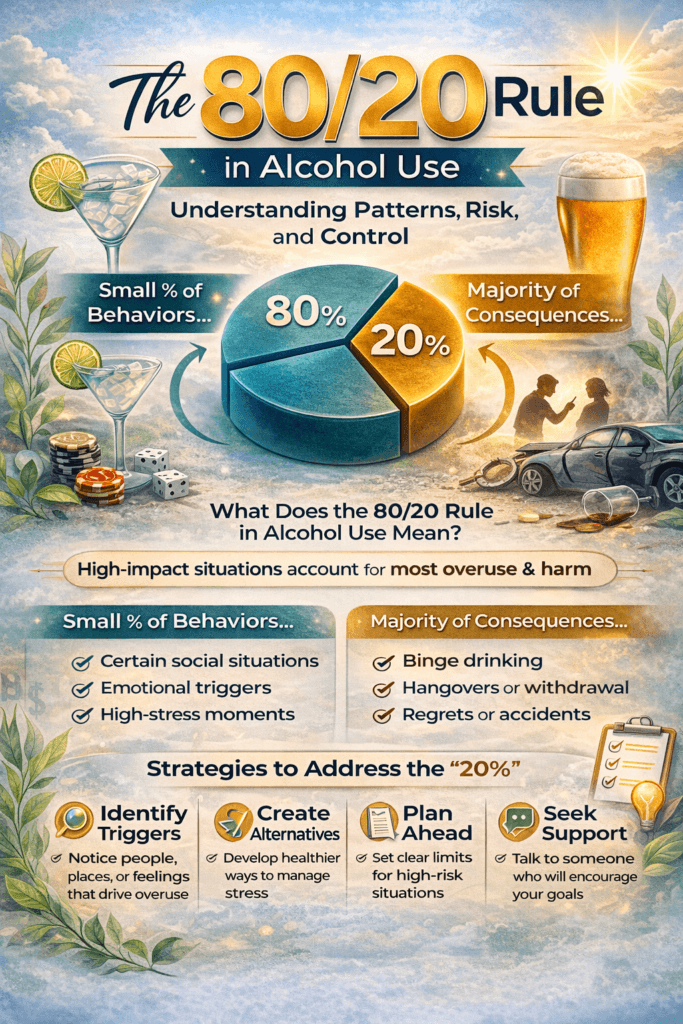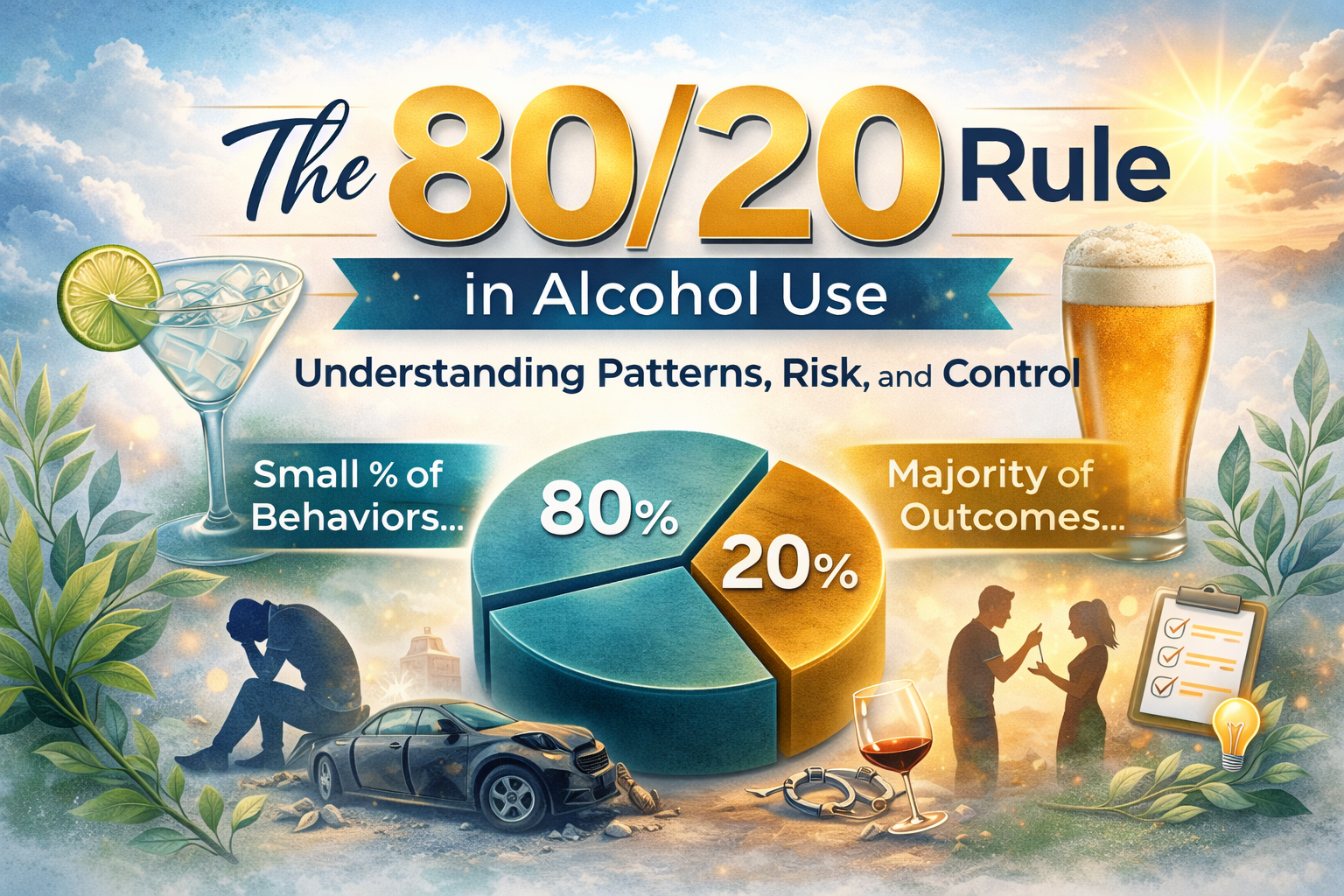
The 80/20 rule, also known as the Pareto Principle, offers a practical lens for understanding alcohol use patterns by suggesting that a small percentage of behaviors often accounts for the majority of consequences. In the context of drinking, this means that a limited number of high-risk situations—such as certain social settings, stress triggers, or emotional states—may be responsible for most overconsumption or negative outcomes. Viewing alcohol use through this framework shifts the focus from broad restriction to targeted awareness, helping individuals recognize which specific habits or circumstances have the greatest impact on their health, relationships, and decision-making.
The 80/20 Rule in Alcohol Use: Understanding Patterns, Risk, and Control
The 80/20 rule, also known as the Pareto Principle, suggests that roughly 80% of outcomes come from 20% of causes. When applied to alcohol use, this concept highlights an important reality: a small percentage of drinking behaviors often accounts for the majority of alcohol-related consequences. Understanding this pattern can help individuals recognize risk early, adjust habits, and make more informed choices about their relationship with alcohol.
In alcohol research and public health discussions, the 80/20 idea is often reflected in statistics showing that a minority of drinkers consume a disproportionately large amount of alcohol. This doesn’t mean moderate drinkers are unaffected; rather, it emphasizes that high-frequency or high-volume use tends to drive most negative outcomes, such as health complications, impaired judgment, accidents, and strained relationships. Recognizing this imbalance helps shift focus from “how often do I drink?” to “how much and why do I drink?”
On a personal level, the 80/20 rule can be used as a self-reflection tool. Many people find that a small portion of their drinking occasions—such as social pressure, stress relief attempts, or emotional triggers—accounts for most of their overconsumption. Identifying the critical 20% of situations enables individuals to target specific triggers rather than overhaul their entire lifestyle. For example, someone might notice that most heavy drinking occurs during late-night social events or after stressful workdays. Addressing those contexts can significantly reduce overall risk.
The principle also highlights the difference between intentional use and automatic habits. When people drink mindfully and set limits, alcohol tends to remain a controlled choice rather than a default coping strategy. But when drinking becomes the primary response to stress, boredom, or emotional discomfort, that small subset of behaviors can gradually expand, increasing dependence risk. Awareness of this pattern empowers individuals to intervene early.
Ultimately, the 80/20 rule isn’t about judgment—it’s about insight. By recognizing that a minority of drinking patterns often drives the majority of consequences, people can focus on targeted changes that produce meaningful results. Small adjustments in high-risk situations can lead to large improvements in health, relationships, and overall well-being.
Smart Drinking: Self-Management Strategies Using the 80/20 Rule for Alcohol Use
The 80/20 rule, or Pareto Principle, suggests that a small portion of behaviors often produces the majority of outcomes. When applied to alcohol use, this idea can be a powerful self-management tool. Many people discover that about 20% of their drinking situations account for 80% of their overconsumption, regrets, or negative consequences. Instead of trying to change everything at once, this approach focuses on identifying and adjusting the specific triggers, environments, and habits that drive the riskiest drinking patterns.
The first strategy is identify your personal 20%. Keep a simple log for a week or two, noting when, where, why, and how much you drink. Patterns often emerge quickly—certain social settings, emotional states, or times of day may consistently lead to heavier use. Awareness alone can reduce impulsive drinking because it shifts behavior from automatic to intentional.
The second strategy is target high-impact moments. Once you know your risk situations, create a plan for them. This could mean setting a drink limit before attending an event, alternating alcoholic drinks with water, choosing lower-alcohol options, or deciding ahead of time to leave early. Focusing on these key moments yields better results than restricting every drinking occasion.
Another essential approach is replace, not remove. If alcohol is commonly used for stress relief or social ease, substitute healthier coping tools for those specific scenarios—exercise after work, a nonalcoholic beverage at gatherings, or a relaxation routine before bed. The goal is not deprivation but balance and control.
Accountability systems also strengthen the 80/20 method. Sharing goals with a trusted friend, therapist, or support group increases follow-through and reduces the likelihood of slipping back into automatic habits. Tracking progress helps reinforce positive change and highlights how small adjustments can produce major benefits.
Ultimately, applying the 80/20 rule to alcohol use encourages smarter, not harsher, self-regulation. By focusing on the small set of behaviors with the greatest impact, individuals can make realistic, sustainable changes that improve health, decision-making, and emotional stability. Meaningful progress doesn’t always require drastic action—sometimes it starts with changing the few habits that matter most.
Family Support Strategies for Applying the 80/20 Rule to Alcohol Use
The 80/20 rule—the idea that a small percentage of behaviors often produces the majority of outcomes—can be a powerful framework for families supporting a loved one working to manage alcohol use. In many cases, about 20% of situations, triggers, or habits account for the most problematic drinking episodes. When families understand and apply this principle, they can focus their energy where it matters most, offering targeted support instead of constant monitoring or conflict.
One of the most effective strategies is helping identify high-risk situations. Families can gently encourage open conversations about when drinking tends to escalate. Is it during stressful weeks, certain social events, or moments of emotional distress? By recognizing patterns together, families help shift attention from blame to problem-solving. This collaborative approach strengthens trust and makes change feel achievable rather than overwhelming.
Another key strategy is to support targeted adjustments rather than demand total control. Rather than insisting on perfection, families can help create realistic plans for those high-impact moments—such as limiting drinks at gatherings, offering alternative activities, or planning alcohol-free family time. Small, strategic changes often lead to large improvements, which reinforces motivation and confidence.
Modeling healthy behavior is equally important. Families who demonstrate balanced coping skills—like exercising, practicing relaxation techniques, or communicating openly about stress—show that alcohol isn’t the only way to manage emotions. This modeling is especially powerful because it teaches skills indirectly, without lectures or pressure.
Families can also strengthen progress through positive reinforcement. Celebrating small wins, such as sticking to a limit or choosing not to drink in a triggering situation, builds momentum. Encouragement helps replace shame with motivation, a crucial factor for lasting change.
Finally, maintaining clear yet compassionate boundaries ensures that support does not become enabling. Boundaries might include not supplying alcohol, refusing to cover up consequences, or encouraging professional help when needed. These limits protect both the individual and the family system, reinforcing responsibility while preserving care.
In the end, the 80/20 rule reminds families that effective support doesn’t require controlling every detail. By focusing on the few situations that have the greatest impact, families can provide meaningful guidance that promotes healthier choices, stronger relationships, and steady progress toward balance and well-being.
Community Strategies for Applying the 80/20 Rule to Alcohol Use
The 80/20 rule, or Pareto Principle, teaches that a small percentage of factors often produces the majority of results. In alcohol use, this concept suggests that a limited number of situations, environments, or behaviors frequently account for most harmful outcomes. Community resources can play a powerful role in helping individuals identify and address those high-impact factors, making change more achievable and sustainable. Instead of trying to control every drinking decision, communities can focus support where it matters most.
One key strategy is targeted prevention programming. Local organizations, health departments, and recovery groups can analyze trends—such as high-risk times, locations, or events associated with heavy drinking—and develop interventions specifically for those situations. For example, late-night transportation services, sober event options, or workplace stress-management workshops can directly reduce the small percentage of triggers responsible for most alcohol misuse episodes.
Another effective approach is accessible education and screening. Community clinics, outreach programs, and public health campaigns can provide quick self-assessments, brief interventions, and educational resources that help individuals recognize their personal “20%” risk patterns. When people understand which situations drive their drinking, they can take targeted steps to change them rather than feeling overwhelmed by the idea of total lifestyle transformation.
Peer support networks also strengthen implementation of the 80/20 principle. Support groups, recovery community centers, and mentorship programs offer practical insight from people who have faced similar challenges. Hearing how others identified and managed their highest-risk triggers helps individuals develop realistic strategies that work in everyday life. This shared learning reduces isolation and builds accountability.
Communities can further reinforce progress through environmental support systems. Safe social spaces, recreational programs, volunteer opportunities, and skill-building workshops provide alternatives to alcohol-centered activities. These resources shift social norms and make healthier choices easier, especially during the specific times or situations when drinking would otherwise occur.
Ultimately, community involvement transforms the 80/20 rule from a theory into a practical support system. When local resources focus on the small set of factors that produce the greatest harm, they create meaningful change without requiring unrealistic perfection. By combining targeted prevention, education, peer connection, and supportive environments, communities help individuals reduce risk, strengthen decision-making, and move toward healthier, more balanced lives.
Frequently Asked Questions
Here are some common questions:
1. What is the 80/20 rule in alcohol use?
It’s the idea that roughly 80% of alcohol-related consequences often come from about 20% of drinking behaviors—usually high-risk situations, triggers, or patterns rather than everyday moderate use.
2. Does the 80/20 rule mean most people drink safely?
Not necessarily. It means that harmful outcomes tend to cluster around specific behaviors or contexts. Even occasional heavy drinking can create significant risks.
3. What are examples of the “20%” high-impact drinking situations?
Common examples include drinking during emotional distress, binge drinking at social events, using alcohol to cope with stress, or drinking in environments that encourage overconsumption.
4. How can someone identify their personal 20% triggers?
Tracking drinking patterns—when, where, why, and how much—helps reveal patterns. Journaling or using habit-tracking apps can make these triggers easier to recognize.
5. Why is this rule helpful for behavior change?
It simplifies change. Instead of trying to eliminate all drinking habits at once, people can focus on modifying the few behaviors that cause the most problems.
6. Can the 80/20 rule help prevent alcohol misuse?
Yes. By identifying high-risk patterns early, individuals can intervene before habits escalate into dependence or serious consequences.
7. Is this rule used in treatment or counseling settings?
Many clinicians informally apply similar principles by helping clients focus on key triggers, environments, and emotional states that most strongly influence their drinking.
8. How can families use the 80/20 approach to support someone?
Families can focus support on high-risk situations rather than monitoring every action. Encouraging healthier coping strategies during those moments is often more effective than constant oversight.
9. Does the 80/20 rule apply to recovery as well?
Yes. A small number of positive habits—like consistent sleep, support meetings, or stress-management routines—can drive most of the recovery progress.
10. Is the 80/20 rule scientifically exact?
No. It’s a guiding principle, not a strict statistic. The exact percentages vary, but the concept highlights that some behaviors have a much larger impact than others.
Conclusion
Ultimately, the value of the 80/20 rule in alcohol use lies in its simplicity and effectiveness. Rather than demanding drastic change, it encourages intentional adjustments in the few situations that matter most. By identifying high-impact triggers and responding with mindful strategies, individuals can achieve meaningful improvements with realistic effort. This approach promotes balance, self-awareness, and sustainable growth, showing that lasting progress often begins not with changing everything—but with changing what counts most.
Video: 80/20 rule that saved me from alcoholism #recovery #habits #personalgrowth