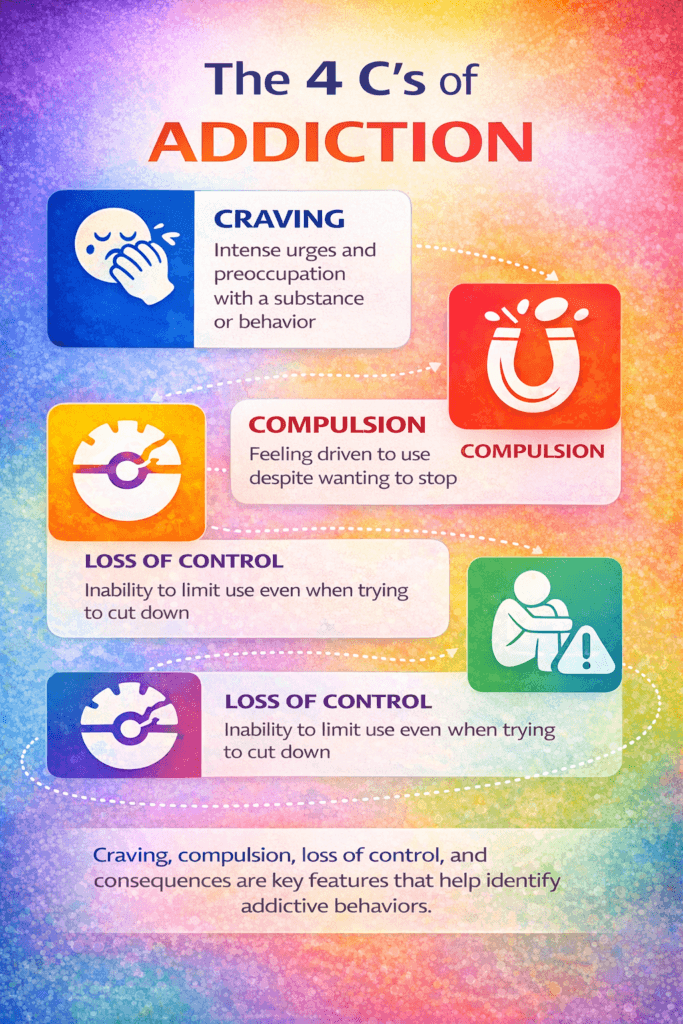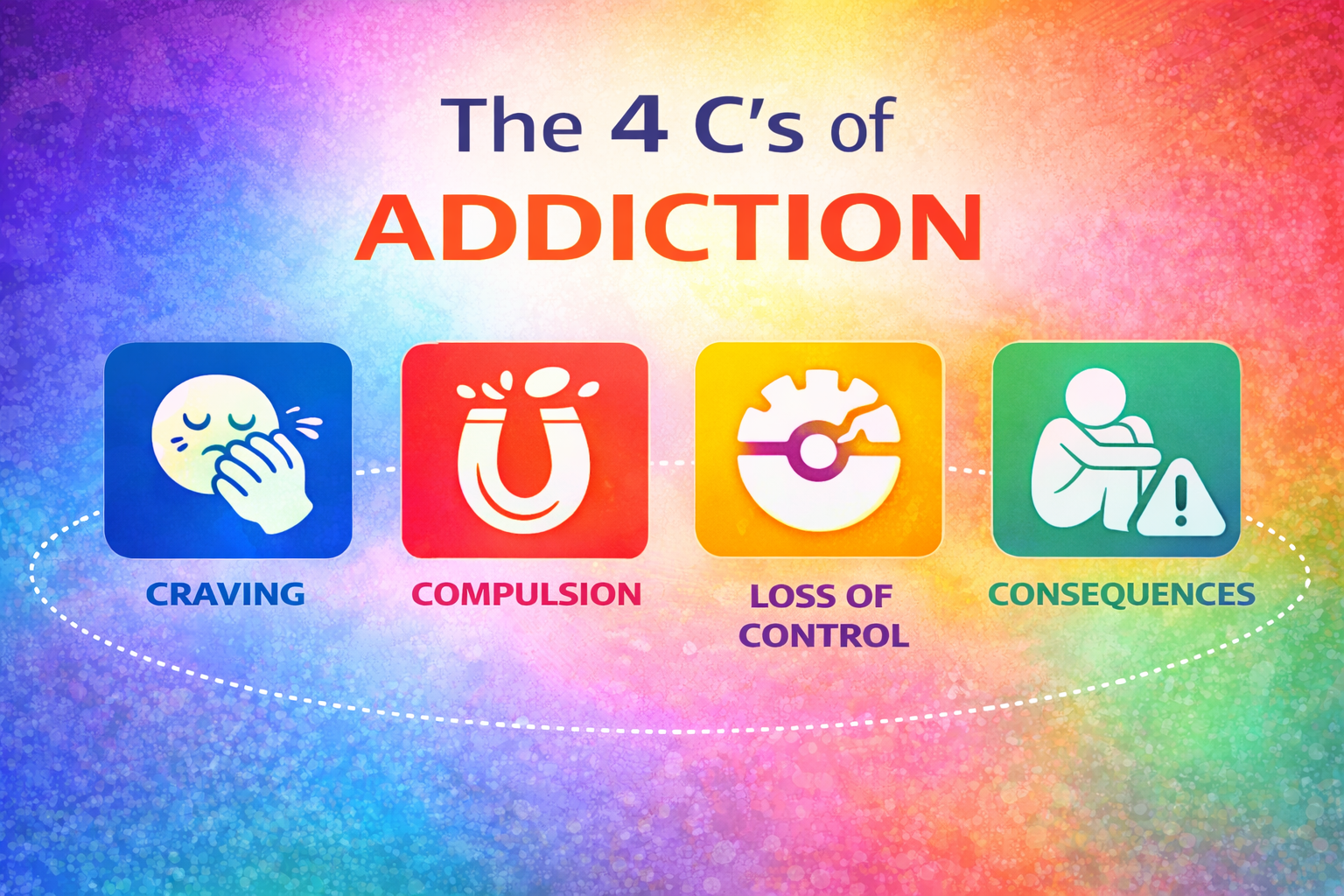
The 4 C’s of Addiction—Craving, Compulsion, Loss of Control, and Consequences—offer a clear and effective way to understand how addiction works. This framework highlights key warning signs that reflect underlying changes in brain function, motivation, and self-control. Craving involves intense urges, compulsion is the strong inner push to act, loss of control refers to difficulty limiting behavior, and consequences describe continued use despite harm. Together, these elements provide a fuller understanding of how addiction develops and persists. By turning complex clinical ideas into recognizable patterns, the 4 C’s help individuals, families, and professionals spot risks early, understand the deeper process, and respond with informed, supportive, and compassionate care.
The 4 C’s of Addiction: A Simple Framework for Understanding Substance Use Disorders
The **4 C’s of addiction—Craving, Compulsion, Loss of Control, and Consequences—**offer a clear and widely used model for recognizing the core features of addictive disorders. This framework is especially helpful because it translates complex neuroscience and behavioral psychology into four observable patterns that individuals, families, and professionals can understand. Rather than defining addiction solely by how much someone uses a substance, the 4 C’s focus on how use affects thinking, behavior, and daily life. By recognizing these patterns early, people can identify risk, seek help sooner, and approach addiction with insight rather than stigma.
Craving — The Persistent Urge
Craving refers to intense urges or preoccupation with a substance or behavior. These urges can feel intrusive and difficult to ignore, often triggered by stress, environments, memories, or emotional states. Cravings are driven by brain reward pathways that associate substances with relief or pleasure. Over time, these pathways become sensitized, making urges stronger and more frequent.
Compulsion — The Drive to Act
Compulsion is the powerful internal drive to use despite intentions not to. Individuals may feel pushed to act even when they consciously want to stop. This reflects changes in the brain’s habit and motivation systems, in which repeated use strengthens automatic behavioral loops. Compulsion often replaces voluntary choice, making behavior feel less controllable.
Loss of Control — Inability to Limit Use
A defining sign of addiction is loss of control. People may plan to use a small amount or for a short time, but end up using more or longer than intended. Attempts to cut down may fail repeatedly. This happens because addiction affects executive functioning—the brain systems responsible for planning, judgment, and self-regulation.
Consequences — Continuing Despite Harm
The fourth C, Consequences, means continuing use even when it causes harm. These harms may include relationship conflict, job loss, declining health, legal problems, or emotional distress. One of addiction’s defining characteristics is that negative outcomes alone are often not enough to stop the behavior, because reward signals override risk perception.
Why the 4 C’s Framework Matters
The 4 C’s are powerful because they focus on patterns rather than labels. Many people mistakenly believe addiction is defined only by frequency or quantity of use. In reality, addiction is more accurately identified by the presence of these four behavioral and psychological markers. This framework helps:
- Clinicians assess severity
- Families recognize warning signs
- Individuals reflect honestly on patterns
- Educators explain addiction clearly
It also reduces stigma by emphasizing that addiction is not simply a choice—it is a condition involving measurable changes in motivation, learning, and self-control.
Practical Use of the 4 C’s Self-Check
A simple reflection tool based on this model asks:
- Do I experience strong cravings?
- Do I feel compelled to use?
- Do I struggle to control my use?
- Do I continue despite consequences?
Answering “yes” to several of these may indicate risk and suggest that support or evaluation could be helpful.
Final Insight
The 4 C’s framework distills addiction into four recognizable signs that anyone can learn to identify. By understanding craving, compulsion, loss of control, and consequences, people gain a clearer picture of how addiction develops and why it can be so difficult to overcome without support. Awareness of these patterns is not meant to diagnose or judge—it is meant to guide early recognition, encourage compassionate responses, and open the door to recovery.
Self-Management Strategies for the 4 C’s of Addiction
Self-management is a cornerstone of recovery and relapse prevention. The **4 C’s of addiction—Craving, Compulsion, Loss of Control, and Consequences—**describe the core patterns that maintain addictive behaviors. Learning to manage these four domains empowers individuals to interrupt cycles early, strengthen decision-making, and build healthier coping systems. Rather than relying solely on external rules or supervision, self-management develops internal skills that support long-term stability. By targeting each of the 4 C’s directly, individuals can transform awareness into daily action and turn recovery into a practical, structured process.
Craving — Managing Urges Before They Escalate
Cravings are temporary physiological and psychological signals, not commands. Effective self-management strategies include urge surfing (observing urges without acting on them), distraction techniques, hydration, physical movement, and grounding exercises. Tracking triggers—such as stress, fatigue, or certain environments—helps individuals anticipate cravings and prepare coping responses. Most cravings peak and fade within minutes when not reinforced, making patience a powerful skill.
Compulsion — Strengthening the Pause Response
Compulsion creates a feeling of urgency that pushes behavior into automatic mode. Self-management focuses on inserting a pause between urge and action. Techniques include counting slowly, stepping away from triggering environments, contacting a support person, or using written reminders of personal goals. Practicing pause-and-reflect repeatedly strengthens neural pathways involved in self-control, making future impulses easier to manage.
Loss of Control — Building Structure and Accountability
Loss of control often improves when structure increases. Scheduling daily routines, setting limits, and creating written commitments help restore predictability and discipline. Tools such as habit trackers, medication logs, and recovery checklists make progress visible. Accountability systems—like sharing goals with a trusted person or attending support meetings—provide reinforcement and an external perspective.
Consequences — Strengthening Awareness of Outcomes
Addiction can weaken sensitivity to consequences, making short-term relief seem more important than long-term well-being. Self-management strategies include journaling about outcomes, reviewing past experiences, and visualizing future goals. Writing down both the positive and negative consequences of choices strengthens insight and helps individuals connect their behavior to its results. This process improves decision-making and reinforces motivation for change.
Integrating the 4 C’s Into a Daily Self-Check
Many people find it helpful to use a brief daily reflection:
| Domain | Self-Check Question |
|---|---|
| Craving | What urges did I notice today? |
| Compulsion | Did I pause before acting? |
| Control | Did I follow my limits? |
| Consequences | What were the results of my choices? |
This simple routine builds awareness and helps individuals detect subtle changes before they become setbacks.
Why Self-Management of the 4 C’s Works
These strategies target the same brain systems affected by addiction: reward processing, impulse control, emotional regulation, and decision-making. Strengthening these systems through intentional practice promotes neuroplasticity—the brain’s ability to reorganize and heal. Over time, consistent self-management reduces automatic behaviors and increases intentional actions.
Final Insight
Self-management of the 4 C’s transforms recovery from a vague goal into a practical skill set. By learning to navigate cravings, interrupt compulsions, rebuild control, and reflect on consequences, individuals gain tools that support independence and resilience. Recovery is not just about resisting urges—it is about developing the awareness and structure needed to consistently make healthier choices. When practiced daily, these skills become habits, and those habits become the foundation of lasting change.
Family Support Strategies for the 4 C’s of Addiction
Families are one of the most powerful influences in addiction prevention and recovery. The **4 C’s of addiction—Craving, Compulsion, Loss of Control, and Consequences—**provide a practical framework that families can use to understand what their loved one is experiencing and how to respond effectively. Rather than reacting emotionally or relying on guesswork, families can apply targeted support strategies for each domain. When families respond with structure, empathy, and consistency, they help reduce the risk of relapse, strengthen accountability, and create an environment that supports long-term healing.
Craving — Supporting Healthy Responses to Urges
Families can help manage cravings by offering reassurance, distraction, and encouragement during difficult moments. Simple actions—such as suggesting a walk, preparing a meal together, or engaging in conversation—can redirect attention away from urges. It is helpful to normalize cravings as temporary experiences rather than signs of failure. Avoid criticism or panic; calm, supportive help reduces stress, which in turn decreases craving intensity.
Compulsion — Reinforcing the Pause and Choice
When compulsive urges arise, individuals often feel pressured to act quickly. Families can support recovery by reinforcing the value of slowing down and thinking before acting. Gentle prompts like “Let’s pause and talk this through” can help interrupt impulsive reactions. Establishing shared coping plans—such as calling a family member during urges—provides practical alternatives to automatic behavior.
Loss of Control — Providing Structure and Accountability
Loss of control improves when routines and expectations are clear. Families can help by maintaining consistent schedules, reinforcing healthy habits, and setting reasonable boundaries. Accountability should be collaborative rather than punitive. For example, checking in about goals or progress can feel supportive when framed as teamwork rather than surveillance. Consistency builds trust and stability, both of which strengthen self-regulation.
Consequences — Encouraging Responsibility With Compassion
One of the hardest roles for families is to allow consequences to unfold while still offering emotional support. Shielding someone from every negative outcome can unintentionally prolong addictive patterns. Instead, families should maintain compassionate boundaries—acknowledging difficulties while encouraging responsibility. Statements such as “We care about you and want to support you, but we can’t support behaviors that harm you” balance empathy with accountability.
Practical Family Check-In Using the 4 C’s
Families can hold structured weekly conversations using these guiding questions:
| Domain | Family Reflection Question |
|---|---|
| Craving | What situations seemed to trigger urges this week? |
| Compulsion | Were there moments when it was hard to pause before acting? |
| Control | Did routines and goals stay on track? |
| Consequences | What positive or negative outcomes occurred? |
These discussions focus on observable patterns rather than blame, helping families stay aligned with recovery goals.
Why Family Strategies Matter
Addiction affects not just the individual but the entire family system. Supportive families strengthen protective factors such as emotional regulation, motivation, and resilience. Research consistently shows that individuals with engaged, informed support networks have higher treatment retention and better recovery outcomes. Families who understand the 4 C’s are better equipped to recognize warning signs early and respond constructively.
Final Insight
Family support does not mean fixing addiction—it means creating conditions where recovery can grow. By applying the 4 C’s framework, families gain a clear roadmap for responding to cravings, interrupting compulsions, restoring control, and reinforcing healthy consequences. Over time, these consistent and compassionate strategies help transform uncertainty into confidence, conflict into collaboration, and struggle into progress.
Community Resource Strategies Using the 4 C’s of Addiction
Addiction is influenced not only by individual choices but also by social environments, access to resources, and community support systems. The **4 C’s of addiction—Craving, Compulsion, Loss of Control, and Consequences—**offer a practical framework that communities can use to design effective prevention, intervention, and recovery programs. When community organizations align their services with these four domains, they create structured systems that address both the psychological and behavioral aspects of addiction. Instead of reacting only after crises occur, communities can proactively reduce risk, strengthen resilience, and support recovery by targeting each of the 4 C’s through coordinated public health strategies.
Craving — Community Supports That Reduce Urges
Communities can help reduce cravings by providing accessible programs that lower stress and increase coping skills. Examples include mindfulness workshops, recreational programs, peer support groups, and wellness classes. These resources help individuals manage emotional triggers that often intensify urges. When communities normalize help-seeking and make services easy to access, individuals are more likely to use healthy coping strategies instead of substances.
Compulsion — Programs That Strengthen Decision-Making
Compulsive behavior often reflects difficulty pausing before acting. Community programs that teach life skills, emotional regulation, and problem-solving strengthen executive functioning and self-control. Mentorship initiatives, youth development programs, and behavioral skills training help individuals practice decision-making in supportive environments. These resources reduce impulsivity and promote thoughtful choices.
Loss of Control — Structured Systems That Promote Stability
Loss of control is more likely when life lacks stability. Communities can counter this by offering structured supports such as housing programs, employment assistance, case management, and recovery coaching. Stable housing, meaningful work, and reliable routines strengthen personal responsibility and reduce vulnerability to relapse. These supports address underlying social determinants that influence addiction risk.
Consequences — Harm Reduction and Early Intervention
Communities can mitigate consequences by implementing harm reduction strategies and early intervention systems. Overdose education, naloxone distribution, crisis hotlines, and mobile health units help prevent medical emergencies and connect individuals to care quickly. Screening programs in schools, workplaces, and healthcare settings can identify warning signs before serious harm occurs.
Applying the 4 C’s as a Community Planning Model
Community leaders and organizations can use a simple framework when evaluating programs:
| Domain | Community Strategy Question |
|---|---|
| Craving | Are we reducing stress and emotional triggers? |
| Compulsion | Are we teaching decision-making skills? |
| Control | Are we improving stability and structure? |
| Consequences | Are we preventing harm and intervening early? |
This model helps communities allocate resources effectively and measure real impact rather than relying solely on participation numbers.
Why Community-Level Strategies Work
Addiction risk is strongly influenced by social determinants such as education, employment, healthcare access, and social connection. Community resources address these broader influences, creating protective environments that reduce vulnerability. When communities invest in prevention and coordinated care, they not only improve individual outcomes but also strengthen public health, safety, and economic stability.
Final Insight
Communities that apply the 4 C’s framework move from reactive crisis management to proactive prevention and recovery support. By reducing cravings through coping resources, strengthening decision-making skills, promoting stability, and minimizing harmful consequences, communities build systems that empower individuals to thrive. In this way, the 4 C’s become more than a clinical concept—they become a blueprint for creating healthier, safer, and more resilient communities.
Frequently Asked Questions
Here are some common questions:
1. What are the 4 C’s of addiction?
The **4 C’s—Craving, Compulsion, Loss of Control, and Consequences—**are a simple framework used to identify core features of addiction. They describe the psychological and behavioral patterns that signal when substance use or a behavior may be becoming addictive.
2. Why are the 4 C’s important?
They help people recognize addiction based on patterns, not just frequency of use. Someone may not use a substance daily but still show these four signs, indicating risk or an emerging disorder.
3. What does “craving” mean in addiction?
Craving refers to strong urges or persistent thoughts about using a substance or engaging in a behavior. These urges can be triggered by stress, emotions, environments, or reminders associated with past use.
4. What is compulsion?
Compulsion is the feeling of being driven to use even when you don’t want to. It reflects a shift from voluntary choice to automatic behavior, often caused by changes in brain habit and reward systems.
5. How is loss of control different from compulsion?
Compulsion is the internal urge to act, while loss of control refers to the inability to stop or limit use once it begins. Someone may plan to use a small amount but end up using far more than intended.
6. What does “consequences” refer to?
Consequences mean continuing use despite negative outcomes, such as relationship problems, health issues, work difficulties, or legal trouble. This is a defining sign of addiction.
7. Do you need all four C’s to have addiction?
Not necessarily. Some individuals show only a few signs early on. However, the more C’s present—and the more severe they are—the higher the likelihood that addiction is developing.
8. Can behavioral addictions also show the 4 C’s?
Yes. Gambling, gaming, shopping, and other behavioral addictions can display the same four patterns because they affect similar brain pathways involved in reward and reinforcement.
9. Are cravings a sign of weakness?
No. Cravings are biological responses caused by learned associations and changes in brain chemistry. They are symptoms, not character flaws.
10. Can the 4 C’s improve with treatment?
Yes. Therapy, medication when appropriate, lifestyle changes, and support systems can reduce cravings, improve control, and help individuals respond more effectively to urges.
11. How can someone use the 4 C’s as a self-check?
People can reflect regularly:
- Do I feel strong cravings?
- Do I feel compelled to use?
- Do I lose control when I start?
- Do I continue despite harm?
Answering “yes” repeatedly suggests it may be helpful to seek professional guidance.
12. Why is understanding the 4 C’s helpful for families?
It gives families a clear, objective way to recognize warning signs and discuss concerns without judgment. Instead of accusations, they can focus on observable patterns.
Conclusion
The strength of the 4 C’s framework lies in its ability to turn abstract ideas about addiction into concrete observations. When people understand these four patterns, they gain a roadmap for recognizing warning signs, guiding treatment decisions, and supporting recovery. Awareness of craving, compulsion, loss of control, and consequences encourages earlier intervention, reduces stigma, and promotes empathy by highlighting addiction as a condition shaped by biology, behavior, and environment—not simply choice or character. Ultimately, the 4 C’s offer more than a definition; they provide a practical lens through which addiction can be understood, addressed, and overcome.
Video: These 4 Psychological Patterns Control Every Addict #addictionrecovery #psychology