The Rule of 3’s in addiction recovery is a simple yet powerful framework that makes the healing process more manageable and less overwhelming. Recovery often involves navigating complex emotions, triggers, and lifestyle changes, which can feel daunting without a clear structure. By organizing key concepts into groups of three—such as triggers, coping strategies, or daily priorities—the Rule of 3’s helps individuals focus on small, actionable steps rather than the entire journey at once. This approach supports clarity, improves memory under stress, and encourages intentional decision-making, making it easier for individuals to stay grounded and committed to recovery.
The Rule of 3’s in Addiction Recovery: A Simple Framework for Lasting Change
Recovery from addiction can feel overwhelming, especially in the early stages when emotions, cravings, and life adjustments seem to happen all at once. Many clinicians, recovery coaches, and peer-support communities use simple frameworks to make healing more manageable. One of the most practical and memorable is the Rule of 3’s—a flexible concept that breaks recovery into manageable, understandable patterns. By organizing challenges and strategies into groups of three, individuals in recovery can better understand triggers, manage cravings, and build sustainable habits. The Rule of 3’s doesn’t represent a single formula but rather a collection of powerful “triads” that support clarity, balance, and progress.
What Is the Rule of 3’s in Recovery?
The Rule of 3’s refers to several key recovery principles commonly grouped into threes to simplify learning and recall. These triads help individuals organize their thoughts, recognize patterns, and respond intentionally rather than impulsively. Because addiction often creates chaos and confusion, structured frameworks like this provide stability and direction.
Core Recovery Triads
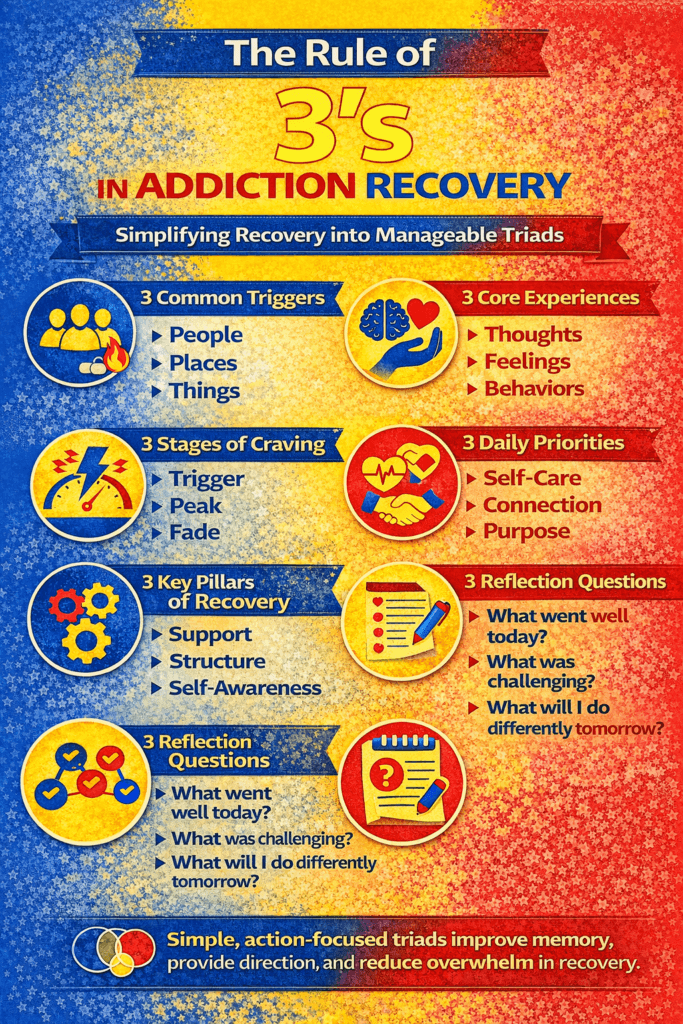
1. The 3 Triggers: People, Places, Things
One of the most well-known recovery principles is identifying high-risk triggers:
- People associated with past substance use
- Places tied to addictive behavior
- Things that remind someone of using
Recognizing these triggers helps individuals prepare coping strategies instead of being caught off guard.
2. The 3 Components of Experience: Thoughts, Feelings, Behaviors
Addiction often creates a cycle where thoughts influence emotions, which then drive behavior. Recovery involves learning to interrupt that cycle:
- Change thoughts → shift feelings → guide behaviors
This triad is commonly used in therapeutic approaches because it teaches individuals that changing one element can positively affect the others.
3. The 3 Stages of Craving
Cravings typically follow a predictable pattern:
- Trigger – something sparks the urge
- Peak – the craving intensifies
- Fade – the urge passes
Understanding that cravings are temporary helps people ride them out rather than react impulsively.
4. The 3 Daily Priorities
Many recovery programs encourage focusing on three daily anchors:
- Self-care
- Connection
- Purpose
When these three areas are supported, individuals are less vulnerable to relapse triggers such as stress, loneliness, and boredom.
5. The 3 Pillars of Sustainable Recovery
Long-term recovery is often built on:
- Support – community, therapy, or peer groups
- Structure – routines and healthy habits
- Self-awareness – emotional insight and accountability
Together, these pillars create a stable foundation that reduces the risk of relapse.
Why the Rule of 3’s Works
The human brain naturally remembers information better in small, structured groups. Threes are especially effective because they:
- Simplify complex ideas
- Improve recall under stress
- Provide clear decision guides
- Reduce overwhelm
In recovery—where stress and emotional intensity are common—simple mental frameworks can make the difference between reacting impulsively and responding thoughtfully.
How to Apply the Rule of 3’s in Daily Life
You can personalize the Rule of 3’s by creating your own recovery triads. For example:
- 3 coping skills to use when stressed
- 3 supportive people to call
- 3 reasons you chose recovery
- 3 goals for the week
Keeping these lists visible or written in a journal reinforces motivation and strengthens resilience.
Benefits of Using This Framework
People who actively use structured recovery tools like the Rule of 3’s often experience:
- Increased emotional awareness
- Better impulse control
- Reduced anxiety during cravings
- Stronger decision-making skills
- Greater confidence in recovery
It transforms recovery from an abstract concept into an actionable one.
Conclusion
The Rule of 3’s in addiction recovery is powerful because it turns a complex, life-changing journey into manageable steps. By organizing triggers, coping strategies, emotional patterns, and goals into simple triads, individuals gain clarity and control in moments that once felt chaotic. Recovery is not about perfection—it’s about progress, consistency, and understanding yourself more deeply each day. The Rule of 3’s serves as a practical reminder that healing doesn’t have to happen all at once. Sometimes, lasting change begins with just three small steps in the right direction.
Three Steps at a Time: Self-Management Strategies Using the Rule of 3’s in Addiction Recovery
Recovery from addiction is often described as a journey, but for many people it can feel more like navigating a storm—unpredictable, emotional, and overwhelming. Self-management skills help individuals regain a sense of direction and control, and one of the most practical tools for doing this is the Rule of 3’s. This approach organizes recovery strategies into simple sets of three, making them easier to remember and apply during stressful moments. By using structured triads for triggers, coping tools, and daily priorities, individuals can transform recovery from a confusing process into a manageable, step-by-step path toward stability and growth.
Why Self-Management Matters in Recovery
Self-management is the ability to monitor thoughts, regulate emotions, and intentionally guide behavior. In addiction recovery, these skills are essential because cravings, triggers, and emotional stress can appear unexpectedly. Structured strategies—like the Rule of 3’s—help reduce impulsivity and increase confidence by providing clear mental anchors when decisions matter most.
Benefits of strong self-management include:
- Improved emotional regulation
- Better stress tolerance
- Increased confidence in handling triggers
- Reduced relapse risk
- Greater independence in recovery
Key Rule of 3 Self-Management Strategies
1. The 3 Awareness Checks
Use these quick internal questions throughout the day:
- What am I thinking?
- What am I feeling?
- What am I doing?
This simple check-in builds mindfulness and helps you catch early warning signs before they escalate into cravings or unhealthy behaviors.
2. The 3 Trigger Plan
Prepare a plan for your most common triggers:
- Identify three triggers you face often
- Choose three coping responses for each
- Contact three supports if needed
Planning ahead removes guesswork and gives you immediate direction when temptation appears.
3. The 3-Minute Reset Technique
When overwhelmed, pause and reset:
- Breathe slowly for one minute
- Ground yourself by noticing your surroundings for one minute
- Choose a healthy action for one minute
This technique interrupts impulsive reactions and restores mental clarity.
4. The 3 Daily Anchors
Stability grows when each day includes:
- One act of self-care
- One moment of connection
- One step toward purpose or goals
These anchors create emotional balance and reduce vulnerability to relapse triggers like loneliness or boredom.
5. The 3-Choice Rule
When facing a decision, list three possible responses before acting. This prevents automatic reactions and strengthens intentional decision-making. Even in difficult moments, knowing you have options builds confidence and control.
6. The 3 Reflection Questions (End-of-Day Practice)
Each evening, reflect on:
- What went well today?
- What challenged me?
- What will I do differently tomorrow?
Reflection strengthens self-awareness and helps transform daily experiences into learning opportunities.
Why the Rule of 3’s Is Effective
The brain processes and remembers information more easily when it’s grouped into small sets. Triads reduce cognitive overload and provide simple, repeatable structures that can be recalled quickly—even during moments of stress or craving. This is especially important in recovery, where clear thinking can sometimes be disrupted by emotional intensity.
Building Your Personal Rule of 3 System
Everyone’s recovery journey is unique, so your triads can be personalized. Examples include:
- Three affirmations that keep you motivated
- Three safe people to call
- Three reasons you chose recovery
- Three healthy coping activities
Writing these lists down and reviewing them daily reinforces commitment and strengthens resilience.
Conclusion
The Rule of 3’s is more than a memory tool—it’s a practical self-management system that turns recovery into a series of achievable steps. By organizing thoughts, coping strategies, and daily habits into simple triads, individuals can respond to challenges with intention instead of impulse. Recovery doesn’t require solving everything at once; it requires steady progress, clear awareness, and supportive structure. With the Rule of 3’s, each small choice becomes a building block toward lasting stability, confidence, and long-term healing.
Stronger Together: Family Support Strategies Using the Rule of 3’s in Addiction Recovery
Family support can be one of the most powerful protective factors in addiction recovery. When loved ones understand how to respond consistently, with empathy, and with structure, they create an environment that promotes healing rather than stress. One practical way families can stay grounded and effective in their support is by using the Rule of 3’s—a simple framework that organizes recovery principles into manageable groups of three. This approach helps families avoid overwhelm, communicate more clearly, and respond intentionally instead of reactively. By applying structured triads to communication, boundaries, and daily support, families can become steady anchors in their loved one’s recovery journey.
Why Families Benefit from the Rule of 3’s
Supporting someone in recovery can feel emotionally complex. Families may struggle with uncertainty, fear of saying the wrong thing, or confusion about how to help. The Rule of 3’s simplifies support into clear, repeatable strategies that:
- Reduce emotional overload
- Improve communication consistency
- Strengthen trust and stability
- Encourage healthy boundaries
- Promote collaborative recovery
Structure helps families remain calm and confident, especially during stressful or triggering situations.
Key Family Support Triads
1. The 3 Foundations of Support
Families can strengthen recovery by focusing on:
- Consistency — predictable responses and routines
- Compassion — empathy instead of judgment
- Communication — open, honest dialogue
These foundations create emotional safety, which is essential for healing.
2. The 3 Helpful Responses During Difficult Moments
When tensions rise, families can rely on:
- Pause before reacting
- Listen without interrupting
- Respond calmly and respectfully
This triad prevents escalation and models emotional regulation.
3. The 3 Boundary Principles
Healthy boundaries protect both the person in recovery and their family:
- Be clear about expectations
- Be consistent in enforcing them
- Be kind while holding them
Boundaries are not punishments—they are safeguards for recovery.
4. The 3 Questions Families Can Ask
When unsure how to help, families can ask:
- What does my loved one need right now?
- What response supports recovery rather than enabling?
- What action keeps our relationship healthy?
These questions guide thoughtful, recovery-centered decisions.
5. The 3 Daily Encouragements
Simple daily support can make a major difference:
- Offer one word of encouragement
- Acknowledge one positive effort
- Express one statement of belief in their progress
Small affirmations build confidence and reinforce motivation.
6. The 3 Signs It’s Time to Step Back
Families must also recognize when space is needed:
- Conversations become heated
- Emotions escalate
- Communication shuts down
Stepping back temporarily allows everyone to regulate and return calmly.
How Families Can Build Their Own Rule of 3 Plan
Each family dynamic is unique, so creating personalized triads can strengthen support. Examples include:
- Three trusted professionals to contact
- Three calming activities to use during stress
- Three shared goals for the month
- Three positive routines to practice together
Writing these down and revisiting them regularly helps families stay aligned and intentional.
Why the Rule of 3’s Works for Families
The brain processes structured information more easily than complex instructions. When families use simple triads, they can remember strategies quickly—even during emotional situations. This reduces impulsive reactions and replaces them with thoughtful responses that protect recovery and relationships.
Conclusion
Family support in addiction recovery does not require perfection—it requires consistency, understanding, and intentional action. The Rule of 3’s offers families a clear and practical way to show up with confidence, compassion, and stability. By organizing communication, boundaries, and daily support into simple triads, families can transform uncertainty into clarity and stress into structure. Recovery is rarely a solo journey, and when families embrace supportive strategies like the Rule of 3’s, they become powerful partners in healing. Sometimes, the strongest support doesn’t come from doing everything—it comes from doing three small things well, every day.
Community in Threes: Resource Strategies Using the Rule of 3’s in Addiction Recovery
Recovery from addiction is not only a personal journey—it is also a community-supported process. While individual effort is essential, long-term success is often strengthened by structured support systems that provide stability, guidance, and accountability. One practical framework communities can use to organize support is the Rule of 3’s, which simplifies complex recovery needs into manageable, easy-to-remember triads. By structuring community resources into three groups—services, supports, and strategies—organizations and local networks can create clearer pathways for individuals seeking recovery while reducing overwhelm and confusion.
Why Community Structure Matters in Recovery
Many individuals entering recovery feel uncertain about where to start or which services to access. Communities that offer clearly organized resources help reduce barriers and increase engagement. Structured support:
- Improves treatment access
- Reduces relapse risk
- Encourages accountability
- Builds connection
- Strengthens long-term recovery outcomes
The Rule of 3’s provides a simple organizational method that communities can use to make support systems more approachable and effective.
Core Community Rule of 3 Strategies
1. The 3 Levels of Support Access
Communities can organize recovery resources into three tiers:
- Immediate Support – crisis lines, urgent care, detox services
- Ongoing Support – therapy, outpatient treatment, medication management
- Long-Term Support – peer groups, vocational programs, housing assistance
This structure helps individuals understand where they are in recovery and what support fits their current needs.
2. The 3 Pillars of Community Recovery Systems
Strong recovery communities typically include:
- Clinical services – medical and mental health care
- Peer support – recovery groups and mentors
- Practical resources – housing, employment, and education
When all three are available, individuals are more likely to maintain stability and progress.
3. The 3 Connection Points
Communities can strengthen engagement by ensuring individuals have:
- One professional contact (therapist, case manager, clinician)
- One peer connection (sponsor, mentor, recovery partner)
- One community link (group, center, or program)
These connection points create a support network rather than a single point of reliance.
4. The 3 Community Outreach Priorities
Effective communities focus on:
- Education – reducing stigma and increasing awareness
- Access – making services affordable and reachable
- Inclusion – ensuring programs serve diverse populations
Balanced outreach ensures recovery resources reach those who need them most.
5. The 3 Prevention Supports
Prevention is as important as treatment. Communities can reduce relapse risk by promoting:
- Healthy activities and social events
- Stress-management and coping workshops
- Early intervention and screening programs
These proactive strategies create protective environments that reinforce recovery.
6. The 3 Signs a Community System Is Working
A recovery-supportive community often shows:
- Increased participation in recovery programs
- Reduced stigma in public attitudes
- Strong collaboration between organizations
These indicators reflect a culture that prioritizes healing and support.
How Communities Can Build Their Own Rule of 3 Framework
Local organizations can tailor this model by identifying three core services, three key partnerships, and three outreach methods specific to their population. Posting these triads publicly—on websites, flyers, or resource boards—helps individuals quickly find help.
Examples:
- Three local emergency contacts
- Three weekly recovery meetings
- Three employment resources
Clear, simple information makes resources more usable.
Why the Rule of 3’s Works for Communities
The Rule of 3’s is effective because it transforms complicated systems into accessible structures. When resources are organized clearly, individuals are more likely to seek help and stay engaged. This model also improves coordination among providers, reducing duplication and closing service gaps.
In recovery support, clarity saves lives.
Conclusion
Community resource strategies built around the Rule of 3’s provide a practical and compassionate way to support addiction recovery. By organizing services into clear triads—levels of care, connection points, and prevention supports—communities make recovery pathways easier to understand and access. This structure empowers individuals to take the next step without feeling overwhelmed and strengthens collaboration among organizations dedicated to healing. Recovery thrives in environments where support is visible, organized, and accessible. Sometimes, the strongest community systems are not the most complex—they are the ones built on three simple, dependable supports that people can rely on every day.
Frequently Asked Questions
Here are some common questions:
1. What is the Rule of 3’s in addiction recovery?
The Rule of 3’s is a simple framework that organizes recovery concepts into groups of three—such as triggers, coping skills, or daily priorities—to make them easier to remember and apply. It helps individuals manage recovery step by step, rather than feeling overwhelmed by the entire process.
2. Why is the number three used in this approach?
Research in learning and psychology shows that the brain processes and remembers information more easily in small groups, especially in groups of three. Triads simplify decision-making, improve recall under stress, and help people respond thoughtfully rather than impulsively during challenging moments.
3. Is the Rule of 3’s a formal treatment program?
No. It’s not a clinical treatment program or official therapy model. Instead, it’s a practical tool often used by counselors, recovery coaches, and individuals to organize coping strategies and recovery goals in a structured, easy-to-follow way.
4. What are examples of recovery “triads”?
Common examples include:
- Three triggers: people, places, things
- Three daily priorities: self-care, connection, purpose
- Three craving stages: trigger, peak, fade
- Three pillars of recovery: support, structure, self-awareness
These groupings help individuals quickly recall helpful strategies when needed.
5. How does the Rule of 3’s help during cravings?
When cravings hit, thinking clearly can be difficult. Having three prepared coping tools—such as calling a support person, practicing breathing exercises, or changing environments—provides immediate options and reduces the chance of acting impulsively.
6. Can I create my own Rule of 3 lists?
Yes. Personalizing your triads makes them more meaningful and effective. Many people create lists such as:
- Three reasons to stay sober
- Three safe people to contact
- Three grounding techniques
- Three goals for the week
Personalized lists strengthen motivation and accountability.
7. Is this method useful for families or supporters, too?
Absolutely. Families can use the Rule of 3’s to guide supportive behaviors, such as three ways to encourage recovery, three healthy communication techniques, or three boundary reminders. It helps loved ones stay calm, consistent, and supportive.
8. Does the Rule of 3’s replace therapy or treatment?
No. It is meant to complement—not replace—professional treatment, therapy, or recovery programs. Think of it as a practical daily tool that supports the larger recovery plan.
9. What are the biggest benefits of using this framework?
People often report:
- Reduced overwhelm
- Clearer thinking under stress
- Better decision-making
- Improved emotional awareness
- Greater confidence in recovery
Its simplicity makes it especially helpful during high-stress moments.
10. Who can benefit from the Rule of 3’s approach?
Anyone involved in recovery can benefit, including individuals in treatment, those in long-term sobriety, family members, peer supporters, and professionals. The structure is flexible enough to adapt to different recovery styles and needs.
Conclusion
Ultimately, the strength of the Rule of 3’s lies in its simplicity and practicality. Recovery does not happen all at once; it unfolds through consistent, manageable choices made day by day. By using triads to guide awareness, coping, and support, individuals gain a structured roadmap that promotes confidence and resilience. The Rule of 3’s reminds those in recovery that progress doesn’t require perfection—only steady steps forward. With clear strategies, supportive systems, and focused priorities, this framework can transform a challenging process into one that feels achievable, empowering, and sustainable over time.
Video: The 3-3-3 Rule That Saved My Sobriety #RecoveryTips #AddictionRecovery #SoberJourney