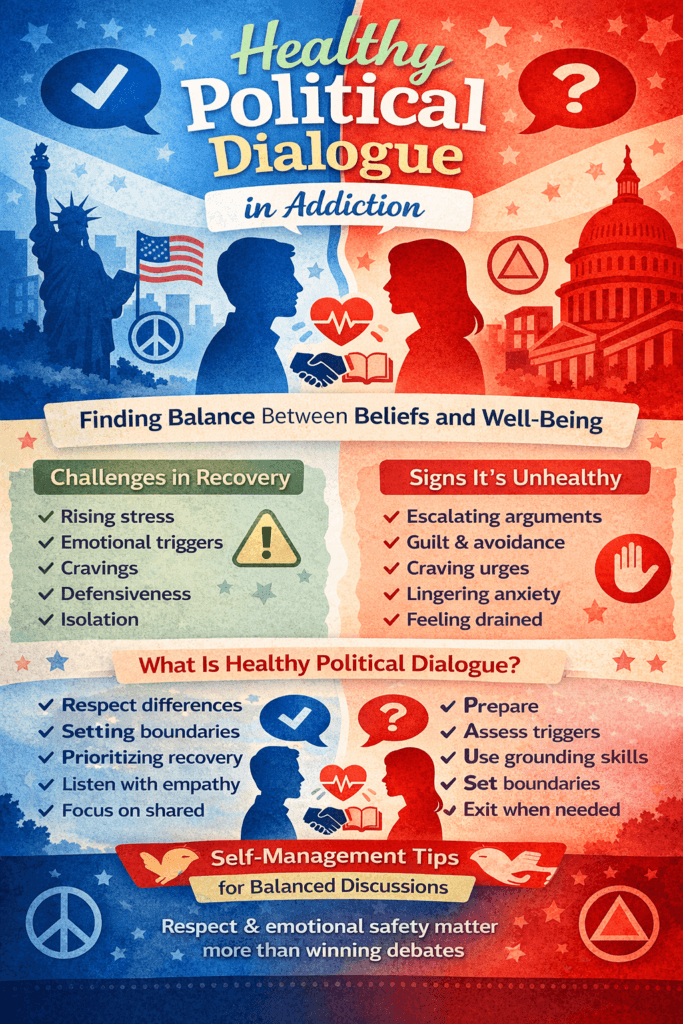
Healthy political dialogue in the context of addiction is about more than discussing policies or opinions—it’s about protecting emotional stability, relationships, and recovery progress. Political conversations can easily become intense or divisive, which may increase stress, trigger emotional dysregulation, or create interpersonal conflict for individuals managing substance use challenges. Because recovery depends heavily on psychological safety, supportive communication, and stress regulation, learning how to engage in respectful, balanced political discussions is an important life skill. When approached with empathy, boundaries, and self-awareness, these conversations can foster understanding rather than tension and connection rather than division.
Healthy Political Relationships in the Context of Addiction: Finding Balance Between Beliefs and Well-Being
Political discussions can be passionate, personal, and emotionally charged—especially in today’s polarized climate. For individuals navigating addiction recovery or substance use challenges, these dynamics can significantly affect mental health, stress levels, and relapse risk. A healthy political relationship doesn’t mean agreeing on everything; it means maintaining respect, emotional safety, and psychological balance even when perspectives differ. Learning how to manage political interactions constructively can protect recovery, strengthen relationships, and foster resilience.
What Is a Healthy Political Relationship?
A healthy political relationship is one where people:
- Communicate respectfully despite differences
- Avoid personal attacks or shaming
- Maintain emotional regulation during discussions
- Respect boundaries when conversations become overwhelming
- Value the relationship more than “winning” an argument
In addiction recovery, emotional stability and supportive social environments are essential. Political hostility can trigger stress responses that increase cravings, anxiety, or feelings of isolation—factors strongly associated with relapse risk.
Why Political Conflict Can Impact Addiction
Political tension can activate the brain’s stress system, increasing cortisol and emotional reactivity. For someone in recovery, this can:
- Trigger old coping habits
- Increase impulsivity
- Reinforce black-and-white thinking
- Intensify shame or defensiveness
- Reduce willingness to seek support
Addiction often thrives in environments of chronic stress and emotional dysregulation. Healthy relational dynamics—including political ones—create psychological safety, which is protective for recovery.
Signs Your Political Interactions Are Unhealthy
You may need boundaries if discussions are regular:
- Escalate into hostility or ridicule
- Leave you emotionally drained or anxious
- Trigger cravings or urges
- Cause you to avoid supportive people
- Lead to guilt, shame, or resentment
Recognizing these signs early allows you to intervene before they undermine your progress.
Strategies for Maintaining Healthy Political Relationships
1. Prioritize Recovery Over Debate
Your well-being matters more than proving a point. If a discussion threatens your stability, it’s okay to disengage.
2. Set Clear Boundaries
You can say, “I value our relationship, but political conversations feel stressful for me right now.”
3. Practice Emotional Awareness
Notice physical signs of tension—tight chest, rapid speech, irritability. These cues signal it’s time to pause.
4. Seek Common Ground
Focus on shared values such as safety, fairness, and community rather than ideological labels.
5. Curate Your Environment
Limit exposure to inflammatory media or online arguments if they elevate stress.
6. Use Recovery Communication Skills
Skills from therapy—active listening, reflective responses, and non-defensive language—work especially well in political conversations.
Role of Support Systems
Healthy relationships act as protective buffers in recovery. Supportive friends, family, sponsors, and peers help regulate emotions and provide perspective. When political disagreements arise within these networks, respectful dialogue preserves trust and stability. If someone repeatedly disregards your boundaries, distancing may be necessary to safeguard recovery.
Clinical Perspective
From a behavioral health standpoint, relational conflict is a known relapse trigger. Therapeutic approaches such as CBT, ACT, and motivational interviewing emphasize emotional regulation, cognitive flexibility, and value-driven behavior—all of which help individuals navigate politically charged situations without compromising recovery goals.
Conclusion
A healthy political relationship isn’t defined by agreement—it’s defined by respect, empathy, and emotional safety. For people managing addiction or recovery, protecting mental stability must come first. By setting boundaries, choosing constructive dialogue, and prioritizing well-being over debate, individuals can maintain meaningful relationships without sacrificing their recovery journey. In a world full of strong opinions, true strength lies in balance, self-awareness, and compassion.
Grounded Dialogue: A Self-Management Strategy for Navigating Political Conversations During Addiction Recovery
Political conversations can quickly become emotionally charged, especially in environments where beliefs are deeply tied to identity and values. For individuals managing addiction or maintaining recovery, these interactions can trigger stress responses that increase cravings, emotional instability, or interpersonal conflict. Developing a self-management strategy for discussing politics allows individuals to participate thoughtfully without compromising emotional regulation or recovery stability. This approach centers on intentional awareness, boundary-setting, and values-guided communication.
Why Self-Management Matters in Political Discussions
Addiction recovery depends heavily on emotional regulation and stress reduction. Heated debates can activate the body’s threat system, increasing heart rate, cortisol, and impulsivity. When stress rises, the brain may revert to familiar coping patterns—including substance use urges. A structured self-management approach acts as a psychological buffer, helping individuals remain grounded rather than reactive.
The “P.A.U.S.E.” Self-Management Framework
A practical strategy for maintaining healthy political interactions is the P.A.U.S.E. method, designed to protect emotional stability while encouraging respectful dialogue.
P — Prepare
Before entering a discussion, check your emotional state. Ask: Am I calm enough for this conversation? If not, delay engagement.
A — Assess Triggers
Identify topics, tones, or people that tend to escalate your stress. Awareness prevents surprise reactions.
U — Use Grounding Skills
Slow breathing, relaxed posture, and steady tone signal safety to your nervous system and reduce reactivity.
S — Set Boundaries
State limits respectfully: “I’m open to talking about this, but I’d like us to keep it respectful.” Boundaries protect both relationships and recovery.
E — Exit When Needed
Disengaging is not avoidance—it’s regulation. Leaving a conversation that feels destabilizing is a sign of strength, not weakness.
Communication Techniques That Support Recovery
Healthy political dialogue relies less on persuasion and more on connection. Effective strategies include:
- Reflective listening instead of interrupting
- Asking clarifying questions rather than making assumptions
- Using “I” statements instead of accusations
- Acknowledging shared values even when opinions differ
These techniques mirror therapeutic communication models used in behavioral health and are particularly protective for individuals with addiction histories.
Warning Signs You Need to Step Back
Even with preparation, some conversations may become harmful. Watch for:
- Rising anger or defensiveness
- Urges to use substances
- Rapid speech or racing thoughts
- Feeling personally attacked
- Loss of focus on recovery priorities
Recognizing these signs early allows you to disengage before emotional escalation occurs.
Clinical Insight
From a behavioral medicine perspective, relapse prevention plans often emphasize environmental and interpersonal triggers. Political conflict can function as both. Self-management strategies strengthen executive control, reduce impulsivity, and support value-driven decision-making—key neurological processes involved in the stability of long-term recovery.
Conclusion
A healthy political relationship is not about avoiding differences; it’s about managing yourself effectively within them. By preparing emotionally, recognizing triggers, using grounding skills, setting boundaries, and exiting when necessary, individuals can engage in meaningful conversations without sacrificing recovery progress. In addiction recovery, the most powerful debate skill isn’t argumentation—it’s self-regulation.
United at the Table: A Family Support Strategy for Healthy Political Conversations During Addiction Recovery
Family conversations about politics can be intense, emotional, and deeply personal. When a loved one is navigating addiction recovery, these discussions can become more than disagreements—they can turn into stressors that affect emotional stability, relapse risk, and family cohesion. A thoughtful family support strategy helps create a safe communication environment where political differences don’t threaten recovery. The goal isn’t to eliminate differing opinions, but to ensure that love, respect, and healing remain stronger than debate.
Why Family Dynamics Matter in Recovery
Family environments strongly influence recovery outcomes. Supportive communication can reduce anxiety, build confidence, and reinforce healthy coping skills. In contrast, hostile or confrontational discussions can activate stress responses, increase emotional dysregulation, and undermine progress. Political conflict can unintentionally recreate patterns common in addiction cycles—criticism, defensiveness, and withdrawal—making intentional family strategies essential.
The “F.A.M.I.L.Y.” Support Framework
This structured approach helps families maintain healthy political dialogue while protecting the stability of recovery.
F — Foster Emotional Safety
Prioritize kindness and tone over being right. Emotional safety allows individuals in recovery to stay grounded and open.
A — Agree on Conversation Guidelines
Set shared rules such as no yelling, no insults, and permission to pause discussions.
M — Monitor Emotional Climate
Families should notice rising tension and intervene early with calming statements or topic shifts.
I — Invite, Don’t Force Participation
Allow the recovering individual to choose whether they want to engage in political discussions.
L — Lead with Empathy
Validate feelings even when opinions differ. Feeling heard reduces defensiveness.
Y — Yield When Necessary
Sometimes the healthiest choice is to stop debating. Protecting the relationship is more valuable than winning an argument.
Practical Family Communication Tools
Families can strengthen supportive dialogue by:
- Using calm tones and neutral language
- Avoiding sarcasm or dismissive gestures
- Asking questions instead of making assumptions
- Acknowledging shared goals such as safety, fairness, or community well-being
- Taking breaks when discussions become emotionally intense
These approaches mirror therapeutic family-systems strategies often used in addiction counseling.
Signs a Conversation Is Becoming Harmful
Family members should pause political discussions if they notice:
- The recovering person is withdrawing or shutting down
- Escalating voices or interruptions
- Emotional overwhelm or visible distress
- Old conflict patterns resurfacing
- Tension lingering long after the discussion ends
Recognizing these signs early helps families redirect conversations before harm occurs.
Clinical Perspective
Behavioral health research consistently shows that supportive family environments improve treatment engagement, reduce relapse rates, and enhance emotional regulation. Structured communication strategies reduce stress activation and help maintain the stability needed for recovery. When families model respect during disagreements, they teach emotional regulation skills that reinforce long-term resilience.
Conclusion
Healthy political conversations within families are less about agreement and more about protection—protecting relationships, emotional safety, and progress toward recovery. By fostering empathy, setting shared guidelines, monitoring emotional tone, and prioritizing connection over debate, families can transform political discussions from sources of conflict into opportunities for understanding. In recovery journeys, the strongest support system isn’t one that thinks alike—it’s one that cares alike.
Stronger Together: A Community Resource Strategy for Healthy Political Dialogue in the Context of Addiction
Communities play a powerful role in shaping recovery environments. Whether through support groups, faith organizations, clinics, advocacy networks, or peer-led programs, community spaces often become safe havens for individuals navigating addiction and healing. Yet political tension can seep into these spaces, creating division, stress, or emotional triggers that threaten stability. A community resource strategy for discussing politics focuses on maintaining respectful dialogue, psychological safety, and shared purpose—ensuring that community support remains healing rather than harmful.
Why Community Matters in Recovery
Recovery rarely happens in isolation. Social connection strengthens resilience, reduces relapse risk, and provides accountability. Community settings often function as emotional regulators, offering structure, belonging, and encouragement. However, political conflict can disrupt these benefits by:
- Increasing stress and emotional reactivity
- Creating social divisions or cliques
- Triggering past trauma or shame responses
- Discouraging participation in support programs
When communities proactively establish healthy discussion norms, they protect both relationships and recovery outcomes.
The “C.O.M.M.O.N.” Community Strategy Framework
C — Create Shared Values First
Establish group agreements emphasizing respect, safety, and support before discussing sensitive topics. Shared purpose reduces polarization.
O — Offer Structured Dialogue Spaces
Instead of spontaneous debates, provide moderated forums or scheduled discussions with clear rules and emotional safety guidelines.
M — Model Respectful Communication
Leaders and facilitators should demonstrate calm listening, neutrality, and validation. Members often mirror the tone set by leadership.
M — Monitor Emotional Impact
Check in with participants during discussions. If tension rises, pause and re-center the group’s focus on wellness.
O — Open Access to Support Resources
Ensure members know where to find counseling, peer support, or crisis help if conversations trigger distress.
N — Normalize Boundaries
Reinforce that opting out of political discussions is acceptable and respected. Participation should always be voluntary.
Practical Community Tools
Communities can strengthen healthy political dialogue by implementing:
- Facilitator-led discussion circles
- Written group guidelines are posted visibly
- Conflict-resolution training workshops
- Peer mediation roles
- Reflection exercises that emphasize empathy and perspective-taking
These tools transform potentially divisive conversations into opportunities for growth, understanding, and skill-building.
Warning Signs a Community Conversation Needs Intervention
Leaders or facilitators should step in if they observe:
- Rising hostility or interruptions
- Members becoming withdrawn or distressed
- Personal attacks or shaming language
- Divisions forming within the group
- Participants expressing emotional overwhelm
Timely intervention protects both individual well-being and group cohesion.
Behavioral Health Perspective
From a clinical standpoint, emotionally safe environments reduce activation of stress pathways linked to relapse vulnerability. Community strategies that emphasize respect, predictability, and choice promote nervous system regulation and cognitive flexibility—key factors in sustaining recovery. Structured dialogue also strengthens interpersonal skills, which are often impaired during active addiction and rebuilt during recovery.
Conclusion
Healthy political conversations within community spaces are not about suppressing opinions—they’re about safeguarding people. When communities prioritize shared values, respectful communication, emotional monitoring, and accessible support, they create environments where individuals can express themselves without jeopardizing recovery stability. In the context of addiction, a strong community isn’t defined by uniform beliefs; it’s defined by collective care.
Frequently Asked Questions
Here are some common questions:
1. Why is political discussion important to address in addiction recovery?
Political conversations can trigger stress, strong emotions, and interpersonal conflict. For individuals in recovery, heightened stress can increase cravings, impulsivity, or emotional dysregulation. Learning how to manage these discussions supports stability and protects recovery progress.
2. Can political debates actually trigger relapse?
They can. While not a direct cause, intense arguments may activate stress responses, increase anxiety, or create feelings of rejection or shame—common relapse triggers. Managing emotional intensity during conversations helps reduce this risk.
3. Should people in recovery avoid political conversations altogether?
Not necessarily. Avoidance isn’t always required. Instead, the goal is intentional engagement—choosing when, how, and with whom to discuss politics in ways that feel emotionally safe and supportive.
4. What are the signs that a political discussion is becoming unhealthy?
Warning signs include rising tension, defensiveness, personal attacks, emotional overwhelm, urges to use substances, or lingering distress after the conversation. These signals indicate it may be time to pause or step away.
5. How can someone set boundaries respectfully?
Clear, calm statements work best, such as:
“I respect your opinion, but this topic feels stressful for me right now. Let’s talk about something else.”
Healthy boundaries protect relationships and recovery simultaneously.
6. What communication skills help keep discussions healthy?
Helpful skills include active listening, using “I” statements, asking questions instead of making assumptions, validating emotions, and focusing on shared values rather than differences.
7. What role do families play in political conversations during recovery?
Families can support recovery by maintaining a respectful tone, avoiding confrontational language, and prioritizing emotional safety over debate. Supportive family communication lowers stress and improves long-term recovery outcomes.
8. How can communities encourage healthy political dialogue?
Communities can create structured discussion spaces, establish clear guidelines, provide moderators, and normalize stepping away from conversations. Safe environments strengthen trust and reduce the risk of relapse.
9. Is it okay to disengage from a political discussion?
Yes. Choosing to step away is a sign of emotional regulation, not avoidance or weakness. Protecting mental health and recovery should always come first.
10. What is the ultimate goal of healthy political dialogue in addiction recovery?
The goal isn’t agreement—it’s stability, respect, and connection. Healthy dialogue allows individuals to express themselves without sacrificing emotional well-being or recovery progress.
Conclusion
Healthy political dialogue does not require agreement; it requires respect, emotional awareness, and a commitment to preserving well-being. For individuals affected by addiction, maintaining stability must always take priority over winning an argument or proving a point. By practicing calm communication, setting limits, and valuing relationships above ideological differences, people can participate in meaningful discussions without compromising recovery. Ultimately, the strongest conversations are not those that change minds, but those that strengthen trust—and in recovery, trust is a cornerstone of healing.
Video: Don’t Let Politics Derail Your Sobriety #SobrietySupport #EmotionalWellness