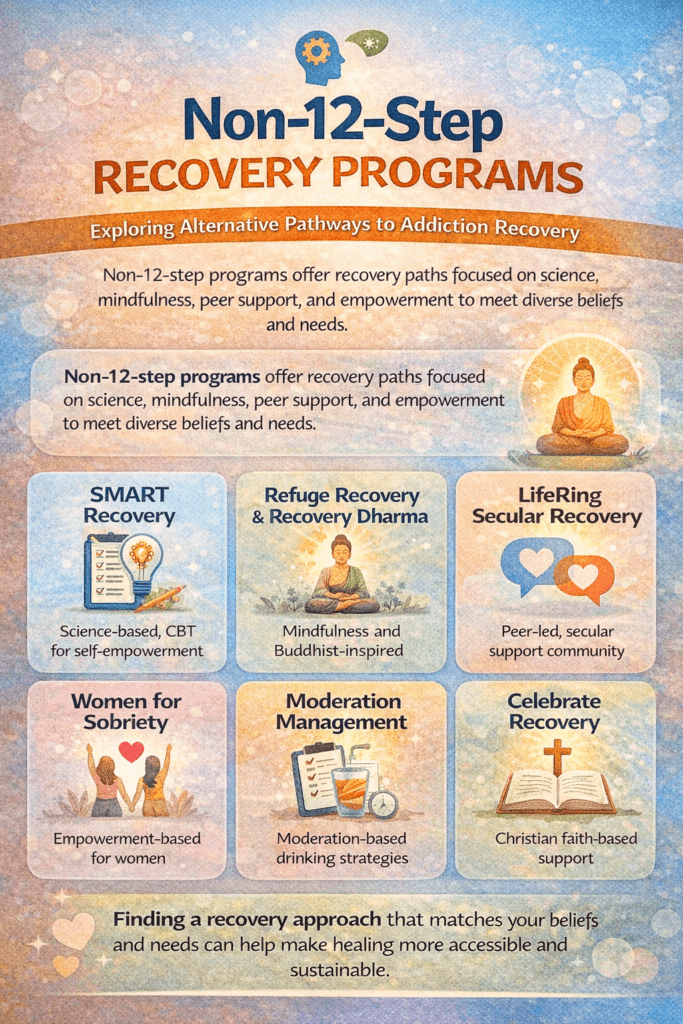
For decades, 12-step programs have been widely recognized as a primary pathway to addiction recovery. While these programs help many individuals, they are not the right fit for everyone. Some people prefer recovery approaches that are secular, science-based, mindfulness-focused, or rooted in personal empowerment rather than spiritual surrender. Non-12-step recovery programs offer diverse pathways that honor individual beliefs, learning styles, and emotional needs. By providing alternatives grounded in psychology, meditation, peer empowerment, or faith-specific models, these programs expand access to healing and increase the likelihood of long-term recovery success.
Exploring Modern, Evidence-Based, and Self-Directed Paths to Healing
For decades, 12-step programs like Alcoholics Anonymous and Narcotics Anonymous have been widely recognized recovery pathways. However, they are not the right fit for everyone. Many individuals seek recovery options that are non-spiritual, science-based, self-directed, or mindfulness- and empowerment-focused. Fortunately, a growing number of alternative recovery programs now provide diverse approaches that respect individual beliefs, learning styles, and emotional needs. Understanding these options allows people to choose recovery paths that align with their values and increase long-term success.
1. SMART Recovery (Self-Management and Recovery Training)
SMART Recovery is a science-based, self-empowerment model grounded in cognitive-behavioral principles. It emphasizes rational thinking, emotional regulation, and skill-building rather than reliance on a higher power. Participants learn tools such as coping with cravings, managing triggers, and building balanced lifestyles. SMART Recovery appeals to individuals who prefer structured, psychology-based, evidence-informed recovery strategies.
2. Refuge Recovery
Refuge Recovery uses mindfulness and Buddhist-inspired philosophy to guide healing. It views addiction as a form of suffering that can be overcome through meditation, compassionate self-awareness, and ethical living. Daily mindfulness practice and reflection on the Four Noble Truths help participants develop emotional balance and inner peace. This model works well for individuals drawn to spiritual growth without religious doctrine.
3. LifeRing Secular Recovery
LifeRing offers peer-led, secular support centered on personal empowerment. It teaches that each person has both a “Sober Self” and an “Addict Self,” and recovery involves strengthening the sober voice through peer connection and shared experience. Meetings focus on encouragement rather than confession, making it appealing to those seeking non-religious community support.
4. SMART Recovery for Family & Friends
Recovery impacts loved ones as well. SMART Family & Friends provides tools for communication, boundary-setting, and self-care for those supporting someone in recovery. Rather than focusing on controlling a loved one’s addiction, it emphasizes emotional resilience and healthy relationship dynamics.
5. Women for Sobriety (WFS)
Women for Sobriety is an empowerment-based recovery program designed specifically for women. It focuses on building self-esteem, emotional stability, and independence through affirmations and peer support. The program recognizes the unique relational and emotional experiences women may face in addiction and recovery.
6. Recovery Dharma
Recovery Dharma is a peer-led program based on Buddhist teachings. Participants use meditation, mindfulness, and compassionate inquiry to address addiction as a pattern of attachment and suffering. Group practice and shared reflection create a supportive, non-dogmatic spiritual environment.
7. Moderation Management
Moderation Management supports individuals who wish to reduce — rather than completely abstain from — alcohol use. It uses behavioral self-management strategies, self-assessment tools, and accountability to promote healthier drinking patterns. This approach is suitable for those not ready for full abstinence or whose substance use has not reached severe dependence.
8. Celebrate Recovery
Celebrate Recovery is a Christian-based program integrating biblical teachings with a 12-step structure. It focuses on spiritual healing, forgiveness, and faith-based community support. This option fits individuals seeking recovery aligned with Christian values.
Summary: Choosing the Right Path
Each recovery approach offers distinct strengths:
SMART Recovery – Structured, science-based tools
Refuge Recovery & Recovery Dharma – Mindfulness-based healing
LifeRing & Women for Sobriety – Secular peer empowerment
Celebrate Recovery – Faith-centered support
Moderation Management – Reduced-use approaches
Final Thought
Recovery is not one-size-fits-all. The most effective program is the one that aligns with personal beliefs, emotional needs, and motivation style. Whether grounded in science, mindfulness, faith, or peer empowerment, these alternative recovery pathways ensure that every individual can find a supportive route toward healing, stability, and lasting freedom from addiction.
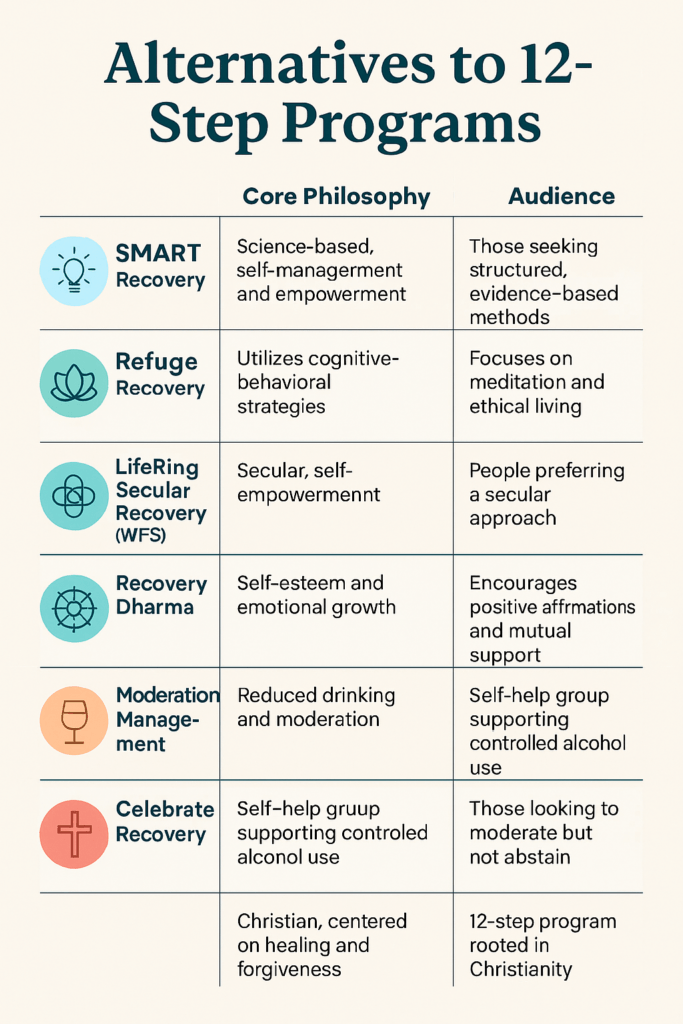
Alternatives to 12-Step Programs: A Comparison Chart
Finding the Right Recovery Path for Your Needs
Traditional 12-step programs such as Alcoholics Anonymous and Narcotics Anonymous have helped millions of people achieve sobriety. However, recovery is not one-size-fits-all. Some individuals prefer non-spiritual approaches, science-based tools, mindfulness practices, or empowerment-focused communities. In recent years, alternative recovery programs have expanded, offering personalized pathways that honor different beliefs, personalities, and healing styles. Understanding how these programs compare makes it easier to choose a recovery model that truly fits.
Why Compare Recovery Alternatives?
Choosing a recovery program is a deeply personal decision. Some people thrive in spiritually oriented groups, while others prefer clinical, self-directed, or mindfulness-based approaches. Comparing recovery models helps individuals identify:
• Whether a program is spiritual, secular, or science-based
• How structured or flexible the approach is
• Whether abstinence or moderation is the goal
• What kind of community support is offered
Comparison Chart: Alternatives to 12-Step Programs
SMART Recovery
Approach: Science-based and cognitive-behavioral
Spiritual Focus: None
Goal: Abstinence or behavior change
Best For: Individuals who want structured, evidence-based tools
Refuge Recovery
Approach: Mindfulness and Buddhist philosophy
Spiritual Focus: Non-theistic spiritual
Goal: Abstinence
Best For: Those drawn to meditation and emotional healing
Recovery Dharma
Approach: Buddhist-inspired mindfulness practice
Spiritual Focus: Non-theistic spiritual
Goal: Abstinence
Best For: People seeking spiritual growth without religion
LifeRing Secular Recovery
Approach: Peer empowerment and self-reliance
Spiritual Focus: None
Goal: Abstinence
Best For: Individuals wanting non-religious community support
Women for Sobriety
Approach: Self-esteem and empowerment model
Spiritual Focus: None
Goal: Abstinence
Best For: Women seeking gender-focused emotional support
Moderation Management
Approach: Behavioral self-management
Spiritual Focus: None
Goal: Reduced drinking (not full abstinence)
Best For: Individuals exploring controlled alcohol use
Celebrate Recovery
Approach: Christian faith-based 12-step model
Spiritual Focus: Christian
Goal: Abstinence
Best For: Individuals seeking faith-centered healing
SMART Family & Friends
Approach: CBT-based family support
Spiritual Focus: None
Goal: Support for loved ones
Best For: Families and partners of individuals in recovery
How to Choose the Right Program
The best recovery program is the one you will consistently engage with. Consider:
Your beliefs about spirituality or religion
Your desire for scientific or clinical tools
Your comfort with group sharing
Your recovery goals (abstinence vs moderation)
Your need for peer or family support
Many people combine programs or try several before finding the best fit.
Final Thought
Recovery is a personal journey, not a single formula. Today’s alternative programs ensure that everyone — regardless of beliefs or background — can find support that feels respectful, empowering, and effective. When recovery aligns with your values, lasting change becomes far more achievable.
Choosing the Right Recovery Program: A Reflection and Fit Assessment Guide
Finding the right recovery program is a deeply personal decision. This handout is designed to help
individuals explore their needs, values, and goals to choose a path that aligns with their
lifestyle—whether it’s a secular, spiritual, behavioral, or faith-based model.
1. Self-Reflection Questions
- What role do spirituality or religion play in my life and recovery goals?
- Do I prefer structured guidance from professionals or peer-led support?
- How important is evidence-based, scientific methodology in my recovery?
- Am I seeking complete abstinence or moderation-based approaches?
- What type of group dynamic feels most supportive—discussion, meditation, education, or worship?
2. Program Matching Tips
- If you value science-based structure, try SMART Recovery for cognitive and emotional tools.
- If you’re drawn to mindfulness and meditation, explore Refuge Recovery or Recovery Dharma.
- If you prefer a faith-based foundation, consider Celebrate Recovery for Christian-centered
healing. - If you want a secular, peer-driven community, LifeRing offers flexible, non-religious meetings.
- If empowerment and affirmation resonate, Women for Sobriety focuses on confidence and
emotional strength. - If moderation feels more realistic for now, Moderation Management teaches self-regulation without
abstinence.
3. Recovery Program Fit Assessment Checklist
- Aligns with my personal beliefs or values.
- Offers support that feels safe and nonjudgmental.
- Encourages long-term growth and accountability.
- Provides a structure or philosophy I can consistently commit to.
- Matches my preferred balance of independence and community support.
- Addresses both mental and emotional aspects of recovery.
- Accessible to my schedule, budget, and location (in-person or online).
4. Additional Resources
- Find local meetings and online options at SMARTRecovery.org, RefugeRecovery.org, or
LifeRing.org. - Consult your healthcare provider or therapist for personalized recommendations.
- Check local community centers or hospitals for free educational sessions on addiction and recovery
paths. - Explore SAMHSA’s National Helpline (1-800-662-HELP) for guidance and referrals.
Choosing a recovery program is about finding what supports your healing, authenticity, and growth. By
reflecting on your values, exploring different approaches, and assessing your comfort level, you can
create a recovery plan that’s sustainable and meaningful. Remember—recovery isn’t one-size-fits-all;
It’s a personal journey toward balance, freedom, and renewed purpose.
Frequently Asked Questions
Here are some common questions:
1. What are non-12-step recovery programs?
Non-12-step recovery programs are alternatives to traditional 12-step models like AA or NA. They offer recovery approaches that may be science-based, secular, mindfulness-focused, or faith-specific, without requiring belief in a higher power or step-based surrender.
2. Are non-12-step programs effective?
Yes. Many evidence-based programs, such as SMART Recovery and mindfulness-based approaches, have demonstrated effectiveness in helping individuals manage cravings, build coping skills, and maintain long-term recovery. Success depends on personal fit and consistent participation.
3. Do non-12-step programs require abstinence?
Some programs focus on full abstinence, while others — like Moderation Management — support reduced or controlled use. Each program clearly defines its recovery goal so participants can choose what aligns with their needs.
4. Are these programs religious?
Most non-12-step programs are secular. However, some, like Recovery Dharma or Refuge Recovery, use spiritual or mindfulness principles without religious doctrine. Celebrate Recovery is faith-based but is still considered an alternative model because it differs from the traditional 12-step structure.
5. Can I combine non-12-step programs with therapy or medication?
Absolutely. Many participants combine non-12-step peer programs with professional therapy, medication-assisted treatment, or counseling. Integrated care often strengthens recovery outcomes.
6. Are meetings available online?
Yes. Most non-12-step programs now offer virtual meetings, online communities, and digital resources, making recovery accessible regardless of location.
7. What if I tried 12-step programs and they didn’t work for me?
Non-12-step programs were created specifically for individuals who want alternatives. Exploring different models increases the chance of finding a recovery approach that feels comfortable and sustainable.
8. Do I need to share personal details in meetings?
Sharing is optional. Many non-12-step groups encourage participation at your comfort level, without forced confession or public testimony.
9. Which program is best for me?
The best program is the one that aligns with your beliefs, emotional needs, and lifestyle — and that you feel motivated to attend consistently.
10. Can family members join non-12-step support programs?
Yes. Programs like SMART Recovery Family & Friends offer tools for loved ones to learn communication skills, boundaries, and self-care.
11. Are non-12-step programs free?
Many meetings are free or donation-based. Some organizations charge small fees for materials or workshops, but online meetings are typically free.
12. What is the biggest advantage of non-12-step recovery?
Choice. These programs empower individuals to choose recovery paths that align with their values, beliefs, and personal identity — increasing engagement and long-term success.
Conclusion
The growth of alternative recovery models reflects a positive shift toward inclusivity, choice, and personal agency in healing. Each program—whether secular, spiritual, or faith-based—offers unique tools to help individuals build resilience and long-term sobriety. The best-fit approach depends on personal values, comfort with spirituality, and preferred learning style. By expanding beyond the one-size-fits-all structure, these alternatives empower people to find recovery that truly fits their identity, promoting not only sobriety but also emotional growth, self-compassion, and community connection.
Video: Heal and Thrive with Alternative Recovery #Non12StepRecovery #AlternativeRecovery