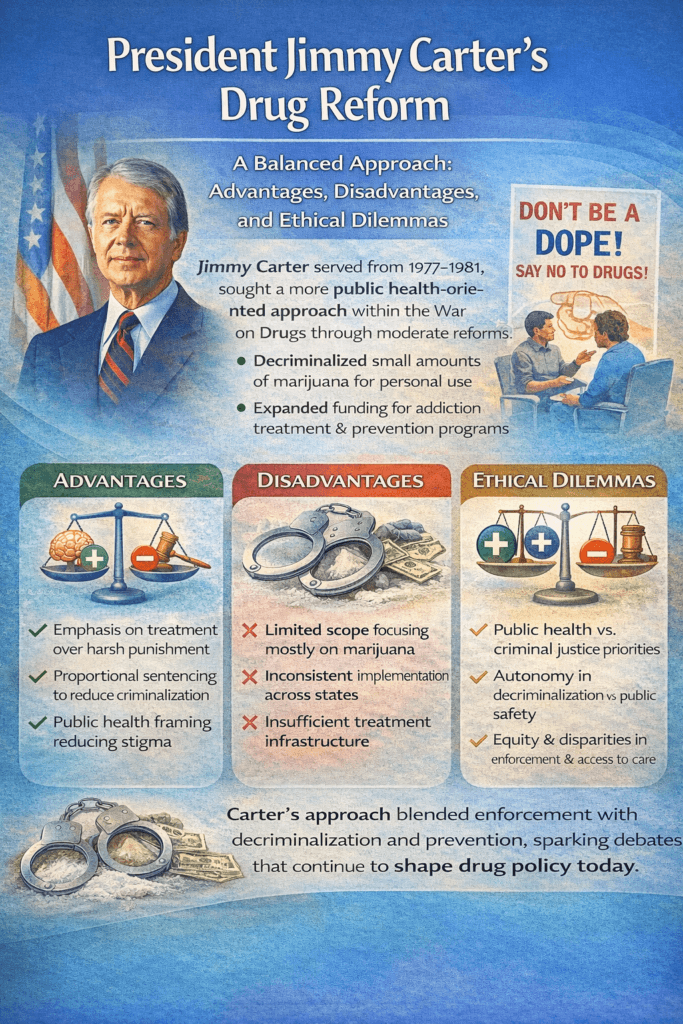
During his presidency from 1977 to 1981, Jimmy Carter adopted a reform-oriented approach within the broader War on Drugs era. While maintaining enforcement against trafficking, he publicly supported decriminalizing small amounts of marijuana and emphasized prevention, treatment expansion, and proportional sentencing. His stance represented a partial shift from purely punitive models toward incorporating public health principles into federal drug policy. The advantages of this approach included reducing excessive criminal penalties for minor possession, encouraging rehabilitation over incarceration, and reframing addiction as a health issue. However, disadvantages included a limited scope of reform, inconsistent implementation across states, and insufficient treatment infrastructure at the time. These policy shifts also introduced ethical dilemmas concerning autonomy, public safety, equity, and the balance between compassion and accountability.
Jimmy Carter and the War on Drugs: A Reform-Oriented Approach
During his presidency from 1977 to 1981, Jimmy Carter took a notably different stance on drug policy compared to the more punitive approaches that characterized much of the broader “War on Drugs” era. While the War on Drugs formally began under President Richard Nixon in the early 1970s, Carter’s administration emphasized public health, decriminalization discussions, and proportional sentencing rather than strict criminal enforcement alone.
A Shift Toward Decriminalization
One of Carter’s most discussed positions involved marijuana policy. In 1977, he publicly supported decriminalizing possession of small amounts of marijuana for personal use. His administration argued that penalties for minor possession should not be more damaging than the drug itself. Carter’s stance reflected growing concerns that harsh criminal penalties disproportionately harmed young people and created long-term social consequences, including barriers to employment and education.
However, Carter did not advocate full legalization. Instead, he supported civil penalties (such as fines) over criminal prosecution for small-scale possession, while maintaining enforcement against trafficking and large-scale distribution.
Public Health and Treatment Emphasis
Carter’s drug policy also emphasized prevention, education, and treatment. His administration expanded federal funding for drug abuse treatment programs and encouraged a medical and rehabilitative approach rather than relying solely on incarceration. This aligned with a broader understanding that substance use disorders involve behavioral and health components requiring structured support systems.
Federal Enforcement and Structural Changes
In 1979, during Carter’s term, the federal government reorganized drug enforcement efforts, resulting in the creation of the Drug Enforcement Administration (DEA), which, under earlier administrations, had been consolidated within the newly created Department of Justice and other federal agencies. Carter maintained enforcement against trafficking networks, particularly in response to rising concerns about cocaine entering the United States.
Political and Cultural Context
Carter’s more moderate tone toward marijuana and his public health framing were controversial at the time. The late 1970s saw increasing public concern about drug use, especially with the growth of cocaine markets. By the early 1980s, political momentum shifted toward more aggressive enforcement under subsequent administrations, marking a departure from Carter’s comparatively reform-minded posture.
Legacy and Historical Perspective
Jimmy Carter’s stance during his presidency is often viewed as an early example of balancing enforcement with decriminalization and treatment-focused strategies. While he did not dismantle the War on Drugs framework, he introduced a national conversation about proportional penalties and rehabilitation. Decades later, many aspects of his position—particularly marijuana decriminalization and treatment-centered responses—have re-emerged in modern drug policy debates.
The Advantages of Jimmy Carter’s Drug Policy Approach in Addressing the Addiction Epidemic
During his presidency (1977–1981), Jimmy Carter introduced a more balanced and reform-oriented approach within the broader War on Drugs framework. While enforcement against trafficking continued, his agenda emphasized proportional penalties, treatment expansion, and public health strategies. Several aspects of this approach offer advantages when considering solutions to today’s addiction epidemic.
1. Emphasis on Treatment Over Excessive Punishment
One major advantage of Carter’s stance was the recognition that substance use disorders require treatment, not solely incarceration. Expanding funding for prevention and rehabilitation acknowledged addiction as a health issue rather than purely a criminal one. This approach reduces long-term societal costs by improving recovery rates and decreasing recidivism.
2. Proportional Sentencing and Reduced Criminalization
Carter’s support for decriminalizing small amounts of marijuana aimed to prevent lifelong consequences for minor possession offenses. By reducing harsh criminal penalties for low-level users, his approach limited barriers to employment, housing, and education—factors that strongly influence recovery and relapse risk. In modern terms, this aligns with diversion programs and harm-reduction strategies.
3. Public Health Framing
Carter’s administration helped shift parts of the national conversation from moral judgment to public health. Viewing addiction through a prevention and treatment lens encourages early intervention, mental health integration, and community-based care. Public health framing reduces stigma, a major barrier to treatment engagement today.
4. Prevention and Education Focus
By supporting education initiatives and prevention programs, Carter’s agenda recognized that reducing demand is as important as controlling supply. Prevention strategies—especially those targeting youth—strengthen resilience before addiction develops. This proactive orientation is critical in addressing emerging drug trends.
5. Balanced Enforcement
Although Carter favored reform for minor offenses, he maintained enforcement against trafficking networks. This balance allowed for accountability at higher levels of distribution while avoiding excessive punishment of individuals struggling with addiction. A targeted enforcement strategy can protect communities without overburdening the justice system.
6. Long-Term Social Stability
Reducing overcriminalization and investing in treatment strengthens families, workforce participation, and community cohesion. Policies that minimize unnecessary incarceration help prevent generational cycles of poverty and instability that contribute to substance misuse.
A Modern Perspective
While Carter’s approach did not eliminate drug-related harms, many of its principles—proportional sentencing, expanded treatment access, prevention emphasis, and reduced stigma—align with contemporary evidence-based responses to the addiction epidemic. Blending public health strategies with focused enforcement remains one of the most sustainable pathways for reducing addiction-related harm.
The Disadvantages of Jimmy Carter’s Drug Policy Approach in Addressing the Addiction Epidemic
During his presidency (1977–1981), Jimmy Carter pursued a more reform-oriented position within the broader War on Drugs framework. He supported the decriminalization of small amounts of marijuana and emphasized treatment and prevention. While aspects of his approach are viewed positively in modern public health discussions, there were also limitations and potential disadvantages when applied to the broader addiction epidemic.
1. Limited Scope of Reform
Carter’s decriminalization support focused primarily on marijuana possession and did not substantially address harder substances such as heroin or cocaine. As cocaine use rose sharply in the late 1970s, the broader stimulant epidemic required more comprehensive policy responses than what was implemented during his term. The limited scope may have a constrained impact on emerging drug crises.
2. Inconsistent National Implementation
Even when federal rhetoric favored decriminalization or treatment expansion, drug enforcement policies remained largely controlled at the state level. Without uniform policy shifts across states, disparities in enforcement persisted. This inconsistency reduced the practical effectiveness of reform messaging.
3. Insufficient Infrastructure for Treatment
Although Carter expanded funding for prevention and treatment, the treatment system at the time lacked the scale and evidence-based protocols seen today. Medication-assisted treatment, long-term recovery models, and integrated mental health services were less developed. As a result, increased funding alone may not have been enough to meaningfully reduce addiction prevalence.
4. Public Perception Challenges
Carter’s more moderate tone toward marijuana decriminalization faced political backlash. Some critics argued that loosening penalties could signal permissiveness and potentially increase experimentation. In times of rising drug concern—especially with growing cocaine markets—public sentiment often favored stricter enforcement, limiting bipartisan support for reform.
5. Continued Enforcement Framework
Despite reform efforts, Carter did not dismantle the broader enforcement structure of the War on Drugs. Federal and state criminal justice systems still prioritized drug arrests, which meant incarceration remained a central response to addiction. This limited the full transition to a health-centered model.
6. Limited Impact on Supply Chains
While Carter maintained enforcement against trafficking networks, international drug trade complexities—particularly involving cocaine—expanded rapidly. Without major structural shifts in global supply reduction strategies, domestic reforms had limited influence on availability.
A Balanced Historical Perspective
Jimmy Carter’s approach introduced important public health discussions into federal drug policy, but it faced structural, political, and practical constraints. The disadvantages largely stemmed from limited infrastructure, incomplete systemic reform, and rising drug trends that outpaced policy adaptation. In hindsight, his term reflects both an early attempt at moderation and the challenges of shifting national drug policy within a politically divided and rapidly evolving substance landscape.
Ethical Dilemmas in Applying Jimmy Carter’s Drug Policy Approach to the Addiction Epidemic
During his presidency (1977–1981), Jimmy Carter adopted a more reform-oriented stance within the broader War on Drugs framework. He supported decriminalizing small amounts of marijuana and emphasized prevention and treatment. While this approach is often viewed as more humane than strictly punitive models, applying his agenda to the addiction epidemic raises several ethical dilemmas that remain relevant today.
1. Public Health vs. Criminal Justice
One central ethical tension involves whether addiction should be treated primarily as a health condition or a criminal act. Carter’s agenda attempted to balance both perspectives—supporting treatment expansion while maintaining enforcement against trafficking. Ethically, this dual model can create inconsistency: individuals may be framed as patients in need of care while simultaneously facing criminal penalties. This raises questions about fairness, proportionality, and stigma.
2. Autonomy vs. Protection
Decriminalization efforts reflect respect for individual autonomy, particularly regarding personal substance use. However, public health policy must also protect communities from harm. The ethical dilemma lies in determining when government intervention protects public welfare and when it encroaches on personal choice. Striking that balance remains controversial in addiction policy debates.
3. Equity and Disparities
Even with reform-oriented messaging, enforcement systems historically produced disparities in arrest and sentencing across racial and socioeconomic groups. An ethical challenge in applying Carter’s framework is ensuring that reduced penalties and expanded treatment are implemented equitably. Without systemic safeguards, well-intentioned reforms can still perpetuate unequal outcomes.
4. Harm Reduction vs. Moral Messaging
Carter’s more moderate tone on marijuana decriminalization contrasted with the strong anti-drug cultural messaging of the era. Ethically, policymakers must consider whether harm-reduction strategies send mixed signals to youth or vulnerable populations. The dilemma centers on whether pragmatic, health-based approaches undermine deterrence or, more accurately, reflect evidence-based prevention.
5. Resource Allocation
Expanding treatment and prevention requires funding. Ethically, governments must decide how to allocate limited resources among enforcement, healthcare, education, and social services. Over-investing in enforcement may neglect treatment; under-investing in enforcement may fail to address trafficking networks. Balancing these competing priorities presents ongoing moral and fiscal challenges.
6. Responsibility and Stigma
Framing addiction as a health issue reduces blame, yet maintaining elements of criminalization may reinforce stigma. The ethical question becomes: can society simultaneously treat addiction compassionately while preserving punitive structures? This tension remains central to discussions of modern drug policy reform.
A Contemporary Ethical Reflection
Jimmy Carter’s drug policy approach introduced early public health considerations into a largely enforcement-driven era. However, applying his framework to the addiction epidemic highlights enduring ethical dilemmas: balancing care with accountability, autonomy with protection, equity with enforcement, and compassion with deterrence. These tensions continue to shape drug policy debates today, underscoring that addiction policy is not only a public health issue but also a deeply ethical one.
Frequently Asked Questions
Here are some common questions:
What was President Jimmy Carter’s overall stance on drug policy?
During his presidency (1977–1981), Carter supported a more balanced approach within the broader War on Drugs framework. He maintained enforcement against trafficking but advocated for treatment, prevention, and proportional penalties—especially regarding marijuana possession.
Did Jimmy Carter support marijuana legalization?
No. Carter supported decriminalizing small amounts of marijuana for personal use, meaning replacing criminal penalties with civil fines. He did not advocate for full legalization or commercial regulation during his term.
Why did Carter favor the decriminalization of small amounts of marijuana?
He believed that criminal penalties for minor possession often caused more harm than the drug itself, especially for young people. Criminal records could create long-term barriers to employment, education, and housing.
Did his policies reduce the War on Drugs?
Carter did not dismantle the War on Drugs framework. Enforcement against trafficking continued, but his rhetoric and policy direction placed greater emphasis on prevention and treatment.
How did Carter approach addiction treatment?
His administration expanded federal support for prevention and treatment programs, recognizing substance use disorders as health issues that required rehabilitation rather than incarceration alone.
What were the advantages of his approach?
Advantages included promoting proportional sentencing, reducing overcriminalization for minor offenses, increasing treatment funding, and beginning to frame addiction as a public health issue rather than solely a criminal matter.
What were the disadvantages?
Reforms were limited in scope and faced political resistance. Rising cocaine use in the late 1970s shifted public concern toward stronger enforcement, and treatment systems at the time were not fully developed or standardized.
Were there ethical debates surrounding his reforms?
Yes. Ethical tensions involved balancing individual autonomy with public safety, determining the proper role of criminal justice versus healthcare, and addressing disparities in enforcement.
How did his stance compare to later administrations?
Carter’s approach was more moderate than the stricter enforcement strategies that followed in the 1980s. Subsequent administrations expanded mandatory minimum sentencing and intensified federal drug enforcement.
What is his legacy in modern drug policy discussions?
Carter’s term is often viewed as an early attempt to integrate public health principles into federal drug policy. Many contemporary debates around decriminalization and treatment-centered responses echo themes introduced during his presidency.
Conclusion
President Carter’s drug reform efforts illustrate the complexity of navigating addiction policy within political, social, and institutional constraints. His administration helped initiate a national conversation about proportional penalties and treatment-focused strategies, laying the groundwork for later public health-oriented reforms. Yet structural limitations, political opposition, and rising drug use constrained the full realization of his agenda. Ethically, his approach highlighted enduring tensions between criminal justice and healthcare models, individual freedom and societal protection, and equity and enforcement. In retrospect, Carter’s term represents an early attempt to balance reform with regulation—an effort that underscores how addiction policy must continually reconcile public health evidence with legal, ethical, and societal considerations.
Video: What Jimmy Carter Knew About Drugs That We Forgot #politics #shorts