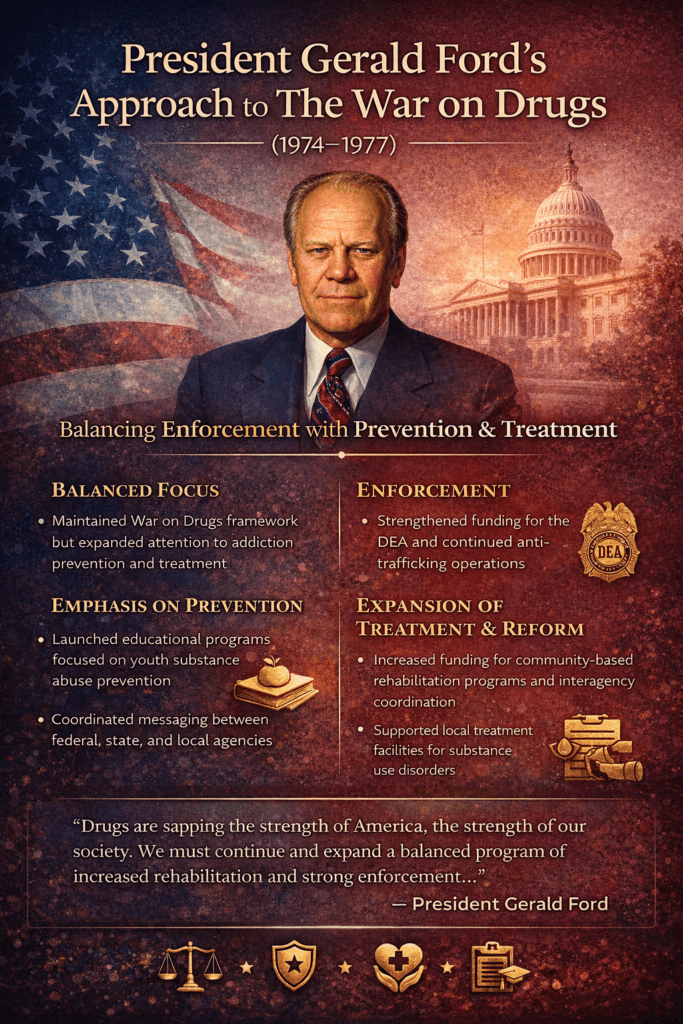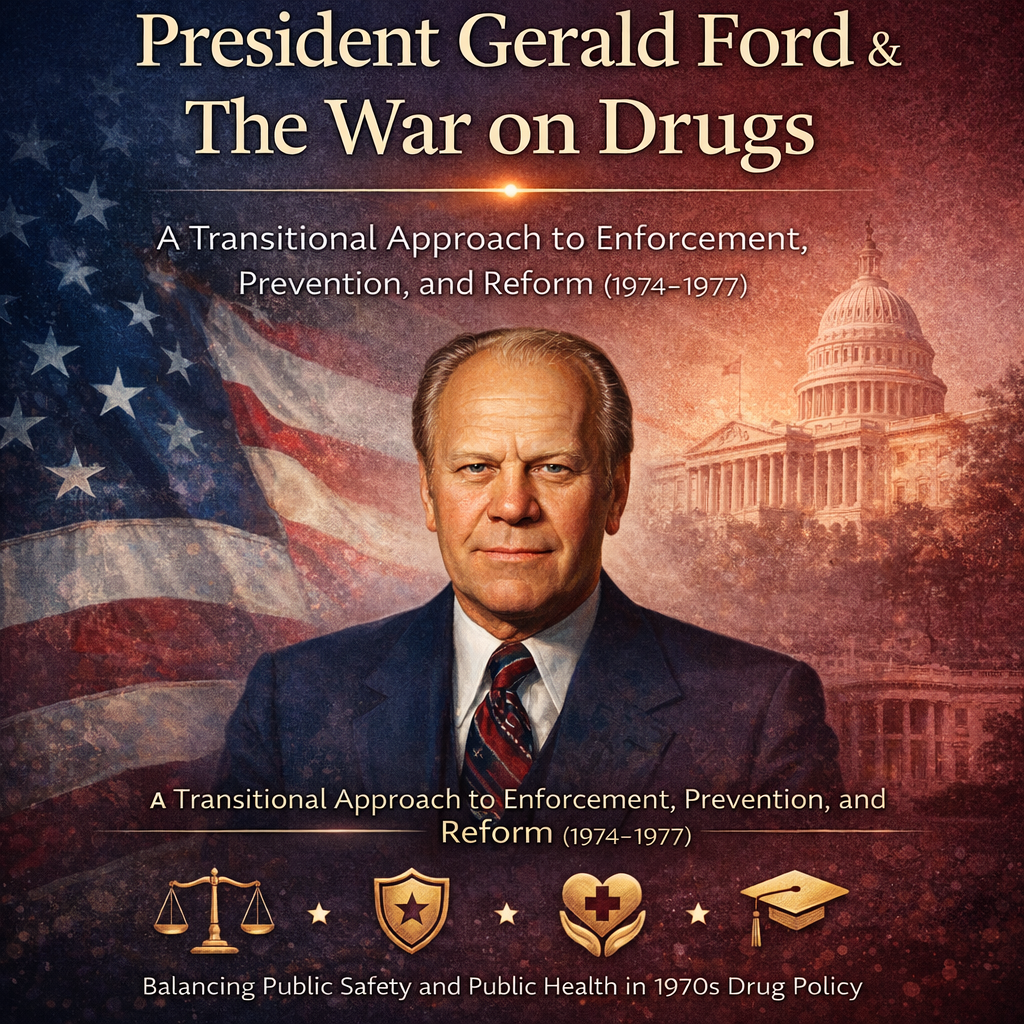
Gerald Ford assumed office at a pivotal moment in American drug policy, following President Nixon’s resignation. There is a growing national concern about substance misuse. He inherited the broader War on Drugs infrastructure that emphasized federal enforcement, centralized drug control agencies, and supply-reduction strategies. Rather than dismantling this framework, Ford adopted a cautious and pragmatic approach. He maintained enforcement mechanisms to preserve political stability and public confidence, yet gradually broadened the national conversation to include prevention, treatment, and interagency collaboration.
Ford’s administration increasingly recognized that addiction could not be addressed solely through criminal justice responses. While law enforcement remained active, greater emphasis was placed on community-based treatment initiatives, youth-focused prevention campaigns, and improved coordination between federal, state, and local agencies. His leadership reflected an incremental reform philosophy—working within established systems to improve efficiency and responsiveness rather than pursuing sweeping structural change. In tone and policy direction, Ford’s presidency marked a subtle but meaningful shift toward acknowledging addiction as a public health issue, even as criminal justice tools continued to play a central role in national drug strategy.
Gerald Ford and the War on Drugs: A Shift Toward Treatment and Reform
When President Gerald Ford took office in 1974, the United States was already immersed in the broader framework of the “War on Drugs” initiated under prior administrations. However, Ford’s stance reflected a nuanced shift in tone—placing greater emphasis on treatment, prevention, and administrative reform rather than purely punitive enforcement.
Ford inherited federal drug control structures established during the Nixon era, including the consolidation of enforcement efforts under the Drug Enforcement Administration (DEA). While law enforcement remained a key component of federal policy, Ford’s administration increasingly recognized substance use as a public health issue alongside a criminal justice concern. This balanced perspective shaped his approach to reform.
During his presidency, federal funding for prevention and rehabilitation programs expanded. The administration supported community-based treatment initiatives and educational campaigns designed to reduce demand rather than focusing exclusively on supply reduction. Ford emphasized coordination between federal agencies and local communities, underscoring that addiction requires structured interventions and cross-sector collaboration.
Importantly, Ford’s administration began laying the groundwork for what would later become more integrated prevention models. Public messaging during this period increasingly addressed youth substance use, school-based prevention, and the importance of early intervention. While enforcement efforts against trafficking continued, the policy conversation broadened to include recovery-oriented services and community responsibility.
From a reform standpoint, Ford sought to enhance administrative efficiency and coordination in federal drug policy. His leadership reflected an understanding that fragmented systems limited effectiveness. Although not revolutionary, these reforms represented incremental progress toward integrating treatment within the national drug strategy.
In retrospect, President Ford’s stance can be viewed as a transitional phase in U.S. drug policy—bridging enforcement-heavy frameworks with emerging recognition of addiction as a health condition. His administration maintained the War on Drugs infrastructure while cautiously expanding prevention and treatment initiatives.
For addiction professionals and policymakers today, Ford’s era highlights an enduring tension in drug policy: balancing public safety with compassionate care. His presidency reminds us that meaningful reform often occurs not through abrupt change but through steady shifts in priorities—especially when science, public health, and policy begin to move in the same direction.
Advantages of Gerald Ford’s Stance on the War on Drugs and Reform
President Gerald Ford’s approach to drug policy during the mid-1970s reflected a measured balance between enforcement and public health reform. While maintaining the broader framework of the War on Drugs, his administration demonstrated several advantages by expanding attention toward treatment, prevention, and interagency coordination.
One key advantage was the growing recognition of addiction as more than a criminal issue. By supporting treatment and rehabilitation programs, Ford’s stance helped reinforce the idea that substance use disorders require medical and behavioral intervention. This approach aligned with emerging scientific understanding of addiction as a brain-based condition rather than solely a moral failing.
Another strength of Ford’s policy direction was increased emphasis on prevention, particularly among youth. Educational campaigns and school-based awareness efforts aimed to reduce demand before patterns of substance misuse became entrenched. Investing in prevention is a cost-effective strategy that could reduce long-term burdens on healthcare and criminal justice systems.
Ford’s administration also supported coordination between federal agencies and local communities. This focus on administrative reform helped reduce fragmentation within drug policy systems. Improved communication among law enforcement, health services, and community organizations enhanced the ability to deliver more consistent and structured responses to substance misuse.
Maintaining enforcement while gradually expanding treatment funding provided stability during a politically sensitive era. Rather than abruptly dismantling existing systems, Ford worked within established structures, reducing policy volatility and maintaining public confidence while broadening the conversation around care.
From a public health perspective, Ford’s balanced stance helped lay the groundwork for later recovery-oriented models. By acknowledging both supply control and demand reduction, his administration contributed to a more comprehensive understanding of addiction policy.
In retrospect, the advantages of Ford’s approach lie in its moderation and integration. His presidency demonstrated that effective drug reform does not require abandoning enforcement entirely but benefits from incorporating prevention, treatment, and coordinated community response. This balanced framework continues to inform modern discussions on sustainable, evidence-based addiction policy.
Disadvantages of Gerald Ford’s Stance on the War on Drugs and Reform
While President Gerald Ford introduced elements of prevention and treatment into national drug policy, his stance also carried notable disadvantages. His administration largely maintained the broader War on Drugs framework established earlier in the decade, meaning enforcement remained a dominant pillar of federal strategy.
One major limitation was the continued emphasis on criminal justice responses. Although treatment funding expanded modestly, enforcement infrastructure remained strong, reinforcing punitive approaches. This imbalance meant that many individuals struggling with substance use disorders continued to encounter the legal system before receiving appropriate medical or behavioral health care.
Another disadvantage was the incremental nature of reform. Ford’s adjustments were cautious rather than transformative. As a result, systemic issues—such as limited access to treatment, stigma, and uneven resource distribution—were not fundamentally restructured. Communities with high substance use rates often lacked sufficient treatment capacity despite growing recognition of addiction as a health issue.
Critics also argue that maintaining a War on Drugs framework, even with expanded prevention efforts, perpetuates long-term consequences such as rising incarceration rates and disproportionate impacts on marginalized communities. Because enforcement policies were not significantly scaled back, structural inequities embedded within the system continued.
Additionally, prevention messaging during the 1970s often relied heavily on abstinence-focused campaigns without fully integrating emerging evidence about behavioral health and trauma. This limited the depth of intervention strategies and may have reduced effectiveness among high-risk populations.
From a policy standpoint, Ford’s approach reflected political caution during a transitional period. However, this caution may have slowed the development of a more comprehensive public health model that integrated addiction treatment into mainstream healthcare systems earlier.
In hindsight, the disadvantages of Ford’s stance highlight the challenges of balancing enforcement with reform. While his administration acknowledged the need for prevention and treatment, the continuation of a primarily punitive structure limited the potential for more substantial change. These lessons remain relevant today as policymakers strive to design drug strategies that prioritize equity, science, and long-term recovery outcomes.
Ethical Dilemmas in Gerald Ford’s War on Drugs Stance and Reform Efforts
President Gerald Ford’s approach to drug policy during the mid-1970s reflected an attempt to balance enforcement with emerging calls for treatment and prevention. However, this balanced stance also created significant ethical dilemmas—many of which continue to shape drug policy debates today.
One central ethical tension was between punishment and treatment. While Ford’s administration expanded prevention and rehabilitation efforts, it maintained the broader enforcement structure of the War on Drugs. This raised moral questions about whether individuals with substance use disorders were being treated as patients in need of care or offenders deserving punishment. The coexistence of both approaches often led to inconsistent responses across jurisdictions and disparities in resource access.
Another dilemma centered on justice and equity. Enforcement-heavy policies, even when accompanied by prevention messaging, disproportionately affected certain communities. Ethical concerns emerged regarding fairness, particularly when incarceration rates rose among marginalized populations. Balancing public safety with equitable treatment became a complex moral challenge.
A further ethical issue involved autonomy and public health responsibility. Prevention campaigns aimed at youth and communities were intended to protect public welfare, yet critics questioned whether abstinence-based messaging adequately respected individual autonomy or addressed underlying social determinants such as poverty, trauma, and limited access to care.
There was also an ethical debate about resource allocation. Maintaining strong enforcement infrastructures while gradually expanding treatment programs required substantial funding. Policymakers faced difficult decisions about how to distribute limited resources between criminal justice systems and healthcare services. Critics argued that insufficient investment in treatment limited the effectiveness of reform efforts.
Additionally, the incremental nature of Ford’s reforms posed an ethical question about urgency. With addiction affecting families and communities nationwide, some believed more decisive action toward a health-centered model was morally necessary. Others defended gradual reform as politically realistic and socially stabilizing.
In retrospect, the ethical dilemmas of Ford’s drug policy illustrate the complexity of governing during a transitional era. His administration recognized addiction as a societal issue requiring prevention and treatment, yet retained enforcement mechanisms that raised concerns about fairness and proportionality. These tensions underscore a broader lesson: drug policy is not only a legal or political matter—it is an ethical balancing act between compassion, accountability, public safety, and social justice.
Frequently Asked Questions
Here are some common questions:
1. What was President Gerald Ford’s general stance on the War on Drugs?
President Ford maintained the broader War on Drugs framework he inherited but introduced a more balanced emphasis on prevention, treatment, and interagency coordination alongside enforcement.
2. Did Ford reduce enforcement efforts?
No. Enforcement structures remained in place during his presidency. However, his administration placed greater emphasis on rehabilitation and prevention strategies rather than on punitive measures.
3. How did Ford view addiction?
While criminal justice remained part of federal strategy, Ford’s policies reflected growing recognition that addiction required treatment and prevention efforts, not just incarceration.
4. Did his administration support treatment programs?
Yes. Ford supported the expansion of community-based treatment and rehabilitation initiatives, thereby laying the groundwork for integrating public health approaches into national drug policy.
5. What role did prevention play under Ford?
Prevention became more visible during his administration, especially youth-focused education campaigns aimed at reducing drug demand before substance use patterns became entrenched.
6. Were there criticisms of his approach?
Yes. Critics argue that reforms were incremental and did not significantly scale back punitive enforcement, which continued to contribute to disparities and incarceration concerns.
7. Did Ford dramatically reform national drug policy?
No. His approach was transitional rather than revolutionary. He worked within established systems while gradually broadening attention toward public health measures.
8. How did his presidency influence later drug policy?
Ford’s administration helped bridge enforcement-focused policies with emerging public health perspectives, influencing later debates about balancing criminal justice with treatment and prevention.
9. What ethical tensions surrounded his stance?
Key tensions included balancing punishment versus treatment, allocating resources between enforcement and healthcare, and addressing equity concerns within drug policy systems.
10. Why is Ford’s drug policy still relevant today?
His presidency highlights an enduring challenge in addiction policy: finding the right balance between public safety, compassionate care, and evidence-based reform. The same debate continues in modern drug policy discussions.
Conclusion
In retrospect, President Ford’s approach to drug policy illustrates the complexities of reform within a politically sensitive climate. His administration preserved enforcement priorities while creating space for prevention and treatment to gain greater visibility within the national strategy. While critics argue that reforms were incremental and insufficient to address systemic inequities, supporters note that his balanced stance helped bridge punitive frameworks with emerging public health perspectives. Ultimately, Ford’s era highlights an enduring policy challenge: reconciling accountability with compassion while shaping a drug strategy that protects communities and supports recovery.
Video: How Gerald Ford Balanced Tough Enforcement With Real Reform #politics #shorts