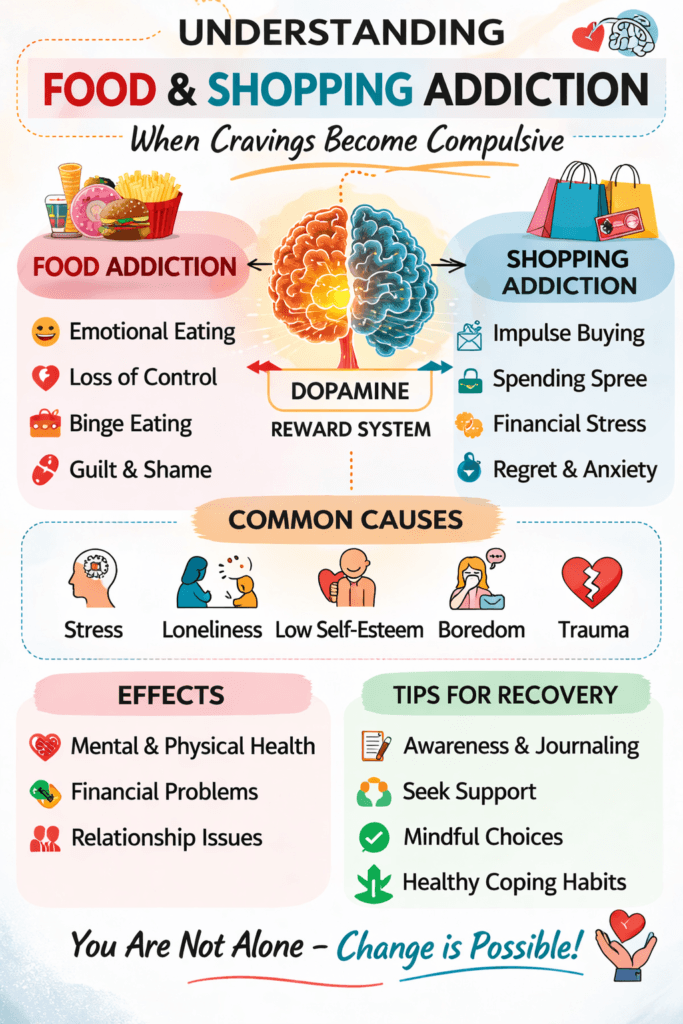
Understanding food and shopping addiction requires looking beyond behavior to the psychological, neurological, and social factors driving compulsion. While eating and purchasing are normal activities, they can become unhealthy coping strategies for stress, trauma, or low self-worth. Both activate the brain’s reward system, reinforcing cycles of craving and temporary relief followed by guilt. Over time, this pattern can lead to loss of control and impairment. A biopsychosocial perspective promotes compassion, reduces stigma, and supports effective intervention.
Understanding Food and Shopping Addiction: When Everyday Needs Become Emotional Dependencies
In modern society, food and shopping are normal, even necessary, parts of life. We all need to eat. We all need to purchase essentials. But for some individuals, these behaviors shift from functional activities to emotional coping mechanisms that can feel difficult — or even impossible — to control.
Food addiction and shopping addiction are behavioral patterns rooted in the brain’s reward system. While they are not identical disorders, they share psychological and neurological similarities that help explain why they can become so powerful.
What Is Food Addiction?
Food addiction refers to compulsive overeating — particularly highly processed foods rich in sugar, fat, and salt — despite negative consequences. While not formally classified as a substance use disorder in the DSM-5, researchers often compare it to drug addiction because similar neural pathways are involved.
The Brain Connection
Highly palatable foods stimulate dopamine release in the brain’s reward circuitry, particularly in the nucleus accumbens. Dopamine is the neurotransmitter associated with pleasure, reinforcement, and motivation. Over time, repeated overstimulation can:
- Reduce dopamine receptor sensitivity
- Increase cravings
- Lead to tolerance (needing more food for the same reward)
- Create withdrawal-like symptoms such as irritability or low mood
This cycle mirrors patterns seen in substance addictions.
Emotional and Psychological Triggers
Food addiction is rarely just about hunger. Common triggers include:
- Stress
- Loneliness
- Trauma
- Depression or anxiety
- Boredom
Food becomes a short-term regulator of emotional distress. Unfortunately, the relief is temporary and often followed by guilt, shame, or physical discomfort, reinforcing the cycle.
What Is Shopping Addiction?
Shopping addiction, clinically referred to as compulsive buying disorder (CBD), involves excessive, impulsive purchasing that leads to financial strain, relationship conflict, or emotional distress.
Unlike responsible consumer behavior, compulsive shopping is driven by emotional needs rather than necessity.
The Psychological Mechanism
Shopping activates the brain’s anticipation and reward pathways. Interestingly, research suggests that the anticipation of buying often produces more dopamine release than the actual purchase.
Individuals with compulsive buying patterns may experience:
- A rush or “high” while browsing or purchasing
- Loss of control over spending
- Hiding purchases
- Financial consequences
- Emotional crashes after buying
Shopping can temporarily increase feelings of identity, status, control, or self-worth — particularly in individuals struggling with low self-esteem or mood disorders.
Shared Underlying Factors
Though food and shopping addictions involve different behaviors, they share common underlying dynamics:
1. Dopamine Dysregulation
Both behaviors hijack the brain’s reward system.
2. Emotional Avoidance
They often function as coping strategies to avoid distressing emotions.
3. Impulse Control Difficulties
Impaired executive functioning (linked to the prefrontal cortex) reduces the ability to delay gratification.
4. Trauma and Attachment Patterns
Early relational instability can increase vulnerability to external soothing mechanisms.
5. Shame Cycles
Guilt and shame reinforce secrecy and continuation of the behavior.
Risk Factors
Certain individuals may be more vulnerable due to:
- Genetic predisposition to addictive tendencies
- Mood disorders (depression, bipolar disorder, anxiety)
- ADHD
- Trauma history
- Chronic stress exposure
Environmental factors such as food marketing, fast-food accessibility, targeted advertising, and easy online purchasing amplify risk in modern society.
When Does It Become a Problem?
A behavior becomes problematic when it:
- Causes significant distress
- Interferes with work, school, or relationships
- Creates financial or health consequences
- Feels out of control
- Continues despite negative outcomes
The key distinction is loss of control and functional impairment, not frequency alone.
Treatment and Recovery
Recovery is possible, and it often involves addressing the root emotional drivers rather than focusing solely on behavior suppression.
Evidence-Based Approaches
- Cognitive Behavioral Therapy (CBT)
- Dialectical Behavior Therapy (DBT)
- Trauma-informed therapy
- Financial counseling (for shopping addiction)
- Nutritional counseling (for food addiction patterns)
- Support groups
In some cases, medication may help manage underlying mood or impulse-control disorders.
Rebuilding Self-Regulation
Effective recovery often focuses on:
- Developing emotional awareness
- Strengthening distress tolerance
- Improving impulse control
- Building healthier reward systems (exercise, creative outlets, connection)
- Practicing mindful consumption
A Compassionate Perspective
It is important to approach behavioral addictions with compassion rather than judgment. These patterns are not moral failures; they are learned coping mechanisms that once served a protective function.
Understanding the neurobiology and psychology behind food and shopping addiction reduces stigma and increases the likelihood of meaningful intervention.
Final Thoughts
In a culture that normalizes excess consumption, it can be difficult to recognize when everyday behaviors become addictive patterns. Awareness is the first step toward change.
If food or shopping feels less like a choice and more like a compulsion, it may be helpful to explore what emotional needs are being met — and what healthier alternatives could provide lasting fulfillment.
Healing begins not with restriction, but with understanding.
Self-Management Strategies in Understanding Food and Shopping Addiction
Practical Tools for Regaining Control and Rebuilding Emotional Balance
Food and shopping addictions are not simply issues of willpower. They are patterns reinforced by neurobiology, emotional conditioning, and environmental triggers. Both behaviors activate the brain’s reward system, particularly dopamine pathways, creating cycles of craving, temporary relief, and subsequent guilt or distress.
Self-management does not mean handling everything alone. Instead, it refers to intentional strategies that strengthen self-regulation, emotional awareness, and behavioral control. Below are evidence-informed strategies that target the psychological and neurological mechanisms underlying compulsive eating and compulsive buying.
1. Strengthening Awareness of Triggers
Addictive behaviors are often triggered by emotional states rather than physical need. Common triggers include:
- Stress
- Loneliness
- Boredom
- Shame
- Fatigue
- Conflict
Practical Strategy: Trigger Mapping
Keep a structured journal for 2–3 weeks and record:
- What happened before the urge?
- What emotion was present?
- What thoughts appeared?
- What action followed?
Over time, patterns emerge. Awareness reduces automaticity, which is critical because addictive behaviors thrive on unconscious repetition.
2. Interrupting the Dopamine Cycle
Both compulsive eating and compulsive shopping stimulate the brain’s reward system. Overstimulation can reduce sensitivity to natural rewards.
Practical Strategy: The 10-Minute Rule
When an urge arises:
- Delay the behavior for 10 minutes.
- Engage in an alternative dopamine-regulating activity:
- A short walk
- Cold water on the face
- Deep breathing
- Light exercise
- Calling a supportive person
Urges peak and decline like waves. Delaying builds distress tolerance and strengthens the prefrontal cortex’s regulatory function.
3. Environmental Restructuring
Addictive behaviors are heavily cue-dependent. Modifying the environment reduces cognitive load and reliance on willpower.
For Food Addiction Patterns:
- Remove highly processed trigger foods from visible spaces.
- Plan structured meals to prevent extreme hunger.
- Avoid grocery shopping when emotionally distressed.
For Shopping Addiction Patterns:
- Unsubscribe from marketing emails.
- Remove saved credit card information from online platforms.
- Implement a 24-hour waiting rule before nonessential purchases.
- Use cash instead of cards to increase psychological awareness of spending.
Environmental design works because behavior is often easier to change than motivation.
4. Emotional Regulation Skill Development
Many compulsive behaviors function as tools for emotional avoidance. Replacing them requires building emotional processing capacity.
Evidence-Based Skills
Cognitive Behavioral Techniques (CBT):
- Identify cognitive distortions (“I deserve this” or “I’ve already failed, so it doesn’t matter.”)
- Challenge all-or-nothing thinking.
Dialectical Behavior Therapy (DBT) Skills:
- Distress tolerance exercises (grounding, sensory reset)
- Emotion labeling (“I feel rejected,” not just “I feel bad.”)
- Opposite action (doing the opposite of the impulsive urge)
Labeling emotions activates cortical regions that reduce amygdala reactivity — a neurological mechanism supporting self-control.
5. Financial and Nutritional Structuring
Structure reduces impulsivity.
For Shopping Addiction:
- Create a zero-based budget.
- Track every purchase.
- Establish accountability with a trusted person.
- Set automatic savings transfers.
For Food Addiction:
- Eat balanced meals containing protein, fiber, and healthy fats.
- Avoid extreme dieting, which increases binge vulnerability.
- Establish consistent meal timing to stabilize blood sugar and mood.
Stability in physiology supports stability in behavior.
6. Addressing Underlying Psychological Conditions
Food and shopping addictions frequently co-occur with:
- Depression
- Anxiety disorders
- ADHD
- Trauma-related disorders
Untreated underlying conditions increase vulnerability to compulsive coping behaviors. Professional support through therapy or psychiatric evaluation may be necessary when self-management alone is insufficient.
Self-management is not a substitute for treatment when impairment is significant.
7. Rebuilding Healthy Reward Systems
Addictive behaviors narrow the reward system. Recovery expands it.
Healthy dopamine sources include:
- Physical activity
- Creative expression
- Social connection
- Skill development
- Volunteering
- Mindfulness practice
The goal is not deprivation, but diversification of reward.
8. Practicing Self-Compassion Instead of Shame
Shame reinforces addictive cycles by increasing emotional distress, which then triggers the behavior again.
Self-compassion involves:
- Recognizing imperfection as part of being human
- Responding to lapses with curiosity rather than criticism
- Viewing setbacks as data, not failure
Research shows that self-compassion enhances behavioral accountability more effectively than self-criticism.
9. Knowing When to Seek Additional Support
Self-management strategies are powerful, but certain signs indicate a need for professional intervention:
- Severe financial debt
- Health complications
- Inability to control behavior despite repeated attempts
- Co-occurring mental health disorders
- Suicidal thoughts
Evidence-based treatments such as CBT, DBT, trauma-informed therapy, and group support can significantly improve outcomes.
Final Reflection
Food and shopping addictions are complex behavioral patterns rooted in neurobiology, emotion regulation, and environmental reinforcement. Effective self-management requires more than restriction — it requires awareness, restructuring, skill-building, and compassion.
Recovery is not about perfection. It is about gradually shifting from automatic coping to intentional living.
Sustainable change begins with understanding — and continues with structured, consistent self-regulation strategies.
Family Support Strategies in Understanding Food and Shopping Addiction
How Loved Ones Can Promote Recovery Without Enabling the Behavior
Food and shopping addictions are behavioral patterns rooted in emotional regulation difficulties and the brain’s reward system. While individual responsibility is part of recovery, family dynamics significantly influence both the development and healing of compulsive behaviors.
Families can unintentionally reinforce addictive cycles through criticism, financial rescue, food policing, or avoidance of difficult conversations. However, when informed and intentional, family members can become powerful protective factors in long-term recovery.
This article explores practical, research-informed strategies families can use to provide support while maintaining healthy boundaries.
1. Educate the Family System
Understanding that food and shopping addiction are not simply “lack of willpower” reduces blame and shame.
Both behaviors involve:
- Dopamine-driven reward cycles
- Emotional avoidance mechanisms
- Impulse control challenges
- Possible co-occurring conditions (anxiety, depression, ADHD, trauma history)
When families shift from moral judgment to neurobiological understanding, communication becomes more productive and less reactive.
2. Separate the Person from the Behavior
One of the most important principles in addiction support is distinguishing identity from behavior.
Instead of:
- “You’re irresponsible.”
- “You have no self-control.”
Try:
- “I’m concerned about the pattern I’m noticing.”
- “I care about you and want to understand what’s happening.”
This approach reduces defensive reactions and preserves attachment security — a critical factor in recovery.
3. Establish Clear, Healthy Boundaries
Support does not mean enabling.
For Shopping Addiction:
- Do not pay off repeated debts without structured agreements.
- Avoid co-signing loans if there is a pattern of financial instability.
- Consider shared financial transparency tools (with consent).
- Create agreed-upon spending limits.
For Food Addiction Patterns:
- Avoid policing food or using shame-based comments.
- Support structured meal planning if requested.
- Keep trigger foods less accessible without creating extreme restriction.
Boundaries protect both the individual and the family system from resentment and burnout.
4. Encourage Open, Non-Defensive Communication
Compulsive behaviors often thrive in secrecy. Families can reduce shame cycles by normalizing conversations about emotions.
Use structured dialogue techniques:
- “I” statements (“I feel worried when…”)
- Reflective listening (“What I hear you saying is…”)
- Scheduled check-ins rather than reactive confrontations
Consistency is more effective than emotional intensity.
5. Avoid the Shame–Control Cycle
Criticism often increases emotional distress, which can trigger more compulsive behavior. This creates a predictable loop:
- Behavior occurs
- Family reacts with anger or shame
- An individual feels guilt and emotional pain
- Compulsive behavior increases as a coping mechanism
Families can interrupt this cycle by responding with calm concern instead of emotional escalation.
6. Model Healthy Coping Mechanisms
Family culture influences behavioral norms.
- Demonstrate balanced spending habits.
- Show healthy emotional regulation.
- Practice mindful eating patterns.
- Discuss stress openly and model adaptive coping (exercise, journaling, social connection).
Modeling is often more impactful than verbal advice.
7. Support Professional Treatment
Encourage, but do not force, therapy or support groups unless safety is at risk.
Evidence-based interventions may include:
- Cognitive Behavioral Therapy (CBT)
- Dialectical Behavior Therapy (DBT)
- Trauma-informed therapy
- Financial counseling (for compulsive buying)
- Nutritional counseling (for disordered eating patterns)
Family therapy can be particularly beneficial when relational dynamics contribute to the behavior.
8. Practice Patience with Relapse and Setbacks
Recovery from behavioral addictions is rarely linear. Slips do not mean failure.
Families can respond constructively by:
- Reviewing what triggered the setback
- Adjusting strategies collaboratively
- Reinforcing progress rather than focusing solely on mistakes
Stability and predictability in family responses reduce emotional volatility.
9. Protect the Family’s Emotional Health
Supporting someone with addictive behaviors can be exhausting. Family members should:
- Seek their own therapy if needed
- Join support groups for loved ones
- Maintain personal financial and emotional boundaries
- Avoid sacrificing their well-being to “fix” the situation
Healthy support requires self-care.
Final Reflection
Food and shopping addictions affect more than the individual; they impact the entire family system. However, families are not powerless. Through education, structured boundaries, emotional validation, and consistent communication, loved ones can become a stabilizing force rather than a reactive one.
The goal is not control — it is collaboration.
When families respond with clarity, compassion, and accountability, they create an environment where sustainable recovery is more likely to take root.
Community Resource Strategies in Understanding Food and Shopping Addiction
Leveraging Collective Support for Sustainable Recovery
Food and shopping addictions are not isolated problems. They are shaped by biological vulnerability, emotional coping patterns, and environmental influences — including marketing, accessibility, cultural norms, and socioeconomic stress. Because these behaviors are reinforced by broader systems, recovery often benefits from broader support.
Community resources extend beyond individual therapy. They provide structure, accountability, education, and social reinforcement — all of which strengthen long-term behavior change.
1. Support Groups and Peer Networks
Peer-based recovery programs reduce isolation and normalize struggles. Shared experiences lower shame and increase accountability.
For Food-Related Compulsive Behaviors:
- Overeaters Anonymous – A 12-step program focused on compulsive eating patterns.
- Food Addicts in Recovery Anonymous – Emphasizes structured abstinence and peer sponsorship.
- Community-based mindful eating workshops.
For Shopping Addiction:
- Debtors Anonymous – Focuses on compulsive spending and financial recovery.
- Financial accountability groups.
- Budgeting support circles are offered by nonprofit organizations.
Peer groups work because they provide:
- Social modeling
- Structured accountability
- Emotional validation
- Reduced secrecy
2. Community Mental Health Services
Local mental health clinics often offer low-cost or sliding-scale services. These may include:
- Cognitive Behavioral Therapy (CBT)
- Dialectical Behavior Therapy (DBT)
- Trauma-informed care
- Group therapy for impulse-control disorders
Community clinics are particularly important for individuals without private insurance or financial flexibility.
Universities with psychology training programs also frequently provide supervised, low-cost therapy services.
3. Financial Education and Counseling Programs
For shopping addiction, financial instability often reinforces shame and stress, which can trigger further compulsive spending.
Community-based solutions include:
- Nonprofit credit counseling agencies
- Financial literacy workshops
- Debt management programs
- Budget coaching services
Programs affiliated with organizations like the National Foundation for Credit Counseling provide structured financial recovery plans and education.
Financial structure reduces impulsivity by increasing visibility and accountability.
4. Nutrition and Public Health Resources
Food addiction recovery benefits from nutritional stability rather than extreme dieting.
Community strategies include:
- Public health nutrition programs
- Community cooking classes
- Access to registered dietitians
- Farmers’ markets and local food cooperatives
Structured meal planning workshops can stabilize blood sugar and reduce binge vulnerability.
5. Faith-Based and Cultural Organizations
Many individuals find support through:
- Church- or mosque-based counseling programs
- Cultural community centers
- Faith-led financial stewardship programs
These environments often provide belonging and moral encouragement, though professional mental health care should still be sought when needed.
6. Digital and Online Community Resources
Online communities expand access, especially for individuals in rural or underserved areas.
Resources include:
- Virtual support meetings
- Budgeting applications
- Telehealth therapy platforms
- Educational webinars on impulse control and emotional regulation
Digital access increases convenience but should be paired with discernment to avoid unmoderated or harmful advice spaces.
7. Workplace and Educational Institution Programs
Some employers and universities provide:
- Employee Assistance Programs (EAPs)
- Financial wellness seminars
- Mental health days
- On-campus counseling services
Structured institutional support reduces stigma and increases early intervention.
8. Policy and Advocacy-Level Resources
On a broader level, community advocacy efforts contribute to prevention by addressing:
- Predatory lending practices
- Aggressive consumer marketing
- Ultra-processed food marketing in vulnerable communities
- Financial literacy education gaps
Public policy shapes behavioral health environments.
Why Community Resources Matter
Addictive behaviors narrow a person’s world. Community support expands it.
Research consistently shows that social connection is a protective factor against relapse. Community-based interventions provide:
- Shared accountability
- Skill-building environments
- Reduced isolation
- Access to affordable services
- Reinforcement of healthier norms
Recovery is rarely sustainable in isolation.
Final Reflection
Understanding food and shopping addiction requires recognizing that these behaviors are not solely individual weaknesses — they are shaped by complex social systems. Community resources provide the scaffolding necessary for long-term behavioral change.
Healing becomes more sustainable when individuals are embedded in networks that promote accountability, education, and emotional support.
Recovery is not just personal — it is collective.
Frequently Asked Questions
Here are some common questions:
1. What is food addiction?
Food addiction refers to compulsive overeating behaviors, particularly involving highly processed foods rich in sugar, fat, and salt. It is characterized by loss of control, persistent cravings, and continued consumption despite negative physical or emotional consequences. While not formally classified as a substance use disorder, it shares similarities with addiction due to its impact on the brain’s reward system.
2. What is shopping addiction?
Shopping addiction, also known as compulsive buying disorder, involves excessive and impulsive purchasing that leads to financial, emotional, or relational problems. Individuals often experience a temporary emotional “high” during the buying process, followed by guilt, regret, or stress.
3. Are food and shopping addictions real addictions?
They are considered behavioral addictions. Although they do not involve ingesting substances like drugs or alcohol, they activate similar neural pathways in the brain—particularly those involving dopamine and the reward system. The key features include craving, loss of control, tolerance, and continuation despite harm.
4. What causes food and shopping addiction?
There is no single cause. These behaviors typically result from a combination of:
- Neurobiological factors (dopamine reward dysregulation)
- Emotional regulation difficulties
- Trauma or chronic stress
- Depression, anxiety, or ADHD
- Environmental influences (marketing, accessibility, online shopping platforms)
They often function as coping mechanisms for emotional distress.
5. How do I know if I have a problem?
Warning signs may include:
For Food Addiction:
- Eating when not physically hungry
- Frequent binge episodes
- Feeling unable to stop once you start
- Guilt or shame after eating
- Health complications related to overeating
For Shopping Addiction:
- Buying items you do not need
- Hiding purchases
- Spending beyond your financial means
- Feeling a rush when shopping
- Experiencing regret or anxiety afterward
If the behavior causes significant distress or interferes with daily life, it may indicate a problem.
6. Is it just a lack of willpower?
No. While personal responsibility plays a role in recovery, these behaviors are influenced by brain chemistry, emotional conditioning, and environmental reinforcement. Framing addiction as a willpower failure oversimplifies a complex biopsychosocial issue.
7. Why does dopamine matter?
Dopamine is a neurotransmitter involved in motivation and reward. Both overeating highly palatable foods and making purchases stimulate dopamine release. Over time, repeated stimulation can reduce sensitivity, increasing cravings and reinforcing the behavior cycle.
8. Can stress make it worse?
Yes. Stress increases cortisol levels, which can intensify cravings and impulsivity. Many individuals use food or shopping as a short-term method of emotional regulation during stress, loneliness, boredom, or trauma reminders.
9. Are these addictions linked to mental health conditions?
Frequently, yes. Food and shopping addiction often co-occur with:
- Depression
- Anxiety disorders
- Bipolar disorder
- ADHD
- Trauma-related disorders
Treating underlying mental health conditions can significantly reduce compulsive behaviors.
10. Can someone recover from food or shopping addiction?
Yes. Recovery is possible with structured support and behavioral changes. Effective approaches may include:
- Cognitive Behavioral Therapy (CBT)
- Dialectical Behavior Therapy (DBT)
- Trauma-informed therapy
- Financial counseling (for shopping addiction)
- Nutritional counseling (for food addiction patterns)
- Support groups
Long-term recovery focuses on emotional regulation, impulse control, and the development of healthier reward systems.
11. Should family members intervene?
Supportive involvement can be helpful, but it should include healthy boundaries rather than criticism or enabling. Education, open communication, and encouragement toward professional support are generally more effective than confrontation or shame.
12. When should professional help be sought?
Professional help is recommended if:
- The behavior feels uncontrollable
- There is severe financial debt
- There are significant health consequences
- Relationships are being damaged
- There are thoughts of self-harm or severe depression
Early intervention improves outcomes.
13. What is the difference between normal behavior and addiction?
The difference lies in loss of control and impairment. Enjoying food or shopping occasionally is normal. Addiction involves compulsivity, repeated unsuccessful attempts to stop, and negative consequences that affect functioning.
14. Can self-help strategies work?
For mild to moderate cases, self-management strategies such as trigger tracking, budgeting systems, structured meal planning, mindfulness practices, and accountability partners can be effective. However, more severe patterns typically require professional intervention.
15. Is relapse common?
Yes. Behavioral change is rarely linear. Relapse does not mean failure—it signals that triggers or coping strategies need adjustment. Recovery involves learning from setbacks rather than viewing them as permanent defeats.
Conclusion
Food and shopping addiction are complex behavioral patterns shaped by neurobiology, emotional regulation, environmental influences, and learned coping strategies. They are not moral failures or simple issues of willpower, but rather attempts to manage internal distress through external rewards. Sustainable change requires awareness, structured self-regulation strategies, supportive family and community systems, and, when necessary, professional intervention. By approaching these patterns with education, accountability, and compassion, individuals and support networks can move from reactive cycles toward intentional, balanced living. Understanding is the foundation of recovery — and recovery is both possible and attainable.
Video: Shopping and Eating: The Coping Mechanism You Don’t Realize #MentalHealthAwareness #Psychology