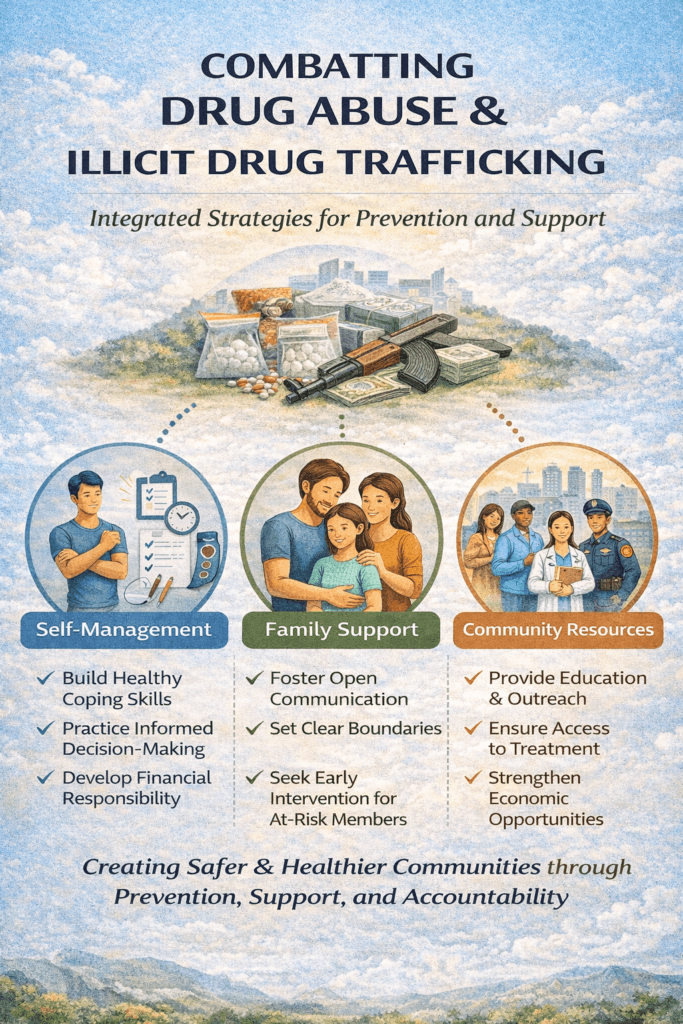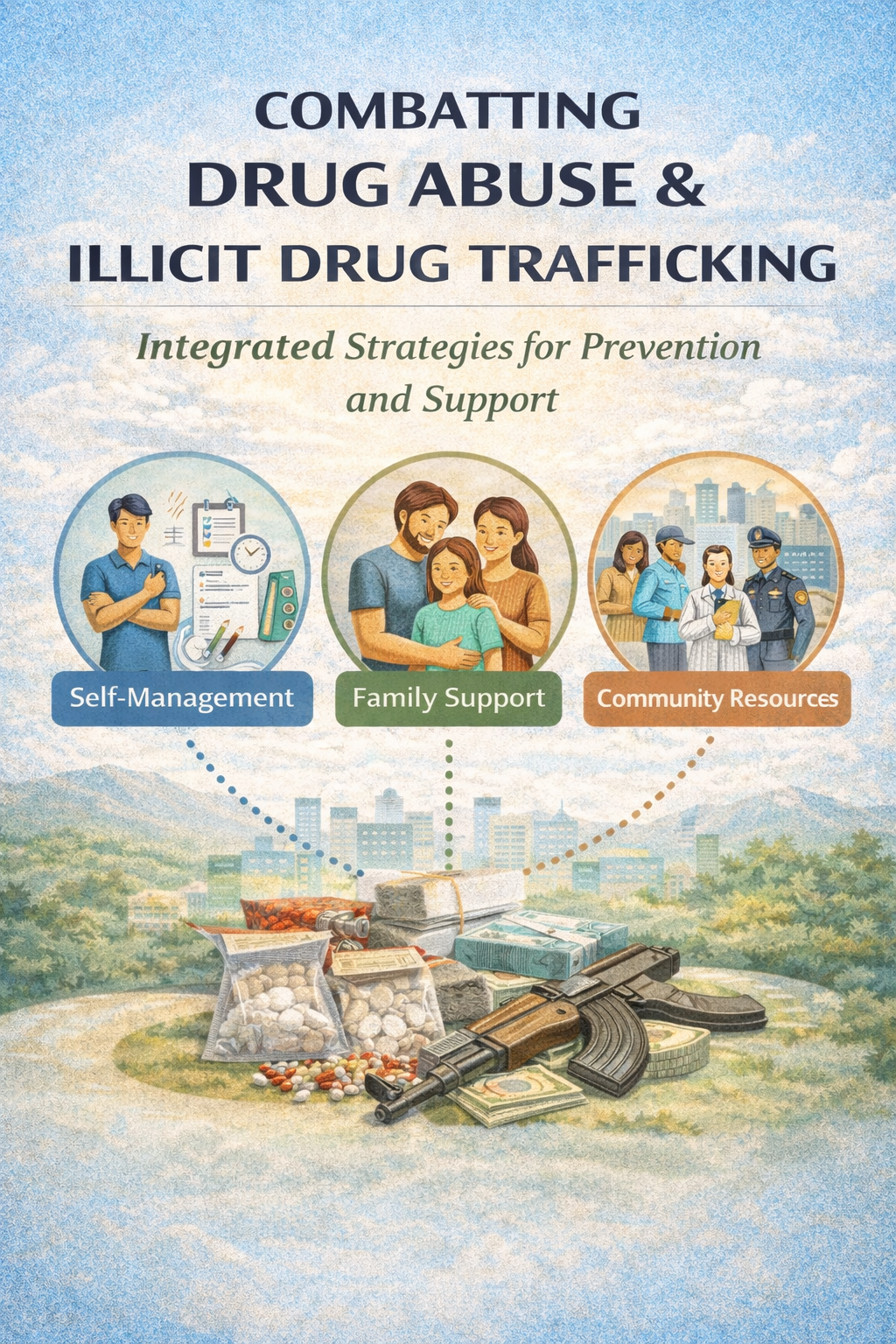
Combatting drug abuse and illicit drug trafficking requires more than enforcement alone—it depends on coordinated efforts at the individual, family, and community levels. Self-management strategies reduce drug demand by strengthening decision-making, emotional regulation, and resistance to substance use. Family support promotes communication, boundaries, and early intervention, while community resources expand prevention, access to treatment, and economic opportunity. Together, these approaches address both the personal and social factors that sustain drug abuse and trafficking.
Combatting Drug Abuse and Illicit Drug Trafficking: A Shared Global Responsibility
Drug abuse and illicit drug trafficking are deeply interconnected challenges that affect public health, community safety, economic stability, and global security. While drug abuse harms individuals and families through addiction, illness, and lost potential, illicit drug trafficking fuels violence, corruption, and organized crime. Effectively addressing these issues requires coordinated strategies that reduce both the demand for drugs and the supply of illicit substances.
Combatting drug abuse begins with prevention and education. Early, evidence-based education helps individuals understand the health risks of substance use, develop coping and decision-making skills, and resist peer pressure. Prevention efforts that focus on mental health, trauma, and social connection are especially effective, as many people turn to drugs as a way to cope with stress, pain, or instability. When prevention is paired with access to healthcare and early intervention, substance use disorders can often be identified and treated before they escalate.
Treatment and recovery services are critical in reducing drug abuse and weakening illicit drug markets. Addiction is a chronic, treatable condition, and access to screening, therapy, medication-assisted treatment, and recovery support significantly lowers overdose risk and relapse rates. When individuals receive effective treatment, demand for illicit drugs decreases, directly impacting trafficking networks.
Illicit drug trafficking thrives on profit, vulnerability, and weak systems. Criminal organizations exploit poverty, political instability, and limited law enforcement capacity to produce, transport, and distribute drugs across borders. Combating trafficking requires strong collaboration among law enforcement, intelligence sharing, financial investigations, and supply-chain disruption. Targeting money laundering and criminal profits is often as important as intercepting drugs themselves.
However, enforcement alone is not enough. Community-based strategies play a vital role in reducing both drug abuse and trafficking. Safe housing, employment opportunities, education, and social services reduce vulnerability to both substance use and involvement in drug trade activities. Communities with strong social support systems and economic opportunity are more resilient to drug-related harm.
International cooperation is essential, as illicit drug trafficking is a global enterprise. Coordinated policies, shared data, and joint operations help countries address production, transit, and distribution more effectively. At the same time, respecting human rights and prioritizing public health approaches ensures that efforts to combat drugs do not unintentionally worsen social harm.
Ultimately, combatting drug abuse and illicit drug trafficking requires a balanced, integrated approach. Prevention, treatment, recovery support, law enforcement, economic development, and international collaboration must work together. When societies reduce demand through compassion and care, and disrupt supply through coordinated action and justice, communities move closer to safer, healthier, and more sustainable futures.
Self-Management Strategies in Combatting Drug Abuse and Illicit Drug Trafficking
Combatting drug abuse and illicit drug trafficking is often discussed at the level of governments, law enforcement, and international policy. However, self-management strategies play a critical and often overlooked role in reducing both personal vulnerability to drug abuse and community exposure to the illicit drug trade. Self-management focuses on individual awareness, responsibility, decision-making, and healthy coping—skills that directly reduce demand for illicit substances and strengthen community resilience.
At the individual level, self-awareness and emotional regulation are foundational strategies. Many people turn to drugs as a way to manage stress, trauma, anxiety, or social pressure. Learning to recognize emotional triggers, tolerate discomfort, and respond with healthy coping strategies—such as mindfulness, problem-solving, exercise, or seeking support—reduces reliance on substances. When individuals manage emotions effectively, the demand that fuels drug markets decreases.
Informed decision-making is another essential self-management strategy. Understanding the legal, health, and social consequences of drug use and drug distribution empowers individuals to make choices aligned with long-term well-being. This includes resisting peer pressure, avoiding high-risk environments, and recognizing how even casual drug use contributes to larger trafficking networks that rely on consumer demand.
Goal setting and personal accountability strengthen resistance to drug abuse. Individuals who establish clear goals related to education, employment, family, or personal growth are less likely to engage in behaviors that jeopardize their future. Self-monitoring tools—such as journaling, recovery plans, or mentorship—help individuals track progress and maintain responsibility for their choices.
Self-management also includes financial and lifestyle responsibility, which reduces vulnerability to involvement in the drug trade. Illicit trafficking often targets individuals facing poverty, debt, or instability. Skills such as budgeting, employment readiness, time management, and seeking legitimate income opportunities reduce the appeal of illegal activities and increase economic resilience.
On a broader level, ethical awareness and civic responsibility are self-management strategies that impact communities. Choosing not to purchase illicit drugs, reporting suspicious activity, supporting prevention initiatives, and modeling healthy behaviors contribute to safer environments. Individual actions, when repeated across communities, weaken the social and economic foundations of trafficking networks.
Finally, help-seeking behavior is a powerful self-management tool. Recognizing when substance use is becoming problematic and accessing education, counseling, or treatment early prevents escalation. Early intervention not only protects the individual but also reduces long-term demand that sustains illicit drug markets.
Self-management strategies do not replace law enforcement or public policy, but they complement them by addressing the demand side of the drug problem. When individuals develop strong self-management skills—emotional regulation, informed decision-making, accountability, and resilience—they become active participants in combatting drug abuse and illicit drug trafficking, strengthening both personal health and community safety.
Family Support Strategies in Combatting Drug Abuse and Illicit Drug Trafficking
Families play a critical role in combatting drug abuse and, indirectly, illicit drug trafficking. While governments and law enforcement address supply chains, families influence the demand side of the drug problem by shaping values, behaviors, resilience, and decision-making from early childhood through adulthood. Strong family support strategies reduce the likelihood of substance use, interrupt cycles of addiction, and help protect communities from the harms associated with illegal drug markets.
One of the most powerful family strategies is open and consistent communication. Families that talk honestly about drugs—without fear, shame, or judgment—create safe spaces for questions and concerns. Ongoing conversations about the risks of substance use, peer pressure, and legal consequences help individuals make informed choices. When communication is respectful and age-appropriate, it strengthens trust and reduces secrecy, which is often exploited by drug dealers and traffickers.
Parental monitoring and involvement are also essential protective factors. Knowing where family members spend time, who they associate with, and how they cope with stress helps identify early warning signs of substance use or risky behavior. Active involvement does not mean control; it means consistent presence, interest, and guidance. Families that stay engaged reduce vulnerability to recruitment into drug use or distribution networks.
Another key strategy is setting clear boundaries and expectations. Families that establish and consistently enforce rules around substance use, curfews, and responsibilities provide structure and accountability. Clear expectations help individuals understand consequences while reinforcing safety and responsibility. Healthy boundaries also prevent enabling behaviors that may unintentionally support substance use or illegal activity.
Education and awareness within the family strengthen prevention efforts. Understanding addiction as a chronic, treatable condition—rather than a moral failing—allows families to respond with empathy and effectiveness. Families informed about how illicit drug trafficking targets vulnerable populations are better equipped to guide loved ones away from risky environments and influences.
Family support also includes emotional regulation and modeling healthy coping skills. Stress, trauma, and conflict within families can increase the risk of substance use. When families model healthy coping—such as problem-solving, emotional expression, and help-seeking—they reduce the appeal of drugs as an escape and reinforce resilience.
Finally, early intervention and support-seeking are critical family strategies. Recognizing changes in behavior, mood, or functioning and responding early with counseling, education, or treatment can prevent escalation into addiction or involvement with drug trafficking networks. Early support protects not only the individual but the broader community by reducing long-term demand for illicit substances.
Family support strategies are a cornerstone of effective drug prevention. When families foster communication, boundaries, education, and emotional stability, they become powerful agents in combatting drug abuse and weakening the social conditions that allow illicit drug trafficking to thrive.
Community Resource Strategies in Combatting Drug Abuse and Illicit Drug Trafficking
Community resource strategies are a critical frontline defense in combatting drug abuse and illicit drug trafficking. While national policies and law enforcement efforts target large-scale supply chains, communities address the environments where drug use begins, spreads, and can be prevented. Strong community systems reduce vulnerability, disrupt local trafficking activity, and promote public health, safety, and resilience.
One of the most effective community strategies is coordinated prevention and education programs. Schools, community centers, faith-based organizations, and healthcare providers play a key role in delivering evidence-based education about substance use, mental health, and coping skills. Prevention programs that focus on resilience, life skills, and trauma-informed care are especially effective in reducing early drug use and long-term addiction risk, thereby lowering demand for illicit drugs.
Community coalitions and partnerships strengthen local responses to drug abuse and trafficking. When public health agencies, law enforcement, social services, schools, and nonprofit organizations collaborate, communities are better equipped to identify emerging drug trends, share data, and respond quickly. These coalitions help align prevention, treatment, and enforcement efforts so that resources are used efficiently and strategically.
Access to treatment and recovery services is another essential strategy for community resources. Communities that provide accessible screening, counseling, medication-assisted treatment, recovery housing, and peer support reduce overdose rates and interrupt cycles of addiction. Effective treatment lowers demand for illicit drugs, weakening the economic foundation that sustains trafficking networks.
Economic and social support resources also play a major role in prevention. Unemployment, housing instability, and poverty increase vulnerability to both substance use and involvement in drug distribution. Job training programs, educational opportunities, housing assistance, and youth development initiatives reduce reliance on illegal income sources and strengthen community stability.
Community strategies also include environmental and neighborhood-based interventions. Improving lighting, housing conditions, recreational spaces, and community engagement reduces opportunities for crime and strengthens social cohesion. Neighborhood watch programs and anonymous reporting systems empower residents to participate safely in identifying and preventing local drug activity.
Finally, public awareness and stigma-reduction efforts are essential. Communities that treat addiction as a public health issue rather than a moral failing encourage help-seeking and early intervention. Reducing stigma increases treatment engagement and community cooperation, making it harder for illicit drug markets to operate unnoticed.
Community resource strategies work best when prevention, treatment, enforcement, and social support operate together. By strengthening local systems, promoting opportunity, and fostering collaboration, communities reduce both drug abuse and the conditions that allow illicit drug trafficking to thrive. These collective efforts create safer, healthier environments where individuals and families can grow free from the harms of drugs.
Frequently Asked Questions
Here are some common questions:
What is the connection between drug abuse and illicit drug trafficking?
Drug abuse fuels demand for illegal substances, while illicit drug trafficking supplies those substances. Reducing drug abuse lowers demand, which weakens trafficking networks and their profitability.
Why can’t law enforcement alone stop drug trafficking?
Enforcement is essential but insufficient on its own. Trafficking adapts quickly to arrests and seizures. Long-term impact requires prevention, treatment, education, and economic opportunity to reduce demand and vulnerability.
How does preventing drug abuse help reduce trafficking?
Prevention reduces the number of people who use illicit drugs. Lower demand means fewer profits for traffickers, making drug markets less sustainable.
What role does addiction treatment play in combatting trafficking?
Effective treatment and recovery services reduce ongoing drug use, relapse, and overdose. When individuals recover, they stop contributing to the illegal drug economy.
How do self-management strategies help address drug abuse?
Self-management strategies—such as emotional regulation, stress management, goal setting, and informed decision-making—help individuals resist substance use and avoid high-risk behaviors linked to drug distribution.
What role do families play in preventing drug abuse?
Families provide early education, emotional support, boundaries, and monitoring. Strong family relationships reduce risk factors such as isolation, trauma, and poor coping skills that increase vulnerability to drug use.
How can families help disrupt illicit drug activity?
Families can promote awareness, discourage substance use, recognize early warning signs, seek help early, and support community prevention efforts that reduce local drug activity.
Why are community resources important in this effort?
Communities provide prevention programs, treatment access, employment support, housing stability, and coordinated responses that address the root causes of drug abuse and trafficking.
What are community coalitions, and why do they matter?
Community coalitions bring together schools, healthcare, law enforcement, social services, and nonprofits to share data, coordinate action, and respond effectively to local drug trends.
How does economic opportunity reduce drug trafficking?
Stable employment, education, and housing reduce the appeal of illegal income from drug distribution and lower stressors that contribute to substance use.
Is drug addiction a moral failure or a health issue?
Addiction is a chronic, treatable health condition influenced by biology, environment, and experience. Treating it as a health issue improves prevention, treatment engagement, and recovery outcomes.
How does stigma interfere with combating drug abuse?
Stigma discourages people from seeking help and isolates those affected. Reducing stigma increases early intervention and community cooperation.
What role does international cooperation play?
Drug trafficking crosses borders. International collaboration allows countries to share intelligence, disrupt supply chains, and collectively address production, transit, and distribution.
How can individuals contribute to combating drug abuse and trafficking?
Individuals can avoid illicit drug use, seek help early, support prevention programs, educate others, and engage in community efforts that promote health and safety.
What is the most effective overall strategy?
The most effective approach is an integrated one: prevention and self-management, family support, accessible treatment and recovery services, community resources, economic opportunity, and coordinated law enforcement.
Conclusion
Lasting progress in combatting drug abuse and illicit drug trafficking is achieved when prevention, support, and accountability operate across all levels of society. Self-management strategies reduce individual vulnerability and promote healthy decision-making. Family support strategies reinforce resilience, guidance, and early response to risk. Community resource strategies strengthen systems that prevent substance misuse, support recovery, and disrupt local drug markets. When these approaches work together, they reduce demand, protect families, and build safer, healthier communities. An integrated strategy that values personal responsibility, family engagement, and community collaboration offers the most sustainable path toward reducing the harms of drug abuse and illicit drug trafficking.
Video: The Brutal Truth About Drug Trafficking Nobody Addresses #HarshReality #Consequences