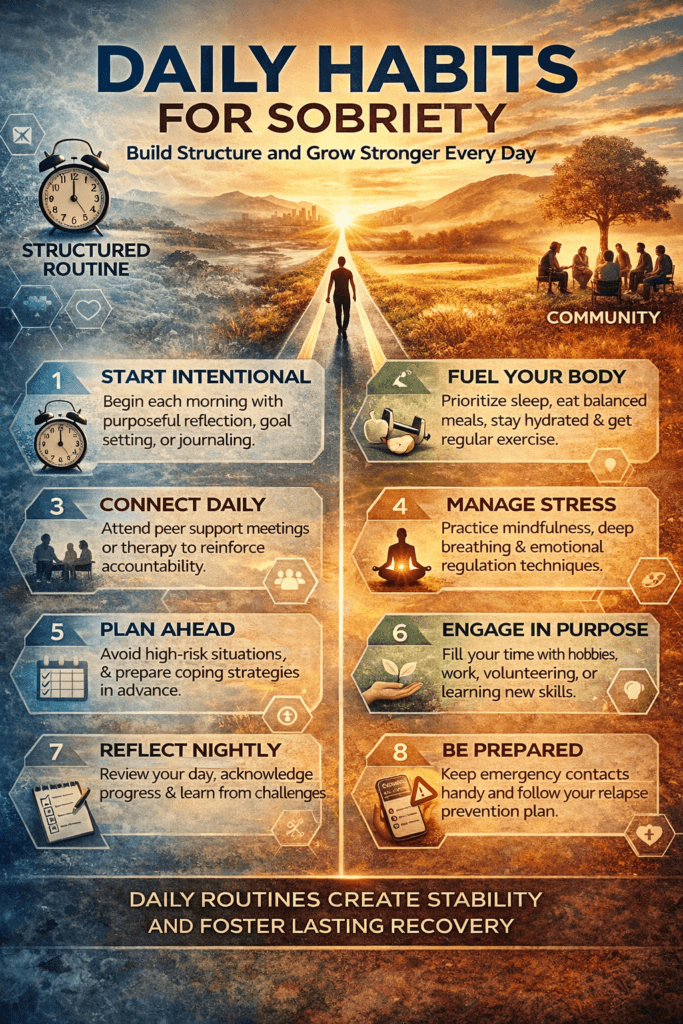
Daily habits are the foundation of lasting sobriety. While motivation and major milestones are important, recovery is ultimately sustained through consistent, intentional routines practiced one day at a time. Addiction often disrupts sleep patterns, emotional regulation, nutrition, and decision-making, leaving individuals without structure or stability. Rebuilding daily habits restores balance to the brain and body, strengthens impulse control, and reduces vulnerability to relapse. Simple practices—such as maintaining a regular schedule, engaging in recovery support, caring for physical health, and managing stress constructively—provide a framework for long-term healing and growth.
Daily Habits for Sobriety: Building Structure That Sustains Recovery
Sobriety is not maintained by motivation alone—it is sustained by daily structure. Addiction disrupts routines, sleep patterns, nutrition, decision-making, and emotional regulation. Recovery requires rebuilding those foundations intentionally. While major milestones such as completing treatment or reaching one year sober are meaningful, long-term recovery is shaped by small, repeated daily habits. Consistency, not intensity, protects sobriety.
1. Start the Day with Intention
A structured morning routine anchors the day. This may include prayer or meditation, journaling, reviewing recovery goals, reading recovery literature, or setting three priorities for the day. Intentional mornings reduce impulsivity and strengthen executive functioning.
2. Prioritize Physical Health
Sleep hygiene, hydration, balanced nutrition, and regular exercise support brain recovery. Substance use alters dopamine and stress-response systems; physical health habits stabilize mood and reduce cravings. Even moderate physical activity improves resilience.
3. Schedule Recovery Check-Ins
Daily sobriety requires ongoing accountability. This may include attending peer support meetings, contacting a sponsor, engaging in therapy, or using recovery-tracking apps. Structured check-ins reduce isolation and reinforce commitment.
4. Practice Emotional Regulation
Unmanaged emotions are a leading relapse trigger. Daily habits such as mindfulness, deep breathing, cognitive reframing, and gratitude journaling build emotional awareness. Learning to pause before reacting is a critical sobriety skill.
5. Avoid High-Risk Situations
Sobriety often requires environmental change. Avoiding triggering locations, limiting contact with active users, and planning responses to unexpected stressors reduce relapse risk. Preparing exit strategies for social events protects recovery.
6. Engage in Meaningful Activity
Idle time increases vulnerability. Employment, volunteer work, creative hobbies, education, or family engagement provide purpose and structure. Recovery thrives when life becomes larger than substance use.
7. Review Progress Each Evening
Ending the day with reflection strengthens growth. Ask:
- Did I honor my boundaries today?
- Did I manage stress constructively?
- What did I learn?
Daily reflection encourages accountability without self-condemnation.
8. Build a Relapse Prevention Mindset
Sobriety requires anticipating risk. Keeping emergency contacts accessible, recognizing early warning signs, and seeking help immediately when cravings intensify prevent minor slips from becoming full relapses.
Clinical Perspective
From a behavioral health standpoint, habits reshape neural pathways. Repetition strengthens prefrontal cortex functioning, which supports impulse control and long-term decision-making. Over time, structured routines replace chaos with predictability—reducing stress and improving emotional stability.
Conclusion
Daily habits for sobriety transform recovery from a hopeful intention into a lived practice. By prioritizing structure, physical health, accountability, emotional regulation, and meaningful engagement, individuals create a stable foundation for long-term recovery. Sobriety is not maintained by avoiding relapse alone—it is sustained by building a life where recovery is supported every single day.
Self-Management Strategies for Daily Habits in Sobriety
Sobriety is strengthened not by occasional motivation, but by disciplined daily self-management. Addiction disrupts routines, impulse control, emotional regulation, and long-term planning. Recovery requires rebuilding these systems intentionally. Self-management strategies transform sobriety from a hopeful goal into a structured lifestyle. When individuals actively regulate their behavior, monitor triggers, and reinforce healthy habits, they increase stability and reduce the risk of relapse.
1. Create a Structured Daily Schedule
Unstructured time increases vulnerability to cravings and impulsive decisions. A written daily plan—including wake time, meals, work, exercise, meetings, and relaxation—reduces chaos. Predictable routines strengthen executive functioning and improve stress tolerance.
2. Monitor Triggers and Warning Signs
Self-awareness is foundational. Keeping a daily log of mood, stress levels, cravings, and high-risk situations helps identify patterns. Early recognition of irritability, isolation, or complacency allows for intervention before relapse escalates.
3. Practice Emotional Regulation Daily
Substance use often masks uncomfortable emotions. In recovery, individuals must learn to tolerate stress, disappointment, and conflict without using. Techniques such as mindfulness, cognitive reframing, breathing exercises, and journaling improve emotional resilience.
4. Build Accountability Systems
Self-management is reinforced through accountability. This may include daily contact with a sponsor, scheduled therapy sessions, peer-support attendance, or digital sobriety trackers. External accountability strengthens internal discipline until habits are deeply ingrained.
5. Protect Physical Health
Sleep, hydration, nutrition, and exercise directly affect mood regulation and impulse control. Structured sleep routines and regular physical activity stabilize neurochemical systems disrupted by substance use.
6. Develop Replacement Behaviors
Cravings often arise from boredom or stress. Planning alternative coping strategies—such as exercise, calling a support person, engaging in creative work, or volunteering—prevents reactive decisions.
7. Review and Reflect Each Evening
Daily reflection strengthens accountability. Ask:
- Did I maintain my boundaries today?
- Did I respond to stress constructively?
- What adjustments are needed tomorrow?
Reflection builds self-correction rather than self-criticism.
8. Plan for High-Risk Situations
Relapse prevention requires preparation. Identify upcoming stressors—such as social events, anniversaries, and work conflicts—and rehearse coping responses. Keeping emergency contacts readily available reinforces safety planning.
Clinical Perspective
Neuroscience shows that repeated healthy behaviors gradually restore prefrontal cortex functioning, improving impulse control and decision-making. Self-management strategies build neural pathways associated with delayed gratification and emotional stability—critical for long-term sobriety.
Conclusion
Self-management strategies for daily sobriety create structure where addiction once created instability. Through consistent scheduling, emotional regulation, trigger monitoring, accountability systems, and physical health maintenance, individuals develop resilience that sustains recovery. Sobriety is not sustained by willpower alone—it is protected by intentional, repeated daily habits that reinforce responsibility, stability, and growth.
Family Support Strategies for Daily Habits in Sobriety
Sobriety is strengthened by daily routines, and families play a powerful role in reinforcing them. While recovery is ultimately the individual’s responsibility, the family environment can either support stability or unintentionally undermine it. Addiction often disrupts routines, trust, and communication within households. Rebuilding daily habits in sobriety requires consistent, predictable, and supportive family engagement. When families align around a healthy structure rather than a crisis response, recovery gains momentum.
1. Encourage Consistent Daily Routines
Families can support sobriety by promoting regular sleep schedules, shared mealtimes, and predictable daily rhythms. Stability reduces stress and lowers the risk of relapse. Even simple routines—such as morning check-ins or evening reflections—reinforce accountability and connection.
2. Reinforce Recovery Activities
Attendance at therapy, peer-support meetings, medication-assisted treatment appointments, or recovery coaching sessions should be encouraged and respected. Families can offer transportation, childcare assistance, or flexible scheduling to support recovery commitments without taking on additional responsibility.
3. Maintain Clear Boundaries
Daily sobriety thrives in environments with consistent expectations. Boundaries regarding substance-free homes, respectful communication, and financial responsibility should remain clear. Families should avoid monitoring obsessively but remain firm about agreed-upon standards.
4. Practice Supportive Communication
Positive reinforcement strengthens habit formation. Acknowledging effort—such as attending meetings, maintaining employment, or managing stress constructively—builds confidence. Avoid revisiting past mistakes during daily progress discussions; focus on forward movement.
5. Reduce Environmental Triggers
Families can remove substances from the home, limit exposure to high-risk social situations, and create sober recreational opportunities. Replacing former substance-centered routines with healthy family activities strengthens connection and stability.
6. Participate in Education and Support Programs
Family education programs and peer-support groups such as Al-Anon help relatives understand addiction neuroscience and relapse prevention. Informed families are better equipped to support daily recovery habits without enabling or over-controlling.
7. Model Healthy Coping Skills
Family members influence recovery culture through their own behaviors. Demonstrating stress management, conflict resolution, and emotional regulation provides a living example of resilience. Sobriety becomes a shared lifestyle of stability rather than an isolated effort.
8. Prepare for Setbacks Constructively
Daily habits reduce the risk of relapse but do not eliminate it. Families should have a plan for early warning signs—encouraging immediate communication with treatment providers and reinforcing accountability without escalating into panic or blame.
Clinical Perspective
Family systems research shows that consistent, predictable environments reduce stress-related triggers that can destabilize recovery. When families shift from crisis management to structured daily reinforcement, they strengthen protective factors such as routine, emotional safety, and accountability.
Conclusion
Family support strategies for daily habits in sobriety center on structure, encouragement, and consistency. By promoting routines, reinforcing treatment engagement, maintaining clear boundaries, and modeling healthy coping, families create a stable environment where recovery can flourish. Sobriety is built one day at a time—and families who support those daily habits contribute meaningfully to long-term resilience and growth.
Community Resource Strategies for Daily Habits in Sobriety
Sobriety is sustained not only by personal discipline and family support, but also by the strength of community infrastructure. Daily habits—such as attending meetings, maintaining employment, engaging in counseling, and practicing structured routines—are easier to sustain when communities provide accessible, recovery-oriented resources. Addiction recovery thrives in environments where accountability, opportunity, and support are embedded into daily life. Community systems help transform sobriety from an isolated effort into a supported lifestyle.
1. Expand Access to Daily Recovery Meetings
Recovery community organizations and peer-support networks provide structured daily engagement. Access to 12-step meetings, SMART Recovery groups, faith-based programs, and peer-led support sessions reinforces accountability and reduces isolation. Regular availability allows individuals to build recovery into their daily routine.
2. Support Medication-Assisted Treatment (MAT) Accessibility
Communities that provide consistent access to medication-assisted treatment for opioid and alcohol use disorders support neurobiological stabilization. Daily medication adherence programs, clinic-based follow-ups, and integrated behavioral therapy strengthen habit formation and relapse prevention.
3. Develop Sober Living and Recovery Housing
Structured sober living environments reinforce daily expectations—curfews, employment requirements, meeting attendance, and drug screening. These environments provide transitional stability for individuals rebuilding routines after detoxification or inpatient care.
4. Promote Employment and Vocational Programs
Stable employment supports daily structure and purpose. Workforce re-entry programs, vocational rehabilitation, and partnerships with recovery-friendly employers reduce economic stress and reinforce accountability. Employment routines are powerful anchors in sobriety.
5. Integrate Recovery into Primary Care
Community healthcare systems that integrate behavioral health screening, counseling referrals, and follow-up appointments normalize recovery as part of routine medical care. This reduces stigma and ensures daily health monitoring remains accessible.
6. Provide Transportation and Childcare Support
Practical barriers often disrupt recovery routines. Community-based transportation services and childcare programs enable individuals to attend therapy, meetings, and work consistently. Reducing logistical barriers strengthens adherence to daily habits.
7. Implement Recovery-Friendly Public Policies
Recovery-friendly workplace policies, diversion programs such as drug courts, and structured probation models reinforce accountability while encouraging treatment engagement. Clear expectations combined with support create consistent external boundaries.
8. Encourage Community Education and Anti-Stigma Campaigns
Public education initiatives that frame addiction as a treatable condition reduce discrimination and improve treatment-seeking behavior. Communities that normalize recovery create environments where daily sobriety habits are respected and supported.
Public Health Perspective
Research consistently shows that recovery outcomes improve when individuals have stable housing, employment, access to healthcare, and social support. Daily habits are more sustainable when supported by predictable systems. Community investment in recovery infrastructure reduces relapse risk and promotes long-term resilience.
Conclusion
Community resource strategies play a critical role in sustaining daily sobriety habits. By expanding access to treatment, peer support, employment programs, healthcare integration, and recovery-friendly policies, communities provide the structure necessary for consistent recovery routines. Sobriety is strengthened when accountability and opportunity are embedded into everyday systems. When communities support daily recovery habits, they help transform individual commitment into sustained, long-term stability.
Frequently Asked Questions
Here are some common questions:
1. Why are daily habits important in sobriety?
Daily habits create structure, and structure reduces the risk of relapse. Addiction often disrupts routines, sleep, nutrition, and emotional regulation. Consistent daily practices rebuild stability and strengthen decision-making skills over time.
2. What are the most important daily habits for sobriety?
Core habits include maintaining a regular sleep schedule, attending recovery meetings or therapy, practicing emotional regulation, exercising, eating balanced meals, avoiding high-risk environments, and checking in with a support system.
3. How do daily routines reduce cravings?
Predictable routines reduce stress and idle time—two major relapse triggers. Structured schedules also improve executive functioning, which helps regulate impulses and manage urges more effectively.
4. Do I need to follow the same routine every day?
Not necessarily, but consistency is key. While flexibility is healthy, maintaining core anchor habits—such as recovery meetings, self-reflection, and physical care—provides stability even when daily demands vary.
5. What role does physical health play in sobriety?
Sleep, nutrition, hydration, and exercise directly influence mood regulation and stress tolerance. Substance use disrupts brain chemistry; healthy physical habits help restore balance and reduce vulnerability to relapse.
6. How can I stay accountable to my daily habits?
Use structured tools such as written planners, sobriety tracking apps, sponsor check-ins, therapy appointments, or daily journaling. External accountability strengthens internal commitment.
7. What if I miss a day of my routine?
Missing a day does not mean failure. Recovery emphasizes progress, not perfection. Reflect on what disrupted the habit, adjust your plan, and resume structuring the following day.
8. How can families support daily habits in sobriety?
Families can encourage consistent routines, respect recovery commitments, reduce environmental triggers, and offer positive reinforcement for progress. Maintaining clear boundaries also protects structure.
9. Are daily habits enough to prevent relapse?
Daily habits significantly reduce risk but do not eliminate it entirely. Ongoing therapy, peer support, relapse prevention planning, and medical treatment when appropriate remain essential components of recovery.
10. How long does it take for sobriety habits to become automatic?
Habit formation varies, but research suggests consistent repetition over weeks to months strengthens neural pathways associated with impulse control and long-term decision-making. Sustained practice makes recovery behaviors more natural over time.
Conclusion
Daily habits for sobriety transform recovery from a temporary effort into a sustainable way of life. Each repeated positive action strengthens resilience, reinforces accountability, and builds confidence in one’s ability to maintain change. While challenges and setbacks may occur, consistent routines provide stability during difficult moments and help individuals return to healthy patterns quickly. Sobriety is not achieved through a single decision but through daily choices that prioritize wellness, responsibility, and purpose. Over time, these habits become more than routines—they become the structure that supports lifelong recovery.
Video: This Daily Practice Saved My Recovery #sobriety #mentalhealth #addictionrecovery