Choosing the right recovery program is one of the most important decisions in the journey toward sobriety and wellness. With so many approaches available—ranging from 12-step models to mindfulness, evidence-based, or faith-centered programs—the process can be both empowering and overwhelming. Individuals must navigate not only practical challenges such as accessibility and cost, but also ethical considerations like autonomy, informed choice, and cultural fit. Successful decision-making relies on self-management skills that foster reflection, research, and emotional readiness. Families play a vital role by providing understanding, boundaries, and logistical support, while communities strengthen the process through accessible education, peer networks, and inclusive resources. Together, these layers of support create a holistic framework that honors individual needs and ensures recovery begins from a place of respect, knowledge, and empowerment.
A Practical Guide to Finding a Recovery Path That Fits Your Life
Choosing a recovery program is one of the most important decisions in the healing journey. Addiction recovery is not one-size-fits-all — people differ in beliefs, emotional needs, learning styles, and life circumstances. Some thrive in structured, evidence-based programs, while others connect more deeply with mindfulness, faith-based support, or peer empowerment. This guide provides reflection questions, program-matching tips, and a fit assessment checklist to help individuals and families find a recovery approach that feels supportive, sustainable, and aligned with personal values.
1. Reflect on Personal Values and Recovery Goals
The right recovery program begins with honest self-understanding. Before choosing a model, consider your beliefs about addiction and healing. Some view addiction as a medical condition, others as a behavioral pattern, emotional struggle, or spiritual challenge. Clarifying your perspective helps narrow the options.
Ask yourself:
What do I believe addiction truly is?
Do I prefer structured, evidence-based guidance or peer-led support?
How important is spirituality or religion in my healing process?
Am I seeking complete abstinence or a moderation-based approach?
What type of group setting feels safest — discussion, education, or mindfulness practice?
These reflections reveal what environment and philosophy will best support your growth.
2. Match Your Goals to Program Types
Different recovery models meet different needs. Aligning your preferences with the right program increases long-term engagement.
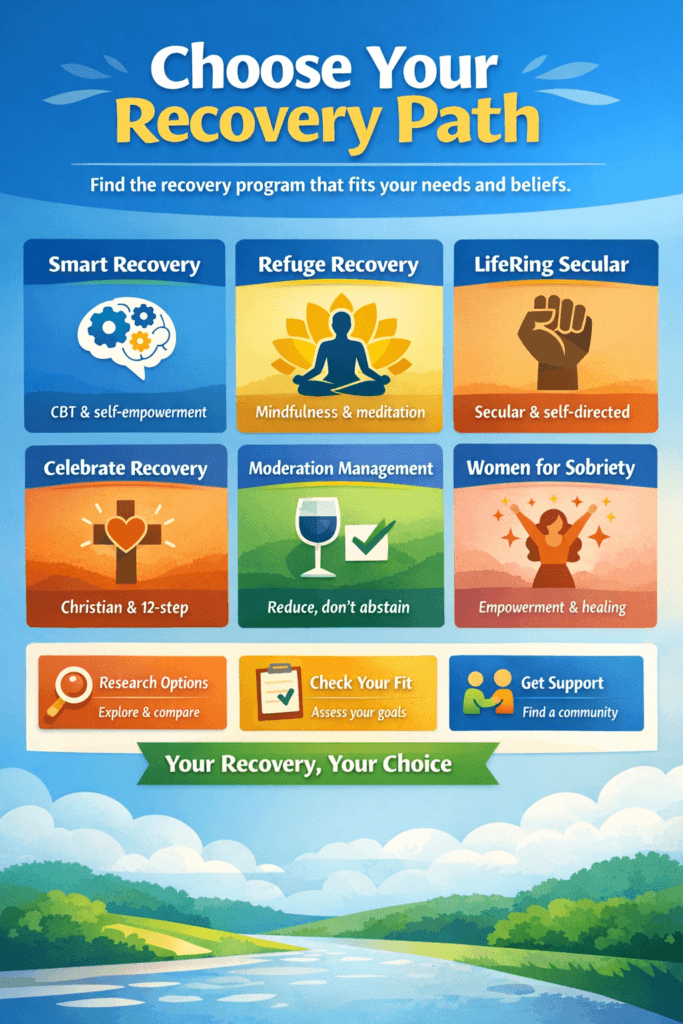
If you prefer science-based structure, SMART Recovery offers cognitive-behavioral tools and self-management strategies.
If you’re drawn to mindfulness and inner calm, Refuge Recovery or Recovery Dharma provides meditation-based healing.
If you want a secular, flexible peer community, LifeRing Secular Recovery focuses on strengthening the “Sober Self.”
If empowerment and affirmation resonate, Women for Sobriety builds emotional confidence and self-worth.
If faith and spirituality guide your healing, Celebrate Recovery offers Christian-centered support.
If moderation feels realistic, Moderation Management teaches behavioral self-regulation strategies.
No single path is superior — the best program is the one you can commit to consistently.
3. Recovery Program Fit Assessment Checklist
Before committing, evaluate whether a program truly fits your needs:
Does it align with my beliefs and values?
Does it encourage accountability and emotional growth?
Does it provide a safe, nonjudgmental environment?
Does the structure match my preferences (group, individual, online)?
Are the methods evidence-based, or are they philosophically meaningful to me?
Does it fit my schedule, location, and budget?
Is aftercare or peer support available?
If most answers are yes, the program is likely a strong fit.
4. Final Thoughts
The “right” recovery program is the one that makes you feel safe, empowered, and supported while promoting long-term healing. Many organizations welcome newcomers to observe meetings before committing, allowing you to explore without pressure. Remember, recovery evolves — combining approaches such as therapy, peer support, and mindfulness often provides the strongest foundation. Recovery is not about fitting into a system. It is about finding the system that fits you.
Why Finding the Right Fit in Recovery Can Feel Difficult
Choosing the right recovery program is one of the most important — and often most challenging — steps in addiction healing. Individuals and families frequently struggle to find a program that aligns with personal beliefs, lifestyle, emotional needs, and readiness for change. With so many recovery approaches available today, the process can feel confusing and overwhelming. Understanding the common challenges involved helps individuals make informed decisions and avoid discouragement early in recovery.
1. Overwhelming Number of Options
The modern recovery landscape includes 12-step programs, secular models such as SMART Recovery, mindfulness-based approaches like Refuge Recovery, faith-based support groups, holistic healing programs, and professional therapy options. While variety increases opportunity, it can also create confusion for individuals who are newly seeking help and are unsure how programs differ.
2. Mismatch Between Beliefs and Program Philosophy
Recovery success often depends on philosophical alignment. Some individuals feel uncomfortable with spiritual or religious elements in traditional 12-step programs, while others find strictly clinical or secular approaches emotionally disconnected. When beliefs and program philosophy do not align, motivation drops, and long-term engagement becomes difficult.
3. Stigma and Misunderstanding
Stigma remains a barrier. Misconceptions about certain recovery models, fear of judgment, or misunderstanding about medication-assisted treatment may discourage people from exploring options that could help them most. Shame or fear of disclosure to family, employers, or social circles can further delay participation.
4. Accessibility and Cost Barriers
Not all recovery programs are equally accessible. Some offer free peer meetings but lack professional guidance. Others provide therapy, coaching, or retreats that can be costly. Geographic location, transportation, work schedules, childcare needs, and limited internet access can also restrict participation.
5. Lack of Education About Recovery Models
Many individuals are unaware of alternatives beyond traditional 12-step programs. Without guidance from healthcare providers, counselors, or treatment centers, people often default to familiar models — even if those models are not the best fit for their beliefs or learning style.
6. Readiness for Change and Self-Awareness
Choosing a program requires honest self-assessment. Someone in early withdrawal may need medical stabilization before peer support. Others may not feel ready for complete abstinence or deep emotional work. Without understanding their current recovery stage, individuals may select programs that feel mismatched or overwhelming.
7. Support Network Compatibility
Family and social support play a major role in recovery. When loved ones misunderstand or disagree with a chosen recovery approach, tension can arise. For example, a family rooted in faith traditions may struggle to understand a secular recovery model. Lack of shared understanding can lead to isolation.
8. Emotional and Cultural Considerations
Personal history, trauma, cultural identity, and emotional safety influence recovery comfort. Programs that lack cultural sensitivity, trauma awareness, or inclusive environments may unintentionally alienate participants. Feeling safe and understood is essential for engagement.
Final Thought
Choosing the right recovery program involves far more than selecting a meeting or therapy style. It requires aligning values, beliefs, emotional readiness, and accessibility with the right support environment. While the process can feel overwhelming, education, self-reflection, and professional guidance make it possible to find a program that feels authentic, empowering, and sustainable. Recovery is not about fitting into a model — it is about finding the model that fits you.
Why Finding the Right Path to Recovery Can Feel Overwhelming
Choosing a recovery program is one of the most important decisions a person can make in the journey toward healing. Yet for many individuals and families, this choice can feel confusing, stressful, and emotionally loaded. With a growing number of recovery models available — from traditional 12-step groups to science-based, secular, mindfulness, and faith-centered approaches — finding the right fit requires self-awareness, education, and support. Understanding the common challenges in selecting a recovery program helps individuals make confident, informed, and sustainable choices.
Overwhelming Number of Options
Today’s recovery landscape offers a wide variety of programs. While this diversity increases access, it can also create decision fatigue — especially for those newly seeking help. Without clear guidance, individuals may struggle to understand the differences between programs and delay starting recovery altogether.
Mismatch Between Beliefs and Program Philosophy
Recovery works best when the program philosophy aligns with personal values. Some individuals feel uncomfortable with spiritual language in traditional 12-step models, while others find strictly clinical or secular programs emotionally distant. When there is a mismatch, motivation and consistency often decline.
Stigma and Misunderstanding
Stigma remains a powerful barrier. Misconceptions about certain recovery approaches, fear of being judged, or misunderstandings about medication-assisted treatment can prevent people from exploring helpful options. Shame or fear of disclosure to family, employers, or social circles can further discourage participation.
Accessibility and Cost Barriers
Not all programs are equally available. Some are free but lack professional support, while others involve therapy or specialized services that may be expensive. Transportation, work schedules, childcare needs, or limited online access can also interfere with participation.
Lack of Education About Recovery Models
Many individuals only know about traditional 12-step programs and are unaware of alternative options. Without education from healthcare providers or treatment professionals, people may default to familiar models that are not the best fit for their needs.
Readiness for Change
Selecting a program requires honest self-assessment. Someone in early recovery may need medical stabilization first, while others may not yet feel ready for complete abstinence or deep emotional work. Choosing a program that does not match current readiness can lead to frustration or dropout.
Support System Compatibility
Family and social networks influence recovery success. When loved ones misunderstand or disagree with a chosen recovery path, individuals may feel isolated or pressured to change programs, even if the chosen approach is working.
Emotional and Cultural Safety
Personal history, trauma, culture, gender identity, and lived experiences shape what feels safe in recovery. Programs lacking inclusivity or trauma-informed care may unintentionally alienate participants who need emotional safety to heal.
Final Thought
Choosing a recovery program is not about finding a perfect system — it is about finding a supportive environment that aligns with personal beliefs, emotional needs, and lifestyle realities. Although the process can feel overwhelming, education, self-reflection, and professional guidance make it possible to choose a recovery path that is authentic, empowering, and sustainable. Recovery is not one-size-fits-all — and that is a strength, not a weakness.
Ethical Dilemmas in Choosing the Right Recovery Program
Navigating Autonomy, Equity, and Responsibility in Recovery Decisions
Selecting a recovery program is not only a clinical or personal decision — it is also an ethical one. With the growing diversity of addiction treatment models, individuals and families face complex choices involving spirituality, science-based care, cost, accessibility, and cultural fit. Counselors and healthcare providers must balance professional responsibility with respect for personal choice. These overlapping factors create ethical dilemmas that are often overlooked but critically important in addiction treatment and rehabilitation planning.
Autonomy vs. Professional Recommendation
A central ethical tension exists between personal autonomy and professional guidance. Clinicians may recommend evidence-based treatments such as medication-assisted recovery or structured behavioral programs, while individuals may prefer mindfulness-based, peer-led, or faith-centered approaches. When professional expertise conflicts with personal belief, the ethical responsibility is to respect the individual’s right to make an informed, voluntary decision. Recovery is most effective when people feel ownership of their chosen path.
Ethical Principle: Respect for autonomy — individuals have the right to direct their own recovery.
Informed Consent and Misinformation
Ethical recovery care requires transparency. Individuals must understand each program’s philosophy, methods, benefits, and limitations. However, some recovery services promote spiritual or alternative healing without clarifying the lack of clinical oversight, while others claim evidence-based success without validated research. Without accurate information, true informed consent is impossible.
Ethical Principle: Honesty and transparency — people deserve accurate information to make educated choices.
Stigma and Value Imposition
Recovery decisions are often influenced by external pressure. Families may push faith-based programs, while clinicians may discourage spiritual models in favor of medical ones. When personal or cultural values are imposed rather than respected, individuals may feel forced into programs that do not align with their beliefs, weakening engagement and trust.
Ethical Principle: Respect for diversity — recovery paths should honor personal beliefs and identities.
Access Inequality and Socioeconomic Bias
Not all recovery programs are equally accessible. Some require insurance, fees, transportation, or time flexibility, while others are free but lack a professional structure. Recommending an ideal but unaffordable program creates ethical inequity. Recovery support should be guided by fairness and realistic access.
Ethical Principle: Justice — fair access to recovery resources regardless of income or background.
Readiness for Change vs. Risk
Individuals enter recovery at varying levels of readiness. Placing someone in an abstinence-only program before they feel prepared may lead to dropout. Conversely, offering moderation-based programs to someone with severe dependence may increase medical risk. Ethical care requires balancing safety with personal readiness.
Ethical Principle: Beneficence — choosing approaches that promote well-being and reduce harm.
Confidentiality and Group Privacy
Different recovery models offer varying levels of privacy protection. Anonymous programs safeguard identity, while other groups may lack formal confidentiality standards. Participants deserve clear information about privacy expectations before joining any program.
Ethical Principle: Confidentiality — protecting personal information and privacy rights.
Cultural Sensitivity and Representation
Many recovery programs originate from Western or Christian frameworks and may not resonate with diverse cultural, spiritual, or gender identities. Lack of inclusive or culturally responsive programming can create emotional disconnection rather than healing.
Ethical Principle: Cultural competence — recovery services should reflect and respect participant diversity.
Final Thought
Ethical recovery care is built on respect, transparency, equity, and compassion. Choosing the right recovery program should empower individuals to make informed decisions aligned with their beliefs, needs, and circumstances — free from pressure, misinformation, or exclusion. When ethics guide recovery planning, treatment becomes not only effective but humane, dignified, and truly person-centered.
Self-Management Strategies for Choosing the Right Recovery Program
Empowering Individuals to Find a Recovery Path That Fits Their Needs and Lifestyle
Selecting a recovery program is a major step in the healing journey. With many treatment models available — from 12-step and faith-based programs to secular, science-driven, and mindfulness-based approaches — individuals may feel uncertain about where to begin. Self-management strategies help people approach this decision with confidence, clarity, and accountability. By strengthening self-awareness, researching options, and developing decision-making skills, individuals can choose recovery paths that align with their beliefs, emotional needs, and daily lives.
1. Self-Reflection and Awareness
Before committing to a recovery program, individuals benefit from honest self-assessment. Understanding personal motivations, strengths, and challenges creates a strong foundation for decision-making.
Helpful strategies include journaling about why recovery matters, identifying emotional triggers and coping abilities, and clarifying what “recovery” personally means — whether total abstinence, harm reduction, or emotional balance. This awareness ensures that recovery choices support genuine personal growth rather than external expectations.
Goal: Build self-understanding to align recovery choices with personal values and readiness.
2. Research and Compare Options
Informed decisions come from accurate knowledge. Exploring multiple recovery models prevents reliance on assumptions or social pressure.
Individuals can review reputable sources such as program websites, healthcare provider recommendations, and national recovery directories. Attending trial meetings or introductory sessions allows for firsthand experience before committing. Comparing program philosophies — such as science-based behavioral models versus spirituality-focused or peer-led approaches — helps identify comfort level and fit.
Goal: Develop an educated perspective about available recovery paths.
3. Set Personal Decision Criteria
Clear criteria reduce confusion when comparing programs. Creating a simple checklist helps objectively evaluate each option.
Consider belief compatibility, accessibility, cost, location, online versus in-person availability, comfort with group sharing, privacy preferences, and desired level of structure. Using consistent criteria keeps decisions grounded in personal needs rather than emotional pressure.
Goal: Select programs that meet emotional, logistical, and motivational requirements.
4. Manage Expectations and Emotions
Choosing a recovery program can bring anxiety, uncertainty, or fear of making the wrong decision. Emotional self-management strengthens confidence.
Mindfulness, grounding techniques, and self-compassion help individuals stay connected to their own needs rather than others’ opinions. Recognizing that recovery paths can evolve over time reduces pressure to find a “perfect” choice immediately.
Goal: Build emotional resilience during recovery planning.
5. Seek Guidance Without Surrendering Autonomy
Professional and peer guidance provide valuable insight, but the final decision belongs to the individual.
Discussing options with counselors, healthcare providers, or peers in recovery can clarify expectations and outcomes. Asking about others’ experiences — rather than seeking approval — supports learning without losing self-agency.
Goal: Balance support from others with personal responsibility for recovery decisions.
6. Create an Action Plan
Once a program is chosen, structure strengthens follow-through.
Setting short-term goals such as attending several meetings, tracking experiences, and reflecting on progress builds accountability. Reevaluating after several weeks allows adjustments if the program does not feel like the right fit.
Goal: Treat recovery planning as an ongoing, adaptable process.
Final Thought
Self-management in choosing a recovery program is an act of empowerment. Through reflection, research, emotional awareness, and structured follow-through, individuals can confidently select recovery paths that feel authentic and sustainable. Recovery is not about finding a perfect program — it is about choosing a supportive path and committing to growth, one informed step at a time.
Family Support Strategies for Choosing the Right Recovery Program
How Loved Ones Can Encourage Informed, Empowered, and Sustainable Recovery Choices
Families play a powerful role in addiction recovery. When a loved one begins exploring recovery programs, family reactions can either strengthen confidence or unintentionally create pressure and confusion. The goal of family support is not to choose the recovery path for the individual, but to create an environment where informed, value-based, and self-directed decisions can flourish. By practicing empathy, education, and healthy boundaries, families become partners in healing rather than directors of the process.
1. Foster Open, Judgment-Free Communication
Exploring recovery options can feel intimidating, especially if family members hold strong opinions about what “should” work. Creating a safe space for honest discussion is essential.
Listening without lecturing allows your loved one to express fears, doubts, and hopes without feeling criticized. Using supportive language such as “I’m proud of you for exploring what feels right for you” reinforces autonomy. Encouraging curiosity instead of pressure helps individuals feel respected rather than controlled.
Goal: Build emotional safety so your loved one feels empowered to choose.
2. Educate Yourself About Recovery Options
Families can offer better support when they understand recovery models.
Researching programs together, attending family orientation sessions, or consulting addiction professionals provides clarity about available approaches. Learning the differences between 12-step, science-based, mindfulness-based, and secular programs prevents misunderstandings and reduces conflict over choices.
Goal: Support decisions with knowledge rather than assumptions.
3. Respect Individual Beliefs and Readiness
Recovery is deeply personal. What works for one family member may not work for another.
Avoid imposing spiritual, cultural, or personal beliefs on the recovery process. Meet your loved one where they are emotionally and motivationally — whether they seek abstinence-based recovery or harm-reduction approaches. Recognize that recovery needs evolve over time.
Goal: Protect autonomy and self-determination.
4. Support Logistical and Emotional Readiness
Practical barriers often delay recovery engagement.
Assisting with transportation, childcare, scheduling, or finding online meeting locations reduces stress. Offering reassurance and positive reinforcement builds confidence during an uncertain decision-making period.
Goal: Make exploring recovery options accessible and manageable.
5. Model Healthy Boundaries and Self-Care
Families must care for themselves to support others effectively.
Participating in family support groups, maintaining realistic expectations, and practicing self-care prevent burnout and enable behaviors. A stable family environment creates emotional security for recovery.
Goal: Sustain supportive involvement without losing personal well-being.
6. Encourage Evaluation and Flexibility
Finding the right recovery program often involves trial and adjustment.
Checking in about experiences, normalizing program changes, and celebrating progress reinforce resilience. Changing programs is not failure — it is growth through learning.
Goal: Promote adaptability and long-term engagement.
Final Thought
Family support in choosing a recovery program is about balance — guiding without controlling, encouraging without pressuring, and supporting without sacrificing personal well-being. When families lead with empathy, curiosity, and respect, they help loved ones choose recovery paths that feel authentic and sustainable. Recovery becomes not just an individual journey, but a shared process of healing and renewed connection.
Community Resource Strategies for Choosing the Right Recovery Program
How Communities Help Individuals and Families Find the Right Path to Recovery
Choosing a recovery program can feel overwhelming for individuals and families, especially when navigating complex treatment systems, financial concerns, and emotional uncertainty. Community resources play a vital role in bridging the gap between confusion and clarity by providing trusted information, equitable access, and ongoing support. When local systems work together, individuals are no longer left to navigate recovery choices alone — they gain guidance, connection, and confidence in selecting the path that fits their needs.
1. Leverage Local Health and Addiction Services
Community health departments, behavioral health clinics, and addiction treatment networks often serve as the first point of contact for recovery guidance. Many provide professional assessments, program directories, and referral services that match individuals to appropriate recovery models based on medical, psychological, and social needs. Recovery specialists and case managers can explain differences between 12-step, secular, mindfulness-based, holistic, and medication-assisted programs.
Goal: Ensure recovery decisions are informed by qualified, evidence-based guidance.
2. Connect with Peer-Led Support Networks
Peer recovery organizations offer powerful insight through lived experience. Attending open meetings at SMART Recovery, Refuge Recovery, LifeRing, or recovery cafés allows individuals to explore different program styles in welcoming, stigma-free environments. Certified peer recovery coaches can also walk individuals through treatment options, sharing practical advice and encouragement.
Goal: Empower individuals through shared experience and relatable support.
3. Promote Education and Awareness Campaigns
Community education reduces stigma and expands understanding of recovery diversity. Workshops, wellness fairs, school programs, library events, and faith-community presentations help residents learn about available recovery approaches. Media campaigns that highlight multiple recovery pathways normalize choice and reinforce that no single model fits everyone.
Goal: Increase awareness so individuals recognize and explore multiple recovery options.
4. Expand Accessibility and Funding Options
Financial and logistical barriers often prevent participation in the program. Communities can partner with nonprofits, insurance navigators, and government agencies to identify free or low-cost programs. Telehealth and online recovery services improve access for rural or underserved populations. Local policy support for diverse recovery models ensures fairness in treatment availability.
Goal: Make recovery services accessible regardless of income or location.
5. Build Cross-Sector Collaboration
Recovery success strengthens when healthcare providers, social services, justice systems, schools, employers, and community organizations collaborate. Coalitions that share resources, coordinate referrals, and map local recovery services create seamless care networks. Workplace wellness and employee assistance programs also help individuals find confidential recovery guidance.
Goal: Create a connected recovery ecosystem where no one navigates alone.
6. Encourage Culturally Inclusive and Trauma-Informed Resources
Effective recovery support must feel emotionally and culturally safe. Partnering with cultural organizations, advocacy groups, and trauma-informed training programs ensures recovery services meet the needs of diverse populations. Specialized peer groups for women, LGBTQ+ individuals, veterans, and minority communities foster a sense of belonging and trust.
Goal: Provide inclusive recovery environments for all identities and backgrounds.
Final Thought
Community resource strategies transform recovery from an individual struggle into a shared responsibility. By offering education, professional guidance, peer connection, financial access, and cultural inclusion, communities empower individuals and families to choose recovery programs with confidence. When communities invest in diverse recovery pathways, they build stronger, healthier, and more resilient futures
Frequently Asked Questions
Here are some common questions:
1. What does “Choose Your Recovery Path” mean?
It means recognizing that addiction recovery is not one-size-fits-all. Different programs use different philosophies—spiritual, scientific, peer-led, or holistic. Choosing your recovery path means finding the approach that best fits your beliefs, lifestyle, and emotional needs.
2. Is the 12-step program the only recovery option?
No. While 12-step programs like AA and NA are widely known, many alternatives exist. These include SMART Recovery, Refuge Recovery, LifeRing, Women for Sobriety, Moderation Management, faith-based programs, and therapy-based or holistic approaches.
3. How do I know which recovery program is right for me?
Start by reflecting on:
- Your beliefs about addiction and healing
- Whether you prefer spiritual or secular approaches
- Your comfort with group sharing
- Your readiness for abstinence or moderation
- Your need for structure or flexibility
Trying a few meetings or sessions before committing can also help.
4. Can I change recovery programs if one doesn’t work for me?
Yes. Recovery is a journey, not a contract. Many people explore multiple programs before finding the right fit. Changing programs is not failure—it is part of learning what best supports your growth.
5. Do I have to believe in a higher power to recover?
No. Secular and science-based programs like SMART Recovery and LifeRing do not use spiritual or religious frameworks. Mindfulness-based programs use meditation without religious doctrine. You can choose a path that matches your personal beliefs.
6. Are non-12-step programs evidence-based?
Some are strongly evidence-based (such as SMART Recovery, CBT-based therapy, and medication-assisted treatment). Others are peer-supported or mindfulness-based. It’s helpful to ask each program about its methods, training, and success data.
7. What if my family disagrees with my program choice?
Family opinions can influence recovery, but the decision should ultimately be yours. Open communication, education, and professional guidance can help families understand and respect your chosen path.
8. Are recovery programs expensive?
Many peer-led programs are free. Others, such as therapy-based or holistic programs, may have fees. Community health services, nonprofits, and online platforms often provide low-cost or free options. Cost should not prevent seeking support.
9. Can I combine different recovery approaches?
Absolutely. Many people use a mix of approaches—such as therapy plus SMART Recovery, or mindfulness plus 12-step meetings. Combining tools often strengthens long-term success.
10. What if I’m not ready for complete abstinence?
Some programs, like Moderation Management or harm-reduction models, support gradual change. A counselor can help determine which level of care fits your current readiness and safety needs.
11. Do recovery programs protect my privacy?
Anonymous programs like AA and NA emphasize confidentiality. Other programs may have different privacy policies. Always ask about confidentiality before joining.
12. Where can I find recovery programs in my community?
Local health departments, addiction treatment centers, SAMHSA’s treatment locator, community clinics, and recovery cafés can provide directories and referrals.
Conclusion
Selecting a recovery program is more than choosing a treatment method—it’s about finding a path that aligns with one’s values, goals, and readiness for change. Despite challenges such as stigma, limited access, and conflicting opinions, individuals can make informed and ethical choices through education, self-awareness, and trusted guidance. Families and communities are essential partners in this process, helping reduce barriers and reinforcing hope and accountability. Ultimately, the right recovery program empowers individuals to take ownership of their healing journey, transforming recovery into a sustainable lifestyle rooted in self-discovery, compassion, and connection.
Video: Choose The Right Path For Your Sobriety #RecoveryOptions #SoberLiving